HomeResourcesSilver Price Per Gram: 999, 925, 900, 835, and 800 Grade Explained (2026)
Finance

Silver Price Per Gram: 999, 925, 900, 835, and 800 Grade Explained (2026)

Silver price per gram calculator for 999, 925, 900, 835, and 800 grade silver. Covers silver calculation formula and how to calculate silver price.

Hassaan RasheedJune 14, 2026
11 min read
Silver Price Per Gram: 999, 925, 900, 835, and 800 Grade Explained (2026)

You picked up a set of European flatware at an estate sale, or maybe a box of mixed jewelry, and you want to know what it is worth before deciding whether to sell. The problem is that most silver pricing guides give you troy ounce figures, and you have pieces measured in grams. The silver per gram calculation answers that directly: how much is this piece worth based on its weight and purity grade.

The Silver Calculator handles the live spot price and per-gram conversion in real time. This guide covers how the silver calculation formula works across every major purity grade, what the numbers stamped into your pieces actually mean, and why the gap between 800 and 925 silver matters more than most people expect on heavier pieces.

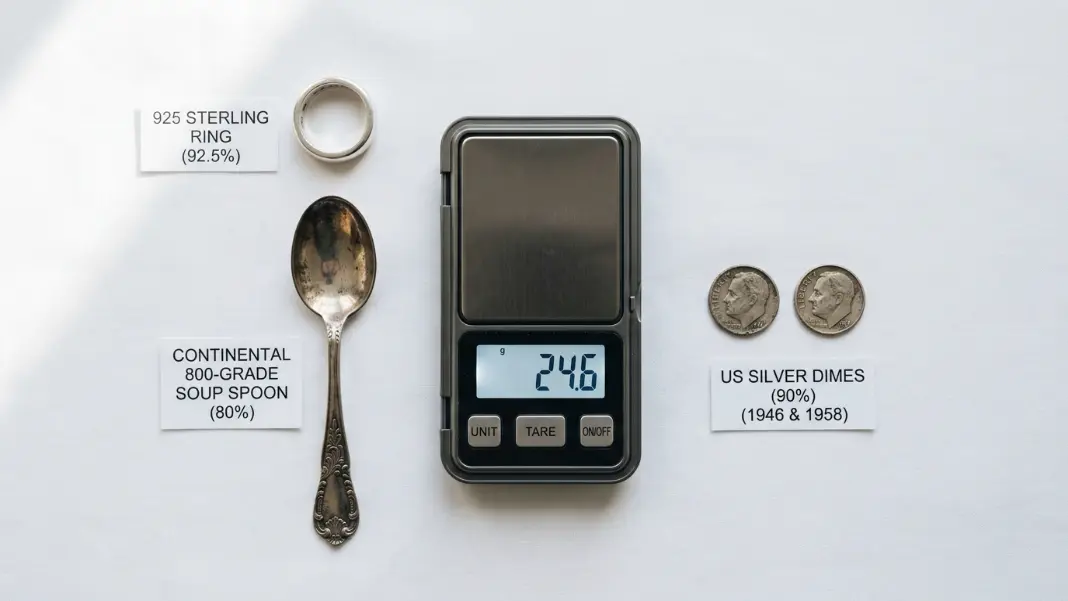
Silver items showing purity grades 999 925 900 835 and 800 with a digital gram scale

How to Calculate Silver Price Per Gram

Silver value per gram uses a two-step formula: convert the spot price from troy ounces to grams, then apply the purity fraction for your specific piece.

Price per gram (pure silver) = Spot Price ÷ 31.1035
Price per gram (any grade)   = (Spot Price ÷ 31.1035) × Purity Decimal

The purity decimal is the grade number divided by 1,000. So 925 becomes 0.925, 835 becomes 0.835, 800 becomes 0.800. The formula is identical for all grades.

Worked example at $33.00/oz spot, all five grades:

GradePer-Gram CalculationValue Per Gram
999$1.0609 × 0.999$1.0598
925$1.0609 × 0.925$0.9813
900$1.0609 × 0.900$0.9548
835$1.0609 × 0.835$0.8858
800$1.0609 × 0.800$0.8487

The base rate at $33.00/oz is $33.00 ÷ 31.1035 = $1.0609/g for pure silver. Every other grade is just that number multiplied by the purity fraction.

The constant 31.1035 is the number most people get wrong. A troy ounce is 31.1035 grams, not 28.35 grams. The 28.35-gram figure is the standard avoirdupois ounce used for everyday weights. Every precious metal market quotes in troy ounces. If you substitute 28.35 for 31.1035, you overstate the per-gram price by about 9.7%. On a 200-gram piece, that error produces a $17 overstatement before you even account for purity.

Spot price changes throughout the trading day. What the formula gives you is melt value: the worth of the silver in the piece as raw metal. What a dealer will actually pay is lower. That gap is covered in the final section.

Silver Purity Grades: What 999, 925, 900, 835, and 800 Mean

Each grade number is the parts of pure silver per 1,000 total. 925 means 925 parts silver and 75 parts of another metal, almost always copper. The grade is stamped as a hallmark directly into the metal.

Common hallmark locations: inside ring shanks, along flatware handles near the base, underneath hollow pieces such as creamers, sugar bowls, and tureens, and on the back of clasps on jewelry.

GradeSilver ContentTypical Use
99999.9%Bullion bars, silver rounds, fine wire
95895.8%Britannia silver (some UK pieces, pre-2010)
92592.5%Sterling jewelry, US silverware, UK flatware
90090.0%Pre-1965 US dimes, quarters, half-dollars
83583.5%German, Dutch, Scandinavian flatware and hollowware
80080.0%French, Italian, Turkish, Egyptian, and other Continental silver

The alloy metal in 925 sterling is predominantly copper, giving freshly cut sterling edges a slight reddish tint. In 800-grade Continental silver, copper makes up a larger 20% fraction, which produces a different appearance under tarnish and a lower melt value per gram.

Not every old piece carries a legible purity number. Some European silver shows only national or assay-office symbols that imply a purity without stating it directly. When a numeric stamp is missing, identify the national mark and look up its standard. A German crescent-moon-and-crown, for example, indicates 800 minimum. A British lion passant on flatware indicates 925 sterling.

How 800 Grade Silver Compares to 925 Sterling

At $33.00/oz spot, 800 silver is worth $0.8487/g and 925 sterling is worth $0.9813/g. That is a difference of $0.133 per gram, roughly 13.5%.

On small jewelry pieces under 10 grams, the gap is minor. On heavier Continental silver, it compounds quickly:

Piece Weight925 Value800 ValueDifference
50 g (bracelet)$49.07$42.44$6.63
150 g (small tray)$147.20$127.31$19.89
300 g (flatware service piece)$294.39$254.61$39.78
600 g (tea service item)$588.78$509.22$79.56

If you are buying European silver at estate sales, knowing the purity before pricing is the difference between a margin and a loss. The What Is 925 Silver Worth guide covers sterling pricing in more detail. For 800 pieces, the key identification marks are: 800, 800S, the French eagle head (imported goods, 800), Italian explicit 800 stamps alongside maker marks, and Turkish star-crescent marks with 800.

One practical note: 800 silver tarnishes faster than sterling because 20% copper oxidises more readily than 7.5% copper. The tarnish polishes out without any change to silver content. That is chemistry, not a quality issue.

The 835 Grade: German and Scandinavian Silver Most Buyers Walk Past

835 silver is 83.5% pure: between junk US silver coins (90%) and sterling (92.5%) in purity, but almost unknown outside Europe. It was the dominant standard for German, Dutch, Norwegian, and some Austrian flatware and hollowware from the 1820s through the 1940s.

At $33.00/oz spot:

  • 835 silver per gram: ($33.00 ÷ 31.1035) × 0.835 = $0.886/g
  • 835 silver per troy ounce: $33.00 × 0.835 = $27.56/oz

That puts 835 silver 9.7% below sterling and 4.4% above 800 grade in per-gram value.

On a 200-gram German gravy boat, 835 silver holds $177.20 in melt value. A comparable-weight 800-grade piece holds $169.74. On individual items, the $7.46 difference rarely drives the buy decision. On a full silver service of 30 pieces averaging 150 grams each, the grade distinction is worth roughly $112 in melt value across the lot. That changes the math on what to pay.

Identifying marks on 835 German silver: explicit 835 or 835 S stamps, often alongside a city mark or maker's name. Pieces made before 1886 may show only the crescent-moon-and-crown hallmark, which indicates 800 minimum but many were actually assayed at 835. Dutch silver uses a lion rampant or sword mark for 0.833 purity, close enough to 835 to calculate identically.

The Junk Silver Calculator is specifically designed for 90% US coin purity. For 835 European pieces, use the per-gram formula above with 0.835 as the purity decimal, or enter 835 directly into the Silver Calculator.

German 835 silver hallmark diagram showing purity stamp crescent moon crown and maker mark annotated

Converting Between Grams and Troy Ounces

Use 31.1035 grams per troy ounce every time. This is not a rounding of 31.1 or approximately 31; it is 31.1035.

Troy ounces = Grams ÷ 31.1035
Grams       = Troy ounces × 31.1035

Example with a 97-gram sterling cake slice:

  • Troy ounces: 97 ÷ 31.1035 = 3.119 troy oz
  • Silver value at 925, $33.00/oz: 3.119 × 0.925 × $33.00 = $95.29

Two other units come up in estate and pawn-shop settings:

Pennyweight (dwt): 20 pennyweights equal 1 troy ounce. To convert from grams to pennyweights, divide by 1.5552. Some gold dealers quote buy prices per pennyweight; for silver it still shows up at older pawn shops. If a dealer quotes you per pennyweight, multiply by 1.5552 to get grams and use the formula above.

Avoirdupois ounce: 28.35 grams. If a silver piece is described as "3 oz" without specifying which type, confirm before calculating. Most gram scales default to grams or avoirdupois ounces unless set to troy mode. Digital jewelry scales above $25 typically include an ozt (troy ounce) mode. Using that mode lets you skip the gram-to-troy conversion entirely.

For mixed lots of pieces with varied purity, weigh and calculate each grade separately. A single calculation for mixed 925 and 800 pieces lumped together will undervalue the 925 and overvalue the 800. The extra ten minutes of sorting is worth it on lots above 500 grams.

Spot Price vs What Dealers Actually Pay

Spot price is the international benchmark for one troy ounce of 999 fine silver for immediate delivery. It is the input to your melt-value calculation. It is not what you will receive.

Dealers apply a discount to cover their refining or resale costs and operating margin. That spread varies by item type and grade:

Item TypeTypical Payout (% of Melt)
999 bullion rounds and bars (major mints)95-98%
925 sterling jewelry and flatware (clean)80-88%
900 junk silver US coins88-95%
835 German and Dutch flatware72-84%
800 Continental European silver68-82%
Damaged, plated, or mixed pieces40-65% or declined

800 and 835 silver trades at the largest discount because fewer local dealers have refinery relationships that handle lower-grade European alloys efficiently. If you have more than 500 grams of 800 or 835 silver, contacting a national silver refiner directly typically adds 5-10% compared to what a local pawn or coin shop will offer.

Before selling any mixed lot, weigh and grade each piece separately and record the grade. Dealers who buy mixed lots price everything at the lowest grade present. Separating clean 925 pieces from 800-grade pieces before negotiating is the simplest way to increase what you are paid.

The Scrap Silver Calculator guide covers the full payout calculation, including how to factor in assay fees and minimum lot sizes that some national refiners require.

Divide the spot price per troy ounce by 31.1035 to get the pure silver price per gram. Then multiply by the purity decimal of your item: 0.999 for fine silver, 0.925 for sterling, 0.835 for German silver, or 0.800 for Continental European silver. At $33.00/oz spot, 925 sterling is $0.9813/g and 800-grade silver is $0.8487/g. The silver calculation formula is the same for all grades and all piece sizes.

At $33.00 per troy ounce spot, 800-grade silver is worth approximately $0.85 per gram in melt value. Exact calculation: ($33.00 ÷ 31.1035) × 0.800 = $0.849/g. At $30.00 spot it drops to $0.772/g; at $36.00 it rises to $0.927/g. Dealer payouts for 800 Continental European silver typically run 68-82% of melt value, so a cash offer at $33 spot would be roughly $0.58-0.70/g depending on the buyer.

Sterling silver (925) price per gram is: spot price ÷ 31.1035 × 0.925. At $33.00/oz spot, that is $0.9813/g. A 50-gram sterling bracelet holds $49.07 in silver melt value. Dealers typically pay 80-88% of melt for clean sterling pieces, meaning a cash offer would be roughly $39-43 on that bracelet at $33 spot. Sterling and 925 silver are the same thing; the terms are fully interchangeable.

Weigh your item on a gram scale, find the purity grade from the hallmark stamped into the piece (common grades: 999, 925, 835, 800), then enter the weight, purity, and current spot price into the calculator. The result is the melt value. For bracelets or chains with a clasp of different metal, try to weigh only the silver portion. If the clasp cannot be separated, subtract an estimated clasp weight from your total.

835 silver is 83.5% pure; 925 sterling is 92.5% pure. 835 is the dominant purity for German, Dutch, and Scandinavian flatware and hollowware from the 19th and early 20th centuries. At $33.00 spot, 835 silver is worth $0.886/g versus $0.9813/g for 925 sterling, about 10% less per gram. German pieces typically show an explicit 835 stamp or a crescent-moon-and-crown hallmark alongside the maker's mark.

Troy ounces (31.1035 g) have been the standard unit for precious metals trading since medieval European commerce. Standard avoirdupois ounces (28.35 g) are used for most everyday goods. The split remains because precious metal markets are global and standardized on troy, while retail goods markets use avoirdupois. Using 28.35 instead of 31.1035 to convert silver prices to per gram overstates the per-gram price by 9.7%.

Tags:silver per gram calculator800 silver calculatorsilver calculation formulahow to calculate silver pricesterling silver price per gramsilver weight calculator925 silver per gramsilver value per gram
HR

Written by

Hassaan Rasheed

Web Developer & Content Researcher

Hassaan builds calculators and writes research-backed guides on finance, math, payroll, and construction topics. Every number in his articles is sourced from official data and worked through by hand.

View LinkedIn Profile

Recent Posts