Chronological Age Calculator: How to Calculate Exact Age for Testing
How to calculate exact age in years, months, and days for psychological testing and enrollment.
7 min readRead →
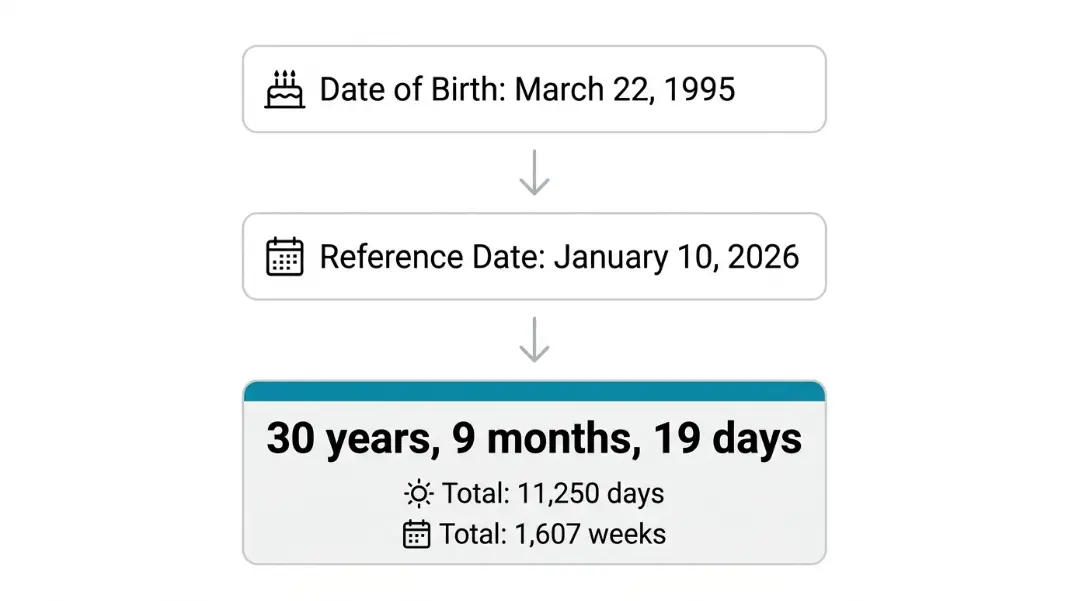
Chronological age is calculated by counting full years from the birth date to the reference date, then counting the remaining full months, then the leftover days. The key rule: if the birthday has not yet passed in the reference year, subtract 1 from the year count.
When day subtraction goes negative, one month is borrowed and its full day count is added back. This handles months of different lengths automatically. For pediatric growth assessments, you need this precision; the Baby Percentile Calculator uses the exact same years-months-days breakdown to look up WHO growth chart percentiles.
Speech-language pathologists (SLPs), occupational therapists (OTs), school psychologists, and educational evaluators all need exact chronological age to score standardized assessments. Tools like the CELF-5, WPPSI-IV, WISC-V, and Bracken school readiness assessment require age in years and months to select the correct norm table.
| Assessment Type | Age Format Needed | Notes |
|---|---|---|
| Speech-language (CELF-5, GFTA-3) | Years:Months (e.g. 7:4) | Use test date as reference date |
| Cognitive (WISC-V, WPPSI-IV) | Years:Months | Must be exact on day of testing |
| School readiness (Bracken, ASQ) | Years:Months | Some tests accept days for prematurity |
| Occupational therapy (BOT-2) | Years:Months:Days | Days matter for borderline norm tables |
| Educational (BRIGANCE) | Years:Months | Separate norms for premature adjustment |
For premature babies, use the adjusted (corrected) age: subtract the number of weeks premature from the chronological age. A child born 10 weeks early who is 18 months chronologically has an adjusted age of approximately 15.5 months. Most assessment publishers specify whether to use chronological or adjusted age in their administration manuals. For ongoing health tracking beyond assessments, the Period Calculator uses the same date arithmetic for cycle-based health tracking.
Chronological age is a fixed count of elapsed time. Biological age reflects how the body has physically aged, which can differ significantly from the calendar count.
| Dimension | Chronological Age | Biological Age |
|---|---|---|
| Definition | Elapsed calendar time from birth | Physical aging state of the body |
| How measured | Date arithmetic (this calculator) | Telomeres, biomarkers, fitness tests |
| Changes over time | Always increases by 1 per year | Can increase faster or slower than 1/yr |
| Affected by lifestyle | No | Yes (diet, exercise, sleep, stress) |
| Used for | Legal, medical, eligibility | Longevity research, wellness programs |
Two people with the same chronological age of 50 can have biological ages ranging from 38 to 65 depending on genetics, diet, and health history. Some health metrics like average blood glucose track closely with biological aging. The A1C Calculator provides a 3-month average blood glucose snapshot that researchers have linked to accelerated biological aging in some studies.
Maria was born on September 14, 1988. Her employer needs to verify her age as of January 1, 2026 for a retirement benefit calculation.
In-depth guides related to this calculator.