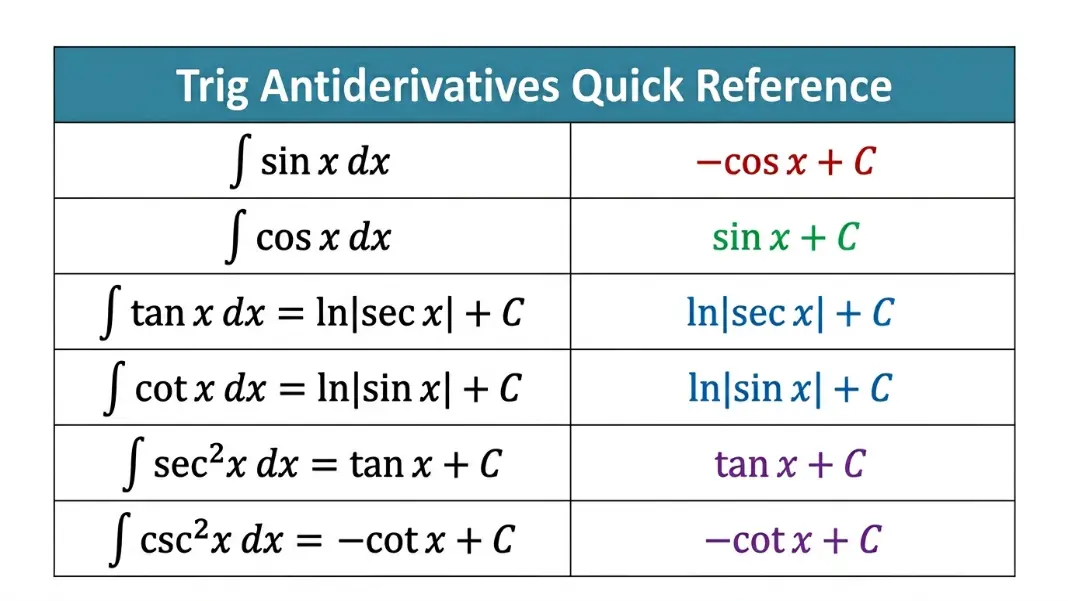
Antiderivative of Trig Functions: Sin, Cos, Tan, Sec, Csc, Cot
Antiderivatives of all six trig functions with proofs, worked examples, and common mistakes.
10 min readRead →
Integrate sums of powers below, including negative and decimal exponents. The trig worksheet further down supports seven common forms with linear inner expressions. Each tool shows its supported syntax and rejects other forms.
Integration worksheet · radians
Integrate one supported trig term with a linear inner expression ax+b. See the substitution, exact coefficient, and derivative check.
Antiderivative
F′(x) = -(3/2) × [−sin(2x+1)] × 2 = 3sin(2x+1). The inner derivative cancels the division by a; C differentiates to zero.
Angles are in radians. The identity holds for every real x; C is an arbitrary constant.
Check agrees at x = 0.25.
f(x) = 2.99248496
Numerical F′(x) ≈ 2.99248496
The centered difference uses nearby F values. Agreement at one point is a numerical check; the chain-rule identity above explains the result.
Rule references: OpenStax antiderivatives and substitution. Calculations stay in this page.
An antiderivative reverses differentiation. If F′(x) = f(x), then F(x) is an antiderivative of f(x). The power tool applies the following rules term by term; its input limits appear above.
Integration is linear, meaning you can integrate term by term. The antiderivative of a sum equals the sum of the antiderivatives:
This linearity is why a polynomial with five terms produces five separate integration steps. For polynomial function analysis using a different approach, the Interpolation Calculator fits a polynomial through data points, which connects naturally to integral approximation.
For every term in the expression, the calculator identifies the rule, applies it, and labels the step. The table below shows the pattern for the most common term types:
| f(x) term | Rule applied | F(x) result | Verification: F'(x) |
|---|---|---|---|
| 6x^2 | Power: exp 2+1=3, coeff 6/3=2 | 2x^3 | 6x^2 ✓ |
| -4x | Power: exp 1+1=2, coeff -4/2=-2 | -2x^2 | -4x ✓ |
| 3 | Constant: ∫ a dx = ax | 3x | 3 ✓ |
| 5x^-2 | Power: exp -2+1=-1, coeff 5/-1=-5 | -5x^-1 | 5x^-2 ✓ |
| x^-1 | Log rule (special case) | ln|x| | 1/x ✓ |
| x^0.5 | Power: exp 0.5+1=1.5, coeff 1/1.5=2/3 | (2/3)x^1.5 | x^0.5 ✓ |
The verification column confirms each result by differentiating. This is the fastest way to check antiderivative work: differentiate F(x), and the result must match f(x) exactly. For coordinate geometry calculations that also involve verifying results step by step, the Midpoint Calculator covers the midpoint formula with full working shown.
The most general antiderivative of f(x) is F(x) + C, where C is an arbitrary constant. This single expression represents infinitely many functions, all with the same derivative. For example, the most general antiderivative of 2x includes x^2, x^2 + 7, x^2 - 100, and every other vertical shift.
Particular antiderivative: When an initial condition is given (such as F(2) = 10), C is determined and the result is a specific function rather than a family. This is the basis of initial value problems in differential equations.
Second antiderivatives follow the same pattern but introduce a second constant. If acceleration a(t) = 6t, velocity is v(t) = 3t^2 + C1, and position is s(t) = t^3 + C1t + C2. Each integration step adds one new constant, determined by an additional initial condition. For data analysis applications where multiple constants are fitted to observations, the Correlation Coefficient Calculator shows how constants are determined from data points.
Find the most general antiderivative of f(x) = 6x^2 - 4x + 3
Researches and verifies the formulas, methodology, and source data behind each calculator on CalculatorFlux. All tools are built and checked against the cited references before publication.
In-depth guides related to this calculator.