ABV Meaning: What Alcohol by Volume Tells You About Any Drink (2026)
ABV is the percentage of a drink that is pure ethanol. Ranges by category, legal tolerances, and standard drink math.
11 min readRead →
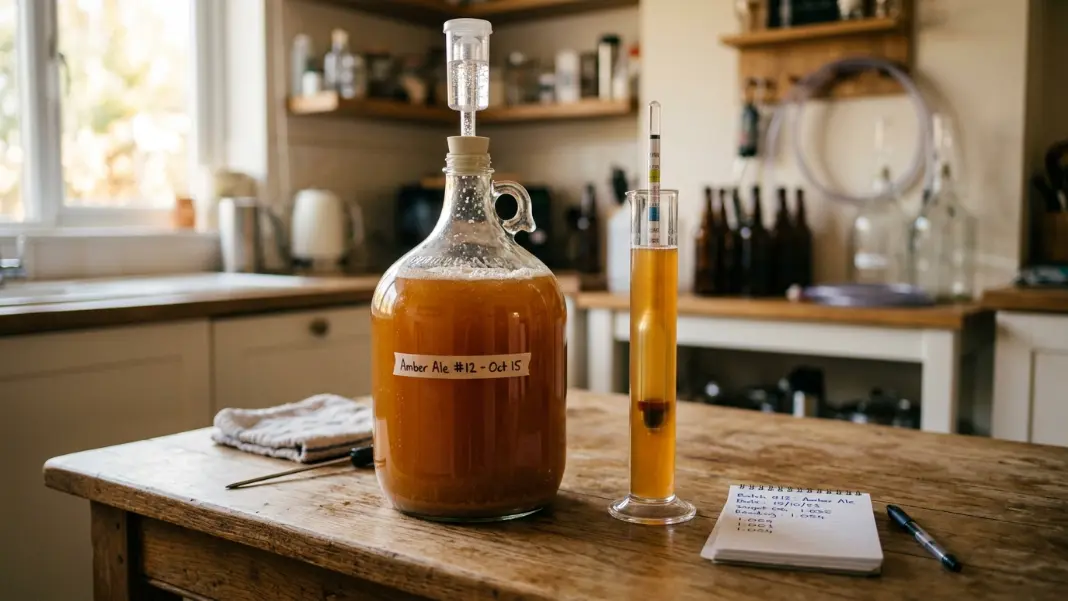
ABV is calculated by measuring how much sugar yeast consumed during fermentation. You record specific gravity before pitching yeast (OG) and after fermentation finishes (FG), then apply the formula. The heavier the original wort and the drier the finish, the higher the ABV.
Why 131.25? The constant comes from the density of ethanol and water. Each gravity point (0.001 SG) represents roughly 0.131% ABV when fully fermented. It was empirically derived and matches commercial lab measurements within 0.2-0.3% for beers under 10%.
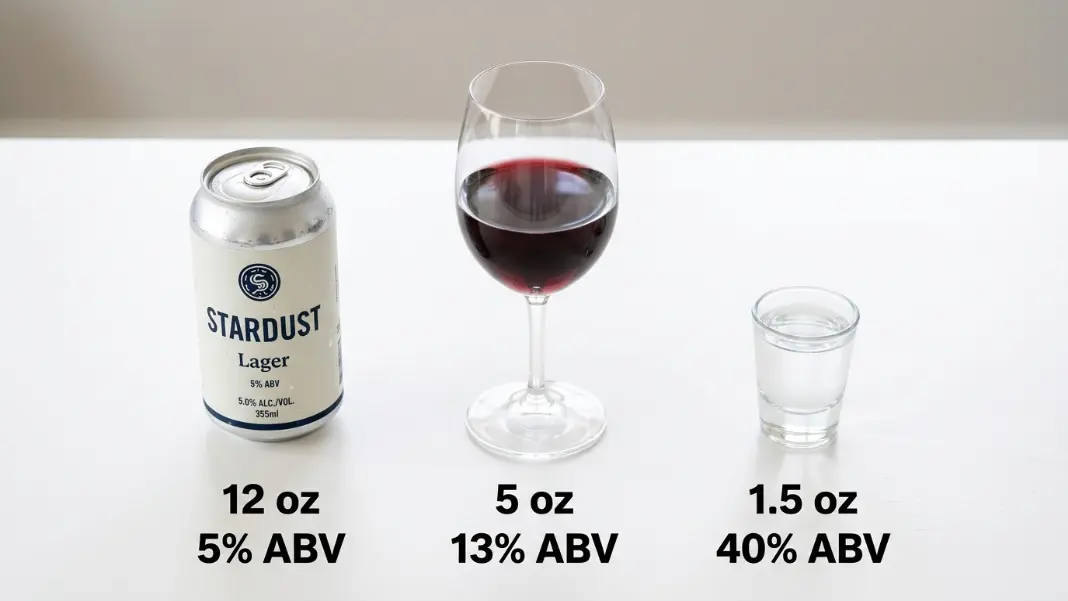
ABV directly determines how many standard drinks a serving contains and how it affects blood alcohol concentration. For calculating how ABV affects your blood alcohol level, use the BAC Calculator.
Each beer style has a target OG range, expected FG range, and resulting ABV band. Use this as a reference to verify your batch is hitting the style target before calculating final ABV:
| Style | OG Range | FG Range | ABV |
|---|---|---|---|
| Session Ale | 1.028-1.040 | 1.004-1.010 | 2.8-4.0% |
| American Lager | 1.040-1.050 | 1.004-1.010 | 4.0-5.0% |
| American Pale Ale | 1.045-1.060 | 1.010-1.015 | 4.5-6.2% |
| American IPA | 1.056-1.075 | 1.008-1.014 | 5.5-7.5% |
| Double / Imperial IPA | 1.075-1.100 | 1.008-1.018 | 7.5-10.0% |
| Belgian Strong Golden | 1.070-1.095 | 1.010-1.024 | 7.5-10.5% |
| Barleywine | 1.080-1.120 | 1.016-1.030 | 8.0-12.0% |
| Imperial Stout | 1.075-1.115 | 1.018-1.030 | 8.0-12.0% |
OG and FG ranges sourced from the Brewer's Association 2024 Style Guidelines. Actual ABV in your batch depends on your specific yeast strain's attenuation rate and fermentation conditions.
The same gravity formula applies to mead and wine, but the OG ranges are much higher. Honey and grape juice ferment more completely than malted grain, so FG readings are typically lower relative to OG.
| Beverage | Typical OG | Typical FG | Expected ABV |
|---|---|---|---|
| Session Mead (Hydromel) | 1.040-1.060 | 0.996-1.006 | 5-8% |
| Traditional Mead | 1.080-1.110 | 0.998-1.010 | 10-14% |
| Sack Mead (Sweet) | 1.120-1.150 | 1.010-1.030 | 14-18% |
| Dry Table Wine | 1.070-1.090 | 0.990-1.000 | 10-13% |
| Fruity / Off-Dry Wine | 1.090-1.110 | 1.000-1.010 | 12-15% |
| Apple Cider (Standard) | 1.045-1.065 | 1.000-1.010 | 5-8% |
Wine ABV is sometimes measured from Brix using a refractometer: SG = 1 + (Brix / (258.6 - (Brix / 258.2) x 227.1)). A Brix reading of 22 is approximately 1.092 SG. Note that refractometers are inaccurate for FG readings after fermentation begins due to the effect of alcohol on light refraction. Use a hydrometer for FG. High alcohol intake affects blood glucose and metabolic markers. The A1C Calculator covers how average blood glucose relates to HbA1c, a key marker affected by regular alcohol consumption.
In the United States, proof is exactly double the ABV percentage. The term originates from an old British test where gunpowder soaked in spirits would still ignite at roughly 57% ABV (100 proof on the British scale). The US simplified this to Proof = ABV x 2.
| ABV % | US Proof | Common Example |
|---|---|---|
| 4.2% | 8.4 | Standard light beer |
| 5.0% | 10.0 | Regular beer |
| 7.0% | 14.0 | Craft IPA |
| 12.0% | 24.0 | Table wine |
| 20.0% | 40.0 | Port / fortified wine |
| 40.0% | 80.0 | Most spirits (vodka, whisky, gin) |
| 50.0% | 100.0 | Cask strength whisky |
| 57.5% | 115.0 | Overproof rum |
The ABV also determines calorie density. Alcohol contributes 7 kcal per gram, more than carbohydrates or protein.
Derek brewed an American IPA. His OG reading was 1.065 and his final gravity after two weeks was 1.012. He is pouring 16 oz pints.
In-depth guides related to this calculator.