Corrected Calcium Formula: How to Adjust for Low Albumin (2026)
Payne formula for albumin correction, when to use ionized calcium instead, and clinical significance of abnormal values.
9 min readRead →
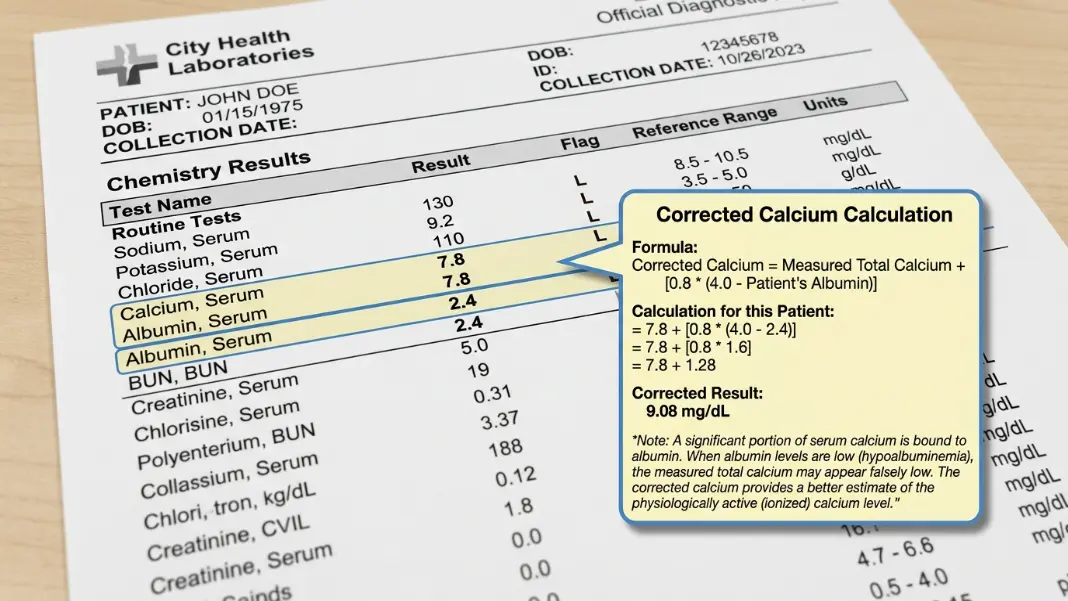
The Payne formula adjusts total serum calcium for low albumin. About 45% of calcium circulates bound to albumin, so a low albumin level artificially deflates the measured calcium reading. The correction restores the estimated true value:
Step-by-step example: Serum calcium 8.0 mg/dL, albumin 2.5 g/dL.
The constant 0.8 was empirically derived by Payne et al. (1973) from correlation studies between albumin levels and calcium binding. For other clinical lab value calculations, the Anion Gap Calculator uses a similar approach for interpreting metabolic panel values.
Total serum calcium has three fractions: protein-bound (45%, mostly albumin), complexed to anions like phosphate and citrate (10%), and free ionized calcium (45%). Only the ionized fraction is biologically active. When albumin falls, the protein-bound fraction falls with it, reducing total calcium without changing ionized calcium.
| Albumin (g/dL) | Correction (mg/dL) | Effect on Total Ca | Clinical Meaning |
|---|---|---|---|
| 1.0 | +2.4 | Severely underestimated | Always correct before acting |
| 1.5 | +2.0 | Severely underestimated | Always correct before acting |
| 2.0 | +1.6 | Significantly underestimated | Correction essential |
| 2.5 | +1.2 | Moderately underestimated | Correction important |
| 3.0 | +0.8 | Mildly underestimated | Correction recommended |
| 3.5 | +0.4 | Minimally underestimated | Correction useful |
| 4.0 | 0 | Accurate | No correction needed |
| 4.5 | -0.4 | Slightly overestimated | Less common scenario |
Hypoalbuminemia is common in hospitalized patients (40-50% incidence) due to malnutrition, liver disease, nephrotic syndrome, and acute inflammation. Acting on uncorrected calcium in these patients frequently leads to unnecessary IV calcium supplementation. For growth and development contexts where calcium status matters across age groups, the Baby Percentile Calculator covers WHO and CDC growth metrics used in pediatric assessments.
Labs in the UK, Canada, Australia, and most of Europe report calcium in mmol/L. The Payne formula has two equivalent forms depending on the units used:
| Units | Formula | Normal Range |
|---|---|---|
| mg/dL (US) | Corrected Ca = Measured Ca + 0.8 x (4.0 - Albumin [g/dL]) | 8.5-10.5 mg/dL |
| mmol/L (SI) | Corrected Ca = Measured Ca + 0.02 x (40 - Albumin [g/L]) | 2.12-2.62 mmol/L |
Converting between units: 1 mmol/L = 4.0 mg/dL for calcium. To convert a mg/dL result to mmol/L, divide by 4. The result card above shows both units automatically. If your lab reports albumin in g/L instead of g/dL, divide by 10 before entering it into the mg/dL formula.
For blood glucose unit conversions in a similar clinical context, the A1C Calculator converts between mg/dL and mmol/L for HbA1c and eAG values.
Dr. Nguyen is reviewing labs for Marcus, a 68-year-old hospitalized patient with liver cirrhosis. Serum calcium reads 7.6 mg/dL and albumin is 2.2 g/dL. Is Marcus truly hypocalcemic?
In-depth guides related to this calculator.