ABV vs Proof: What's the Difference and How to Convert (2026)
In the US, proof is ABV doubled. A 40% spirit is 80 proof. Conversion table, formulas, and how the old UK proof system set 100 proof at 57% ABV.
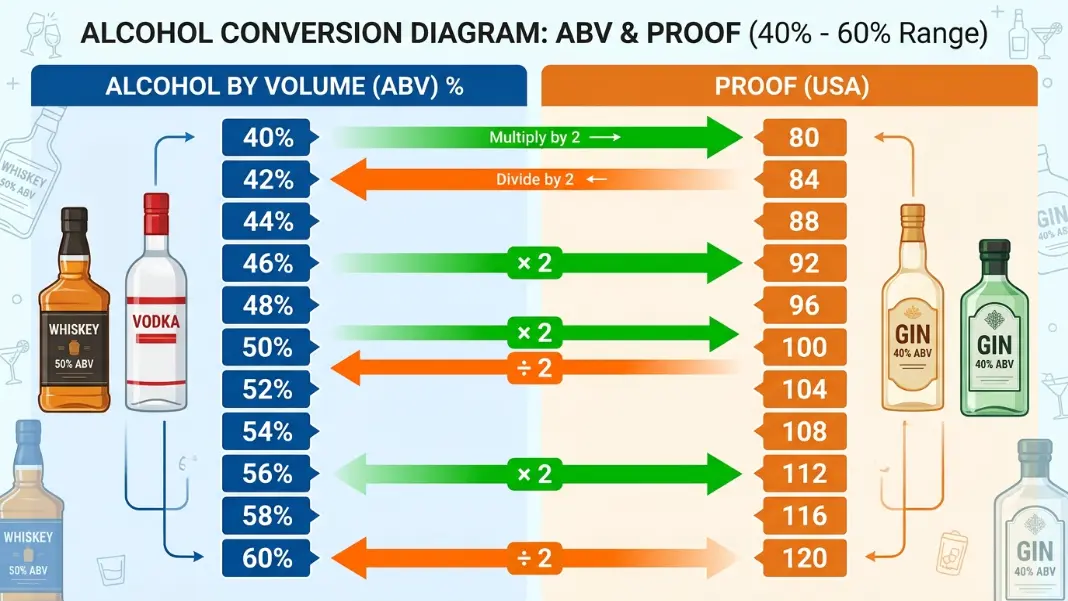
Proof and ABV both measure alcohol concentration, but they use different numbers. A bottle labeled 80 proof and one labeled 40% ABV contain exactly the same amount of alcohol. In the US, proof is always double the ABV percentage, making conversion trivial once you know the rule. To calculate the alcohol content of a homebrew batch from gravity readings, use the ABV Calculator.
How to Convert ABV to Proof (and Proof to ABV)#
The US conversion between proof and ABV is a single arithmetic step:
US Proof = ABV × 2
ABV      = US Proof ÷ 2
That is the complete formula. There are no correction factors, temperature adjustments, or exceptions in the US system.
Converting ABV to proof:
| ABV | US Proof |
|---|---|
| 40% | 80 proof |
| 43% | 86 proof |
| 45% | 90 proof |
| 50% | 100 proof |
| 57.5% | 115 proof |
| 60% | 120 proof |
| 75.5% | 151 proof |
| 100% | 200 proof |
Worked examples:
A bottle of bourbon is labeled 107 proof. To find the ABV:
ABV = 107 ÷ 2 = 53.5%
A gin is labeled 47% ABV. To find the proof:
Proof = 47 × 2 = 94 proof
The math never changes direction or scale. If you see a proof number on a US bottle, halve it to get ABV. If you have an ABV percentage, double it to get proof.
ABV vs Proof Reference Table for Common Spirits#
Spirits are rarely labeled at arbitrary numbers. Most commercially sold spirits cluster around a small set of proof points.
| Spirit Category | Typical ABV | US Proof | Notes |
|---|---|---|---|
| Light beer | 4.0 – 5.0% | 8 – 10 | Not labeled in proof |
| Craft IPA | 6.0 – 8.0% | 12 – 16 | Not labeled in proof |
| Table wine | 11.5 – 13.5% | 23 – 27 | Not labeled in proof |
| Port / sherry | 17 – 20% | 34 – 40 | Fortified wine |
| Standard vodka, gin, rum, tequila | 40% | 80 | Most common shelf product |
| Many whiskeys | 43 – 46% | 86 – 92 | Export / premium strength |
| Bottled in Bond bourbon | 50% | 100 | Legally mandated under 1897 act |
| Cask-strength bourbon | 55 – 65% | 110 – 130 | Varies by barrel |
| Overproof rum (151) | 75.5% | 151 | High-proof category |
| Pure ethanol | 100% | 200 | Not consumed directly |
Note that beer and wine are almost never labeled in proof in the US market. The proof designation appears almost exclusively on distilled spirits, particularly whiskey, bourbon, and rum.
Why US Proof Is Exactly Double ABV#
The current US proof system dates to 1848, when Congress defined 100 proof as 50% alcohol by volume for tax purposes. That definition made the conversion between proof and ABV a clean factor of 2. The Alcohol and Tobacco Tax and Trade Bureau (TTB) still uses this definition today.
Before the 1848 standardization, the US used an adapted version of the British system, which defined 100 proof based on a gunpowder ignition test rather than a simple percentage. The British threshold turned out to be approximately 57% ABV, a number that did not simplify cleanly into a doubling relationship. The US chose to redefine proof to make tax calculations and blending ratios straightforward.
Setting 100 proof at 50% ABV accomplished that goal. Every 1% increase in ABV corresponds to exactly 2 proof points. Blending a batch from 120 proof (60% ABV) down to 80 proof (40% ABV) requires proportional dilution that any distiller can calculate without special reference tables.
For reference on how ABV is calculated from fermentation data, see How to Calculate ABV for Homebrewers, which covers the gravity-based formula used in brewing.
UK Proof vs US Proof: Two Different Systems#
The US and UK proof systems both use the word "proof" but define it at entirely different alcohol concentrations. This caused decades of confusion before the UK abandoned the system entirely.
| System | Definition of 100 Proof | 80 Proof equivalent |
|---|---|---|
| US Proof (current) | 50% ABV | 40% ABV |
| UK Proof (historical) | 57.15% ABV | 45.7% ABV |
The British origin:
The British "proof spirit" was codified in 1816 as the concentration at which spirits, when poured over gunpowder, would allow the powder to ignite. Below that concentration (below proof), the water content extinguished the flame. At or above it (at or over proof), the powder caught. That threshold happened to be 57.15% ABV at 51°F (10.6°C).
Under the British system, spirits were expressed as degrees over proof (OP) or under proof (UP). A whisky labeled 70 OP was 170% of the proof standard, which equals roughly 97% ABV. A spirit labeled 30 UP was 70% of the proof standard, roughly 40% ABV. The arithmetic required to convert these designations was not intuitive.
When the UK switched:
The UK replaced proof labeling with ABV on January 1, 1980, following EU harmonization standards. All EU member states adopted ABV as the required expression of alcohol content. Proof disappeared from British bottles entirely.
The US retained proof alongside ABV. Federal regulations (27 CFR 5.32) require distilled spirits to display ABV on the label. Proof is optional as a secondary statement and widely used in marketing, especially for whiskey and bourbon.
How Proof and ABV Appear on US Spirit Labels#
US federal regulations require the alcohol content of distilled spirits to appear on labels as a percentage of alcohol by volume. Proof is permitted as an additional statement but is not required.
In practice, most US distilled spirits show both. A label will typically read "40% Alc/Vol (80 Proof)" or "43% Alc/Vol (86 Proof)." Some craft distillers list only ABV, which is fully compliant. A label cannot display proof without the corresponding ABV percentage.
Why producers keep using proof:
The term carries cultural weight in the American spirits market. "Bottled in Bond" bourbon must be exactly 100 proof (50% ABV) under the Bottled in Bond Act of 1897. "Barrel proof" or "cask strength" bourbons are bottled without water dilution, typically ranging from 110 to 130 proof. These proof designations communicate style and dilution level to buyers in a way that a plain ABV number may not convey as immediately.
Proof also provides a second data point on labels designed for consumers who still think in those terms, particularly in markets where premium bourbon and American whiskey are sold. The ABV number satisfies the regulatory requirement; the proof number serves the marketing context.
For taking accurate alcohol measurements in a homebrew setting, see Using a Hydrometer to Measure ABV, which covers specific gravity readings and temperature correction.
80 proof equals 40% ABV. In the US system, proof is always double the ABV percentage, so 80 divided by 2 equals 40. Most standard vodkas, gins, rums, and whiskeys sold in the US are 80 proof or 40% alcohol. A shot glass of 80 proof spirit contains 40% ethanol by volume.
Yes, in the US system 40% ABV is exactly 80 proof. The relationship is always Proof = ABV × 2, so 40 × 2 = 80. A bottle labeled 40% ABV and a bottle labeled 80 proof contain identical amounts of alcohol. Both descriptions often appear on the same US spirit label to satisfy the regulatory ABV requirement and the marketing convention of stating proof.
In the US, 100 proof equals 50% ABV. Divide 100 by 2 to get 50. Some bourbons and whiskeys are sold at exactly 100 proof, and Bottled in Bond bourbon is legally required to be 100 proof under the 1897 Bottled in Bond Act. Under the old British proof system, 100 proof meant 57.15% ABV, which is a different number entirely.
Proof labeling is a historical carryover that stayed embedded in US spirits culture. The US defined 100 proof as 50% ABV in 1848, and the distilled spirits industry continued using proof in marketing long after ABV became the regulatory standard. Bourbon producers in particular use proof as a quality signal: 90 proof, 100 proof, and barrel proof expressions communicate dilution level and intensity. The language is familiar to whiskey buyers in a way that a plain ABV percentage is not.
US proof is double the ABV: 100 proof = 50% ABV. UK proof was based on a gunpowder ignition test from the early 1800s: 100 UK proof = 57.15% ABV. The two systems define 100 proof at different alcohol concentrations. The UK abandoned the proof system in 1980 and switched to ABV-only labeling in line with EU standards. The US retained both, with ABV required and proof optional on distilled spirit labels.
Divide the proof number by 2. The formula is ABV = Proof ÷ 2. For example, 90 proof ÷ 2 = 45% ABV. To convert the other way: ABV × 2 = Proof, so 45% × 2 = 90 proof. This only applies to the US system. The historical UK proof system used a different ratio (100 UK proof = 57.15% ABV) but is no longer in commercial use.
Written by
Hassaan Rasheed
Web Developer & Content Researcher
Hassaan builds calculators and writes source-linked guides across the site's subject areas. Calculator methods and reference data are documented in each guide so readers can verify the underlying sources.
About the author and methods