How to Calculate ABV for Homebrewers: Step-by-Step Formula (2026)
Calculate ABV from original and final gravity using the standard homebrewing formula. Worked examples for beer, wine, and cider. No signup.
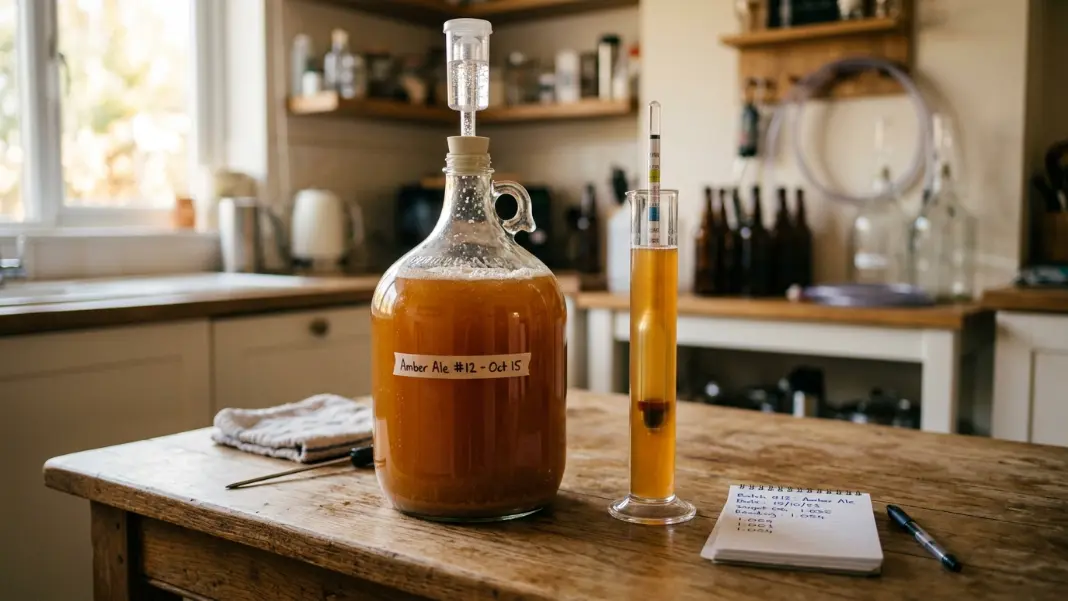
Every homebrew batch produces two gravity readings: one before fermentation starts and one after it finishes. The difference between those two numbers tells you exactly how much alcohol your yeast produced. The math is straightforward, and once you understand it, you will never need to guess at your batch's strength again. To skip the manual calculation, use the ABV Calculator directly.
What ABV Actually Measures#
ABV stands for alcohol by volume. It represents the percentage of a liquid that is pure ethanol. A beer labeled 5% ABV contains 5 ml of ethanol per 100 ml of liquid. This number matters for homebrewers for three reasons: recipe development, legal requirements if you share or sell, and simply knowing what you are drinking.
Yeast converts fermentable sugars into ethanol and carbon dioxide. The more sugar present at the start and the more completely yeast ferments it, the higher the ABV. Gravity readings measure sugar concentration, which is why they are the input for the ABV formula.
The Standard ABV Formula for Homebrewers#
The formula used by most homebrewers:
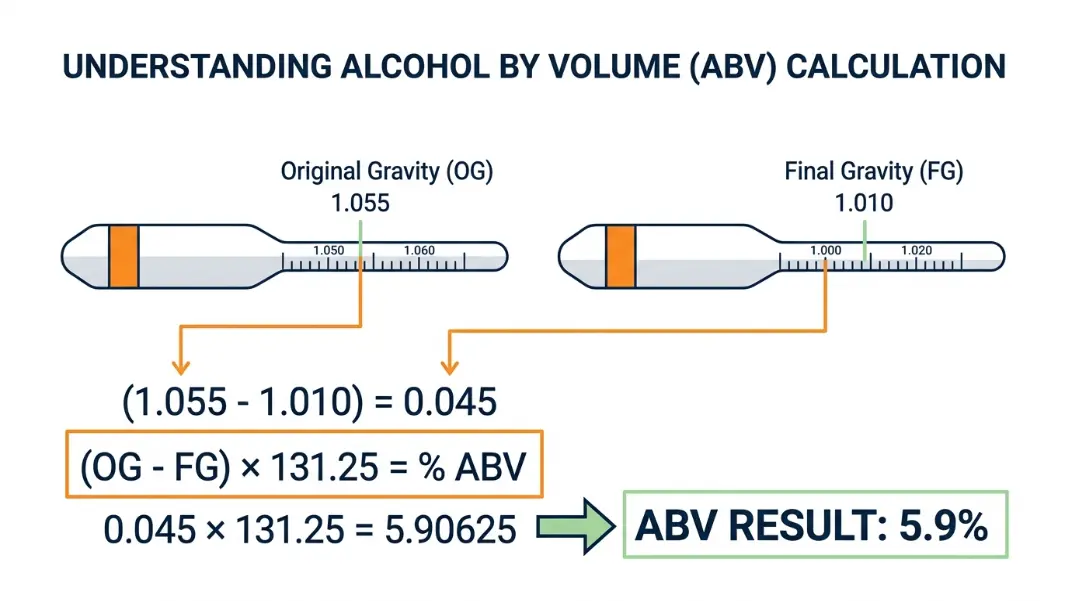
ABV = (OG - FG) × 131.25
Where:
- OG = Original Gravity (specific gravity before fermentation)
- FG = Final Gravity (specific gravity after fermentation is complete)
- 131.25 = a constant derived from the density of ethanol and water
Worked example:
- OG: 1.055
- FG: 1.010
- ABV = (1.055 - 1.010) × 131.25 = 0.045 × 131.25 = 5.9% ABV
This formula is accurate for most standard-strength beers (ABV under 8%). It is the same calculation the ABV Calculator runs when you enter your gravity readings.
The Alternate Formula for High-Gravity Batches#
For beers, wines, or meads above 8% ABV, the standard formula starts to underestimate alcohol content. Ethanol is less dense than water, and at higher concentrations this affects the specific gravity reading in ways the simplified formula does not fully account for.
The alternate formula (sometimes called the Brix-corrected or advanced formula):
ABV = 76.08 × (OG - FG) / (1.775 - OG) × (FG / 0.794)
Example with a strong Belgian ale:
- OG: 1.090
- FG: 1.018
Standard formula: (1.090 - 1.018) × 131.25 = 9.45% ABV Alternate formula: 76.08 × (0.072) / (1.775 - 1.090) × (1.018 / 0.794) = 9.8% ABV
The difference of 0.35% seems small, but at high gravities this divergence grows. For a standard session ale at 5%, both formulas give the same result within 0.1%. Use the standard formula for beers under 8% and switch to the alternate for anything stronger.
Understanding Original Gravity and Final Gravity#
Original Gravity (OG) is measured after the wort is cooled and before pitching yeast. It reflects the concentration of dissolved sugars available for fermentation. Water has a specific gravity of 1.000. A wort with an OG of 1.060 contains significantly more dissolved solids (mostly sugars) than water.
Typical OG ranges by style:
| Beer Style | OG Range |
|---|---|
| Light lager | 1.028 - 1.040 |
| American pale ale | 1.045 - 1.060 |
| IPA | 1.056 - 1.075 |
| Stout | 1.050 - 1.075 |
| Belgian tripel | 1.075 - 1.095 |
| Barleywine | 1.085 - 1.120 |
Final Gravity (FG) is measured after fermentation is complete and the gravity has been stable for at least 2-3 days. It reflects the residual sugars and non-fermentable dextrins left after yeast finishes working.
FG is not zero because not all sugars in wort are fermentable. Dextrins, proteins, and certain carbohydrates remain regardless of how long fermentation runs. A beer that finishes at 1.010 instead of 1.008 is not stuck. It may simply have reached its natural attenuation limit.
Apparent Attenuation is a useful companion metric:
Attenuation = ((OG - FG) / (OG - 1.000)) × 100
For OG 1.055, FG 1.010: ((0.045) / (0.055)) × 100 = 81.8% attenuation
Most ale yeasts attenuate between 73% and 82%. Lager yeasts and some Belgian strains push higher, into the 80-88% range. If your attenuation falls well below your yeast strain's published range, fermentation may not be complete.
Step-by-Step: Calculating ABV for Your Batch#
Step 1: Measure OG after cooling your wort
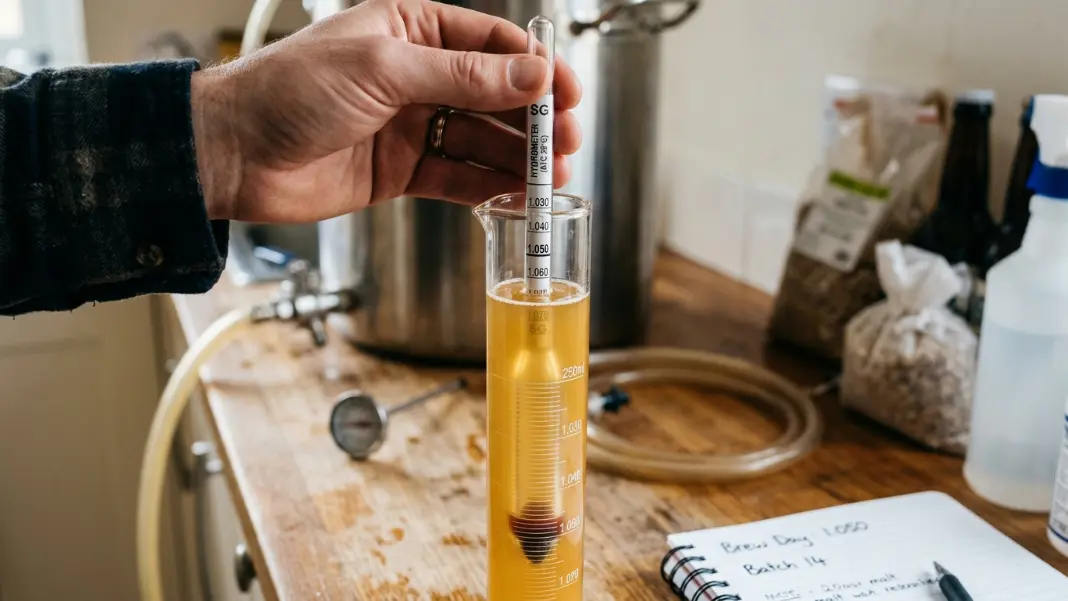
Take the reading after the wort reaches pitching temperature (below 80°F). Warm wort gives a falsely high reading. If you take a reading at 80°F on a hydrometer calibrated to 60°F, add approximately 0.003 to correct for temperature. For a precise guide on taking hydrometer readings and temperature corrections, see Using a Hydrometer to Measure ABV.
Step 2: Record OG and pitch yeast
Write it down. This sounds obvious but estimating OG from memory after 2-3 weeks of fermentation introduces error into the final calculation.
Step 3: Measure FG after fermentation stabilizes
Take a gravity reading once visible fermentation activity slows. Take a second reading 48-72 hours later. If both readings match, fermentation is complete. If the gravity is still dropping, wait longer.
Step 4: Apply the formula
ABV = (OG - FG) × 131.25
Enter your two readings into the ABV Calculator to get the result instantly, along with apparent attenuation.
Step 5: Compare to target
Your recipe should have a target OG and FG based on the grain bill and yeast strain. Comparing your actual readings to target tells you whether your mash efficiency hit the mark and whether fermentation ran to completion.
ABV Calculation for Wine and Cider#
The same formula applies to wine and cider. The inputs look different because winemakers often use Brix instead of specific gravity, but the underlying measurement is the same.
Converting Brix to Specific Gravity:
SG = 1 + (Brix / (258.6 - (Brix / 0.879) × 0.11))
A simpler approximation used by most home winemakers:
SG ≈ (Brix / 1000) + 1
So a grape must reading 23 Brix converts to approximately 1.095 SG.
Wine example:
- OG (must): 1.095 (23 Brix)
- FG (after fermentation): 0.994
ABV = (1.095 - 0.994) × 131.25 = 13.3% ABV
Note the FG below 1.000. Dry wines often finish below water density because ethanol is less dense than water, pulling the reading below 1.000. This is normal and expected in dry wine styles.
Cider example:
- OG (fresh pressed juice): 1.050
- FG (dry cider): 1.002
ABV = (1.050 - 1.002) × 131.25 = 6.3% ABV
Why Your Calculated ABV May Differ from Expected#
Mash efficiency below target: If your OG comes in lower than the recipe predicted, your ABV will be lower than the style target. The grain bill assumed a certain extraction efficiency, typically 70-75% for homebrew systems. Lower efficiency means less fermentable sugar in the kettle.
Fermentation did not fully complete: An FG higher than expected (e.g., 1.018 instead of 1.010) means yeast left fermentable sugar behind. This could be under-pitching, fermentation temperature too low, nutrient deficiency in wine or mead, or a yeast strain with low attenuation. The result is a sweeter, lower-ABV beer than planned.
Temperature correction not applied: A hydrometer reading taken at 75°F on a 60°F-calibrated instrument without correction introduces roughly 0.004 error into the gravity reading. On a 5-gallon batch this is minor, but it compounds across OG and FG measurements.
Refractometer not corrected post-fermentation: Refractometers give accurate Brix readings in unfermented wort but require a correction formula once alcohol is present. If you use a refractometer for FG, apply the Terrill or Sean Terrill correction formula before converting to SG and calculating ABV. Without the correction, refractometer FG readings in fermented beer are not reliable.
The standard formula is ABV = (OG - FG) × 131.25. OG is original gravity measured before fermentation and FG is final gravity measured after fermentation is complete. For beers above 8% ABV, use the alternate formula: ABV = 76.08 × (OG - FG) / (1.775 - OG) × (FG / 0.794) for greater accuracy.
For a 5% ABV beer, you need a gravity drop of approximately 0.038 points. A common combination is OG 1.050 and FG 1.012, which gives (1.050 - 1.012) × 131.25 = 4.99%. You can also achieve 5% with OG 1.055 and FG 1.017, or OG 1.060 and FG 1.022. The exact OG and FG depend on your grain bill and yeast strain's attenuation range.
Take a gravity reading, then take another reading 48 to 72 hours later. If both readings are identical, fermentation is complete. If the gravity is still dropping, wait and check again. Visible signs like airlock bubbling are not reliable indicators of completion. The only accurate method is two consecutive matching gravity readings.
You can use a refractometer to measure OG before fermentation. However, refractometers require a post-fermentation correction formula to give accurate FG readings because alcohol affects the refractive index of the liquid. A hydrometer remains the most straightforward tool for both readings. See the guide on using a hydrometer to measure ABV for step-by-step instructions.
The most common reasons are: mash efficiency lower than the recipe assumed (resulting in lower OG), fermentation that did not run to completion (resulting in higher FG than expected), or both. Check your OG against the recipe's target OG first. If OG hit the mark but FG is higher than expected, the issue is fermentation, not extraction.
Yes. The same formula (OG - FG) × 131.25 applies to wine, cider, and mead. Winemakers often measure in Brix rather than specific gravity, so convert Brix to SG first using SG = Brix / 1000 + 1 (approximate). Dry wines and meads often finish below 1.000 SG, which is normal. The calculation still works with FG values below 1.000.
Written by
Hassaan Rasheed
Web Developer & Content Researcher
Hassaan builds calculators and writes source-linked guides across the site's subject areas. Calculator methods and reference data are documented in each guide so readers can verify the underlying sources.
About the author and methods