How 401k Matching Works: Formula, Vesting, and Contribution Limits (2026)
How 401k employer matching works: dollar-for-dollar vs percentage formulas, vesting schedules, and whether employer match counts toward your limit.
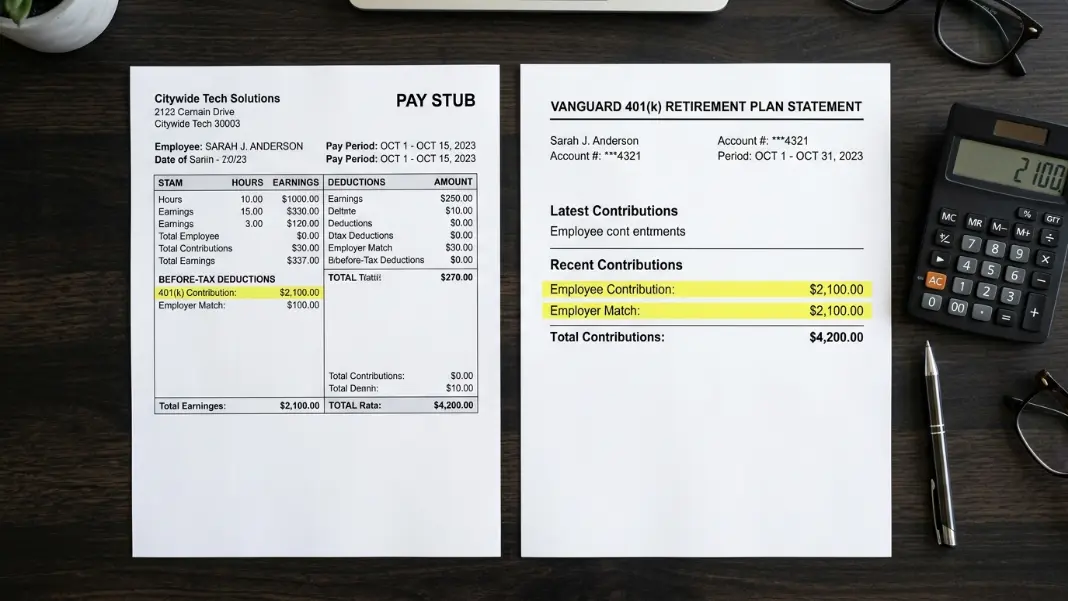
Contributing below the rate required for a full employer match can reduce an employee's total compensation. A 50% match on the first 6% of a $70,000 salary promises up to $2,100 per year. If the employee defers 3%, the formula produces $1,050 instead. Whether later payroll deferrals or a year-end true-up can recover a shortfall depends on the plan document.
An employer match can be valuable, but it is not an investment return or a universal guarantee: eligibility, vesting, compensation definitions, payroll timing, annual limits, and plan amendments matter. The 401k Match Calculator estimates a simple match-rate-and-cap formula. This guide explains how those formulas work, when employer money vests, and how the two relevant contribution limits differ.
What 401k Employer Matching Actually Is#
Employer matching is money a company deposits into a 401(k) under a formula triggered by an employee's elective deferrals. The employee and employer amounts are tracked by source inside the plan. Investment elections and default-investment rules determine how each source is invested; do not assume every source necessarily uses the same election.
The match is part of total compensation. It can encourage participation, but offering a match alone does not establish compliance. Non-safe-harbor plans can still be subject to nondiscrimination testing, while qualifying safe harbor designs follow prescribed contribution and other requirements.
What triggers the match:
A matching formula is based on what the employee defers. Contributing nothing produces no matching contribution, although a plan may separately provide a nonelective or profit-sharing contribution. Contributing below the formula's threshold usually produces a partial match. The plan may calculate this each pay period or over the plan year, and a true-up provision may reconcile some shortfalls.
What the match money looks like in your account:
Employer contributions appear as a separate source from employee deferrals. Pre-tax and designated Roth sources have different tax treatment, and employer contributions may also have different vesting, withdrawal, and distribution treatment. Vesting is covered below.
How the Match Formula Works: Dollar-for-Dollar vs Percentage Match#
The examples below cover a flat single-tier match and a dollar-for-dollar match. Multitier, dollar-capped, age-based, service-based, and discretionary designs also exist, so the Summary Plan Description controls.
Percentage match with a salary cap (most common):
Match Amount = Match Rate × min(Employee Contribution,
                                Match Cap × Eligible Annual Compensation)
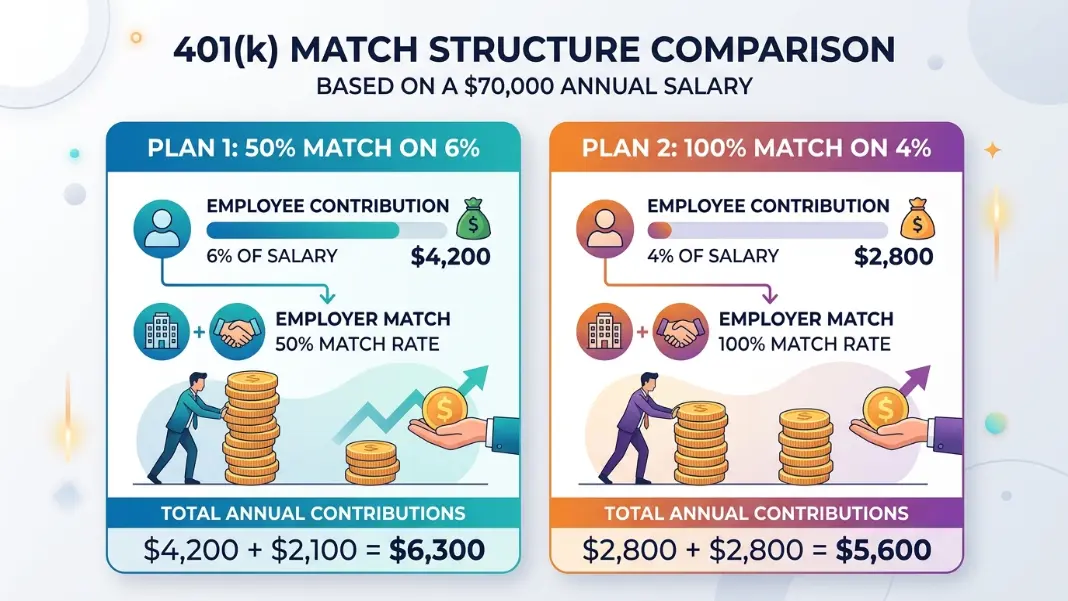
In Vanguard's estimated 2025 data, 50% on the first 6% of pay was the most frequently used single formula, appearing in 12% of plans that offered a match. At a $70,000 salary:
- Employee contributes 6% = $4,200
- Employer matches 50% of $4,200 = $2,100
- Total deposited: $6,300
If the same employee contributes only 3% instead of the full 6%:
- Employee contributes 3% = $2,100
- Employer matches 50% of $2,100 = $1,050
- Lost match: $1,050 per year
The match cap means contributing beyond 6% does not generate additional employer contributions. An employee contributing 10% still receives the same $2,100 match as one contributing 6%.
Dollar-for-dollar match:
A plan offering "100% match on the first 4% of salary" matches every dollar you put in, up to 4% of salary. At $70,000:
| Your Contribution | Employer Match | Total Deposited |
|---|---|---|
| 2% ($1,400) | $1,400 | $2,800 |
| 4% ($2,800) | $2,800 | $5,600 |
| 6% ($4,200) | $2,800 (capped) | $7,000 |
The match stops at 4% of salary. Contributing 6% earns the same match as contributing 4%. The optimal contribution for capturing the full match is exactly at the cap.
Roth 401k and employer match:
An employer can match designated Roth 401(k) deferrals. Employer contributions are usually pre-tax, but SECURE 2.0 permits a plan to let a participant designate fully vested matching or nonelective contributions as Roth. Availability and tax reporting are plan-specific. The Roth vs Traditional 401k Calculator compares simplified employee-contribution scenarios.
Vesting Schedules: When the Employer Match Is Actually Yours#
Your own salary deferrals are fully vested. Employer matching contributions may vest immediately or under a permitted schedule, which means service can affect how much of the employer-funded balance you keep after leaving.
Two vesting structures are in use:
Cliff vesting: You own 0% of the employer match until a set date, then 100% immediately.
A 3-year cliff means an employee who leaves after 2 years 11 months keeps their own contributions but forfeits the entire accumulated employer match. An employee who leaves one month later keeps all of it.
Graded vesting: You earn a percentage each year until you reach 100%.
The IRS sets maximum vesting schedules for graded plans. A common 6-year graded structure:
| Years of Service | Vested Percentage |
|---|---|
| Less than 2 | 0% |
| 2 | 20% |
| 3 | 40% |
| 4 | 60% |
| 5 | 80% |
| 6+ | 100% |
An employee leaving after 4 years keeps 60% of the employer match accumulated during their tenure. The remaining 40% is forfeited back to the plan.
Immediate vesting:
Some plans vest employer contributions immediately. Traditional required safe harbor contributions are immediately vested. QACA safe harbor contributions may use a schedule but must be fully vested after no more than two years; that does not require a two-year cliff. If you are evaluating an offer, compare the vesting rule as well as the match formula.
Year of service definition:
A plan document defines how vesting service is credited; a year-of-service method often uses 1,000 hours during the applicable computation period, while elapsed-time methods can work differently. Do not infer the vesting date only from a hire-date anniversary.
Does Employer Match Count Toward Your 401k Contribution Limit#
Employer match does not reduce the employee elective-deferral limit, but it does count toward a separate annual-additions limit.
There are two separate IRS limits:
Employee elective deferral limit (2026): $24,500
This is the regular cap on an employee's elective deferrals across applicable plans. Employer match does not count against it. A participant can defer up to $24,500 and still receive employer contributions, subject to the plan terms and other limits.
When the plan permits catch-ups, the 2026 limit is generally $8,000 for an eligible participant age 50 or older. For ages 60 through 63, the higher limit is $11,250 instead of $8,000. Other catch-up rules, including the Roth requirement for some higher-wage participants, can apply.
Annual additions limit (2026): the lesser of $72,000 or 100% of compensation
Employee elective deferrals, employer match, nonelective or profit-sharing contributions, and employee after-tax contributions generally count toward this ceiling. Eligible catch-up contributions are excluded. A worker earning $85,000 who contributes $24,500 and receives an employer contribution equal to 4% of pay adds $3,400 from the employer, for $27,900 before any other counted contribution.
The 2026 compensation taken into account for qualified-plan contribution calculations is generally capped at $360,000. The practical answer is therefore: employer match does not use the employee's $24,500 regular deferral space, but both sources interact under the separate annual-additions rule. For IRA-specific limits, see the Roth IRA Contribution Limits 2026 guide.
How to Estimate Your Annual 401k Match#
To calculate your annual employer match, you need three numbers from your plan summary: your salary, the match rate, and the match cap as a percentage of salary.
General formula:
Employer Match = Match Rate × min(Your Contribution, Match Cap × Salary)
The min() function means you take whichever is smaller: your actual contribution or the match cap ceiling. If you contribute more than the cap, the cap is used. If you contribute less than the cap, your actual contribution is used.
Worked example:
- Salary: $85,000
- Plan: 100% match on up to 5% of salary
- Your contribution rate: 8%
Step 1: Your contribution = $85,000 × 8% = $6,800
Step 2: Match cap = $85,000 × 5% = $4,250
Step 3: Employer match = 100% × min($6,800, $4,250) = $4,250
You contributed beyond the cap, so the match is capped at $4,250. Dropping your contribution to 3% gives:
Step 1: Your contribution = $85,000 × 3% = $2,550
Step 2: Match cap = $4,250 (same)
Step 3: Employer match = 100% × min($2,550, $4,250) = $2,550
By contributing 3% instead of 5%, you left $1,700 in annual match uncollected.
What partial match rates look like:
For a 50% match on up to 6% of salary at $85,000:
- Contribute 6%: Match = 50% × ($85,000 × 6%) = 50% × $5,100 = $2,550
- Contribute 3%: Match = 50% × ($85,000 × 3%) = 50% × $2,550 = $1,275
The match rate and the cap work together. Always read both numbers from your plan documents before assuming you know the formula.
The 401k Match Calculator handles a simple custom percentage match and deferral cap. The embedded calculator on the safe harbor guide handles its listed tiered formulas. Neither tool can reproduce every plan's compensation, payroll, true-up, vesting, or allocation rules, so compare the estimate with the plan document. The Coast FIRE Calculator can then model a separate long-term savings scenario.
Primary Sources#
Current dollar limits come from the IRS 401(k) contribution-limit table. Vesting details come from the IRS matching-contribution vesting guidance. Formula frequencies come from Vanguard's How America Saves 2026 report, based on estimated 2025 data from Vanguard-administered plans.
An employer contributes under the formula in its plan document. For example, a 100% match on the first 4% of $60,000 produces $2,400 when the employee defers at least 4%. Matching requires an employee deferral, although a plan may separately make nonelective contributions. Whether to defer enough for the full match also depends on plan terms, vesting, cash needs, emergency savings, and high-cost debt.
Employer match does not count against the regular $24,500 employee elective-deferral limit for 2026. It does count toward the annual-additions limit, generally the lesser of $72,000 or 100% of compensation. Employee after-tax and other allocated contributions can also count, while eligible catch-up contributions are excluded.
In Vanguard's estimated 2025 data, the average maximum promised match was 4.7% of pay and the median was 4.0% among measured single- and multitier formulas. The most frequently used single formula—50% on the first 6%—appeared in 12% of plans offering a match. These are scoped plan-design benchmarks, not the average amount every participant received or a census of all employers.
Dollar-for-dollar matching means the employer contributes $1 for every $1 the employee defers, up to the formula's cap. For a 100% match on the first 5% of a $70,000 salary, a 5% deferral ($3,500) produces a $3,500 match; a 3% deferral produces $2,100. A 50% formula instead contributes $0.50 per matched employee dollar.
A vesting schedule determines when an employer contribution becomes nonforfeitable. Employee deferrals are always fully vested; an employer match may vest immediately, after completing three years under a cliff schedule, or incrementally under a permitted graded schedule. Service credit follows the plan's method, so calendar time alone may not determine the vesting date.
Yes. A plan can match an employee's designated Roth 401(k) deferrals. Employer contributions are usually pre-tax, but SECURE 2.0 permits a plan to offer designated Roth treatment for fully vested matching or nonelective contributions when the requirements are met. Check the plan document and tax reporting rather than assuming one treatment is universal.
Written by
Hassaan Rasheed
Web Developer & Content Researcher
Hassaan builds calculators and writes source-linked guides across the site's subject areas. Calculator methods and reference data are documented in each guide so readers can verify the underlying sources.
About the author and methods