Safe Harbor 401(k) Match Calculator: 2026 Formulas
Calculate the traditional basic, enhanced 4%, QACA, or 3% nonelective safe harbor contribution. Includes 2026 IRS limits, vesting, and notice rules.
Safe Harbor 401(k) Match Calculator
Annualized estimate using 2026 IRS limits. Compare the result with your plan document.
100% of the first 3% deferred, plus 50% of the next 2% (4% maximum at a 5% deferral).
This is an annual formula estimate, not a benefits determination. Eligibility, the plan's compensation definition, payroll timing, true-up provisions, catch-up matching and other contributions can change the deposited amount. Sources: IRS safe harbor formula guidance and 2026 contribution limits.
A safe harbor 401(k) is not an investment product or a separate account type. It is a plan design with prescribed employer contributions and other conditions. A traditional safe harbor can satisfy the annual ADP nondiscrimination test, and a qualifying matching design can also satisfy the ACP safe harbor. A Qualified Automatic Contribution Arrangement (QACA) uses different matching and vesting rules.
The structure matters because the formula is written into the plan document. Safe harbor contributions are subject to stricter amendment and notice rules than a discretionary standard employer match, although federal rules do allow some mid-year amendments and limited prospective reductions or suspensions when their conditions are met. Use the calculator above for an annual estimate, then compare it with the formula and compensation definition in your Summary Plan Description.
What Makes a 401k Plan a Safe Harbor Plan#
A traditional safe harbor 401(k) follows IRC Section 401(k)(12); a QACA follows Section 401(k)(13) and includes automatic enrollment. The core requirements depend on the design but generally cover:
- A qualifying employer contribution (matching or nonelective)
- The vesting rule for that design—immediate for traditional safe harbor contributions and no more than two years for QACA safe harbor contributions
- Any notice requirements that apply to the selected design
Meeting the applicable requirements provides an ADP safe harbor. Matching arrangements that also meet the separate ACP conditions can satisfy the ACP safe harbor. Additional employer contributions can carry their own testing and vesting treatment, so “safe harbor” does not mean every contribution in the plan automatically escapes every test.
What safe harbor status is not:
Safe harbor does not change the employee's contribution limits, the investment menu, or the account structure. It does not make the underlying investments safer. It is purely a compliance classification with specific employer contribution obligations attached.
When an employer says its 401(k) is safe harbor, check whether it uses a traditional matching formula, a nonelective contribution, or QACA. That determines whether you must defer salary to receive the contribution, when it vests, and which notice rules apply. For general matching mechanics, see How 401k Matching Works.
The Three Safe Harbor Contribution Formulas#
Traditional safe harbor plans commonly use one of the following three approaches. QACA has a separate basic matching formula, shown afterward.
Option 1: Basic match
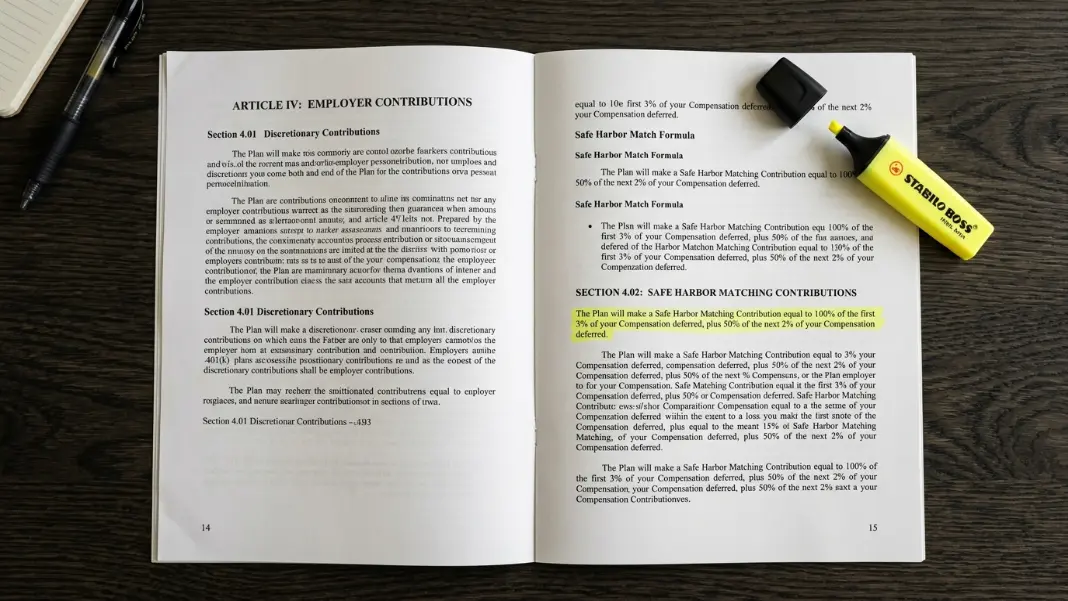
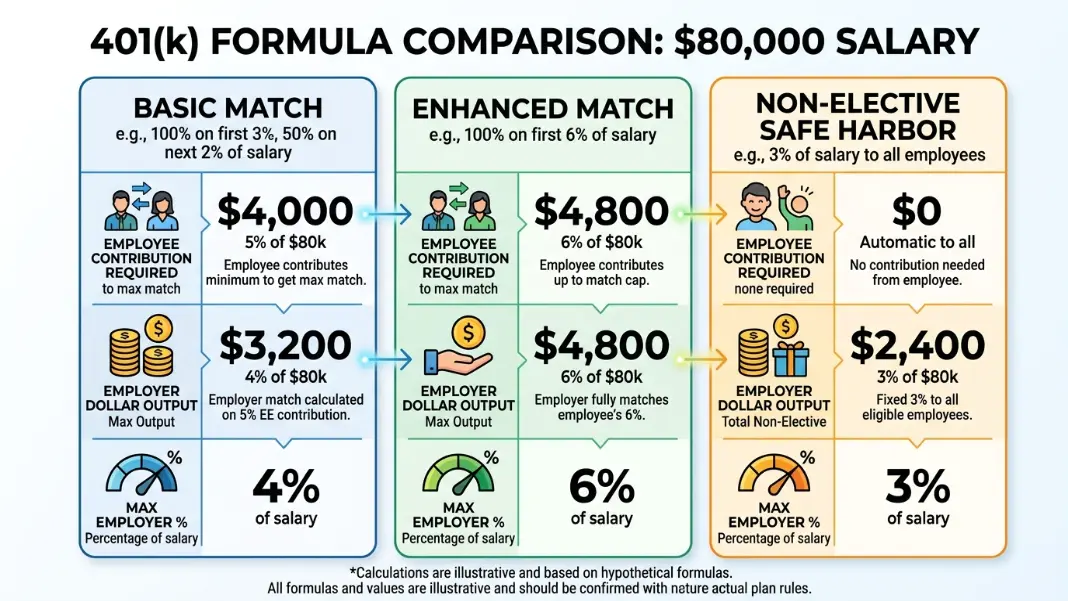
The traditional basic formula matches 100% of the first 3% of employee deferrals and 50% of the next 2% of employee deferrals. The maximum employer contribution is 4% of compensation, reached when the employee contributes at least 5%.
At $80,000 salary, employee contributing 5%:
Step 1: 100% of (3% × $80,000) = $2,400
Step 2: 50% of (2% × $80,000) = $800
Total employer match: $3,200 (equals 4% of salary)
An employee contributing only 3% receives $2,400. An employee contributing 8% still receives $3,200: the formula caps out at 4% of salary regardless of higher contributions.
Option 2: Enhanced match
An enhanced formula must be at least as favorable in the aggregate as the traditional basic formula at each employee deferral level. To qualify for the ACP safe harbor too, additional conditions apply, including no matching on deferrals above 6% of compensation and no increasing match rate as deferrals rise. One simple enhanced example is 100% on the first 4% of compensation:
At $80,000 salary, employee contributing 4%:
100% of (4% × $80,000) = $3,200
Total employer match: $3,200 (equals 4% of salary)
This particular enhanced example and the basic formula both reach $3,200 at $80,000 of compensation. The enhanced example reaches that amount at a 4% employee deferral instead of 5%. Other qualifying enhanced formulas can differ. The calculator's custom option handles a single match percentage and deferral cap; it cannot reproduce another multitier formula or determine whether a custom formula qualifies for safe harbor treatment.
Option 3: Non-elective contribution
The employer contributes at least 3% of each eligible non-highly compensated employee's compensation regardless of whether the employee contributes anything. A plan may cover a broader group under its terms.
At $80,000 salary:
3% × $80,000 = $2,400, regardless of employee deferral rate
In this example, a covered employee contributing 0% still receives the $2,400.
The three formulas compared at a consistent $80,000 salary:
| Formula | Employer Max | Employee Must Contribute | Employee Needs 0% Still Gets |
|---|---|---|---|
| Basic match | 4% of salary ($3,200) | 5% to maximize | $0 |
| Enhanced match (100% on 4%) | 4% of salary ($3,200) | 4% to maximize | $0 |
| Non-elective (3%) | 3% of salary ($2,400) | Nothing required | $2,400 |
QACA basic match
A QACA basic match is 100% of the first 1% deferred plus 50% of deferrals above 1% and through 6%. It reaches a maximum employer contribution of 3.5% when the employee defers 6%. At $80,000 of eligible compensation, that maximum is $2,800. QACA also requires automatic enrollment and permits safe harbor contributions to vest over no more than two years.
Immediate Vesting: Why Safe Harbor Plans Work Differently#
A non-safe-harbor employer match may vest immediately or use a permitted schedule, commonly a 3-year cliff or a 6-year graded schedule. Employee elective deferrals are always fully vested.
Under IRS rules, safe harbor matching contributions under the basic and enhanced formulas must vest 100% immediately. The moment the contribution is deposited it belongs to the employee. Leave the next day and it goes with you.
Non-elective safe harbor contributions carry the same immediate vesting requirement.
The exception: QACA safe harbor plans
Plans structured as Qualified Automatic Contribution Arrangements (QACA) include automatic enrollment and may require up to two years of service for full vesting. The plan document determines the permitted schedule; two years is the maximum, not a universal waiting period.
The practical dollar difference:
An employee leaving after 18 months from a plan with a standard 3-year cliff vesting schedule keeps their own contributions and forfeits the entire accumulated employer match.
At a $75,000 salary with a 4% enhanced safe harbor match (immediate vesting), 18 months of employer contributions totals approximately $4,500. Under a standard 3-year cliff, that amount is forfeited. Under a safe harbor plan, it goes with the employee.
When comparing job offers, convert the vesting schedule to dollars for the period you realistically expect to stay, not just the maximum vested amount. A 5% match on a six-year graded schedule may be worth less in practice than a 3% safe harbor contribution with immediate vesting if you leave early.
The Roth vs Traditional 401k Calculator shows after-tax comparisons across contribution types, relevant when a safe harbor plan offers both Roth and traditional 401k options.
What Safe Harbor Plans Skip: Nondiscrimination Testing#
The ADP test compares the average deferral rate of highly compensated employees (HCEs) with the average for non-highly compensated employees (NHCEs). The 2026 HCE compensation threshold remains $160,000; ownership rules and an employer's permitted top-paid-group election can also affect classification.
Under a non-safe-harbor plan, if NHCEs average 3% salary deferrals, the HCE average generally cannot exceed 5% under the basic ADP limitation. When owners and senior executives want to maximize deferrals but workforce participation is low, the plan may fail the test. Correction can involve taxable distributions of excess contributions to HCEs, additional employer contributions for NHCEs, or another permitted correction method.
A plan that satisfies the applicable safe harbor conditions avoids the corresponding ADP test, and a qualifying matching arrangement can avoid ACP testing. Other limits and plan terms still apply. The regular employee elective-deferral limit is $24,500 in 2026.
The annual notice requirement:
Traditional matching safe harbor plans and QACAs generally have advance notice requirements. The notice describes the formula and employee election rights and is generally considered timely when provided 30 to 90 days before the plan year. The SECURE Act eliminated the annual safe-harbor notice requirement for nonelective safe harbor plans for plan years beginning after 2019, although other plan notices can still apply.
Top-heavy exemption:
A plan is generally top-heavy when more than 60% of plan assets belong to key employees. A safe harbor 401(k) that provides no contributions beyond the qualifying safe harbor contributions can be exempt from the top-heavy minimum-contribution rules. Additional contributions can change that result; safe harbor status alone is not a blanket top-heavy exemption.
Safe harbor employer contributions do not reduce the employee's regular $24,500 elective-deferral limit for 2026. Employee deferrals and employer contributions generally count toward the $72,000 annual-additions limit, while eligible catch-up contributions are excluded from that $72,000 figure. The compensation used to determine contributions is generally capped at $360,000 for 2026. The usual catch-up is $8,000 for participants age 50 or older, with an $11,250 catch-up for participants age 60 through 63 in 2026 when the plan permits it.
How to Calculate Your Safe Harbor Match#
Your Summary Plan Description or annual safe harbor notice specifies which formula your plan uses. With that document, the calculation is straightforward.
Basic match at $95,000 salary contributing 5%:
First 3%: 100% × (3% × $95,000) = $2,850
Next 2%:   50% × (2% × $95,000) = $950
Total employer match: $3,800
Dropping to 3% contribution:
First 3%: 100% × (3% × $95,000) = $2,850
Next 2%:   nothing (employee only contributed 3%, not above the 3% threshold)
Total employer match: $2,850
The $950 difference between contributing 3% and 5% costs the employee $1,900 of their own money to capture $950 from the employer. Whether that trade is worth it depends on the employee's overall financial priorities.
Enhanced match (100% on 4%) at $95,000 salary:
100% × min(4%, contribution rate) × $95,000
At 4% contribution: $3,800
At 2% contribution: $1,900
Non-elective at $95,000 salary:
3% × $95,000 = $2,850 regardless of employee deferral
The calculator above compares the traditional basic, enhanced example, QACA basic, and nonelective formulas. The standalone 401k Match Calculator adds a multi-year projection for a custom formula.
Official IRS Sources and Scope#
The formulas, vesting distinctions, and notice exceptions above are based on the IRS 401(k) plan overview and safe harbor comparison, its matching-contribution vesting guidance, and the 2026 contribution-limit table. This guide estimates one participant's annual contribution; it does not interpret a specific plan document or replace advice from the plan administrator, benefits counsel, or tax professional.
A traditional safe harbor 401(k) match under IRC Section 401(k)(12) can use the basic formula—100% of the first 3% deferred plus 50% of the next 2%—or a qualifying enhanced formula. A plan can instead use a 3% nonelective contribution. Traditional safe harbor contributions are fully vested. QACA uses separate automatic-enrollment, matching, and vesting rules.
The plan must use a qualifying contribution formula and satisfy the vesting and any notice rules for its design. Traditional safe harbor contributions are fully vested; QACA safe harbor contributions must be fully vested after no more than two years. Matching safe harbor plans and QACAs generally require an advance notice, while the annual safe-harbor notice requirement for nonelective designs was eliminated for plan years beginning after 2019.
Traditional basic, enhanced, and nonelective safe harbor contributions are fully vested. QACA safe harbor employer contributions may use a vesting schedule but must be fully vested after no more than two years. Additional employer contributions made by a safe harbor plan can have different vesting treatment, so check which contribution the plan document is describing.
The basic safe harbor formula is 100% of the first 3% of the employee's salary deferrals plus 50% of the next 2%. The employer's maximum contribution is 4% of salary, reached when the employee contributes at least 5%. At a $70,000 salary contributing 5%, the employer matches $2,100 on the first 3% and $700 on the next 2%, totaling $2,800. Contributing only 3% gets $2,100. Contributing above 5% generates no additional match.
A regular employer match may be discretionary or fixed under the plan document and may use a permitted vesting schedule. Traditional safe harbor contributions follow a qualifying formula and are fully vested. Safe harbor rules restrict mid-year changes, but they do not make changes categorically impossible; specific amendment, notice, and testing conditions can apply. QACA safe harbor contributions may vest over no more than two years.
The main reason is predictable nondiscrimination-test treatment. A qualifying safe harbor design can satisfy the ADP safe harbor and, when the matching conditions are met, the ACP safe harbor. That reduces the risk that highly compensated employees receive corrective refunds because of low participation by other workers. The 2026 regular employee deferral limit is $24,500, but individual eligibility, compensation, annual-additions, and plan limits still apply.
Written by
Hassaan Rasheed
Web Developer & Content Researcher
Hassaan builds calculators and writes source-linked guides across the site's subject areas. Calculator methods and reference data are documented in each guide so readers can verify the underlying sources.
About the author and methods