VO2 Max Chart: What Is a Good Score by Age and Gender (2026)
VO2 max chart with ACSM categories by age: excellent for men 20-29 is 42.5+ mL/kg/min, for women 36+. How to measure, read your number, and improve.
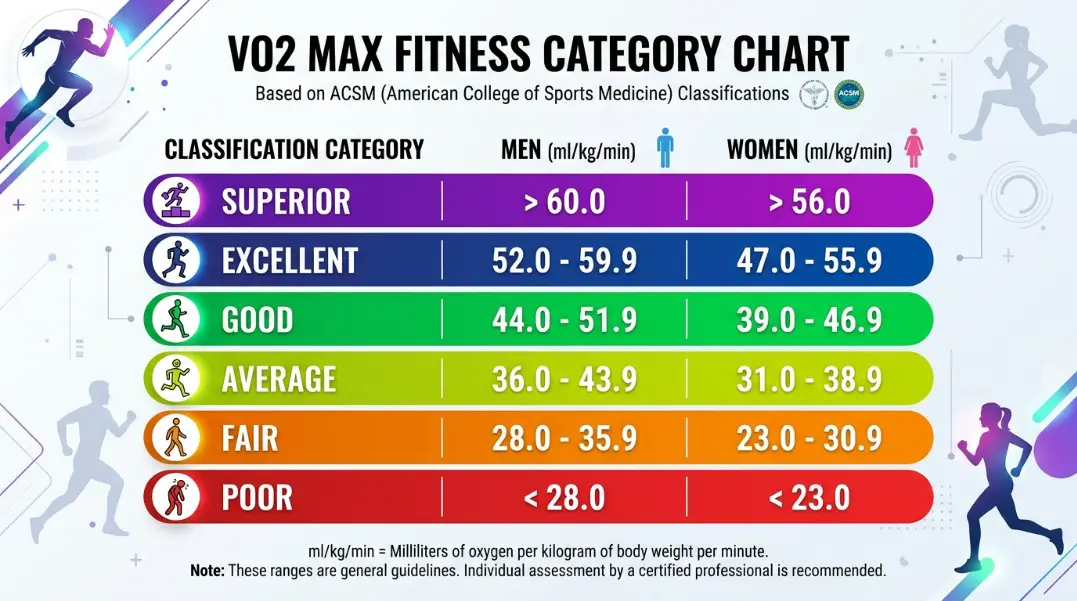
A 42-year-old man with a VO2 max of 28 mL/kg/min has the cardiorespiratory fitness of a typical 65-year-old. The same man at 40 mL/kg/min sits in the excellent range for his age group. Same person, 12 points apart, two completely different risk profiles for cardiovascular disease, type 2 diabetes, and all-cause mortality.
VO2 max -- maximal oxygen uptake -- measures how much oxygen your body can consume and use during intense exercise, expressed in milliliters per kilogram of body weight per minute (mL/kg/min). The VO2 Max Calculator estimates your score from a 12-minute Cooper Test run. This guide covers what your number means against ACSM reference tables by age and gender, how to estimate it without a lab, and what training actually raises it.
How VO2 Max Is Calculated#
VO2 max (Cooper Test) = (Distance in meters – 504.9) ÷ 44.73
Run as far as you can in 12 minutes on a flat track at the hardest pace you can sustain. Record the distance in meters and plug it into the formula.
Worked example:
Distance: 2,400 meters
VO2 max = (2400 – 504.9) ÷ 44.73 = 42.4 mL/kg/min
For a 28-year-old man, 42.4 lands at the top of the good range. For a 48-year-old man, it sits in the excellent range. The same number reads differently depending on your age group -- which is why the ACSM chart below is the reference tool, not any single threshold.
Direct laboratory measurement uses a metabolic cart: you exercise to exhaustion on a treadmill or bike while breathing into a mask that analyzes expired air in real time. Lab testing is highly accurate but costs $100-300 at a sports medicine clinic and requires specialized equipment. Field estimates fall within 10-15% of lab values for most people -- accurate enough for fitness classification and progress tracking.
VO2 Max Chart for Men by Age (ACSM)#
The American College of Sports Medicine fitness classification tables are the standard reference in clinical exercise testing and health screening. These categories come from large population samples across age groups.
| Age Group | Poor | Fair | Good | Excellent | Superior |
|---|---|---|---|---|---|
| 20-29 | Below 31.5 | 31.5-35.4 | 35.5-42.4 | 42.5-46.4 | 46.5 or above |
| 30-39 | Below 28.5 | 28.5-33.4 | 33.5-41.0 | 41.1-44.9 | 45.0 or above |
| 40-49 | Below 25.5 | 25.5-30.1 | 30.2-38.0 | 38.1-42.4 | 42.5 or above |
| 50-59 | Below 22.5 | 22.5-26.0 | 26.1-32.2 | 32.3-36.4 | 36.5 or above |
| 60-69 | Below 20.0 | 20.0-24.9 | 25.0-31.0 | 31.1-35.7 | 35.8 or above |
All values in mL/kg/min.
The good range for a 45-year-old man (30.2-38.0) overlaps significantly with the poor range for a 25-year-old (below 31.5). A 35-year-old who scores 32 should not compare himself to a 25-year-old reference. The chart tells you where you stand against people your own age -- that is the only comparison that matters.
VO2 Max Chart for Women by Age (ACSM)#
| Age Group | Poor | Fair | Good | Excellent | Superior |
|---|---|---|---|---|---|
| 20-29 | Below 23.6 | 23.6-28.9 | 29.0-35.9 | 36.0-41.0 | 41.1 or above |
| 30-39 | Below 22.8 | 22.8-26.9 | 27.0-33.7 | 33.8-38.9 | 39.0 or above |
| 40-49 | Below 21.0 | 21.0-24.4 | 24.5-31.3 | 31.4-36.9 | 37.0 or above |
| 50-59 | Below 20.2 | 20.2-22.7 | 22.8-28.1 | 28.2-32.2 | 32.3 or above |
| 60-69 | Below 17.5 | 17.5-20.1 | 20.2-24.4 | 24.5-30.2 | 30.3 or above |
All values in mL/kg/min.
Women's values run approximately 15-20% lower than men's for the same fitness classification. This is not a performance gap. It reflects structural biology: women carry proportionally lower hemoglobin concentrations, smaller heart chambers, and a higher essential body fat percentage. When VO2 max is adjusted for lean body mass rather than total weight, the male-female gap narrows substantially. A woman at 36 mL/kg/min at age 32 is performing better relative to her population than a man at 36 at the same age.
What Elite Numbers Look Like#
The ACSM "superior" category describes highly fit adults within a general population sample. Professional endurance athletes operate in a separate tier entirely.
| Population | VO2 Max (mL/kg/min) |
|---|---|
| Sedentary adult | 25-35 |
| Recreational runner | 40-50 |
| Competitive amateur | 50-60 |
| Professional endurance athlete | 65-80 |
| Eliud Kipchoge (estimated) | ~92 |
| Oskar Svendsen (highest recorded) | 97.5 |
| Elite female endurance athlete | 60-75 |
Oskar Svendsen's 97.5, measured in 2012, is the highest reliably documented VO2 max in history. Cross-country skiers consistently record the highest sport averages because the event engages both upper and lower body muscles simultaneously. More muscle mass working at once means a higher ceiling for oxygen consumption.
Most people reading this sit between sedentary adult and recreational runner. That range also happens to be where training produces the largest relative improvements -- the lower your starting point, the more room there is to gain.
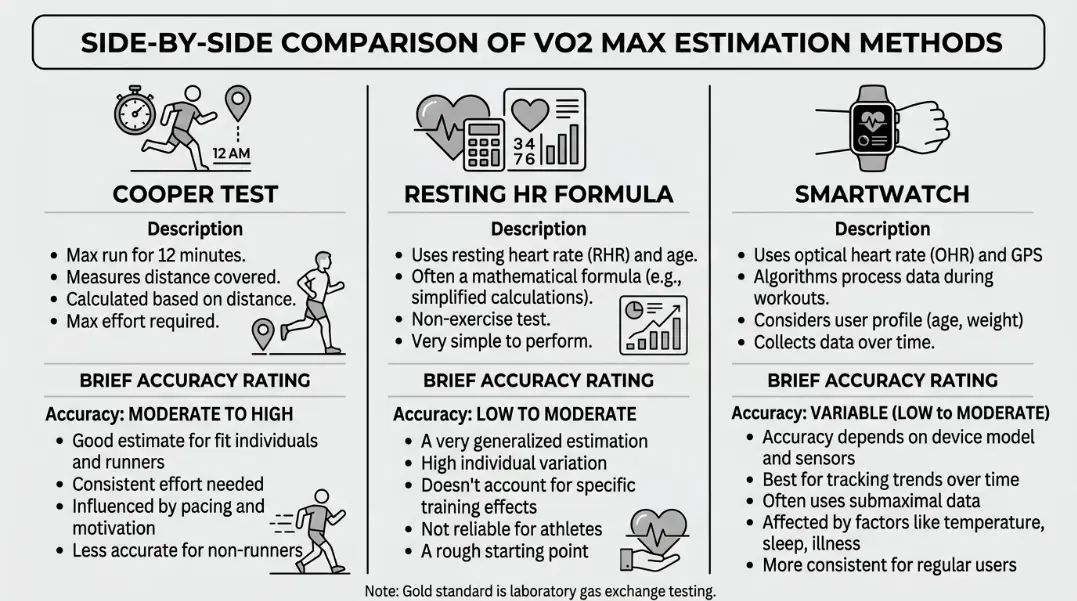
How to Estimate Your VO2 Max Without a Lab#
Three methods produce reliable estimates outside of a clinical setting.
Cooper Test (most accurate field estimate): Run on a flat, measured track for exactly 12 minutes at the hardest pace you can hold for the full duration. Record total distance in meters. Apply the formula at the top of this page or use the VO2 Max Calculator to convert your distance directly.
A person covering 2,200 meters scores approximately 37.9 mL/kg/min. For a 38-year-old woman that lands in excellent. For a 25-year-old man it lands in good. Same distance, different categories because the charts are age-matched.
Resting heart rate method:
VO2 max = 15 × (Max HR ÷ Resting HR)
Max HR is typically estimated as 220 minus age. A 40-year-old with a resting HR of 58:
Max HR = 220 – 40 = 180
VO2 max = 15 × (180 ÷ 58) = 46.6 mL/kg/min
This method assumes a standardized max HR formula, which can be off by 10-20 beats in either direction. Use it for directional information only, not for precise ACSM classification.
Smartwatch estimates: Garmin, Polar, and Apple Watch estimate VO2 max from GPS pace and heart rate data collected during outdoor runs. Research comparing wrist-based estimates to lab values shows mean error of 5-10%, comparable to the Cooper Test. Accuracy improves after several weeks of consistent data collection as the device learns your heart rate response patterns.
VO2 Max and Longevity: What the Research Shows#
Cardiorespiratory fitness measured by VO2 max is among the strongest predictors of cardiovascular and all-cause mortality in the general population. The research on this point is unusually consistent across populations and study designs.
A 2018 JAMA Network Open study following 122,007 patients found that extremely low cardiorespiratory fitness carried a mortality hazard ratio of 5.04 compared to high fitness. That effect size exceeded hypertension, smoking, and diabetes as standalone predictors. The relationship was not linear: moving from low to moderate fitness produced a larger mortality reduction than moving from moderate to high.
A 2022 meta-analysis in the British Journal of Sports Medicine covering 20.9 million person-years found that a 3.5 mL/kg/min increase in VO2 max, roughly one fitness category on the ACSM chart, was associated with a 13% reduction in all-cause mortality risk.
Higher VO2 max correlates with lower visceral fat accumulation, better insulin sensitivity, lower resting blood pressure, and reduced systemic inflammation. These are the same pathways that abdominal obesity disrupts. For context on how fat distribution and visceral fat interact with cardiovascular risk, the Waist to Hip Ratio Chart covers the WHO abdominal obesity thresholds and why central fat carries disproportionate metabolic risk compared to subcutaneous fat.
A 35-year-old moving from fair to good on the ACSM chart is not just improving their running pace. They are statistically reducing their likelihood of a cardiovascular event over the next two decades by a measurable amount.
How to Improve Your VO2 Max#
VO2 max responds to training faster than most people expect, especially from a low starting point.
High-intensity interval training is the most efficient method. Multiple randomized controlled trials show that 8-12 weeks of HIIT at 85-95% of maximum heart rate produces VO2 max gains of 5-15% in previously sedentary adults. A person starting at 35 mL/kg/min can realistically reach 38-40 within 10-12 weeks with consistent effort.
A simple protocol that the research supports:
- 4 intervals of 4 minutes each at 90-95% of max HR
- 3 minutes of active recovery (easy walking or slow jog) between intervals
- 3 sessions per week
- Progress by adding 30 seconds per interval every 2 weeks
Zone 2 training builds the aerobic base. Moderate-intensity steady-state cardio at 60-70% max HR -- a pace where you can hold a conversation -- does not raise VO2 max as fast as HIIT. But it builds mitochondrial density and fat oxidation capacity that allows you to sustain high-intensity efforts longer. Most elite endurance athletes do 70-80% of their volume in Zone 2 and 20-30% at high intensity. The combination outperforms HIIT alone over a full training block.
Consistency outweighs any single session. VO2 max begins declining noticeably after 10-14 days of inactivity. A person who trains hard for 4 weeks then takes 3 weeks off will end up close to where they started. Frequency across weeks and months matters more than what happens in any one workout.
The natural decline: VO2 max drops approximately 1% per year after age 25 in sedentary adults and around 0.5% per year in consistently trained adults. A 55-year-old who has trained since their 30s can hold a higher VO2 max than an untrained 38-year-old. The decline is real, but it is not inevitable. Training delays it substantially; inactivity accelerates it.
Maintaining lean muscle mass also slows the decline. Resistance training preserves the muscle tissue responsible for oxygen consumption. For a full picture of how lean mass and body composition interact with fitness, the FFMI Calculator guide covers how to track fat-free mass index alongside cardiovascular fitness markers.
A good VO2 max falls in the ACSM "good" or "excellent" category for your specific age group. For men aged 30-39, good is 33.5-41.0 mL/kg/min and excellent is 41.1-44.9. For women aged 30-39, good is 27.0-33.7 and excellent is 33.8-38.9. The thresholds shift downward each decade as fitness naturally declines with age, so always compare your number to the age-matched table rather than to an overall population average that ignores age.
For women aged 20-29, excellent is 36.0-41.0 mL/kg/min and superior is 41.1 or above. For women aged 40-49, excellent starts at 31.4. Women's values run 15-20% lower than men's for equivalent fitness classifications due to biological differences in hemoglobin, heart size, and essential body fat. A woman with a VO2 max of 36 at age 35 is outperforming a larger share of her population than a man with the same number at the same age.
The Cooper Test is the most reliable field method. Run on a flat, measured surface for exactly 12 minutes at the hardest pace you can sustain, then measure the total distance in meters. Apply the formula: VO2 max equals distance in meters minus 504.9, divided by 44.73. A 2,200-meter result gives approximately 37.9 mL/kg/min. Smartwatches from Garmin, Polar, and Apple estimate VO2 max from GPS and heart rate data and typically fall within 5-10% of lab values after several weeks of regular use.
Yes. High-intensity interval training at 85-95% of maximum heart rate for 8-12 weeks produces VO2 max gains of 5-15% in previously sedentary adults. A person starting at 35 mL/kg/min can reach 38-40 within 10-12 weeks with 3 HIIT sessions per week. Zone 2 steady-state cardio builds the aerobic base that sustains those improvements. Combining both training types over a full block outperforms either method used alone.
VO2 max declines approximately 1% per year after age 25 in sedentary adults and around 0.5% per year in consistently trained adults. A sedentary person who scored 45 mL/kg/min at age 25 can expect roughly 32 by their mid-50s without training. A trained adult at 55 can retain a score that exceeds untrained adults in their late 30s. The decline is partly biological and partly a function of reduced activity levels that tend to increase with age. Training delays it substantially.
Research consistently shows it does, and more reliably than most standard health markers. A 2018 JAMA Network Open study of 122,007 patients found extremely low cardiorespiratory fitness carried a mortality risk 5 times higher than high fitness, a larger effect than hypertension, smoking, or diabetes as standalone predictors. A 2022 meta-analysis of 20.9 million person-years found that each 3.5 mL/kg/min improvement in VO2 max -- roughly one ACSM fitness category -- is associated with a 13% reduction in all-cause mortality risk.
Written by
Hassaan Rasheed
Web Developer & Content Researcher
Hassaan builds calculators and writes source-linked guides across the site's subject areas. Calculator methods and reference data are documented in each guide so readers can verify the underlying sources.
About the author and methods