One Rep Max Formulas: Epley, Brzycki, Lander, and Lombardi (2026)
Epley, Brzycki, Lander, and Lombardi 1RM formulas compared by rep range. Which is most accurate, when they diverge, and how to get the best estimate.

Run 185 pounds for 5 reps through the Epley formula and you get a 216-pound max. Run the same set through Brzycki and the number comes back as 208. Neither is wrong. They are solving the same problem from different mathematical assumptions, and the gap between them widens significantly as your rep count climbs past 10.
The Bench Press Max Calculator runs all 4 formulas simultaneously and returns an averaged result, which is more reliable than any single formula for most training sets. This guide covers what each formula calculates, where they agree and where they split, which rep ranges produce the most trustworthy estimates, and how to read your output against a meaningful strength benchmark.
The Four 1RM Formulas#
Each formula takes 2 inputs: the weight lifted and the reps completed. The output is an estimated 1-rep max in the same unit as the input.
Epley (1985):
1RM = Weight × (1 + Reps ÷ 30)
The most widely cited formula in strength training literature. It applies a linear scaling factor: each additional rep adds 1/30th of the base weight to the estimate. At 5 reps, the multiplier is 1.167. At 10 reps, 1.333.
Brzycki (1993):
1RM = Weight × (36 ÷ (37 − Reps))
Built from a regression model using powerlifting data. The denominator (37 minus reps) creates a curve that tightens as reps increase. Brzycki tracks close to Epley at low rep counts and diverges above 10 reps, producing higher estimates than Epley in that range.
Lander (1985):
1RM = (100 × Weight) ÷ (101.3 − 2.671 × Reps)
Derived from empirical testing on trained lifters. The 2.671 coefficient is a regression-fitted constant, not a round number. It reflects how the formula was built: from actual measurement data rather than a clean mathematical model. Lander tends to sit between Epley and Brzycki across most rep ranges.
Lombardi (1989):
1RM = Weight × Reps^0.10
The most compact of the four. The exponent 0.10 means each rep multiplies the base weight by its 10th root. Lombardi tracks well in the 3-to-8-rep range but underestimates significantly at 12 or more reps compared to the others.
Worked example, 185 lbs for 5 reps:
Epley:    185 × (1 + 5 ÷ 30)              = 185 × 1.167 = 216 lbs
Brzycki:  185 × (36 ÷ (37 − 5))           = 185 × 1.125 = 208 lbs
Lander:   (100 × 185) ÷ (101.3 − 13.356)  = 18,500 ÷ 87.9 = 210 lbs
Lombardi: 185 × 5^0.10                    = 185 × 1.175 = 217 lbs
Average:                                                  = 213 lbs
At 5 reps the formulas stay close. The full spread here is 9 lbs (208 to 217). At 12 reps, that same spread grows to nearly 30 lbs.
How the Formulas Diverge by Rep Range#
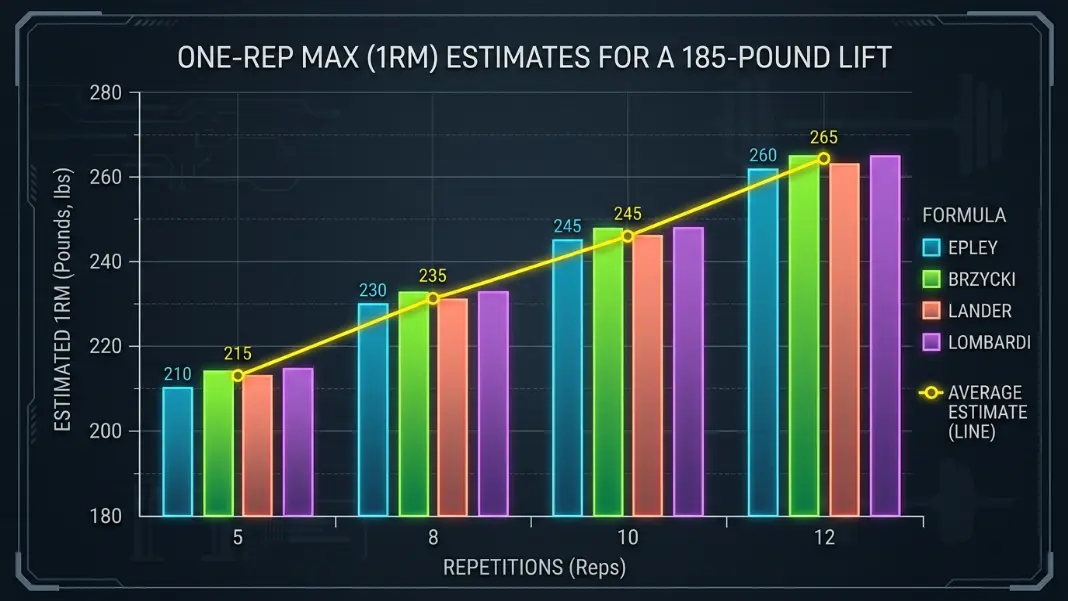
The formulas agree closely at low rep counts and split notably above 10 reps. The table below shows estimated 1RM for a 185-pound set at five different rep counts.
| Reps | Epley | Brzycki | Lander | Lombardi | Average |
|---|---|---|---|---|---|
| 3 | 204 lbs | 196 lbs | 198 lbs | 207 lbs | 201 lbs |
| 5 | 216 lbs | 208 lbs | 210 lbs | 217 lbs | 213 lbs |
| 8 | 234 lbs | 230 lbs | 231 lbs | 228 lbs | 231 lbs |
| 10 | 247 lbs | 247 lbs | 248 lbs | 233 lbs | 244 lbs |
| 12 | 259 lbs | 266 lbs | 267 lbs | 237 lbs | 257 lbs |
Two things stand out. First, Epley and Brzycki converge to the same number at exactly 10 reps (both produce 247 lbs). This is a fixed property of how the two formulas are built: their mathematical curves cross at that point. Second, Lombardi falls away sharply above 10 reps. At 12 reps it outputs 237 lbs while Brzycki and Lander return 266-267. A 30-pound gap from the same set.
For practical programming, this divergence matters most when you estimate from high-rep work. Pulling a number from a 15-rep set and trusting a single formula can put your training percentages off by 15-20%, which is enough to meaningfully distort your load selection across a peaking cycle.
Which Formula Is Most Accurate#
No formula is universally most accurate. The answer depends on your rep range and how closely the training population in the original study resembles you.
For 1 to 5 reps: Brzycki and Lander consistently show the tightest agreement with tested 1RMs in powerlifting research. Epley reads slightly high in this range. The differences are small (2-5%) and all 3 formulas are usable for practical programming.
For 6 to 10 reps: All 4 formulas produce reasonable estimates with errors under 5-8% for most trained lifters. This is the range where the averaged output from the Bench Press Max Calculator is most consistent.
Above 10 reps: Accuracy drops for every formula. Lombardi underestimates significantly. Brzycki and Lander overestimate in different ways. The compounding effects of fatigue and rep-to-rep variability mean the actual 1RM is harder to predict from any single model.
Why averaging helps: Each formula captures a different aspect of the weight-reps relationship. Epley and Lombardi tend to read slightly higher at low rep counts. Brzycki tends to read slightly lower. Lander sits in the middle. Averaging the 4 reduces the impact of whichever formula is having its worst day for your specific rep range, producing a middle estimate that is less likely to be a significant outlier.
The Rep Range That Gives the Most Reliable Estimate#
3 to 5 reps is the sweet spot. At this range, you are close enough to maximal effort that the formulas have minimal corrective work to do. The lift requires genuine intensity without the cardiovascular fatigue that builds during longer sets. Estimates from 3-to-5-rep near-failure sets are consistently within 3-6% of actual tested maximums for most trained lifters.
8 to 10 reps is acceptable. Accuracy starts to drop slightly, but estimates in this range are still useful for programming percentages. Many lifters prefer this range for regular max estimation because the risk of injury is lower than handling very heavy loads for 3 reps.
12 reps or more should not be used for serious estimates. Fatigue becomes the dominant variable in a 12-rep set. Whether you complete 12 reps or 15 depends as much on conditioning and rest time as raw strength. The formulas assume a clean relationship between reps and maximal force output, which breaks down significantly at high rep counts.
The set must also be taken to near-failure. A 5-rep set where you had 4 more reps in reserve will underestimate your max considerably. The formula calculates from a set performed at genuine limit, not a comfortable training weight.
How consistently these formulas track your true strength also depends partly on your body composition. Lifters with more lean muscle relative to their bodyweight tend to produce more linear rep-to-strength relationships, which means the formulas work better for them. If you want a baseline for where your lean mass sits, the FFMI Body Composition Guide covers how to interpret the relationship between lean mass, bodyweight, and training status.
Strength Standards: What Your 1RM Means#
A raw number (225 lbs, 300 lbs) means little without context. The more useful metric is your 1RM as a multiple of your bodyweight, which adjusts for the fact that absolute strength scales with body size.
The following tiers are for the bench press specifically, based on strength-to-bodyweight ratios across trained populations.
Men:
| Level | 1RM to Bodyweight Ratio |
|---|---|
| Beginner | Below 0.75x |
| Novice | 0.75x to 1.0x |
| Intermediate | 1.0x to 1.5x |
| Advanced | 1.5x to 2.0x |
| Elite | Above 2.0x |
Women:
| Level | 1RM to Bodyweight Ratio |
|---|---|
| Beginner | Below 0.5x |
| Novice | 0.5x to 0.75x |
| Intermediate | 0.75x to 1.0x |
| Advanced | 1.0x to 1.5x |
| Elite | Above 1.5x |
These ratios reflect general strength training populations, not competitive powerlifters. An elite powerlifter in a lower weight class often benches 2.5x bodyweight or more. For recreational and intermediate lifters, reaching 1.5x bodyweight for men or 1.25x for women is a meaningful long-term target.
Body composition affects where you sit in these tiers independently of your training. Two people at the same bodyweight can sit at different strength levels because their lean-to-fat ratio differs. The FFMI Calculator measures lean mass relative to height, which pairs with a 1RM assessment to give a more complete picture of your actual training status.
How to Use Your Estimated Max in Training#
A 1RM estimate is most useful as a percentage anchor for programming. Strength work typically falls at 85-95% of 1RM. Hypertrophy work runs 65-80%. If your estimated max is 250 lbs, your 85% training weight is 212 lbs and your 70% is 175 lbs.
Running your own estimation set:
Choose a weight you can complete for 3 to 5 reps taken to near-failure. Rest 3 to 5 minutes between warm-up sets. Record the exact weight and reps. Run those inputs through the calculator. The output is your training max: a reference number for programming, not a weight to attempt cold without a spotter.
If you test across multiple rep ranges on different days, estimates from 3-to-5-rep sets should consistently run closer to your actual ceiling than 8-to-10-rep estimates. When both ranges agree within 10 lbs, the estimate is reliable. When they diverge by more than 15 lbs, the higher-rep set is likely inflating the number through fatigue underestimation.
For ongoing tracking, retest every 6 to 8 weeks using the same weight and rep range each time. A 5-rep near-failure set with the same load over time is a clean signal. Switching rep ranges or adding arbitrary weight between tests makes the trend line noisy and harder to interpret.
Understanding where your body composition sits also affects how you read strength progress over time. A shift in lean mass that shows up on a body fat scan often precedes a strength increase that hasn't appeared in your rep counts yet. The InBody scan vs DEXA comparison covers how to read measurement changes in that context.
Run your test set numbers through the Bench Press Max Calculator to get the averaged result across all 4 formulas at once.
No single formula is most accurate across all rep ranges. Brzycki and Lander show the tightest agreement with tested 1RMs for sets of 1 to 5 reps. Epley performs reliably from 3 to 10 reps. Lombardi underestimates significantly above 10 reps. Averaging all 4 formulas, as the Bench Press Max Calculator does, reduces the impact of any individual formula's error and produces a more reliable middle estimate for most training populations.
Sets of 3 to 5 reps produce the most accurate 1RM estimates because they reflect near-maximal effort with minimal fatigue distortion. Sets of 8 to 10 reps are acceptable for general programming. Avoid estimating from sets of 12 or more reps, where accumulated fatigue makes every formula significantly less reliable. The set must be taken to near-failure. A comfortable working set will produce a substantial underestimate regardless of which formula you use.
Epley uses a linear model where each rep adds a fixed fraction of the base weight to the estimate. Brzycki uses a regression curve from powerlifting data with a different mathematical shape. They diverge below 10 reps and above 10 reps but converge exactly at 10 reps, where both formulas produce an identical output. The difference is small at low rep counts (within 3-5%) and grows meaningfully above 12 reps, where Brzycki tends to overestimate more than Epley.
Treat the estimate as a training reference, not a weight to load cold. Your actual 1RM on any given day depends on technique quality, warm-up progressions, accumulated fatigue, and equipment. If you want to test a true single, build up with incremental warm-up sets, have a spotter in position, and do not attempt a 1RM without experience handling near-maximal loads. For most training purposes, working from a calculated max is safer and sufficient.
For men, pressing your bodyweight is a solid intermediate benchmark. Reaching 1.5x bodyweight is advanced. For women, 0.75x bodyweight is intermediate and 1.25x is strong. These ratios vary by training age. A beginner should expect years of consistent work to reach intermediate levels. Competitive powerlifters in lower weight classes often exceed 2x bodyweight, but those numbers are not relevant reference points for general strength training.
Lombardi uses an exponential function (reps^0.10) that grows more slowly than the linear or regression-based models in the other three formulas. At low rep counts this tracks reasonably well. Above 10 reps, the rate of growth falls behind the actual fatigue penalty, producing estimates that run consistently lower than tested 1RMs. This behavior makes Lombardi partially useful in the average: its tendency to underestimate offsets Brzycki's tendency to overestimate in the same rep range.
Written by
Hassaan Rasheed
Web Developer & Content Researcher
Hassaan builds calculators and writes source-linked guides across the site's subject areas. Calculator methods and reference data are documented in each guide so readers can verify the underlying sources.
About the author and methods