Cattle Gestation Table: Breed Due Dates and Calving Guide (2026)
Cattle gestation table by breed: Angus averages 281 days, Hereford 287, Brahman 292. Includes a breeding date to calving date chart and calving signs.
A Brahman cow bred on September 1 won't calve until early June the following year. A Holstein bred the same day will calve about 12 days earlier. That difference between breeds does not sound like much until it determines whether your calf hits the ground in a late-season blizzard or after the thaw, and whether your calving crew is available or not.
The Cattle Gestation Calculator calculates expected calving dates for 15 breeds from any breeding date, and includes the recommended calving pen move date. This guide covers the breed-by-breed gestation table, a breeding month to calving month chart, how fetal sex and body condition affect timing, and the physical signs that tell you calving is imminent.
The Standard Cattle Gestation Period#
The average gestation period for cattle is 283 days, roughly 9 months and 10 days. The range across all breeds runs from approximately 279 days at the short end to 295 days in heavily Zebu-influenced breeds like Brahman.
Expected Calving Date = Breeding Date + Breed Gestation Days
The formula is straightforward. The variable is the breed-specific number you plug in. Using 283 as a universal average introduces enough error to matter for pen scheduling and calving crew coordination. The breed-specific figures in the table below are more accurate starting points.
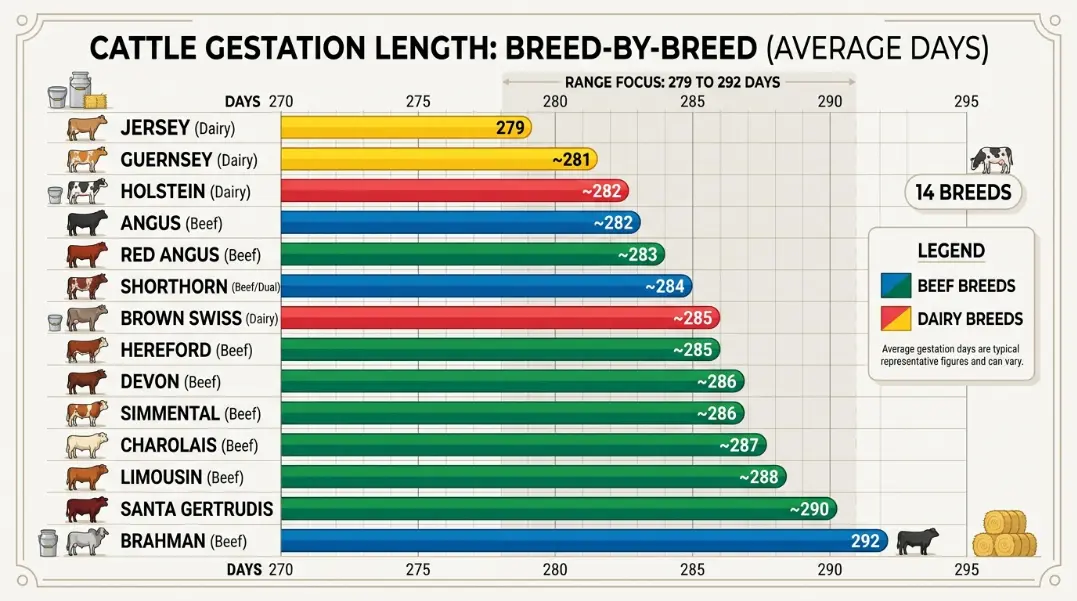
Cattle Gestation Table by Breed#
The values below reflect published breed association data and university extension research. The "Range" column shows the normal variation within each breed, accounting for differences in sire, cow condition, and fetal sex.
| Breed | Avg. Days | Normal Range | Type |
|---|---|---|---|
| Jersey | 279 | 276-282 | Dairy |
| Holstein | 280 | 278-283 | Dairy |
| Angus | 281 | 279-284 | Beef |
| Red Angus | 282 | 279-285 | Beef |
| Shorthorn | 283 | 280-287 | Beef/Dual |
| Brangus | 285 | 282-289 | Beef |
| Hereford | 287 | 284-290 | Beef |
| Simmental | 288 | 285-292 | Beef |
| Gelbvieh | 288 | 285-291 | Beef |
| Charolais | 289 | 285-293 | Beef |
| Limousin | 290 | 287-293 | Beef |
| Beefmaster | 290 | 286-294 | Beef |
| Chianina | 291 | 287-294 | Beef |
| Brahman | 292 | 288-296 | Beef |
The clearest pattern in the table: European continental breeds (Charolais, Limousin, Simmental) gestate longer than British breeds (Angus, Hereford). Zebu-influenced breeds like Brahman and Beefmaster gestate longest of all. Dairy breeds run shortest.
When crossing breeds -- for instance, breeding a British cow to a continental bull -- the expected gestation typically falls between the two breed averages, weighted slightly toward the sire's breed influence on fetal size.
Breeding Date to Calving Date Chart#
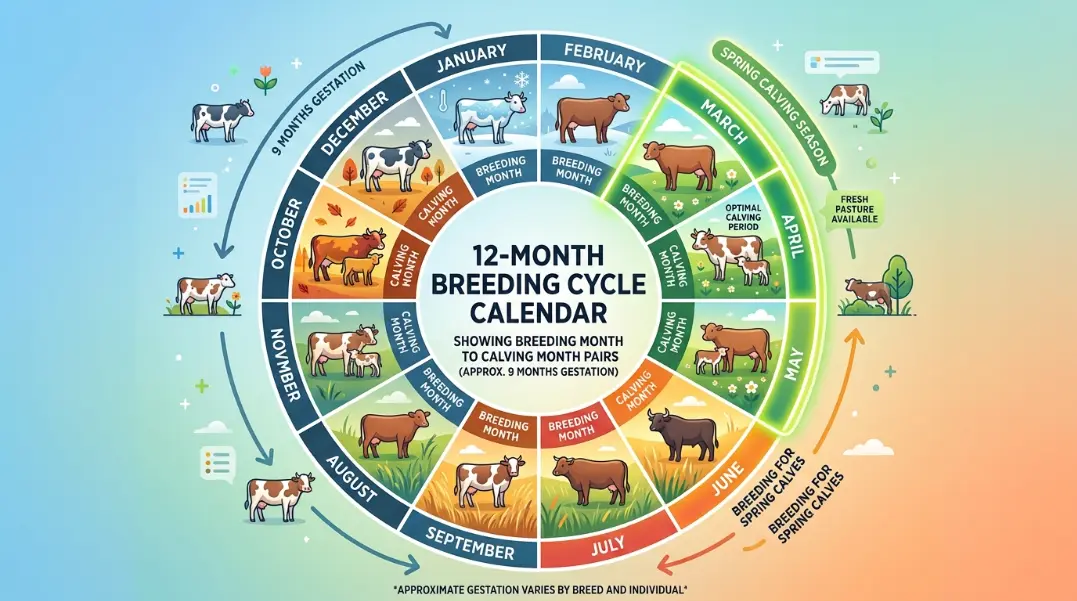
The table below shows approximate calving months using a 283-day average. For breed-specific or exact-date calculations, use the Cattle Gestation Calculator, which adjusts automatically for your breeding date and selected breed.
| Breeding Month | Calving Month (283 days) | Notes |
|---|---|---|
| January | October | Fall calving season |
| February | November | Late fall |
| March | December | Early winter |
| April | January | Peak spring calving prep |
| May | February | Spring calving season |
| June | March | Spring calving peak |
| July | April | Late spring |
| August | May | Grass calving |
| September | June | Summer calving |
| October | July | Mid-summer |
| November | August | Late summer |
| December | September | Early fall |
Spring calving (February through April) remains the most common calving season in the US because it aligns calf nutritional needs with spring grass growth, reduces the cost of supplemental feeding, and typically produces higher weaning weights by fall sale time. Fall calving programs (September through November) work well for operations with reliable forage into late fall and lower labor during the spring planting season.
Bull Calf vs Heifer Calf: How Fetal Sex Affects Gestation#
Fetal sex has a measurable effect on gestation length. Bull calves consistently gestate 1-3 days longer than heifer calves within the same breed. The effect is small but real: in a large Angus herd, cows carrying bull calves average 282-283 days while those carrying heifer calves average 280-281 days.
The practical implication is modest. Most producers do not adjust calving pen scheduling based on fetal sex, especially since sex determination by ultrasound is typically done at 60-70 days of gestation and the timing difference is within normal variation anyway.
Twin pregnancies are a more significant factor. Cows carrying twins typically deliver 3-7 days earlier than the breed average. If pregnancy checking confirms twins, move the calving pen date forward accordingly and prepare for higher labor demands: twin deliveries have a greater incidence of malpresentation, and twin calves are lighter at birth and more susceptible to scours and respiratory issues in the first week.
Factors that can extend gestation beyond the breed average:
- Sire influence: Some bulls consistently sire longer-gestation calves. If you have multi-year calving records from the same sire, his calves' actual gestation is a better predictor than the breed average.
- Cow body condition: Cows in poor body condition (BCS 3 or below at breeding) show more variable gestation lengths and higher rates of dystocia.
- Extremely hot weather at breeding: Heat stress at conception has been associated with slightly shorter gestations in some research, though the effect is inconsistent across studies.
Signs a Cow Is Close to Calving#
Physical changes follow a predictable sequence in the final weeks before calving. Knowing where a cow is in that sequence tells you how closely she needs to be monitored.
2 to 4 weeks before calving: The udder begins to fill and become firm. In first-calf heifers this is often the first visible sign. Teats start to extend. The vulva shows early swelling.
24 to 48 hours before calving:
- The pelvic ligaments relax, creating a visible depression on both sides of the tailhead. Run your hand along the sacral ligament just ahead of the tailhead -- a soft, sunken feel indicates active relaxation.
- Mucus discharge becomes visible at the vulva, often yellowish or clear.
- The cow may become restless and repeatedly stand and lie down.
6 to 12 hours before calving:
- The cow separates from the herd and seeks a corner or quiet area.
- Frequent tail lifting and straining begin.
- The water sac may be visible at the vulva in the final 1-2 hours.
First-stage labor (restlessness without visible pushing) typically lasts 2-6 hours in cows and up to 8 hours in first-calf heifers. Second-stage labor (active pushing with visible calf presentation) should be complete within 1-2 hours after the water sac appears. If active straining has continued for more than 30 minutes without visible progress, manual or veterinary intervention is needed.
The placenta should pass within 8-12 hours of delivery. Retained placenta beyond 24 hours requires veterinary attention.
When to Move a Cow to the Calving Pen#
Most producers move cows to a calving pen 7-14 days before the expected due date. The tighter the calving window you are managing, the more precisely you need to time this.
For operations with a 60-day breeding season: The spread of expected calving dates is wide enough that daily checking of the pre-calving group and moving cows based on physical signs is more practical than moving every cow two weeks out.
For operations using AI and a tight breeding season: Moving cows 10 days before the calculated due date works well. The physical signs (pelvic ligament relaxation, udder development) then give you a 24-48 hour window to decide if a cow needs individual attention.
Heifer pen management: First-calf heifers should be penned 2-4 weeks before their due date and checked at least every 2 hours during peak labor hours (9 PM to 9 AM -- research shows the majority of cattle deliveries occur at night). Dystocia rates in heifers run 20-30% in most herds, compared to under 5% in mature cows. First-calving heifers bred to calving-ease sires still require more supervision than cows.
After calving, the first 2 hours determine the calf's colostrum status. A calf that does not nurse within 2 hours needs to be assisted. Colostrum quality is highest in the first milking and degrades rapidly over 12-24 hours. For operations that supplement colostrum or tube calves, scaling quantities by calf body weight follows the same proportional approach used in any feeding rate calculation; the Recipe Conversion Calculator handles those scaling adjustments if you are working from a batch formulation.
Body Condition Score and Calving Success#
Body condition score (BCS) at calving is one of the most predictive factors for subsequent reproductive performance. The target for cows at calving is BCS 5-6 on a 9-point scale. Heifers should be at BCS 6 or above.
Cows calving at BCS 4 or below take significantly longer to return to estrus (often 40-80 days vs. 25-30 days for cows at BCS 5+), directly compressing the rebreeding window. In a spring calving program with breeding starting in late May, a cow that calved in February needs to cycle and conceive by mid-June to stay in the program. A cow that lost significant condition during a difficult winter may not cycle in time.
Cows calving at BCS 4 also produce less colostrum and lower-quality colostrum. Birth weight is lower. First-week survival rates are lower. The investment in body condition before calving pays more dividends than almost any other management practice.
For calf growth benchmarking after birth, weight-for-age tracking by breed is the livestock analog of pediatric growth monitoring. The Baby Weight Percentile Chart illustrates how the percentile-based approach works, and the same logic applies to calf weights measured at birth, weaning, and yearling stages against breed-specific standards.
The average cattle gestation period is 283 days, roughly 9 months and 10 days. The normal range runs from 279 days in Jersey and Holstein dairy breeds to 292-296 days in Brahman and other Zebu-influenced beef breeds. British beef breeds like Angus average 281 days and Hereford 287 days. The exact figure depends on breed, the sire, and whether the cow is carrying a bull calf (1-3 days longer) or twins (3-7 days shorter than the breed average).
Yes, breed is the biggest single variable in cattle gestation length outside of twins. Dairy breeds gestate shortest: Jersey averages 279 days, Holstein 280 days. British beef breeds are mid-range: Angus 281 days, Hereford 287 days. Continental European breeds gestate longer: Charolais 289 days, Limousin 290 days. Zebu-influenced breeds are longest: Brahman averages 292 days. The 13-day spread between Jersey and Brahman is operationally significant when scheduling calving pens and crew.
Move cows to a calving pen 7-14 days before the calculated due date. For first-calf heifers, 14-21 days is a safer window given higher dystocia rates and the need for more frequent checks. The most reliable timing signal is pelvic ligament relaxation: when the sacral ligament on both sides of the tailhead feels soft and sunken rather than firm, calving is typically within 12-24 hours. Udder development and vulva swelling begin 2-4 weeks out and confirm you are in the right window.
The most reliable signs appear in a predictable sequence. Two to four weeks out: udder fills and firms, teats extend, vulva begins to swell. Twenty-four to forty-eight hours out: pelvic ligaments relax at the tailhead (feel soft and sunken), mucus discharge is visible at the vulva. Six to twelve hours out: the cow separates from the herd, tail lifts repeatedly, and she shows active restlessness. The water sac appears at the vulva within 1-2 hours of delivery. Active straining without progress after 30 minutes requires assistance.
Yes. Bull calves consistently gestate 1-3 days longer than heifer calves within the same breed. The difference is small and falls within normal breed variation, so most producers do not adjust pen scheduling based on fetal sex. Twin pregnancies have a more significant effect: twins typically arrive 3-7 days before the breed average, and the shorter gestation is worth accounting for in pen timing since twin deliveries also carry higher rates of malpresentation and dystocia.
Add the breed-specific gestation days to the confirmed breeding date. For an Angus cow bred on June 15, add 281 days: the expected calving date falls around March 23. For a Brahman bred the same day, add 292 days: the expected date is around April 3. The Cattle Gestation Calculator handles this automatically for any breed and any breeding date, and also outputs the recommended calving pen move date based on a 14-day pre-calving window.
Written by
Hassaan Rasheed
Web Developer & Content Researcher
Hassaan builds calculators and writes source-linked guides across the site's subject areas. Calculator methods and reference data are documented in each guide so readers can verify the underlying sources.
About the author and methods