Recipe Conversion Calculator: How to Scale Any Recipe Up or Down (2026)
Recipe conversion: scale factor = desired servings ÷ original servings. Adjust ingredients, handle spices and leaveners, resize pans, and plan batch cooking.
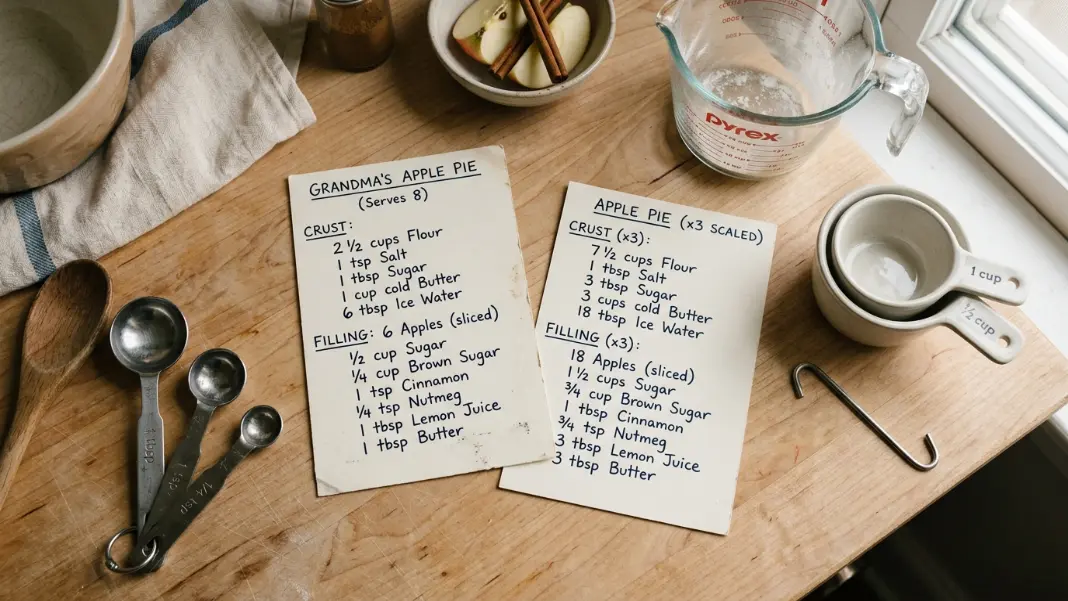
Every cook makes this mistake at least once: they triple a recipe and add three times the baking powder. The result does not rise three times as well. It collapses with a faintly soapy taste, and the texture is wrong in a way that is hard to diagnose the first time it happens. Most ingredients scale perfectly with one formula. A small category does not, and that category happens to contain the ingredients most capable of silently ruining a batch.
The Recipe Conversion Calculator takes your original serving count, your target, and every ingredient amount, then multiplies each by the scale factor at once. This guide covers the scale factor formula, which ingredients need manual adjustment below the linear amount, why cooking time does not scale the same way ingredients do, how pan volume affects baked goods at larger sizes, and how recipe conversion applies to batch cooking and food cost.
How the Scale Factor Works#
The scale factor is a single number: desired servings divided by original servings. Every ingredient multiplies by that number.
Scale Factor = Desired Servings ÷ Original Servings
Scaled Amount = Original Amount × Scale Factor
Worked example scaling up:
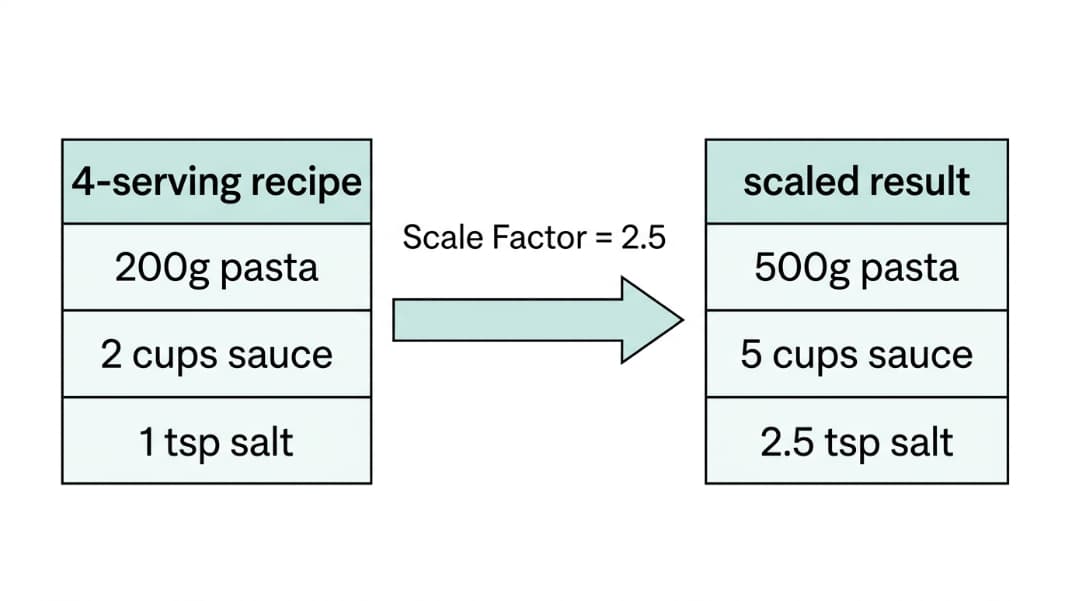
A pasta recipe serves 4 and calls for:
- 200 g dried pasta
- 2 cups tomato sauce
- 3 cloves garlic
- 1 tsp salt
You need to serve 10.
Scale Factor = 10 ÷ 4 = 2.5

Pasta:         200 g × 2.5 = 500 g
Tomato sauce:  2 cups × 2.5 = 5 cups
Garlic:        3 cloves × 2.5 = 7.5 → round to 8 cloves
Salt:          1 tsp × 2.5 = 2.5 tsp (adjust down — see next section)
Garlic rounds up because splitting a clove is not practical. Most rounding calls like this have no measurable effect on the dish.
Worked example scaling down:
Same 4-serving recipe, scaling to 1 serving.
Scale Factor = 1 ÷ 4 = 0.25

Pasta:         200 g × 0.25 = 50 g
Tomato sauce:  2 cups × 0.25 = 0.5 cup (½ cup)
Salt:          1 tsp × 0.25 = ¼ tsp
Scaling down creates the practical challenge of small measurements. A quarter teaspoon is a standard measure. An eighth of a teaspoon is workable. Anything below that is realistically a pinch, and the recipe tolerates the imprecision.
Once you have scaled amounts, you can calculate cost per serving for any batch size directly using the Food Cost Calculator, which takes ingredient prices and quantities and returns a per-serving cost.
Salt, Spices, and Baking Powder: Ingredients That Don't Scale at 1:1#
The scale factor works cleanly for flour, butter, eggs, liquid, and most proteins. It breaks for three categories: salt and assertive spices, chemical leaveners, and flavor extracts.
Salt and assertive spices:
Human perception of salt and spice intensity is not linear. Double the salt does not produce a dish that tastes twice as salty to most people; it tastes over-seasoned. The safe approach is to scale salt and bold spices (chili, cumin, pepper, fresh herbs) to approximately 75% of the linear amount for a 2x batch, and 65% to 70% for a 3x batch. Add conservatively, taste before serving, and adjust.
The following table shows the recommended starting point for salt when scaling up.
| Scale Factor | Linear Salt Amount | Recommended Starting Salt |
|---|---|---|
| 2x | 2x | 1.5x to 1.75x |
| 3x | 3x | 2x to 2.25x |
| 4x | 4x | 2.5x to 3x |
You can always add salt at the end. You cannot remove it.
Baking powder and baking soda:
These are the ingredients that cause the most visible failures when over-scaled. At full linear amounts for large batches, baking powder produces excess carbon dioxide relative to the batter structure. The result is a rapid rise that the structure cannot support, followed by collapse, and a bitter aftertaste. The practical rule is to scale leaveners to about 75% to 85% of the linear amount when multiplying above 2x.
The following table shows the adjusted leavener range for common scale factors.
| Scale Factor | Linear Baking Powder | Adjusted Starting Amount |
|---|---|---|
| 2x | 2 tsp | 1.75 tsp |
| 3x | 3 tsp | 2.25 to 2.5 tsp |
| 4x | 4 tsp | 3 tsp |
Baking soda follows the same direction with slightly different sensitivity. Use the lower end of the range on the first test batch.
Vanilla extract and flavor concentrates:
Scale these at roughly 75% of linear above 2x. Triple-scaled vanilla tends to taste artificial rather than more fragrant. The same applies to almond extract and other high-intensity flavor concentrates.
Cooking Time When You Scale a Recipe Up#
Scaling ingredients does not scale cooking time in the same ratio. This is the most common assumption error outside of baking, and it applies to every cooking method differently.
Heat travels into food from the outside. Cooking time is governed primarily by the thickest dimension of what you are cooking, not the total mass or volume. A doubled batch of roasted vegetables spread across two pans cooks in the same time as the original. The same doubled batch crowded into one pan traps moisture and steams instead of roasting, taking significantly longer and producing a different texture.
Stovetop liquids:
A larger volume of liquid takes longer to come to a boil because of increased thermal mass. Add approximately 5 to 10 minutes to reach temperature for every additional quart of liquid. Once simmering, the active cooking time for soups, sauces, and braised meats stays roughly the same regardless of batch size.
Baked goods in the same pan:
If your scaled recipe fits the same pan and the depth of the product is unchanged, cooking time stays close to the original. Check visual cues and use a toothpick or thermometer rather than extending time proportionally.
Baked goods in a larger or deeper pan:
When a larger batch goes into a bigger pan with greater depth, the center takes longer to reach the correct internal temperature. Add 5 to 15 minutes and start checking at the original time. The crust or top sets before the center, which is expected; use an internal temperature probe or toothpick test to confirm doneness.
For large-format proteins, time scales with thickness, not weight. A 20-pound turkey does not take twice as long as a 10-pound turkey because heat travels from the outside in at the same rate regardless of total mass. The Turkey Cooking Time Calculator applies the correct time-per-pound adjustments based on actual thermal penetration, which is a useful reference for understanding why simple weight-based scaling fails for larger cuts.
Pan Size and Volume for Scaled Baked Goods#
Pan volume is the dimension most people forget when scaling up baked goods. Putting double the batter in the same pan is one of the most reliable ways to get a raw center, an overflowed oven, or both.
When you double a recipe, you need a pan with roughly double the volume. Fill the pan no more than halfway to two-thirds to allow room for rise.
The following table shows approximate volumes for common baking pans.
| Pan | Approximate Volume |
|---|---|
| 8-inch round | 4 cups |
| 9-inch round | 6 cups |
| 8x8-inch square | 8 cups |
| 9x9-inch square | 10 cups |
| 9x5-inch loaf | 8 cups |
| 9x13-inch | 14 to 15 cups |
| 10-cup Bundt | 10 cups |
A doubled 9-inch round recipe produces roughly 12 cups of batter. That fits a 9x13-inch pan at about 85% capacity, which is too full. Two separate 9-inch rounds at the original size is the better choice. Alternatively, if the recipe fills a 9-inch round to half capacity, a doubled batch in one 9x13-inch pan works.
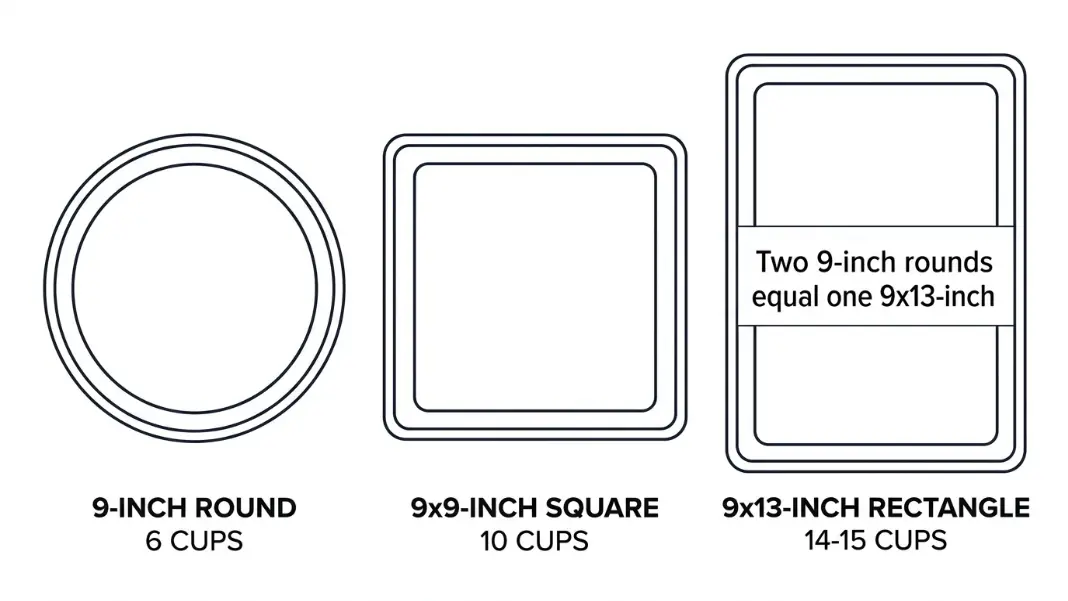
If the scaled volume does not fit a single pan at two-thirds fill or less, bake in two pans at the original dimensions rather than forcing the batter into one oversized container. Bake time stays closer to the original with this approach.
Recipe Scaling for Batch Cooking, Catering, and Cost#
Recipe conversion changes more than amounts. At scale, it changes cost per serving, equipment capacity, and prep time. These downstream effects are where the scale factor earns its full value.
Batch cooking:
A home recipe scaled 4x or 5x front-loads preparation time but eliminates daily cooking for the week. The scale factor applies identically to a meal prep batch. The practical limits appear in equipment: a standard stand mixer handles one or two batches of dough, not five. A domestic oven fits two sheet pans without compromising air circulation. Scaling the recipe is straightforward; scaling the kitchen is the constraint.
Catering and event cooking:
Professional kitchens standardize recipes at specific batch sizes (commonly 25 or 50 portions) because the arithmetic recurs every service. When converting a home recipe to catering quantities, test at 2x before committing to 20x. Flavor profiles can shift at scale because evaporation rates and cooking vessel surface-to-volume ratios change, particularly for sauces, soups, and reductions.
Cost per serving:
Larger batches reduce cost per serving through packaging efficiency: a 5-pound bag of flour costs less per ounce than a 1-pound bag. Waste percentages also fall at scale. The Recipe Cost Calculator takes the full scaled ingredient list and total yield and returns cost per serving alongside a food cost percentage, which is the core metric for anyone cooking for a business or tracking household food budgets.
The scale factor is the foundation that makes every downstream number accurate. An ingredient list scaled correctly produces reliable cost, nutrition, and timing estimates. One scaled incorrectly, particularly on leaveners or salt, produces a batch that fails at the pan before it ever reaches the table.
Divide your desired serving count by the original serving count to get the scale factor, then multiply every ingredient by that number. For a 4-serving recipe you want to serve 10, the factor is 10 ÷ 4 = 2.5. A 2-cup flour becomes 5 cups; a 1 tsp salt becomes 2.5 tsp. For salt, spices, and baking powder, reduce slightly below the linear amount, especially when scaling 3x or more. The Recipe Conversion Calculator applies this to every ingredient simultaneously.
Cooking time does not scale proportionally with batch size. For stovetop liquids, a larger volume takes longer to reach temperature but simmers in roughly the same time. For baked goods in the same pan dimensions with unchanged depth, cooking time stays close to the original. If batter depth increases because of a larger pan, add time and rely on visual cues or a thermometer rather than extending time by the scale factor.
Baking powder at full linear scale in large batches produces excess carbon dioxide relative to the batter's structure. The result is a rapid rise the batter cannot support, leading to collapse and a soapy aftertaste. When scaling up 2x to 4x, reduce leavener to about 75% to 85% of the linear amount. A recipe using 1 tsp baking powder for 4 servings should use about 1.75 tsp for an 8-serving batch rather than the full 2 tsp.
You need a pan with approximately double the volume. Fill the pan no more than halfway to two-thirds to allow room for rise. Two 9-inch round pans hold roughly the same volume as one 9x13-inch pan. If the scaled batter volume does not fit a single pan at two-thirds fill, bake in two separate pans at the original size rather than overfilling one large pan. Bake time stays closer to the original with this approach.
Scale salt and assertive spices to about 75% of the linear amount when doubling or tripling a recipe. Add conservatively and taste at the end before serving. Human perception of saltiness is not linear: double the salt tastes more than twice as salty to most people. Vanilla extract and flavor concentrates follow the same principle and should be scaled to about 75% of linear above 2x. Mild aromatics like onion and garlic can be scaled closer to the full linear amount.
Yes. The scale factor works for any ratio including decimals. Original 4 servings to desired 6 gives a 1.5x factor. Original 12 to desired 3 gives 0.25x. Fractional results like 0.75 cup correspond to common kitchen measures (three-quarter cup, or 12 tablespoons). The main practical challenge is measuring amounts below one-eighth of a teaspoon, where a pinch is the realistic substitute. Enter any original and desired serving count into the Recipe Conversion Calculator to scale the full ingredient list at once.
Written by
Hassaan Rasheed
Web Developer & Content Researcher
Hassaan builds calculators and writes source-linked guides across the site's subject areas. Calculator methods and reference data are documented in each guide so readers can verify the underlying sources.
About the author and methods