Baby Weight Percentile Chart by Age: WHO Reference Tables (2026)
Baby weight percentile chart with WHO reference values from birth to 24 months. Selected tables for boys and girls, plus the WHO LMS calculation method.
Baby Weight and Length Percentile Calculator by Age
WHO Child Growth Standards, birth to 24 completed months.
On this WHO weight-for-age chart, this measurement is heavier than approximately 50% of the reference population with the same age and sex. A single percentile is not a diagnosis; clinicians assess repeated measurements and the full growth pattern.
| 3rd | 5th | 10th | 25th | 50th | 75th | 90th | 95th | 97th |
|---|---|---|---|---|---|---|---|---|
| 6.44 kg | 6.61 kg | 6.89 kg | 7.37 kg | 7.93 kg | 8.54 kg | 9.12 kg | 9.48 kg | 9.72 kg |
Sources: WHO weight-for-age and length/height-for-age standards. Calculated from the published monthly LMS parameters for completed whole months. Weight-for-age alone does not classify underweight or overweight. Reference tool only — not medical advice.
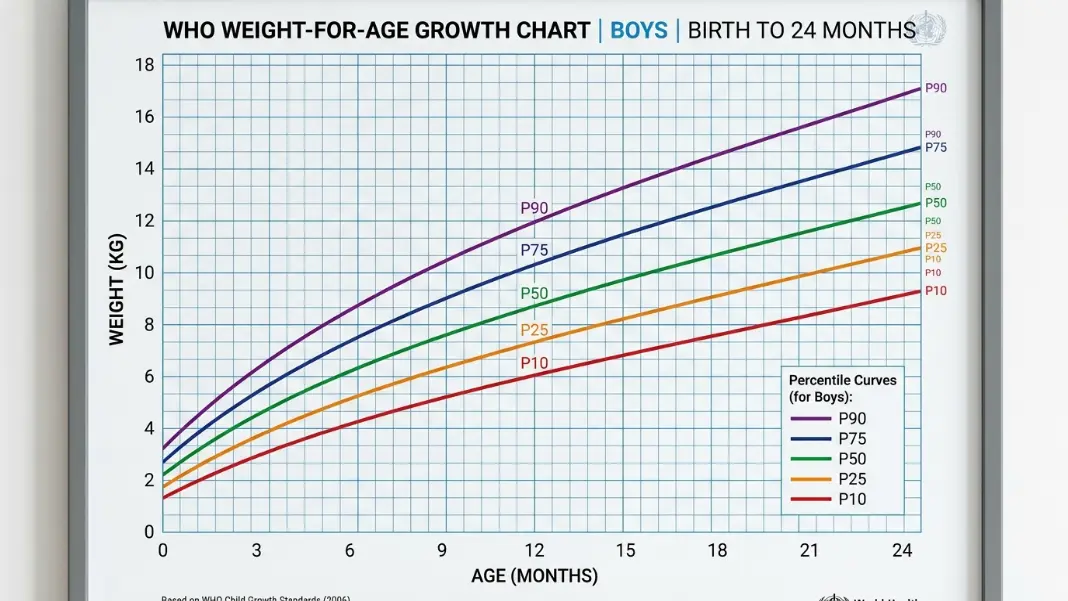
Most baby percentile guides explain what percentile means but never show you the actual numbers. This one does. The tables below come from the WHO Child Growth Standards (2006), the same reference used by pediatricians and health departments worldwide. They show reference weights at five percentile levels for boys and girls from birth to 24 months.
Use the calculator above with your baby's completed age in months, sex, and weight or recumbent length, then use the selected reference tables below to put the result in context.
The calculator uses the sex-specific LMS parameters in the official WHO weight-for-age tables and WHO length/height-for-age tables. It converts the measurement to a z-score and then to a percentile; it does not estimate a result by drawing a straight line between a few percentile bands. Ages are entered as completed whole months. A standalone version of the baby percentile calculator is also available.
WHO Baby Boy Weight Percentile Chart: Birth to 24 Months#
These are WHO weight-for-age reference values for boys. The P50 is the median: half of boys in the reference population weigh more and half weigh less. P10 and P90 describe positions in the reference distribution; they are not, by themselves, diagnostic boundaries.
Boys weight-for-age reference (kg) at selected percentile levels:
| Age | P10 | P25 | P50 | P75 | P90 |
|---|---|---|---|---|---|
| Birth | 2.8 | 3.0 | 3.3 | 3.7 | 4.0 |
| 1 month | 3.8 | 4.1 | 4.5 | 4.9 | 5.3 |
| 2 months | 4.7 | 5.1 | 5.6 | 6.0 | 6.5 |
| 3 months | 5.5 | 5.9 | 6.4 | 6.9 | 7.4 |
| 4 months | 6.0 | 6.5 | 7.0 | 7.6 | 8.1 |
| 5 months | 6.5 | 7.0 | 7.5 | 8.1 | 8.6 |
| 6 months | 6.9 | 7.4 | 7.9 | 8.5 | 9.1 |
| 9 months | 7.7 | 8.3 | 8.9 | 9.6 | 10.2 |
| 12 months | 8.4 | 9.0 | 9.6 | 10.4 | 11.1 |
| 18 months | 9.5 | 10.1 | 10.9 | 11.8 | 12.6 |
| 24 months | 10.5 | 11.3 | 12.2 | 13.1 | 14.1 |
The WHO also publishes lower and upper centile curves, including the 3rd and 97th. These are statistical reference lines, not diagnoses. The boys' 3rd-centile value is about 2.5 kg (5.5 lb) at birth and 9.8 kg (21.6 lb) at 24 months.
Reading the table in practice:
A 6-month-old boy weighing 7.2 kg falls between P10 (6.9 kg) and P25 (7.4 kg). A 12-month-old boy weighing 11.1 kg is near P90. Those positions describe weight-for-age only; interpretation also depends on measurement quality, the child's earlier trajectory, and weight relative to length.
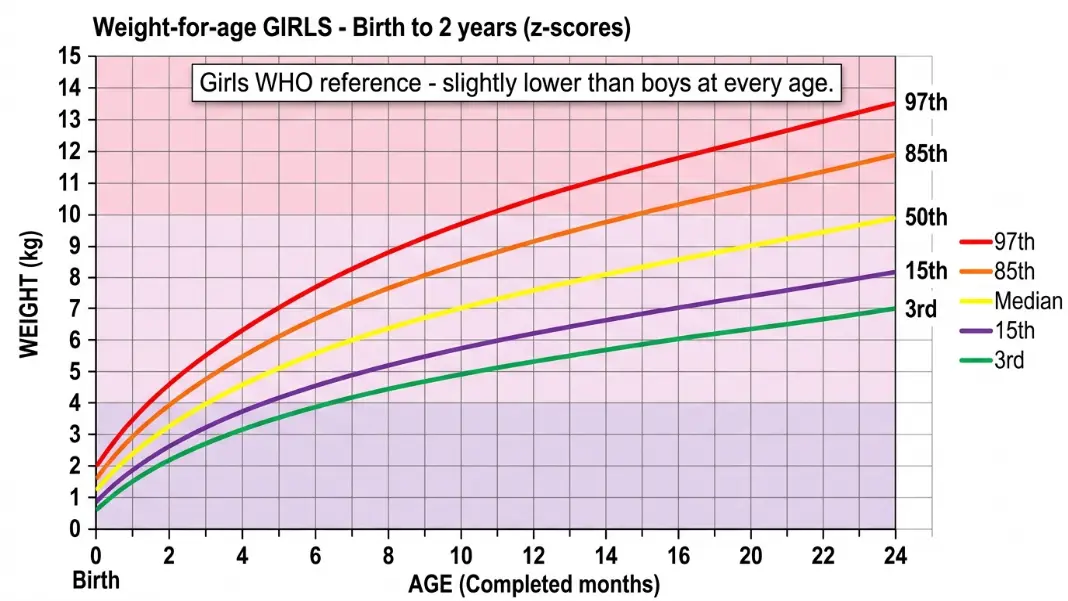
WHO Baby Girl Weight Percentile Chart: Birth to 24 Months#
Girls grow at a slightly different rate than boys throughout infancy, with lower median weights at every age. The WHO reference values for girls are derived from the same multinational study population as the boys tables but are calculated separately.
Girls weight-for-age reference (kg) at selected percentile levels:
| Age | P10 | P25 | P50 | P75 | P90 |
|---|---|---|---|---|---|
| Birth | 2.7 | 2.9 | 3.2 | 3.6 | 3.9 |
| 1 month | 3.5 | 3.8 | 4.2 | 4.6 | 5.0 |
| 2 months | 4.3 | 4.7 | 5.1 | 5.6 | 6.0 |
| 3 months | 5.0 | 5.4 | 5.8 | 6.4 | 6.9 |
| 4 months | 5.5 | 5.9 | 6.4 | 7.0 | 7.5 |
| 5 months | 5.9 | 6.4 | 6.9 | 7.5 | 8.1 |
| 6 months | 6.2 | 6.7 | 7.3 | 7.9 | 8.5 |
| 9 months | 7.0 | 7.6 | 8.2 | 8.9 | 9.6 |
| 12 months | 7.7 | 8.2 | 8.9 | 9.7 | 10.5 |
| 18 months | 8.8 | 9.4 | 10.2 | 11.1 | 12.0 |
| 24 months | 9.8 | 10.6 | 11.5 | 12.5 | 13.5 |
The girl-boy difference in median weight is small at birth (about 0.1 kg) and remains modest throughout infancy. At 12 months, the median is approximately 8.9 kg for girls and 9.6 kg for boys.
Why it matters to use the correct sex-specific table:
Using the boys table for a girl will make her appear lower than she is. Using the girls table for a boy will make him appear higher. The sex-specific reference tables are not interchangeable. The Baby Percentile Calculator automatically selects the correct reference table based on the sex input.
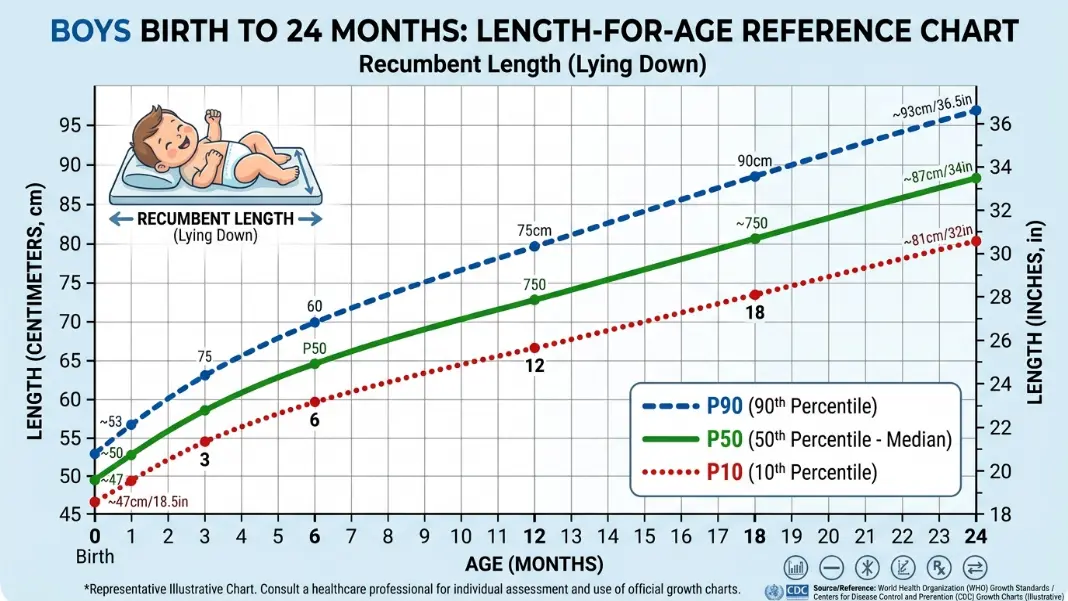
WHO Baby Length Percentile Chart: Birth to 24 Months#
Length percentile is tracked alongside weight percentile at every well-child visit. A baby can be in a high weight percentile but a low length percentile, or vice versa. The relationship between the two tells a more complete growth story than either measurement alone.
Length is measured lying down (recumbent length) for babies under 24 months. This is slightly different from standing height, which is used from age 2 onward. Recumbent length measurements run 0.5 to 1.0 cm longer than standing height for the same child, which is why the chart uses age-specific references. For the next age range, use the toddler weight and height percentile chart.
Length-for-age P50 reference values (cm) for boys and girls:
These are approximate WHO median values from birth to 24 months.
| Age | Boys P50 Length | Girls P50 Length |
|---|---|---|
| Birth | 49.9 cm (19.6 in) | 49.1 cm (19.3 in) |
| 3 months | 61.4 cm (24.2 in) | 59.8 cm (23.5 in) |
| 6 months | 67.6 cm (26.6 in) | 65.7 cm (25.9 in) |
| 9 months | 72.0 cm (28.3 in) | 70.1 cm (27.6 in) |
| 12 months | 75.7 cm (29.8 in) | 74.0 cm (29.1 in) |
| 18 months | 82.3 cm (32.4 in) | 80.7 cm (31.8 in) |
| 24 months | 87.8 cm (34.6 in) | 86.4 cm (34.0 in) |
The spread from the 10th to the 90th percentile for length is roughly 6 to 8 cm at many ages. The calculator uses the exact monthly LMS row rather than assuming that a fixed distance below the median always maps to the same percentile.
For more detail on how length percentile is calculated and interpreted alongside weight, the What Does Baby Percentile Mean guide covers the full reference framework including how weight and length percentiles are tracked together and what a gap between them indicates.
How to Use a Baby Percentile Chart at Home Between Visits#
The primary use of the growth chart outside a clinical setting is reassurance and preparation. Most parents check their baby's weight on a home scale between well-child visits. There are a few things worth knowing before drawing conclusions from that reading.
Home scale accuracy:
Bathroom scales, even digital ones, are designed for adult weights and often have a resolution of 0.1 to 0.2 kg. For a 4-month-old baby weighing 6.5 kg, a 0.2 kg error is a 3% discrepancy, which can shift the apparent percentile by several points. Clinical infant scales are calibrated for weights under 15 kg and have resolution of 10 to 20 grams. If you weigh your baby at home and get a reading that appears lower than expected, consider whether measurement accuracy is the explanation before interpreting the result.
Timing matters within the day:
A baby weighed before a feed weighs less than the same baby weighed after a feed. For a baby who takes 120 to 150 ml per feed, that is a 120 to 150 gram difference. At well-child visits, babies are typically weighed without clothing and at a consistent time, which reduces this variability. At home, try to weigh at the same time of day and in similar conditions for the most comparable reading.
Using the chart to prepare questions:
If your baby's at-home weight places them in a lower percentile than their last clinical measurement, the most useful thing to do is note the reading and the date, weigh again in 1 to 2 weeks, and bring both readings to the next appointment. A single lower reading rarely tells you anything definitive. Two or three readings over a month that all show the same pattern give the pediatrician something to work with.
Converting between lb/oz and kg:
The WHO reference tables use kilograms. One pound is 0.453592 kg and one ounce is 0.0283495 kg. A baby weighing 17 lb 4 oz is about 7.82 kg. The calculator handles the full-precision conversion automatically when you select imperial units.
When the Baby Percentile Chart Shows a Pattern Worth Discussing#
The WHO growth chart is most useful as a trend tracker. A single reading above or below a printed centile line does not establish a problem by itself. Repeated measurements, taken accurately and reviewed with the child's clinical context, are more informative.
The two-line rule:
Crossing two major centile spaces downward is one screening pattern clinicians may consider when assessing possible growth faltering, but the exact rule depends on the chart and guideline in use. A baby who was in the 50th-to-75th band and later plots in the 10th-to-25th band has changed trajectory; that change is a reason to review the measurements, feeding, and health history rather than a diagnosis on its own.
A substantial upward change also deserves context, especially when weight-for-length changes. Ask the child's clinician about the timing rather than waiting if you also have feeding, breathing, swelling, development, or other health concerns.
Comparing weight and length percentiles:
Weight-for-age and length-for-age should not be turned into a diagnosis by comparing their percentile numbers directly. For children under 2, clinicians use the separate WHO weight-for-length standard to assess weight relative to body length, together with serial measurements and clinical history.
For a detailed explanation of what the 3rd, 97th, and 99th percentile positions do—and do not—show, see 99th Percentile Baby: What High and Low Percentiles Mean.
Preterm babies and adjusted age:
For a child born preterm, the age and chart used for growth assessment may need adjustment. Corrected age is chronological age minus the number of weeks born before 40 weeks; for example, 5 months chronological age minus 8 weeks is about 3 months corrected age. Ask the child's clinician how long to use corrected age and whether a preterm-specific chart is appropriate.
There is no single weight-for-age percentile that guarantees healthy growth. A percentile describes position in the WHO reference distribution; clinicians interpret it with prior measurements, weight-for-length, feeding, development, and health history. A large change across visits or a measurement near an extreme centile is worth discussing, but neither is a diagnosis by itself.
WHO median weights for boys are about 3.3 kg at birth, 6.4 kg at 3 months, 7.9 kg at 6 months, 9.6 kg at 12 months, and 12.2 kg at 24 months. For girls they are about 3.2, 5.8, 7.3, 8.9, and 11.5 kg at the same ages. These are reference medians, not targets.
The WHO publishes its Child Growth Standards as downloadable charts and tables. They include weight-for-age, length/height-for-age, weight-for-length/height, and head-circumference-for-age standards. This calculator uses the official monthly LMS data for weight-for-age and length-for-age from birth through 24 completed months.
The 50th percentile is the reference median, not an ideal or target. It cannot establish health on its own. Clinicians interpret the measurement alongside the child's trajectory, weight-for-length, development, feeding, and other findings.
Find your baby's age along the bottom axis and draw a vertical line upward. Find your baby's weight on the left axis and draw a horizontal line across. The point where the two lines intersect falls between two printed percentile curves. The percentile curves are labeled (for example, 10th, 25th, 50th, 75th, 90th). The two curves your baby's measurement falls between define their percentile band. If their weight point falls exactly on one line, that is their percentile. The Baby Percentile Calculator does this automatically and shows the exact estimated percentile.
The WHO publishes separate weight-for-age charts for boys and girls because their reference curves differ. At 6 months, for example, the median is about 7.3 kg for girls and 7.9 kg for boys. The size of the percentile error from using the wrong chart is not fixed; always use the sex-specific standard selected for the child.
Written by
Hassaan Rasheed
Web Developer & Content Researcher
Hassaan builds calculators and writes source-linked guides across the site's subject areas. Calculator methods and reference data are documented in each guide so readers can verify the underlying sources.
About the author and methods