What Does Baby Percentile Mean: WHO Chart Explained (2026)
Baby percentile compares your baby's weight or length to WHO reference babies the same age and sex. What the number means, how it's calculated, and what to watch.
Baby Weight and Length Percentile Calculator
WHO Child Growth Standards, birth to 24 completed months.
On this WHO weight-for-age chart, this measurement is heavier than approximately 50% of the reference population with the same age and sex. A single percentile is not a diagnosis; clinicians assess repeated measurements and the full growth pattern.
| 3rd | 5th | 10th | 25th | 50th | 75th | 90th | 95th | 97th |
|---|---|---|---|---|---|---|---|---|
| 6.44 kg | 6.61 kg | 6.89 kg | 7.37 kg | 7.93 kg | 8.54 kg | 9.12 kg | 9.48 kg | 9.72 kg |
Sources: WHO weight-for-age and length/height-for-age standards. Calculated from the published monthly LMS parameters for completed whole months. Weight-for-age alone does not classify underweight or overweight. Reference tool only — not medical advice.
The doctor says your baby is in the 30th percentile and moves to the next item on the chart. You nod. Most parents nod and leave without being sure whether that number is reassuring, concerning, or just noise.
Use the calculator above to compare a weight or recumbent-length measurement with the sex-specific WHO standard for the same completed month of age.
Baby percentile is a comparison tool, not a grading system. The calculator matches weight or length, completed age in months, and sex with the WHO Child Growth Standards derived from the six-country Multicentre Growth Reference Study. A baby at the 30th percentile for weight plots above 30% of the modeled weight-for-age reference distribution at the same age and sex. That is all it says; it does not label the weight insufficient, ideal, or excessive.
Understanding how the number is produced, and what it genuinely measures versus what it does not, is what makes the well-child visit useful rather than just an exercise in receiving a percentage and nodding.
How Baby Percentile Is Calculated: WHO Child Growth Standards#
The WHO Child Growth Standards, published after a multinational research program, cover children from birth to 5 years. The study selected populations under health and environmental conditions intended to support growth, including breastfeeding recommendations and non-smoking mothers. WHO describes these as standards for how children should grow under those conditions, not merely a snapshot of one country's average.
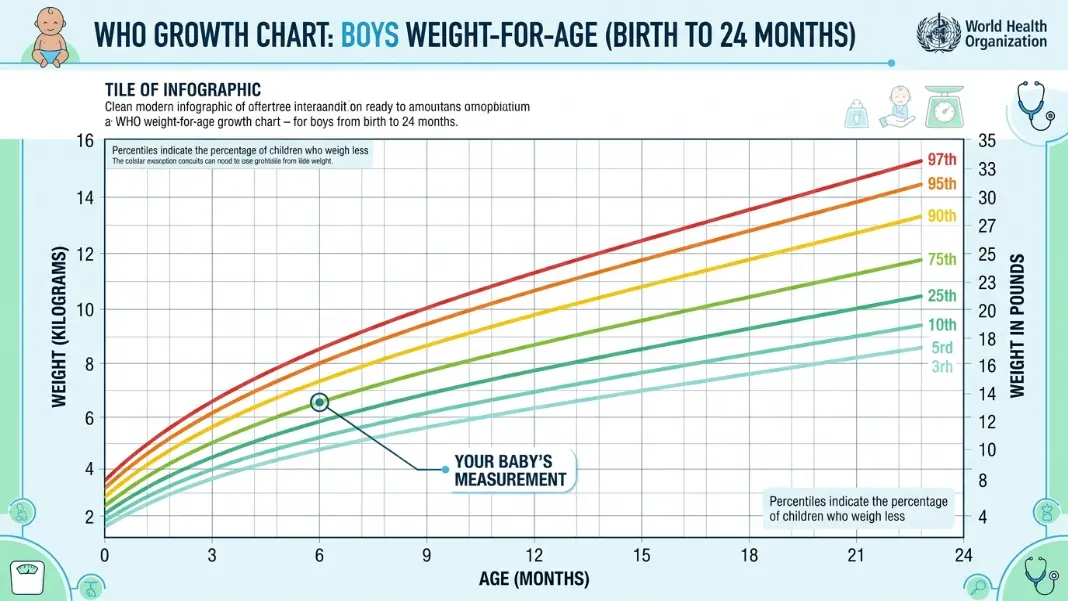
WHO publishes sex-specific LMS parameters for each whole month. Weight-for-age runs from birth to 60 months; recumbent length-for-age runs through 24 months and standing height-for-age from 24 to 60 months. Charts and tables also display selected centiles such as the 3rd, 15th, 50th, 85th, and 97th.
Percentile = % of the modeled same-age, same-sex reference distribution below the measurement
A baby at the 60th percentile for weight at 6 months plots above 60% of the modeled sex-specific reference distribution. A baby at the 50th percentile is at the median.
How this calculator derives the percentile:
The calculator uses the official LMS row for the child's completed whole month. M is the median, S describes spread, and L handles skewness through a Box-Cox transformation. The measurement is converted to a z-score with those parameters, then the standard normal distribution converts the z-score to a percentile. This preserves the shape of the WHO curve; it does not linearly interpolate between a few printed percentile bands. The primary data are available from WHO's weight-for-age and length/height-for-age pages.
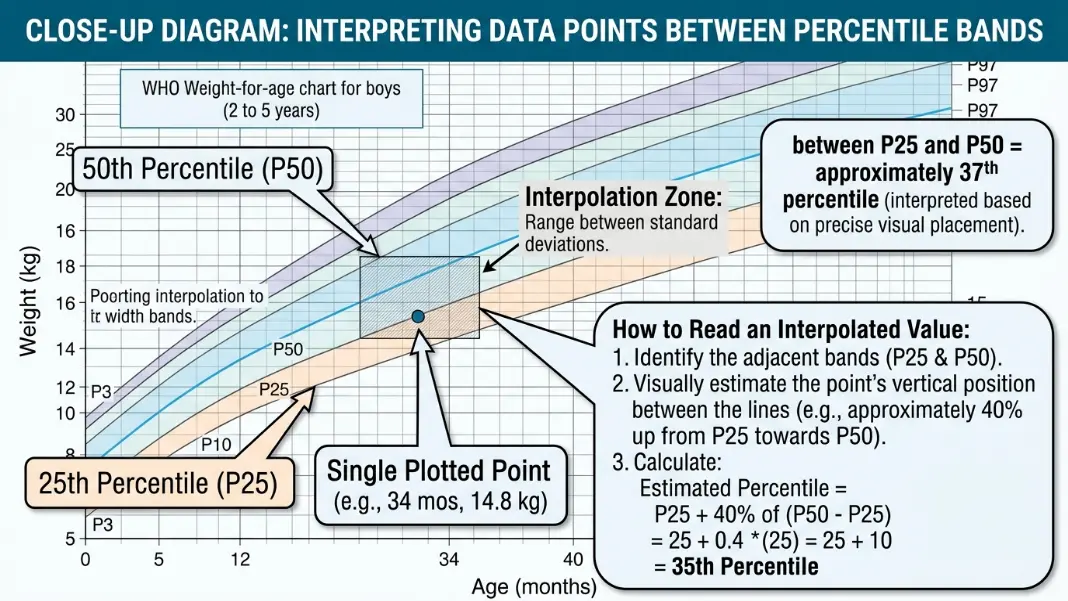
What Percentile Is My Baby: Reading the WHO Chart Correctly#
A WHO growth chart for weight-for-age shows selected curved centile lines across age. Your baby's measurement is a plotted point. The lines above and below that point identify its approximate centile band; the LMS calculation can estimate a continuous percentile.
Printed charts can show different selected centile or z-score lines. Check the labels rather than assuming the bottom or top line represents a particular percentile.
A baby's weight-for-age and length-for-age percentiles can differ, but subtracting them does not measure proportionality. For children under 2, the separate weight-for-length standard is the appropriate comparison. The Baby Weight Percentile Chart by Age provides selected WHO reference values and explains the monthly LMS method.
Approximate WHO reference values at the 50th percentile for boys (the median):
These are the median measurements from birth to 24 months, giving a reference point for comparison.
| Age | Weight (50th) | Length (50th) |
|---|---|---|
| Birth | 3.3 kg (7.3 lb) | 49.9 cm (19.6 in) |
| 3 months | 6.4 kg (14.1 lb) | 61.4 cm (24.2 in) |
| 6 months | 7.9 kg (17.4 lb) | 67.6 cm (26.6 in) |
| 12 months | 9.6 kg (21.2 lb) | 75.7 cm (29.8 in) |
| 18 months | 10.9 kg (24.0 lb) | 82.3 cm (32.4 in) |
| 24 months | 12.2 kg (26.9 lb) | 87.8 cm (34.6 in) |
A 3-month-old boy weighing about 5.9 kg is near P25 on the WHO weight-for-age standard, while the median is about 6.4 kg. That single position does not establish whether growth is adequate; prior measurements and weight-for-length add the needed context.
What Baby Percentile Numbers Actually Tell You About Growth#
Baby percentile describes where a measurement sits on a modeled reference distribution at one point in time. It does not, by itself, describe whether a baby is healthy, adequately nourished, or on an optimal growth path. Two babies at the same percentile can be in different clinical situations.
There is no weight-for-age percentile band that guarantees health. A stable trajectory can be reassuring context, while a substantial change across visits can prompt closer review, but both still need accurate measurements and a broader clinical assessment.
Two questions matter more than the percentile number itself:
- Is this reading consistent with the pattern from recent visits, or has it shifted significantly?
- Are weight and length percentiles reasonably aligned, or is there a large gap between them?
Pediatricians track both, but they do not diagnose proportionality by subtracting the two percentile numbers. For children under 2, the separate WHO weight-for-length standard compares weight directly with recumbent length. The result is then interpreted with growth history, feeding, development, and examination.
A note on prenatal percentiles:
If your baby had an estimated fetal weight percentile during pregnancy, that number was calculated differently, using ultrasound estimates and a fetal reference curve. Fetal and postnatal percentiles are not directly comparable. A change from P42 on a 32-week scan to P58 on the postnatal WHO chart does not, by itself, prove that the baby's relative growth position changed. The Baby Percentile During Pregnancy guide explains the separate methods.
What the 3rd, 5th, 95th, and 97th Percentile Lines Show#
The 3rd, 5th, 95th, and 97th are commonly displayed centile lines. Plotting beyond one of them means the measurement is uncommon in that reference distribution; the line itself does not diagnose undernutrition, overweight, or disease. In particular, weight-for-age cannot assess weight relative to length.
What each zone says statistically:
| Percentile Zone | Description on this reference |
|---|---|
| Below 3rd | Fewer than 3% of reference measurements plot lower |
| 3rd to 5th | Between the P3 and P5 curves |
| 5th to 95th | Between the P5 and P95 curves |
| 95th to 97th | Between the P95 and P97 curves |
| Above 97th | Fewer than 3% of reference measurements plot higher |
A change from P20 to P4 across visits deserves review for measurement error and clinical context, but the chart alone cannot determine its cause or urgency.
Breastfed babies and the WHO chart:
The WHO study's feeding criteria reflected its breastfeeding recommendations. The WHO standard is intended for children regardless of feeding method, and a consistent chart should be used across visits. Do not dismiss a downward shift as a breastfeeding effect without reviewing intake, measurement quality, weight-for-length, development, and health with the child's clinician.
Tracking Baby Percentile Across Visits: When to Watch and When to Wait#
Most parents leave a well-child visit focused on the number they heard. Most pediatricians leave focused on whether that number moved.
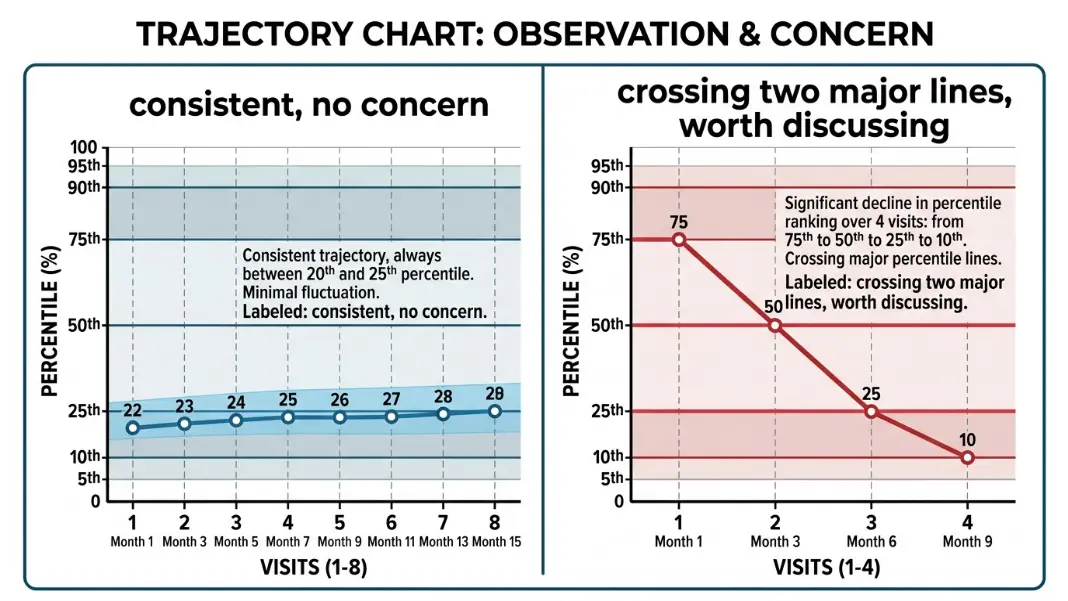
A baby whose weight percentile remains between P20 and P25 across several accurate measurements has a different pattern from one plotted at P75, then P60, then P45. The latter pattern is worth reviewing, but its meaning depends on feeding, illness, development, length, and measurement quality.
Crossing two major centile spaces downward is one screening pattern used in some growth-faltering guidance, not a universal diagnostic rule. The chart and guideline determine which spaces count. A substantial change across repeated, accurate measurements is a reason to ask the child's clinician to review the full picture.
Reasons percentile positions can shift:
Percentile movement can reflect biological change, measurement variation, illness, feeding changes, or a child's evolving trajectory. The chart alone cannot identify which explanation applies.
Some babies move toward a different centile in early infancy, and family size can provide context. It should not be assumed to explain a change without reviewing feeding, measurements, development, and health.
Illness or feeding disruption can affect intake and weight, while timing and measurement technique can affect the plotted point. Symptoms and reduced intake still deserve appropriate clinical attention rather than being dismissed as temporary.
Short measurement intervals can make a plotted series look uneven. Clinicians interpret it using the spacing and precision of the measurements, not an assumption that every apparent jump or plateau represents true growth velocity.
For more on what the extreme values in the distribution mean clinically, including the 99th and 3rd percentile readings, the 99th Percentile Baby: What High and Low Percentiles Mean guide covers both ends of the chart in detail.
Baby percentile shows how a weight or length measurement compares with the modeled WHO distribution for the same age and sex. A weight at P40 plots above 40% of the weight-for-age reference distribution. Percentiles are not grades and cannot establish health from one reading.
There is no single percentile band that guarantees healthy growth. Printed charts often show P3, P5, P95, or P97 lines, but those are statistical markers. Clinicians interpret weight-for-age with the trajectory, weight-for-length, feeding, development, health history, and examination.
This calculator selects the official sex-specific WHO LMS row for the baby's completed month, transforms the weight or length to a z-score, and converts that z-score to a percentile with the standard normal distribution. It does not linearly interpolate between a handful of printed centile values.
The 50th percentile is the modeled reference median. It is the midpoint of the distribution, not the healthiest or best outcome, and it has no special clinical status on its own.
Enter completed age in months, sex, and weight or recumbent length into the calculator above. It compares those inputs with the WHO LMS data and returns a percentile estimate. A calibrated infant scale and correctly measured recumbent length reduce input error; this calculator cannot quantify the error in a home measurement.
A low weight-for-age percentile is not a diagnosis by itself. Discuss the result with the baby's clinician, especially if it is new, accompanies weight loss, feeding difficulty, fewer wet diapers, illness, developmental concerns, or a change from the earlier trajectory. Family size can provide context but should not be used to dismiss symptoms.
Written by
Hassaan Rasheed
Web Developer & Content Researcher
Hassaan builds calculators and writes source-linked guides across the site's subject areas. Calculator methods and reference data are documented in each guide so readers can verify the underlying sources.
About the author and methods