Baby Percentile During Pregnancy: Week-by-Week EFW Calculator (2026)
Calculate estimated fetal-weight percentile by exact pregnancy week using INTERGROWTH-21st standards, then understand EFW, centiles, scan trends, and limits.
Fetal Weight Percentile Calculator by Gestational Age
Enter the estimated fetal weight and gestational age shown on the scan report, then choose the matching EFW method.
Many scan reports calculate EFW with Hadlock using head circumference (HC), abdominal circumference (AC), and femur length (FL). Choose the original 2017 option only when the report uses the INTERGROWTH AC/HC EFW equation; mixing an EFW formula with a different reference curve can change the percentile.
On the selected Hadlock HC/AC/FL reference, an EFW of 1,795 g at 32 weeks corresponds to an estimated percentile of 50. EFW and percentile are estimates; clinicians interpret the scan, growth trend, and clinical context together.
| 10th percentile | 50th percentile | 90th percentile |
|---|---|---|
| 1,556 g | 1,795 g | 2,072 g |
Sources: INTERGROWTH-21st Hadlock EFW standard (2020) and the original INTERGROWTH EFW standard (2017). The equations are evaluated at exact weeks plus days; values are not linearly interpolated. Reference tool only — not medical advice.
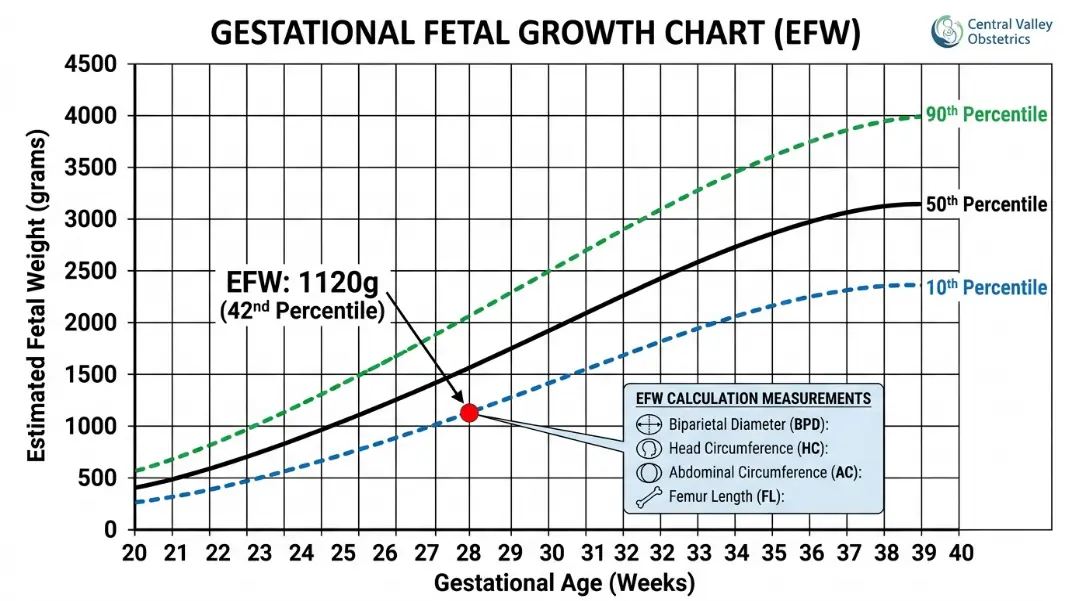
The anatomy scan is the first time many parents hear a percentile attached to their baby. The sonographer records biometry, the ultrasound system calculates an estimated fetal weight, and the report may add a percentile. The appointment moves on; you leave with a number you were not prepared to interpret.
Use the calculator above with the estimated fetal weight (EFW) and exact gestational age printed on the scan report. Match the reference option to the formula used to produce that EFW whenever the report identifies it.
Baby percentile during pregnancy means something different from the percentile your pediatrician tracks after birth. The postnatal Baby Percentile Calculator uses WHO growth standards and direct weight measurements. Fetal percentile is estimated differently: it uses ultrasound-derived measurements and a separate fetal reference population, with measurement uncertainty that postnatal scale weights do not carry. Understanding that gap prevents a lot of unnecessary confusion when a fetus reads "32nd percentile" on the scan and then arrives at the 55th percentile on the WHO chart after birth.
How Fetal Weight Percentile Is Estimated During Pregnancy#
Fetal weight cannot be measured directly. An ultrasound system first combines biometry measurements in an EFW equation. A widely used Hadlock variant uses head circumference (HC), abdominal circumference (AC), and femur length (FL); other Hadlock variants also use biparietal diameter (BPD). The number in grams on the report is the equation's estimate.
Ultrasound biometry → an EFW equation → estimated weight in grams
Estimated weight + exact gestational age → a matching reference curve → percentile
The equation and the percentile curve are separate choices. By default, this tool compares a scan-reported EFW calculated with Hadlock's HC/AC/FL equation with the matching INTERGROWTH-21st Hadlock-specific EFW standard published in 2020, valid from 24 to 43 weeks. It also offers the original INTERGROWTH-21st EFW standard published in 2017, valid from 22 to 40 weeks, which was developed with INTERGROWTH's AC/HC EFW equation. The same gram value can map to a different percentile on those curves. Do not switch curves simply to obtain a preferred result; ask the imaging unit which EFW equation and chart appear on the report.
The EFW percentile guide provides the matching by-week reference table and a worked explanation of the two standards.
Sources of estimation error that matter in practice:
Ultrasound EFW has meaningful uncertainty, often summarized clinically as roughly ±15% and sometimes more at the extremes. A reported 2,000 g should therefore not be treated as a direct scale weight or an exact percentile input.
Abdominal circumference contributes strongly to common EFW equations, and small differences in the measurement can move the weight estimate and percentile. Serial scans are spaced so that expected biological growth is large enough to distinguish from measurement noise; the treating team chooses the interval for the pregnancy.
Baby Percentile Week by Week: What Each Trimester Scan Shows#
Fetal growth is not linear across pregnancy. The rate of weight gain accelerates significantly in the third trimester, which means the same absolute difference in weight carries a different percentile implication at 24 weeks versus 36 weeks.
Most practices structure growth surveillance around specific gestational windows.
| Gestational Week | Scan Purpose |
|---|---|
| 18 to 22 weeks | Anatomy scan: first detailed size measurements, organ structure review |
| 28 to 32 weeks | Third-trimester growth assessment when routinely offered or clinically indicated |
| 34 to 36 weeks | Additional assessment in higher-risk pregnancies |
| 38 to 40 weeks | Biophysical profile and amniotic fluid assessment when indicated |
The anatomy scan at 18 to 22 weeks can include biometry and an EFW, but later surveillance depends on local practice and individual risk. Early-onset and late-onset fetal growth restriction can present at different gestational ages, so no row in this general table replaces the scan schedule set by the obstetric team.
A series of estimates near P28 presents a different pattern from estimates that move from P50 to P18. Because EFW error and chart choice can also move the percentile, a clinician reviews the underlying measurements, interval, dating, Doppler findings, and other risk factors before interpreting either pattern.
What normal variation looks like across scans:
Fetal percentile can shift between appointments because of real growth, measurement variability, gestational-age dating, or use of a different equation or reference curve. There is no fixed number of percentile points that always counts as noise. EFW and abdominal circumference are interpreted with serial biometry and, when indicated, Doppler and other surveillance.
The question your OB is tracking is not "what is the percentile today?" but "is the estimated fetal weight increasing at a rate consistent with this gestational age?"
For context after birth, the Baby Weight Percentile Chart by Age provides selected WHO values and explains the monthly LMS calculation, which is different from fetal EFW tracking.
How to Increase Baby Percentile During Pregnancy: What Has Evidence#
This question is one of the most searched topics in prenatal nutrition forums. The honest answer is that the interventions available to a pregnant person in a low-risk, normal-growth pregnancy are fewer than many guides suggest, and the ones with actual evidence are fairly basic.
What has documented effect on fetal growth:
Meeting pregnancy nutrition needs supports maternal and fetal health, but it is not a way to target a particular percentile. ACOG's pregnancy nutrition guidance gives general energy and nutrient advice; individual needs vary with pre-pregnancy weight, activity, multiple pregnancy, medical conditions, and the care team's recommendations.
Avoiding tobacco is important for pregnancy health. Anyone who smokes should ask their prenatal clinician for cessation support rather than trying to change fetal growth with food or supplements alone.
Iron deficiency and anemia should be diagnosed and treated by the prenatal team. Do not start high-dose iron or other supplements solely to try to raise an EFW percentile.
What does not affect fetal percentile in a normal pregnancy:
No specific food, supplement, or exercise plan can reliably raise a fetal percentile. When placental insufficiency is suspected, nutrition changes cannot substitute for obstetric assessment, surveillance, and delivery-timing decisions.
The What Does Baby Percentile Mean guide explains how postnatal percentile is calculated and why no weight-for-age band alone guarantees healthy growth.
When a Low Fetal Percentile Becomes a Clinical Concern: SGA and FGR#
Two terms come up when fetal percentile is low, and they are not interchangeable.
Small for gestational age (SGA) is a size description usually based on a value below P10 for gestational age. It does not identify the cause. Terminology varies between prenatal EFW and birth-weight reporting.
Fetal growth restriction (FGR) is the preferred current term when growth is concerning. The SMFM Consult Series #52 recommends defining sonographic FGR as EFW or abdominal circumference below P10 and calls EFW below P3 severe FGR. Doppler findings, growth velocity, gestational age, maternal conditions, and other findings then shape surveillance and delivery decisions. A fetus above P10 can still need assessment when growth decelerates or other concerns are present, even though it does not meet that size criterion.
Monitoring thresholds used in obstetric practice:
These are general guidelines; individual practices and high-risk maternal-fetal medicine specialists may use different protocols.
| EFW or AC result | What the SMFM size criterion indicates |
|---|---|
| At or above P10 | Does not meet the SMFM size criterion by this value alone |
| P3 to below P10 | Meets the recommended sonographic FGR definition if EFW or AC is in this band |
| Below P3 | Meets the SMFM definition of severe FGR by EFW |
| Deceleration or other abnormal findings | Requires clinical review even if the absolute EFW remains at or above P10 |
Umbilical-artery Doppler is an important part of FGR surveillance, but a normal result does not by itself prove constitutional smallness or eliminate risk.
Fetal Percentile vs. Postnatal Percentile: Why the Numbers Rarely Match#
Many parents notice their baby arrives in a different percentile than the ultrasound predicted. This is normal and expected for two distinct reasons, and understanding them removes the confusion.
First, the methods and reference populations differ. This tool's default is the 2020 INTERGROWTH-21st standard specifically paired with Hadlock HC/AC/FL EFW; its alternate is the original 2017 INTERGROWTH AC/HC EFW standard. Postnatal percentiles use the WHO Child Growth Standards and a directly measured weight. The charts share the percentile concept but not a common scale.
Second, measurement is fundamentally different. Prenatal EFW is calculated from selected ultrasound biometry and has meaningful uncertainty; postnatal weight is measured directly on a scale. Time between the final scan and birth adds real growth as well, so the prenatal and birth values should not be expected to match exactly.
After birth, use a postnatal standard and direct measurements rather than continuing to project the fetal EFW curve. The Baby Percentile Calculator uses WHO weight-for-age or length-for-age data from birth through 24 completed months; clinical interpretation still requires weight-for-length, trajectory, and the child's wider context.
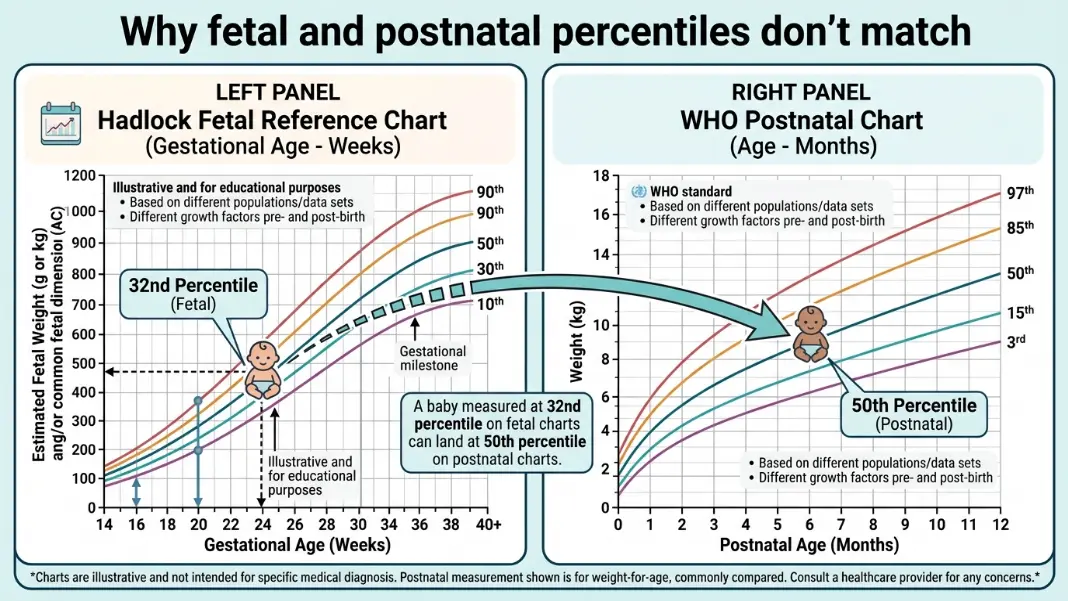
Baby percentile during pregnancy compares a scan's estimated fetal weight with a gestational-age reference curve. An ultrasound system first uses a named EFW equation—often a Hadlock variant—to turn biometry into grams; a separate reference curve turns that gram estimate into a percentile. Ultrasound uncertainty, chart choice, and the different postnatal WHO standard all help explain why fetal and postnatal percentiles may not match.
There is no safe, reliable way to target a higher fetal percentile with a specific food or supplement. Follow the prenatal team's individualized nutrition advice, avoid tobacco, and treat diagnosed deficiencies as directed. Suspected placental insufficiency requires obstetric surveillance; diet cannot substitute for it.
P10 and P90 are commonly used size thresholds, but no percentile guarantees a good outcome. SMFM recommends defining sonographic FGR as EFW or abdominal circumference below P10, with EFW below P3 classified as severe FGR. Growth velocity, Doppler, gestational age, dating, maternal conditions, and other findings determine the clinical meaning.
The ultrasound system combines selected biometry measurements in an EFW equation, then compares the estimated grams with a gestational-age reference curve. Check the report for both the EFW formula and the reference chart; using a curve developed for a different EFW equation can change the percentile.
SGA describes small size relative to gestational age and does not identify a cause. FGR is the clinical concern that growth is restricted. For prenatal ultrasound, SMFM recommends defining FGR as EFW or abdominal circumference below P10, then using Doppler, growth velocity, gestational age, and the wider clinical picture to guide care.
A lower percentile on a later scan can reflect real growth change, measurement variability, dating, or a different EFW equation or reference chart. There is no fixed percentile-point drop or required number of scans that answers this for every pregnancy. The obstetric team reviews the underlying biometry, interval, Doppler when indicated, and other risk factors.
Written by
Hassaan Rasheed
Web Developer & Content Researcher
Hassaan builds calculators and writes source-linked guides across the site's subject areas. Calculator methods and reference data are documented in each guide so readers can verify the underlying sources.
About the author and methods