InBody Scan vs DEXA Scan: Body Fat Accuracy Compared (2026)
InBody scan vs DEXA scan: how each measures body fat, where results diverge, and which test to choose based on your goal and budget.
Your gym's InBody machine prints 22% body fat. A DEXA scan a week later says 17%. Same body, two machines, a 5-point gap that changes the interpretation entirely. Neither device is broken. They are measuring body composition through fundamentally different physics, and that difference explains why the numbers rarely match.
Knowing which reading to trust matters for any calculation that uses body fat percentage as an input. The FFMI Calculator takes body fat percentage alongside height and weight to produce a lean mass score, and a 5-point error in that input shifts the FFMI result by over a point, enough to change the category. This guide explains exactly how each test works, what makes them disagree, and which one fits your situation.
How InBody and DEXA Measure Body Composition Differently#
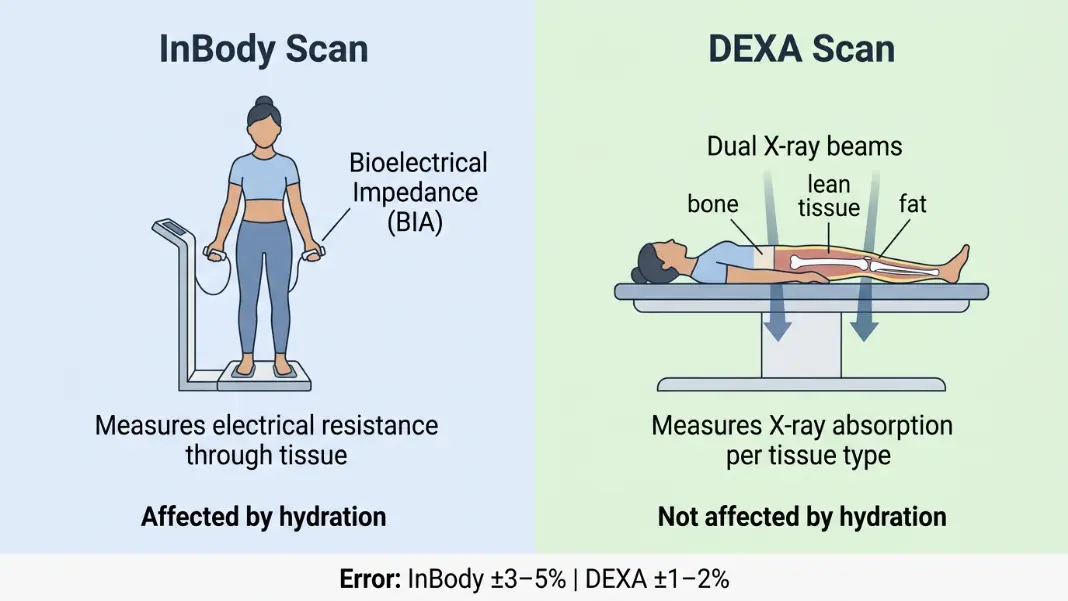
InBody uses bioelectrical impedance analysis (BIA). The machine sends a weak electrical current through your body and measures how strongly different tissues resist that current. Fat resists electricity more than muscle or water because fat contains very little water. By measuring this resistance (impedance) at multiple frequencies across different body segments, the software estimates how much of your weight is fat and how much is lean tissue.
The InBody 570 and 770 models use 8-point contact: electrodes on both hands and both feet. This multifrequency, segmental approach is more sophisticated than a cheap bathroom BIA scale, which typically uses a single frequency and only measures the lower body. Even so, the fundamental limitation of all BIA methods is the same: the calculation depends on tissue water content as a proxy for lean mass, which means hydration status directly affects the result.
DEXA (Dual-Energy X-ray Absorptiometry) works through X-ray physics. The scanner sends two beams at different energy levels through your body. Bone absorbs more X-ray energy than muscle, which absorbs more than fat. By measuring how much energy each tissue absorbs across thousands of scan points, the software builds a precise map of bone mineral, lean tissue, and fat mass. The result does not depend on hydration because it is measuring tissue composition through radiation absorption, not electrical resistance.
This physical difference is the root of every discrepancy between the two tests. DEXA is measuring what the tissues actually are. InBody is inferring what they might be based on how they conduct electricity, which changes hour to hour with your hydration state.
Accuracy Gap: Where InBody and DEXA Results Diverge#
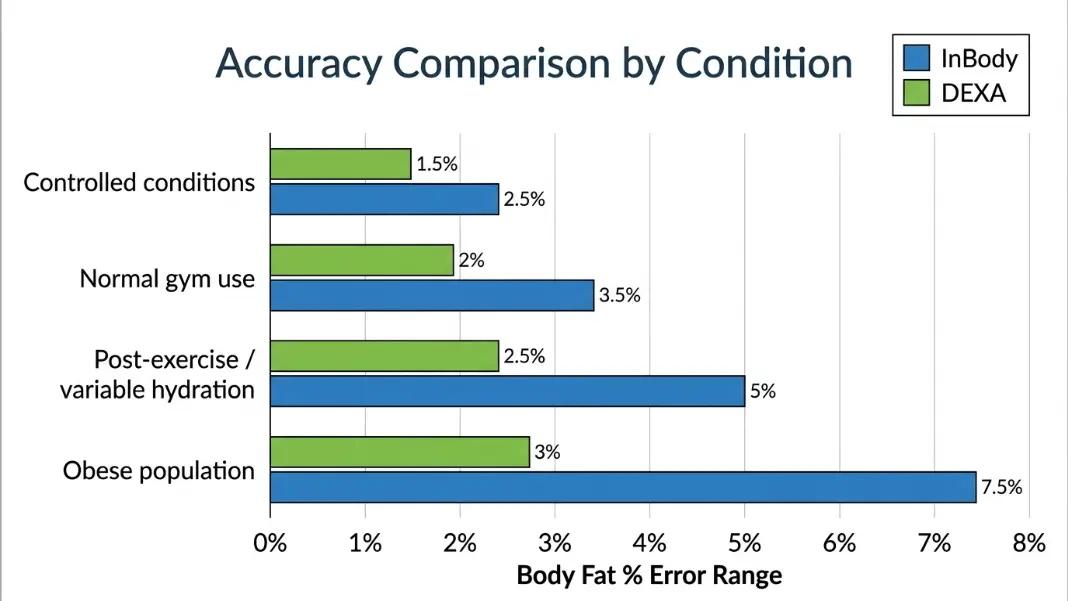
DEXA is consistently more accurate. In research comparisons with criterion methods (hydrostatic weighing and 4-compartment models), DEXA shows error margins of 1 to 3 percentage points for body fat. InBody in controlled conditions shows error margins of 3 to 5 percentage points in healthy adults, and up to 8 percentage points when hydration conditions vary.
The following situations cause the largest gaps between InBody and DEXA readings:
Hydration. This is the dominant variable for InBody accuracy. Being well-hydrated increases the water content of lean tissue, making it conduct electricity better, which the algorithm interprets as more lean mass and therefore lower body fat. Dehydration does the opposite. Research shows that drinking 500 ml of water immediately before an InBody scan can lower the body fat reading by 1 to 1.5 percentage points compared to a pre-hydration measurement, with no actual change in tissue composition.
Time of day. The human body is more hydrated first thing in the morning (from overnight immobility and fluid equilibration) and less hydrated after standing, exercise, or heat exposure. InBody scans taken in the morning consistently read lower body fat than afternoon scans of the same person.
Recent exercise. Resistance training causes micro-trauma in muscle fibers that triggers water retention in those muscles for 24 to 48 hours. This temporarily elevates the apparent lean mass in BIA, reading as lower body fat. A scan taken the day after heavy leg training will differ from a scan taken after three days of rest.
Menstrual cycle. Water retention during the luteal phase (days 14 to 28 of the cycle) affects BIA significantly. InBody body fat readings can vary by 2 to 4 percentage points across a single cycle in the same person.
Extremes of body composition. InBody tends to underestimate body fat in individuals with obesity and overestimate lean mass in very lean, highly trained athletes. DEXA performs more consistently across the full range of body compositions.
The following comparison shows typical error ranges under various conditions:
| Condition | InBody Error | DEXA Error |
|---|---|---|
| Controlled (fasted, standardized hydration) | ±2 to 3% | ±1 to 2% |
| Normal gym conditions | ±3 to 5% | ±1 to 2% |
| Post-exercise or variable hydration | ±5 to 8% | ±1 to 2% |
| Obese population | ±4 to 7% | ±2 to 3% |
| Lean athlete population | ±3 to 5% | ±1 to 2% |
DEXA's error stays consistent because it is not affected by hydration. InBody's error widens significantly under real-world conditions.
InBody Scan: What Actually Affects Your Reading#
Understanding what moves your InBody number is the practical key to using it correctly. If you cannot control the variables, the reading is not comparable across time.
The variables you can control:
Scan at the same time of day every time. Morning, fasted, before any exercise, is the most consistent window. Afternoon or post-workout scans are the least reproducible.
Do not eat or drink for at least 3 hours before scanning. Food and liquid in the GI tract conduct electricity and artificially inflate the lean mass reading.
Avoid scanning within 24 hours of intense resistance training. The water retention from muscle micro-trauma will underestimate your body fat temporarily.
Use the bathroom immediately before scanning. A full bladder adds measurable impedance variance.
Wear the same amount of clothing each time, remove shoes and socks, and stand still with the same posture and hand grip pressure.
The variables you cannot control:
Your natural hydration fluctuates even with a standardized protocol. Women experience hormonal fluid shifts that no preparation routine eliminates. Travel, heat, illness, and alcohol consumption all affect hydration independently. Even barometric pressure changes affect body water distribution.
This does not make InBody useless. It makes InBody a tool for tracking trends over time with a consistent protocol rather than a precise single-point measurement. The number it gives you on a given day may be 2 to 4 points off your true body fat. But if you measure monthly under the same conditions, the direction of movement (improving or declining) is meaningful even when the absolute number is not perfectly accurate.
What a DEXA Scan Report Actually Shows#
A DEXA report gives you significantly more information than a single body fat percentage.
Regional breakdown. DEXA distinguishes fat and lean mass separately for your arms, legs, and trunk. This is useful for identifying asymmetries in muscle development between left and right limbs, which is not something InBody can reliably detect. It also provides android (upper body, abdominal) and gynoid (hip and thigh) fat distribution, which carry different metabolic risk profiles.
Visceral fat. DEXA can estimate the visceral adipose tissue surrounding your organs separately from subcutaneous fat. Visceral fat is the metabolically active fat that correlates most strongly with insulin resistance, cardiovascular disease risk, and inflammation. Total body fat percentage does not tell you how much of it is visceral. DEXA does.
Bone mineral density. Every DEXA scan also shows T-scores and Z-scores for bone density. This is particularly relevant for older adults, female athletes in calorie-restricted phases, and anyone with a history of stress fractures. A body composition scan and a bone density assessment happen simultaneously.
Tracking small changes. DEXA is sensitive enough to detect lean mass changes of approximately 0.5 lbs. For a natural athlete in year 5 of training who might gain 2 to 3 lbs of lean mass annually, this sensitivity matters. InBody cannot reliably detect changes that small because its measurement noise exceeds the signal.
The same principle applies to tracking body fat loss during a cut. If you are trying to confirm that you lost primarily fat rather than lean mass during a 12-week cut, DEXA can distinguish a 2 lb lean mass loss from a 2 lb fat loss. InBody's margin of error at real-world measurement conditions makes that distinction unreliable.
This mirrors the reasoning behind using A1C instead of a single fasting glucose for blood glucose assessment. The A1C Calculator captures a 90-day picture rather than a single-moment snapshot, just as DEXA provides a precise tissue map rather than a conductance-based estimate. Both replace a noisier single-point measurement with something more structurally informative.
Which Test Fits Your Goal#
The right choice depends on what you are trying to learn and how often you plan to measure.
Use DEXA when:
You need body fat percentage for a precise calculation, such as FFMI or a body recomposition assessment. The FFMI Calculator Guide notes that a 5-point body fat error on a 185 lb frame moves the FFMI score by over a point. If that shift changes your interpretation category, it matters. DEXA's 1 to 2% error keeps you in the right category. InBody's 3 to 5% real-world error may not.
You are older and want bone density data alongside body composition. DEXA is the only commonly available test that provides both in a single scan.
You want to detect small lean mass changes from a training program. Annual or quarterly DEXA scans with a 0.5 lb detection threshold track natural athlete progress meaningfully.
You are identifying visceral fat specifically. Total body fat percentage does not distinguish visceral from subcutaneous, and visceral fat is the metabolically harmful fraction.
Use InBody when:
Your gym has it available and you want regular check-ins between quarterly DEXA scans. Monthly InBody scans with a standardized morning protocol give you directional trend data even if the absolute number is 2 to 4 points off.
You want segmental lean mass data without the cost of DEXA. InBody shows how much lean mass is in each limb, which is useful for monitoring rehabilitation progress after an injury.
Cost and access:
DEXA scans through dedicated body composition clinics cost $40 to $100 per session. Some sports medicine clinics and universities offer them at lower rates. InBody is often included in gym memberships or costs $10 to $25 per scan. If DEXA costs you $80 quarterly and InBody is free monthly, using DEXA for reference benchmarks and InBody for monthly direction-of-travel checks is the practical combination most serious trainees use.
For aerobic capacity assessed alongside lean mass, the VO2 Max Calculator estimates your cardiovascular fitness from submaximal test data. Tracking FFMI, body fat via DEXA, and VO2 max together gives a more complete fitness picture than any single metric provides on its own.
DEXA is more accurate. In controlled comparisons against criterion methods, DEXA shows error margins of 1 to 2 percentage points. InBody shows 3 to 5 percentage points under standardized conditions and up to 8 points with variable hydration. DEXA measures tissue through X-ray absorption, which is not affected by hydration. InBody uses electrical impedance, which changes with your hydration state, time of day, recent exercise, and hormonal cycle. For a single precise reading, DEXA is the more reliable choice.
The most common reason is hydration. InBody measures electrical resistance through tissue, and water conducts electricity better than fat. If you were better hydrated for one test than the other, the InBody reading shifts significantly. A 5-point gap between InBody and DEXA is normal and expected. DEXA is not affected by hydration because it measures X-ray absorption rather than conductance. Other factors that shift InBody readings include time of day, recent exercise, menstrual phase, and food or drink consumed before the scan.
InBody accuracy in controlled conditions (fasted, standardized hydration, same time of day) is approximately 3 to 5 percentage points of error compared to criterion methods. Under typical gym conditions with variable hydration and timing, the error range widens to 5 to 8 percentage points. InBody is more accurate than a single-frequency bathroom scale but less accurate than DEXA. For consistent tracking over time, a standardized InBody protocol produces meaningful trend data even when the absolute reading is imprecise.
A DEXA scan shows regional lean and fat mass separately for arms, legs, and trunk; visceral fat mass distinct from subcutaneous fat; bone mineral density with T-scores and Z-scores; and android versus gynoid fat distribution. It can detect lean mass changes as small as 0.5 lbs, which makes it useful for tracking natural athletes who gain 2 to 3 lbs of lean mass annually. Visceral fat and bone density data come automatically with every DEXA body composition scan at no additional cost.
Scan in the morning, fasted for at least 3 hours, before any exercise, with normal hydration the day before (avoid excessive water loading or restriction). Use the bathroom immediately before scanning. Remove shoes, socks, and extra clothing. Keep the same protocol every time you measure. Avoid scanning within 24 hours of intense resistance training, during the luteal phase of the menstrual cycle if you notice large variations, or after any activity that causes unusual fluid retention. Consistency of conditions matters more than any single preparation step.
Quarterly DEXA scans are sufficient for most people tracking body composition seriously. The cost of DEXA ($40 to $100 per scan) and the slow rate of lean mass change in trained individuals make more frequent DEXA testing unlikely to add information. InBody scans monthly, under a consistent standardized protocol, provide directional trend data between DEXA reference points. The practical combination is DEXA quarterly for accurate benchmarks and InBody monthly to confirm you are moving in the right direction.
Written by
Hassaan Rasheed
Web Developer & Content Researcher
Hassaan builds calculators and writes source-linked guides across the site's subject areas. Calculator methods and reference data are documented in each guide so readers can verify the underlying sources.
About the author and methods