Brix to ABV: How to Use a Refractometer for Alcohol Measurement (2026)
Brix from a refractometer converts to SG and potential ABV. Includes a Brix-to-SG table, the ABV formula, and correction for post-fermentation readings.
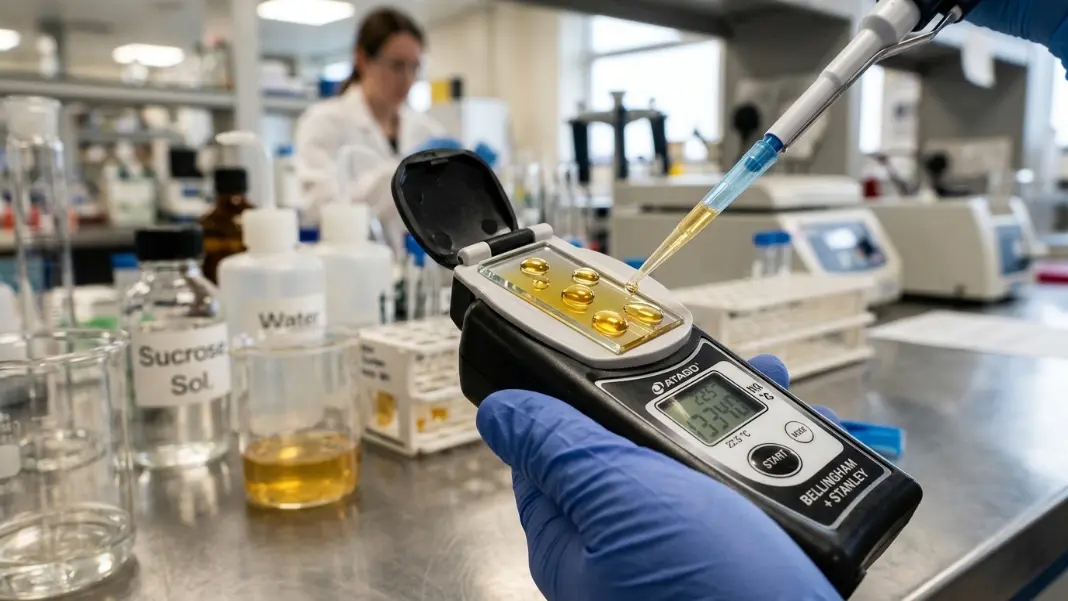
A refractometer gives you a Brix reading in seconds from a single drop of liquid. Before fermentation, that number converts directly to specific gravity and potential ABV. After fermentation, alcohol distorts the reading and a correction formula is required before the number means anything. Understanding both conversions is what separates an accurate pre-fermentation check from a useless post-fermentation guess. For the final ABV calculation from gravity readings, use the ABV Calculator.
How a Refractometer Works and How to Take a Reading#
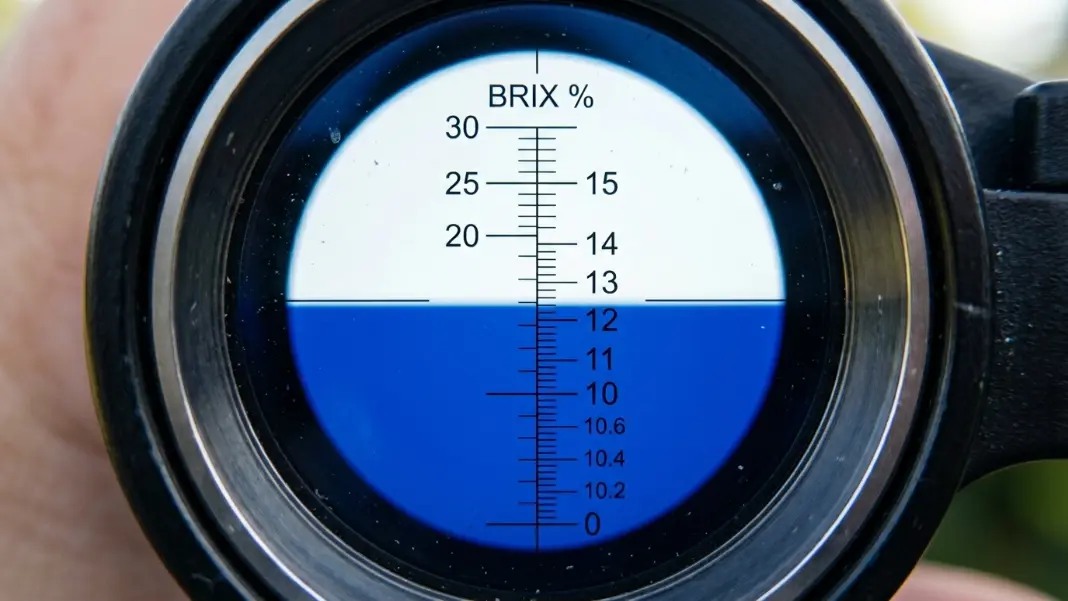
A refractometer measures how much a liquid bends (refracts) light. Dissolved sugars increase the refractive index of water. The more sugar present, the more light bends, and the higher the Brix reading. The instrument converts that bending angle into a Brix value displayed on an internal scale.
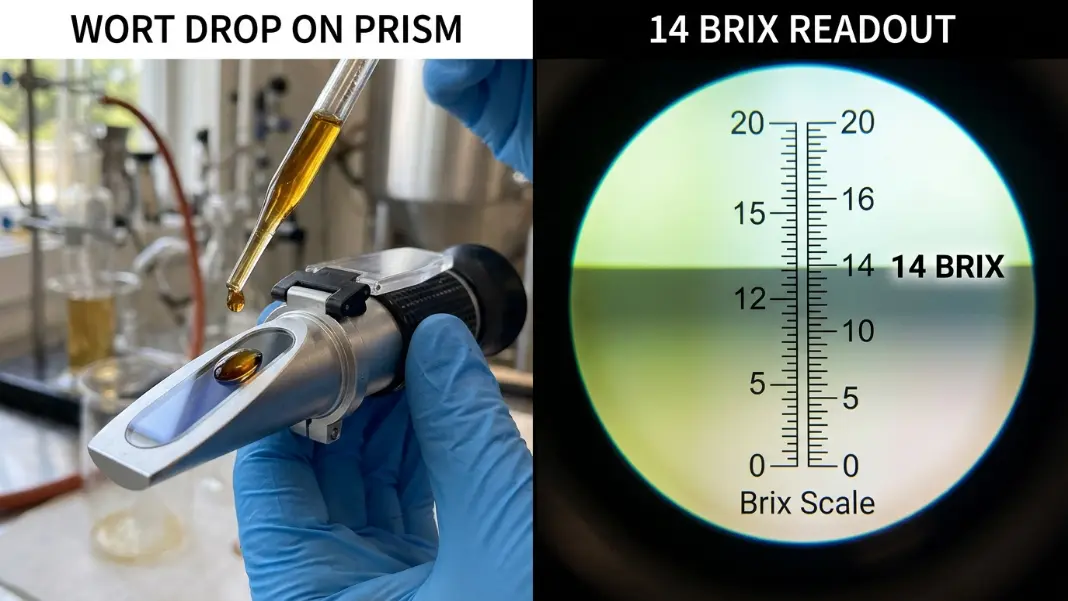
How to use a homebrew refractometer:
- Open the daylight plate and place 2-3 drops of sample on the prism
- Close the plate gently so the liquid spreads into a thin film without bubbles
- Hold the instrument toward a light source (a window or lamp)
- Look through the eyepiece and read the number at the boundary between the light and dark fields
- Rinse the prism with distilled water and dry with a soft cloth between samples
Most homebrew refractometers are calibrated for Brix and include a secondary scale showing approximate specific gravity. The SG scale on most instruments is calculated from the same Brix reading using the standard conversion, so reading directly from the SG scale is equivalent to converting Brix manually.
Calibration: Before each brewing session, place 2-3 drops of distilled water on the prism. The reading should show exactly 0.0 Brix. If it does not, use the calibration screw (usually on the side or top of the eyepiece) to zero the instrument. Calibration drift is common if the refractometer is stored in temperature extremes.
Temperature: Most ATC (automatic temperature compensation) refractometers correct for sample temperatures between 50°F and 86°F (10°C and 30°C). Take readings after the sample cools to below 86°F. For wort, cooling a small sample in a glass of ice water before measuring is faster than waiting for the full batch to cool.
Brix to Specific Gravity: Conversion Formula and Table#
Before fermentation, Brix and specific gravity measure the same thing: dissolved sugar concentration. The conversion between them is well established.
Simple approximation (accurate within 0.001 SG for most homebrew ranges):
SG = 1 + (Brix / 1000 × 4)
Or written differently: SG ≈ (Brix × 0.004) + 1
More precise formula used by laboratory instruments:
SG = 1 + (Brix / (258.6 - (Brix / 0.879) × 0.11))
Worked example:
A grape must reads 22 Brix on a refractometer.
Simple: SG = 1 + (22 × 0.004) = 1.088 Precise formula: SG ≈ 1.0917
The simple approximation gives 1.088 vs the precise value of 1.092. For most homebrewing decisions, the difference is negligible. Use the precise formula if you are entering the SG into the ABV Calculator for an accurate potential alcohol estimate.
Brix to specific gravity reference table:
| Brix | SG (Approx) | Typical Use |
|---|---|---|
| 5 | 1.020 | Very light beer, water kefir |
| 8 | 1.032 | Session ale, low-alcohol beer |
| 10 | 1.040 | Standard lager, session ale |
| 12 | 1.048 | American pale ale |
| 14 | 1.057 | IPA, amber ale |
| 16 | 1.065 | Strong ale |
| 18 | 1.074 | Belgian strong ale |
| 20 | 1.083 | Barleywine, dry table wine |
| 22 | 1.092 | High-sugar wine must |
| 24 | 1.100 | Dessert wine must |
| 26 | 1.110 | High-gravity wine, mead |
| 28 | 1.119 | Strong mead |
For winemaking, grape juice at harvest typically reads 20 to 26 Brix depending on variety and ripeness. For beer, target OG readings usually fall in the 10 to 20 Brix range.
Calculating Potential ABV from a Brix Reading#
Potential ABV is an estimate of how much alcohol a must or wort can produce if fermentation runs to completion.
Formula using specific gravity (most accurate):
Convert Brix to SG first, then use the standard ABV formula with an assumed final gravity:
Potential ABV ≈ (SG - estimated FG) × 131.25
For beer, a typical estimated FG is OG - 0.007 to OG - 0.010 depending on yeast attenuation.
Direct Brix-to-potential-ABV approximation (wine and cider):
Winemakers use a simplified rule that assumes near-complete fermentation:
Potential ABV ≈ Brix × 0.59
For beer (assumes 75% apparent attenuation):
Potential ABV ≈ Brix × 0.55
Worked examples:
A winemaker measures 23 Brix on a refractometer before adding yeast:
- Potential ABV = 23 × 0.59 = 13.6% ABV
A homebrewer measures 13 Brix on their wort before pitching:
- Potential ABV = 13 × 0.55 = 7.2% ABV (at 75% attenuation)
Using the SG-based formula is more precise because it accounts for your specific yeast strain's expected attenuation. The Brix multiplier method is a quick field estimate, not a final calculation.
For a detailed walkthrough of the full OG-to-FG ABV calculation, see How to Calculate ABV for Homebrewers.
Post-Fermentation Refractometer Correction#
This is where most homebrewers go wrong with refractometers. Once alcohol is present in the sample, it changes the refractive index independently of sugar content. A refractometer reading taken from fermented beer or wine is not a true Brix reading. It is an apparent Brix reading that reads higher than the actual residual sugar would indicate.
If you take a refractometer reading from fully fermented beer and treat it as the final gravity without correction, your calculated ABV will be significantly lower than the actual value.
Why alcohol distorts the reading:
Ethanol has a different refractive index than water. At a given sugar concentration, a liquid containing 6% ABV bends light more than the same liquid with no alcohol. The refractometer cannot distinguish between sugar and alcohol as sources of increased refraction, so it reports an inflated Brix number.
The Terrill correction formula (simplified linear version):
Corrected FG = 1.001843
             - 0.002318474 × Brix_OG
             + 0.00574 × Brix_FG
Where:
- Brix_OG = the original Brix reading taken before fermentation
- Brix_FG = the apparent Brix reading taken after fermentation (from the refractometer)
- Corrected FG = the actual final gravity in SG units
Worked example:
- Brix_OG = 13.5
- Brix_FG (apparent, post-fermentation) = 5.2
Corrected FG = 1.001843 - (0.002318474 × 13.5) + (0.00574 × 5.2)
             = 1.001843 - 0.031299 + 0.029848
             = 1.000392
Then convert OG from Brix to SG: SG ≈ 1 + (13.5 × 0.004) = 1.054
ABV = (1.054 - 1.000392) × 131.25 = 0.053608 × 131.25 = 7.0% ABV
Without correction (wrong approach):
Converting apparent FG of 5.2 Brix directly to SG: 1 + (5.2 × 0.004) = 1.021 ABV = (1.054 - 1.021) × 131.25 = 4.3% ABV
The uncorrected result is 4.3% vs the corrected 7.0%. That is a significant error for a 7% beer. Never use a raw post-fermentation refractometer reading as your final gravity without applying a correction.
The full higher-order Terrill formula adds additional polynomial terms for greater accuracy at extreme gravities. For most standard homebrew situations (OG under 1.100, FG above 1.005), the simplified version above is sufficient.
Refractometer vs Hydrometer: Which to Use for Homebrew#
Both instruments measure sugar concentration, but they have different strengths and limitations that make each better suited for specific situations.
Where a refractometer wins:
Taking a sample during the mash or kettle requires only 2-3 drops of wort, compared to the 100-150 ml a hydrometer needs. This means less wort lost to gravity samples over the course of a brew day. For frequent mid-mash checks to verify your target OG is on track, a refractometer is faster and wastes less liquid.
Refractometers also do not require temperature corrections in the same way a hydrometer does. A hydrometer calibrated at 60°F gives inaccurate readings if the sample is significantly warmer. While hot wort should still be cooled before measuring, ATC refractometers handle moderate temperature variation automatically.
Where a hydrometer wins:
After fermentation starts, a hydrometer is the more reliable instrument for monitoring gravity without running a correction formula. A hydrometer directly measures liquid density regardless of ethanol content. The reading reflects the true specific gravity of the fermented liquid. For final gravity measurements that feed directly into an ABV calculation, a hydrometer eliminates the need for the post-fermentation correction step entirely.
Recommended workflow:
Use a refractometer for OG checks on brew day. Take the OG reading with both a refractometer and a hydrometer once to verify they agree, then rely on the refractometer for the convenience of small samples. For FG checks after fermentation, switch to a hydrometer to avoid the correction formula step. If you only own a refractometer, apply the Terrill correction before calculating ABV.
For a complete guide on hydrometer technique and temperature correction, see Using a Hydrometer to Measure ABV.
A refractometer cannot directly confirm completion because alcohol distorts the reading. Instead, take two corrected FG readings 48 to 72 hours apart and apply the Terrill correction formula to both. If the corrected FG values match, fermentation has likely finished. A stabilized apparent Brix reading alone is not sufficient confirmation because the refractometer reading reflects both residual sugar and alcohol content.
A refractometer is accurate for pre-fermentation OG measurements, typically within 0.001 to 0.002 SG of a hydrometer reading. For post-fermentation measurements, accuracy depends entirely on applying the correct correction formula. Without the Terrill or equivalent correction, post-fermentation refractometer readings will underestimate ABV by 2 to 4 percentage points on a typical homebrew batch. With the correction applied, accuracy comes within about 0.3 to 0.5% ABV of the true value.
Yes, but you must apply a correction formula. Alcohol changes the refractive index of the liquid independently of sugar content, causing the refractometer to report an inflated apparent Brix value. The Terrill correction formula takes both the original Brix reading (pre-fermentation) and the apparent final Brix reading (post-fermentation) and calculates the corrected final gravity in SG units, which you can then use to calculate ABV accurately.
For pre-fermentation potential ABV, multiply Brix by 0.59 for wine and cider (assuming near-complete fermentation) or by 0.55 for beer (assuming 75% attenuation). For a more accurate estimate, convert Brix to SG using SG = 1 + (Brix × 0.004), then subtract your expected final gravity and multiply by 131.25. For actual ABV after fermentation, use the Terrill-corrected FG in the standard formula: ABV = (OG - corrected FG) × 131.25.
Most table wine grapes are harvested at 20 to 24 Brix, producing wines between 11% and 14% ABV. Dessert wine grapes and late-harvest styles may reach 26 to 32 Brix, producing wines above 15% ABV or leaving residual sweetness if fermentation is stopped early. Sparkling wine grapes are typically harvested at lower Brix, around 17 to 20, to preserve acidity. Below 18 Brix, most grapes will not produce enough alcohol for a stable wine without chaptalization (adding sugar before fermentation).
Ethanol has a higher refractive index than water at equivalent concentrations. Once your must or wort contains alcohol, the refractometer reads the combined effect of dissolved sugars and dissolved alcohol, not sugars alone. This causes the instrument to report a Brix value that is higher than the true residual sugar level. The result is an apparent gravity that is higher than the actual gravity, which leads to an underestimate of ABV if no correction is applied. Use the Terrill correction formula with both your original Brix reading and the post-fermentation apparent reading to get an accurate final gravity.
Written by
Hassaan Rasheed
Web Developer & Content Researcher
Hassaan builds calculators and writes source-linked guides across the site's subject areas. Calculator methods and reference data are documented in each guide so readers can verify the underlying sources.
About the author and methods