Trig Antiderivatives Table: Sin, Cos, Tan, Sec, Csc & Cot
Calculate seven common trig antiderivatives with substitution steps and a derivative check, then use the sin, cos, tan, sec, csc and cot reference table.
Trig antiderivatives do not all follow one obvious pattern. The power rule handles polynomials mechanically, while integrating trig functions requires recognizing several derivative identities. Knowing why each result works makes the formulas easier to recall and verify.
Use the worksheet below for a single sine, cosine, tangent, secant-squared, cosecant-squared, secant-times-tangent, or cosecant-times-cotangent term. It accepts a constant multiplier and a linear inner expression such as 3sin(2x+1), shows the substitution, and checks the result by differentiation. Angles are in radians. Unsupported forms receive an explanation instead of a guessed answer.
Integration worksheet · radians
Trig antiderivative calculator
Integrate one supported trig term with a linear inner expression ax+b. See the substitution, exact coefficient, and derivative check.
Antiderivative
Substitution and integration
- Let u = 2x+1. Then du = 2 dx, so dx = du / 2.
- Take the constant outside: k/a = 3 / 2 = (3/2).
- Reverse the standard trig derivative, then multiply by k/a: ∫ 3sin(2x+1) dx = -(3/2)cos(2x+1) + C.
Differentiate to check
F′(x) = -(3/2) × [−sin(2x+1)] × 2 = 3sin(2x+1). The inner derivative cancels the division by a; C differentiates to zero.
Angles are in radians. The identity holds for every real x; C is an arbitrary constant.
Check agrees at x = 0.25.
f(x) = 2.99248496
Numerical F′(x) ≈ 2.99248496
The centered difference uses nearby F values. Agreement at one point is a numerical check; the chain-rule identity above explains the result.
Rule references: OpenStax antiderivatives and substitution. Calculations stay in this page.
The reference table also includes standalone sec, csc, and cot; those three forms are explained in the guide but are outside the worksheet's scope. For sums of powers, use the Antiderivative Calculator. General sums, nonlinear substitutions, exponential functions and integration by parts require other techniques.
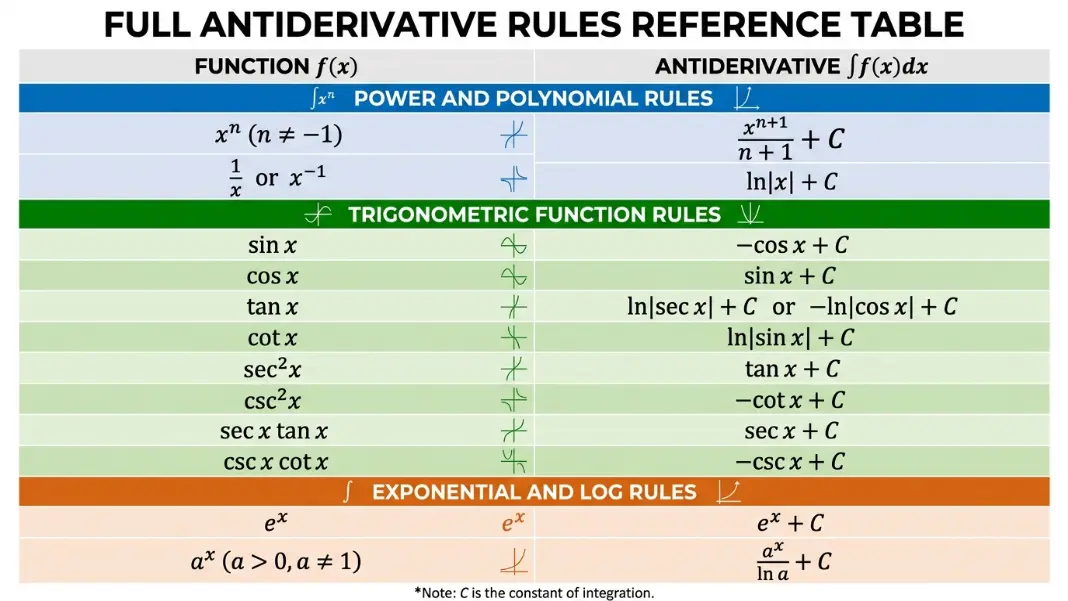
Trig Antiderivatives Quick Reference Table#
| Function f(x) | Antiderivative ∫ f(x) dx |
|---|---|
| sin x | -cos x + C |
| cos x | sin x + C |
| tan x | -ln|cos x| + C = ln|sec x| + C |
| cot x | ln|sin x| + C |
| sec x | ln|sec x + tan x| + C |
| csc x | -ln|csc x + cot x| + C |
| sec²x | tan x + C |
| csc²x | -cot x + C |
| sec x tan x | sec x + C |
| csc x cot x | -csc x + C |
These formulas assume angles are measured in radians. Each identity applies on an interval where the integrand and logarithmic expression are defined; the constant C can differ between disconnected intervals.
Antiderivative Symbol and Notation#
Before working through trig antiderivatives, the notation needs to be clear. The integral sign ∫ is the antiderivative symbol. A full indefinite integral is written as:
∫ f(x) dx = F(x) + C
Each part has a specific meaning:
| Symbol | Meaning |
|---|---|
| ∫ | Integral sign (elongated S, from "summa") |
| f(x) | The integrand, the function being integrated |
| dx | The variable of integration (with respect to x) |
| F(x) | The antiderivative, any function whose derivative is f(x) |
| + C | Constant of integration, represents all possible antiderivatives |
The notation ∫ f(x) dx is read as "the integral of f of x with respect to x." The dx is not optional, it tells you which variable is being integrated when more than one variable appears.
The relationship between derivative and antiderivative: if F'(x) = f(x), then ∫ f(x) dx = F(x) + C. Integration reverses differentiation.
Antiderivative of Sin x and Cos x#
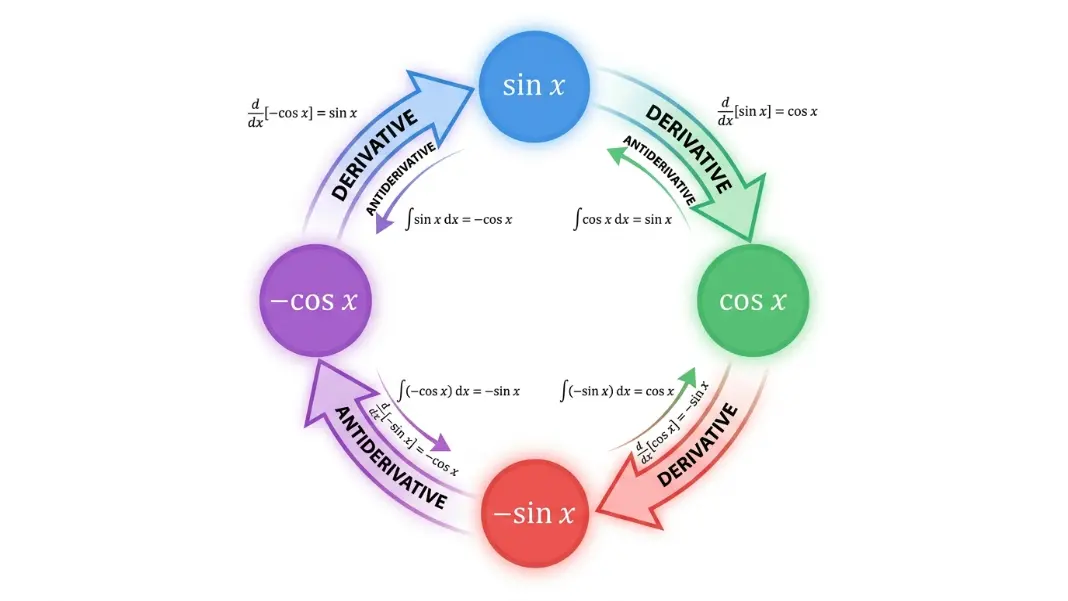
The simplest trig antiderivatives come from reversing the standard derivative rules for sine and cosine.
Derivative facts to remember:
- d/dx(sin x) = cos x
- d/dx(cos x) = -sin x
- d/dx(-cos x) = sin x
- d/dx(sin x) = cos x
Working backwards from these:
∫ sin x dx = -cos x + C
∫ cos x dx =  sin x + C
Why -cos x for sin x? Because the derivative of -cos x is -(-sin x) = sin x. The negative sign is essential. A common exam error is writing ∫ sin x dx = cos x + C, which is wrong, differentiating cos x gives -sin x, not sin x.
Worked examples:
Find ∫ 4 sin x dx:
= 4 ∫ sin x dx        [pull the constant out]
= 4(-cos x) + C
= -4 cos x + C
Verify: d/dx(-4 cos x) = -4(-sin x) = 4 sin x ✓
Find ∫ (3 cos x - sin x) dx:
= 3 ∫ cos x dx - ∫ sin x dx
= 3 sin x - (-cos x) + C
= 3 sin x + cos x + C
Verify: d/dx(3 sin x + cos x) = 3 cos x + (-sin x) = 3 cos x - sin x ✓
For compound angle forms like ∫ sin(2x) dx, a substitution is needed: let u = 2x, du = 2 dx. Then ∫ sin(2x) dx = (1/2) ∫ sin u du = -(1/2) cos(2x) + C.
Antiderivative of Tan x and Cot x#
Tangent and cotangent antiderivatives both produce logarithmic results. This is because neither has a simple polynomial antiderivative, their integration requires recognizing a u-substitution pattern.
Antiderivative of tan x:
Write tan x = sin x / cos x. Let u = cos x, so du = -sin x dx, which means sin x dx = -du.
∫ tan x dx = ∫ (sin x / cos x) dx
           = ∫ (-1/u) du
           = -ln|u| + C
           = -ln|cos x| + C
           = ln|sec x| + C
Both forms (-ln|cos x| + C and ln|sec x| + C) are correct since sec x = 1/cos x.
Antiderivative of cot x:
Write cot x = cos x / sin x. Let u = sin x, so du = cos x dx.
∫ cot x dx = ∫ (cos x / sin x) dx
           = ∫ (1/u) du
           = ln|u| + C
           = ln|sin x| + C
Quick summary:
| f(x) | ∫ f(x) dx |
|---|---|
| tan x | -ln|cos x| + C = ln|sec x| + C |
| cot x | ln|sin x| + C |
Worked example, find ∫ 5 tan x dx:
= 5 ∫ tan x dx
= 5(-ln|cos x|) + C
= -5 ln|cos x| + C
The absolute value bars matter. Without them the expression is undefined for cos x < 0.
Antiderivative of Sec x, Csc x, and Their Combinations#
The antiderivatives of secant and cosecant are the most unusual results in basic calculus. They are not intuitive and must be memorized with understanding.
Antiderivative of sec²x and csc²x:
These come directly from derivative reversal:
- d/dx(tan x) = sec²x, so ∫ sec²x dx = tan x + C
- d/dx(-cot x) = csc²x, so ∫ csc²x dx = -cot x + C
Antiderivative of sec x tan x and csc x cot x:
- d/dx(sec x) = sec x tan x, so ∫ sec x tan x dx = sec x + C
- d/dx(-csc x) = csc x cot x, so ∫ csc x cot x dx = -csc x + C
Antiderivative of sec x (the full form):
The antiderivative of sec x itself requires a trick: multiply top and bottom by (sec x + tan x):
∫ sec x dx = ∫ sec x · (sec x + tan x)/(sec x + tan x) dx
           = ∫ (sec²x + sec x tan x)/(sec x + tan x) dx
Let u = sec x + tan x, then du = (sec x tan x + sec²x) dx, which is exactly the numerator.
= ∫ (1/u) du
= ln|u| + C
= ln|sec x + tan x| + C
Antiderivative of csc x:
Using a similar approach with multiply by (csc x + cot x)/(csc x + cot x):
∫ csc x dx = -ln|csc x + cot x| + C
An equivalent form is ln|csc x - cot x| + C.
Antiderivative of 1/x and Exponential Functions#
These fall outside trig but are frequently needed alongside trig integrals in calculus problems.
Antiderivative of 1/x:
∫ (1/x) dx = ln|x| + C (x not equal to 0)
This is the special case of the power rule at n = -1. The power rule gives x^(n+1)/(n+1), which requires dividing by zero when n = -1. The correct result is the natural logarithm. The absolute value is required because ln is only defined for positive arguments, but 1/x is defined for negative x too.
Antiderivative of e^x and e^(kx):
∫ e^x dx   = e^x + C
∫ e^(kx) dx = (1/k) e^(kx) + C     (k not equal to 0)
The factor of 1/k comes from the chain rule in reverse: d/dx[(1/k)e^(kx)] = (1/k) · k · e^(kx) = e^(kx).
Examples:
- ∫ e^(2x) dx = (1/2)e^(2x) + C
- ∫ e^(-x) dx = -e^(-x) + C
- ∫ e^(3x) dx = (1/3)e^(3x) + C
Antiderivative of ln x:
∫ ln x dx requires integration by parts (u = ln x, dv = dx):
∫ ln x dx = x ln x - x + C
Verify: d/dx(x ln x - x) = ln x + x · (1/x) - 1 = ln x + 1 - 1 = ln x ✓
Antiderivative of a^x (general exponential base):
∫ a^x dx = a^x / ln(a) + C (a > 0, a not equal to 1)
For physics problems where acceleration is a trig or polynomial function and you need to recover velocity or position by integration, the Acceleration Calculator shows how kinematic equations relate velocity and acceleration, the same relationship that integration formalizes.
Inverse Trig Antiderivatives#
Two antiderivatives produce inverse trig functions and appear frequently in calculus II:
∫ 1/(1 + x²) dx  = arctan x + C
∫ 1/√(1 - x²) dx = arcsin x + C
These come from reversing the derivative formulas for arctan and arcsin:
- d/dx(arctan x) = 1/(1 + x²)
- d/dx(arcsin x) = 1/√(1 - x²)
For scaled versions:
∫ 1/(a² + x²) dx = (1/a) arctan(x/a) + C
∫ 1/√(a² - x²) dx = arcsin(x/a) + C
The scaled formulas above assume a > 0; the arcsine formula applies on -a < x < a. They follow by substituting u = x/a. For data fitting with polynomial bases, the Interpolation Calculator shows how an interpolating polynomial is constructed.
The antiderivative of sin x is -cos x + C. This comes from reversing the derivative rule: d/dx(-cos x) = -(-sin x) = sin x. The negative sign is required. Writing cos x + C is a common error, differentiating cos x gives -sin x, not sin x.
The antiderivative of 1/x is ln|x| + C. This is the special case of the power rule at exponent -1, where the standard formula x^(n+1)/(n+1) would require dividing by zero. The absolute value is necessary because 1/x is defined for negative x but ln is only defined for positive arguments. For 1/(2x), the result is (1/2) ln|x| + C by factoring out the constant.
The antiderivative of tan x is -ln|cos x| + C, which is equivalent to ln|sec x| + C. This is found by writing tan x as sin x / cos x and applying a u-substitution with u = cos x. Both forms are correct. The absolute value bars are required since the expression is valid for values where cos x is negative.
The antiderivative symbol is ∫, called the integral sign. It is an elongated S, derived from the Latin word "summa" (sum). The full notation ∫ f(x) dx means "the antiderivative of f(x) with respect to x." The dx is not decorative, it specifies the variable of integration and is required as part of correct integral notation.
The antiderivative of ln x is x ln x - x + C. This result requires integration by parts with u = ln x and dv = dx. Verification: d/dx(x ln x - x) = ln x + x(1/x) - 1 = ln x + 1 - 1 = ln x. The result surprises many students because it involves both ln x and a polynomial term.
The antiderivative of sec²x is tan x + C. This comes from reversing the derivative rule: d/dx(tan x) = sec²x. Similarly, the antiderivative of csc²x is -cot x + C, since d/dx(-cot x) = csc²x. These two are among the most-used trig antiderivatives because sec²x and csc²x appear frequently when integrating expressions involving tangent and cotangent substitutions.
References
Written by
Hassaan Rasheed
Web Developer & Content Researcher
Hassaan builds calculators and writes source-linked guides across the site's subject areas. Calculator methods and reference data are documented in each guide so readers can verify the underlying sources.
About the author and methods