How to Find the Antiderivative: Power Rule and Polynomial Guide (2026)
Find common power, polynomial, exponential and log antiderivatives with worked examples. Check coefficients, integration constants and domains by differentiation.
For 6x², an antiderivative is 2x³, because differentiating 2x³ gives 6x². The general family is 2x³ + C. The power rule adds one to the exponent, then divides by the new exponent. The Antiderivative Calculator accepts bounded sums of decimal powers; its separate trig worksheet accepts seven supported forms with a linear inner expression. It is not a general symbolic integrator. Exponential and nonlinear substitution examples below explain hand methods beyond the editor's supported input.
An antiderivative is a function whose derivative equals the integrand on the interval in question. If f'(x) = 6x², then f(x) = 2x³ + C describes the general family. A request for one antiderivative can be answered with 2x³; a request for the general indefinite integral needs the arbitrary constant.
This guide covers the power rule, polynomial antiderivatives, exponential and logarithm cases, u-substitution for composite functions, and the most frequent mistakes. Trig function antiderivatives have their own set of identities and are covered separately.
The Power Rule for Antiderivatives#
The power rule is the most-used formula in basic integration:
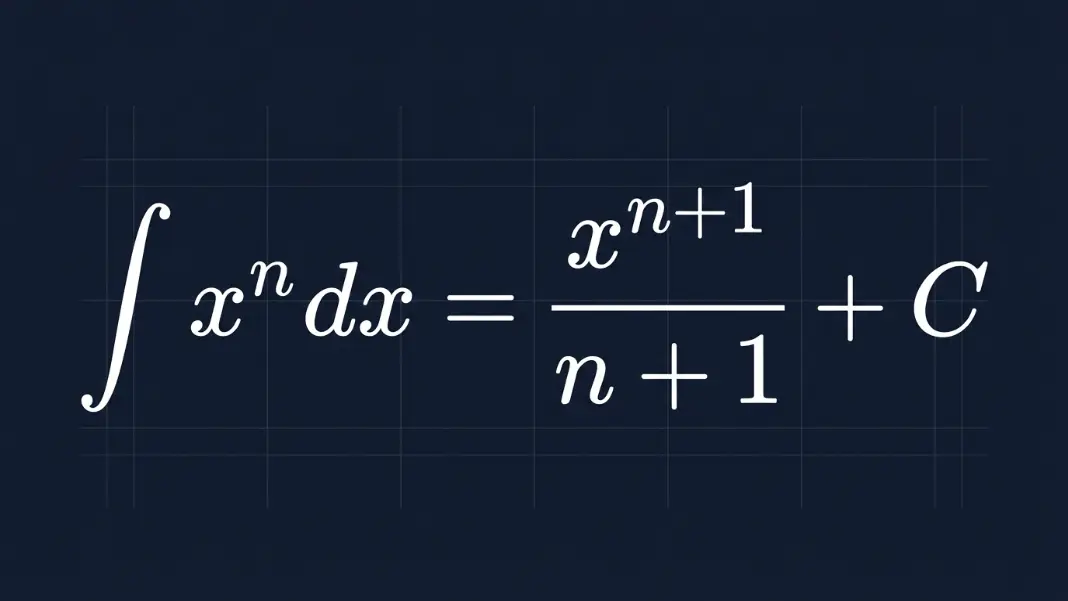
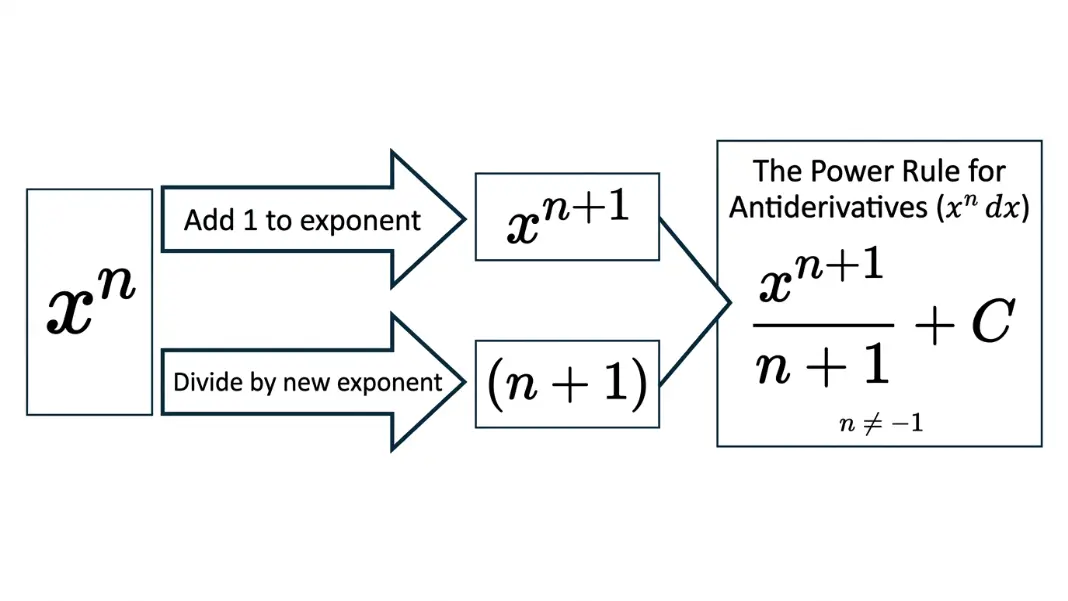
∫ xⁿ dx = x^(n+1) / (n+1) + C where n ≠ -1
Add one to the exponent, divide the coefficient by that new exponent. Two operations, applied in that order.
Worked examples:
- ∫ x⁴ dx: exponent becomes 5, divide 1 by 5: x⁵/5 + C
- ∫ 3x² dx: exponent becomes 3, divide 3 by 3: x³ + C
- ∫ x⁻³ dx: exponent becomes −2, divide 1 by −2: −x⁻²/2 + C
- ∫ √x dx = ∫ x^(1/2) dx: exponent becomes 3/2, divide by 3/2: (2/3)x^(3/2) + C
The rule works for negative and fractional exponents, with n ≠ −1, on intervals where the real powers are defined and differentiable. For a general real exponent, x > 0 is a suitable domain; some integer or rational powers allow more. The n = −1 case is ∫ 1/x dx = ln|x| + C on either side of zero, a separate rule covered below. In the calculator, write x^0.5 for the square-root example; slash fractions such as x^(1/2) are outside the power editor's syntax.
Constants: ∫ k dx = kx + C. A constant k is effectively k · x⁰, and applying the power rule gives k · x¹/1 = kx.
Polynomials: Applying the Power Rule Term by Term#
Polynomials are antidifferentiated term by term. Apply the power rule to each term separately, then combine.
Example: ∫ (4x³ − 6x² + 2x − 5) dx
- ∫ 4x³ dx = 4 · x⁴/4 = x⁴
- ∫ −6x² dx = −6 · x³/3 = −2x³
- ∫ 2x dx = 2 · x²/2 = x²
- ∫ −5 dx = −5x
Result: x⁴ − 2x³ + x² − 5x + C
Only one C is needed regardless of the number of terms. Each term technically produces its own constant, but they all collapse into a single C.
Verification by differentiation: Take the derivative of x⁴ − 2x³ + x² − 5x. You get 4x³ − 6x² + 2x − 5, which matches. This is the fastest check for any antiderivative: differentiate it and confirm you get the original function back.
Fractional coefficients are treated the same way. For ∫ (x²/3 + x/4) dx:
- ∫ x²/3 dx = (1/3) · x³/3 = x³/9
- ∫ x/4 dx = (1/4) · x²/2 = x²/8
Result: x³/9 + x²/8 + C
Antiderivative Rules for Exponential and Log Functions#
Three rules handle the most common non-polynomial cases:
∫ eˣ dx = eˣ + C
∫ aˣ dx = aˣ / ln(a) + C     (a > 0, a ≠ 1)
∫ 1/x dx = ln|x| + C
The function eˣ is its own antiderivative. That is not a coincidence: e is defined so that this property holds, which is why it appears throughout calculus, differential equations, and complex analysis.
For base-a exponentials:
∫ 2ˣ dx = 2ˣ / ln(2) + C. Since ln(2) ≈ 0.693, this is approximately 2ˣ / 0.693 + C. For base 10: ∫ 10ˣ dx = 10ˣ / ln(10) + C ≈ 10ˣ / 2.303 + C.
For the log rule:
∫ 1/x dx = ln|x| + C. The absolute value is required when x can be negative, because ln(x) is only defined for positive x. If the problem specifies a domain of positive x, ln(x) + C is acceptable. Exams that require full generality need the absolute value.
This is the case the power rule cannot handle. Applying ∫ x⁻¹ dx with the power rule gives x⁰/0, which is undefined. The ln|x| result stands on its own.
The same relationship between differentiation and antidifferentiation extends to multivariable functions, which the Partial Derivative Calculator handles when you need to differentiate in one variable while treating others as constants.
U-Substitution: When the Power Rule Does Not Apply Directly#
U-substitution handles integrals of composite functions. The method reverses the chain rule from differentiation.
When to use it: Look for a function and its derivative both present in the integrand. The pattern: ∫ f(g(x)) · g'(x) dx.
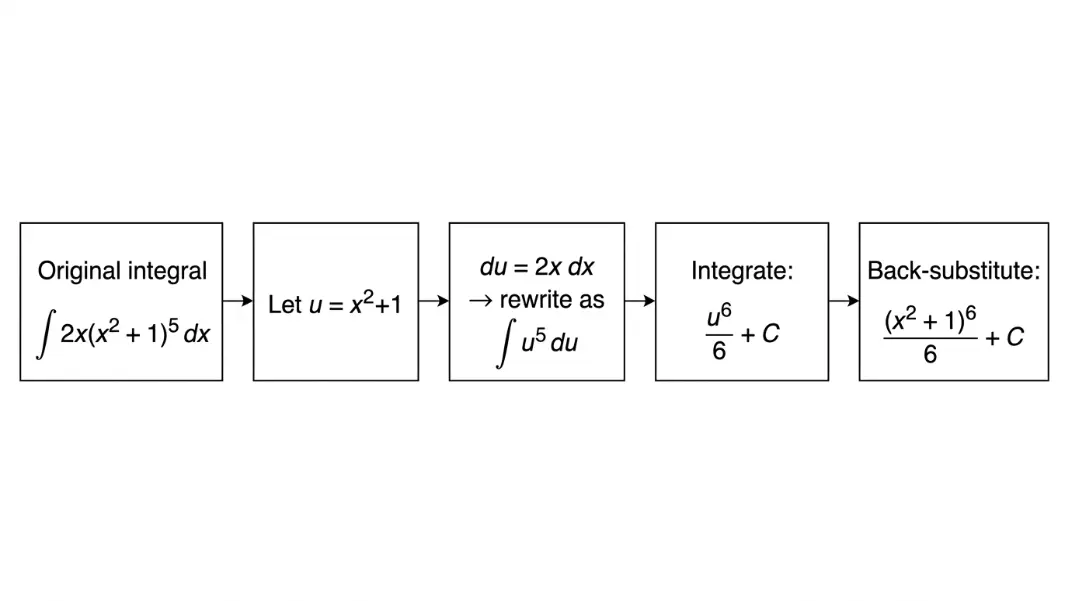
Example: ∫ 2x(x² + 1)⁵ dx
Let u = x² + 1. Then du/dx = 2x, so du = 2x dx.
∫ 2x(x² + 1)⁵ dx = ∫ u⁵ du = u⁶/6 + C = (x² + 1)⁶/6 + C
The 2x and dx pair becomes du exactly, so the substitution works cleanly.
Example: ∫ cos(3x) dx
Let u = 3x. Then du = 3 dx, so dx = du/3.
∫ cos(3x) dx = ∫ cos(u) · du/3 = (1/3) sin(u) + C = (1/3) sin(3x) + C
Check the differential: ∫ (x² + 1)⁵ dx does not yield (x² + 1)⁶/6 + C: differentiating that answer introduces an extra 2x. Without the matching factor, the direct substitution above does not reduce to a simple power integral in u. Other substitutions may still help; for this polynomial, expanding the binomial and integrating term by term is one method.
One Antiderivative Versus the General Family#
Use + C when presenting the general indefinite integral. If asked for one antiderivative, selecting a particular constant is enough.
The functions x³ + 5, x³ − 7, and x³ are all valid antiderivatives of 3x². On a connected interval, any two antiderivatives of the same function differ by a constant. If the domain consists of separate intervals, such as x < 0 and x > 0 for 1/x, their constants can be chosen independently.
Solving for C from initial conditions:
When a specific point on f(x) is known, you can find the particular antiderivative.
Given f'(x) = 3x² and f(0) = 5:
f(x) = x³ + C
f(0) = 5: 0³ + C = 5 → C = 5
Particular solution: f(x) = x³ + 5
This function passes through (0, 5). The general form x³ + C covers every vertical shift of x³, while x³ + 5 is the one that satisfies the initial condition.
When evaluating a proper definite integral using an antiderivative on the interval, the same C cancels between the bounds. A condition such as f(0) = 5 instead selects a particular member of the family.
For the complete set of antiderivative rules for sin, cos, tan, sec, csc, and cot, the Antiderivative of Trig Functions guide covers each identity with worked examples.
Checking Your Antiderivative: Differentiation as Verification#
Differentiate your answer and compare it with the original integrand throughout the stated interval. For these elementary examples, the check is short. Agreement at a single numerical point is useful evidence but does not prove a functional identity.
For ∫ 3x² dx = x³ + C: differentiate x³ + C to get 3x². Matches. Correct.
For the polynomial from the section above: differentiate x⁴ − 2x³ + x² − 5x + C. The result is 4x³ − 6x² + 2x − 5, which is the original integrand. Correct.
This check exposes the errors that are hardest to catch by inspection:
Coefficient errors after the power rule. If you wrote ∫ 5x⁴ dx = 5x⁵ + C instead of x⁵ + C, differentiating 5x⁵ gives 25x⁴, not 5x⁴. The mismatch is immediate.
Absolute value dropped in ln|x|. The derivative of ln|x| is 1/x for all x ≠ 0. If you wrote ln(x) and the domain includes negative values, the function is undefined there. The verification step forces you to confirm the domain is handled correctly.
Back-substitution errors after u-substitution. Once you substitute back from u to x, differentiate the full result. Any constant placed in the wrong position or incorrect chain rule reversal surfaces when the derivative does not match the original integrand.
A derivative check tests the sign, coefficient and functional form together. It complements arithmetic checks; follow any working and notation requirements in your course.
The Math Calculators section covers antiderivatives, derivatives, matrix operations, and statistical tools in one place.
The power rule states that ∫ xⁿ dx = x^(n+1)/(n+1) + C, where n can be any real number except −1. Add one to the exponent and divide the coefficient by the new exponent. For example, ∫ 4x³ dx = 4 · x⁴/4 + C = x⁴ + C. The rule applies to negative and fractional exponents. When n = −1, use ∫ 1/x dx = ln|x| + C.
The antiderivative of a constant k is kx + C. For example, ∫ 7 dx = 7x + C. A constant can be treated as k · x⁰, and the power rule gives k · x¹/1 = kx. You can verify by differentiating: d/dx(7x + C) = 7, which is the original constant.
The constant is required to describe the general family on an interval, provided an antiderivative exists there. One specific antiderivative need not display an arbitrary constant. For example, x³, x³ + 2, and x³ − 9 each differentiate to 3x². An initial condition can select one member of the family. Separate intervals may have independently chosen constants.
An especially direct case is ∫ f(g(x)) · g'(x) dx. Let u = g(x), write du = g'(x) dx, and rewrite the integrand and differential consistently. If the matching factor is absent, that substitution may not simplify the problem, but this does not rule out all useful substitutions. Differentiate the final answer to check the factors.
The antiderivative of 1/x is ln|x| + C. The power rule cannot handle this case because x⁻¹ would require dividing by zero. The absolute value matters: ln(x) is only defined for positive x, but the integral ∫ 1/x dx is valid for any x ≠ 0. For a domain restricted to positive x, writing ln(x) + C is acceptable.
Differentiate the proposed function and establish that its derivative equals the integrand throughout the stated interval. For example, d/dx(x³ + C) = 3x². Check the domain as well as the formula. Numerical agreement at one point does not by itself prove the identity.
References
Written by
Hassaan Rasheed
Web Developer & Content Researcher
Hassaan builds calculators and writes source-linked guides across the site's subject areas. Calculator methods and reference data are documented in each guide so readers can verify the underlying sources.
About the author and methods