Partial Derivative Calculator: How Partial Differentiation Works (2026)
Rules for computing partial derivatives, second-order and mixed partials, gradient vector, and real applications.
11 min readRead →
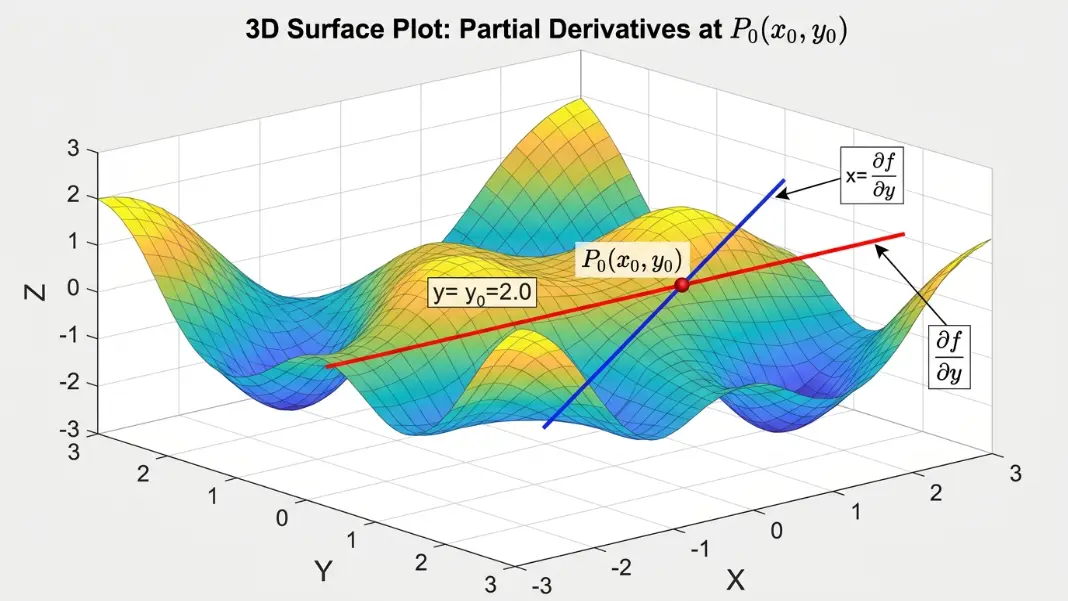
For a multivariable polynomial, each partial derivative treats all other variables as constants. This calculator differentiates each term with respect to x (holding y constant) and with respect to y (holding x constant) using the power rule.
Partial differentiation and integration are inverse operations in the same sense that ordinary differentiation and integration are. For computing the integral (antiderivative) of a single-variable function, see the Antiderivative Calculator.
The partial derivative uses the symbol ∂ (Unicode U+2202), called the curly d or Jacobi symbol, to distinguish partial from ordinary derivatives. There are two common notations for partial derivatives.
| Notation Style | Written Form | Meaning | LaTeX Code |
|---|---|---|---|
| Leibniz (fraction) | df/dx | Partial derivative of f with respect to x | \frac{\partial f}{\partial x} |
| Leibniz (fraction) | df/dy | Partial derivative of f with respect to y | \frac{\partial f}{\partial y} |
| Subscript | f_x | Partial derivative of f with respect to x | f_x |
| Subscript | f_y | Partial derivative of f with respect to y | f_y |
| Second order | d^2f/dx^2 | Second partial derivative w.r.t. x twice | \frac{\partial^2 f}{\partial x^2} |
| Mixed | d^2f/dxdy | First diff w.r.t. y, then w.r.t. x | \frac{\partial^2 f}{\partial x \partial y} |
In typed mathematics and homework, f_x and f_y (subscript notation) are often faster to write than the full Leibniz fraction. Both notations are accepted on exams. The ∂ symbol can be inserted in Microsoft Word with the Symbol menu, in LaTeX as \partial, or typed directly on macOS with Option+D in some applications.
When a multivariable function depends on variables that are themselves functions of other variables, the chain rule extends to partial derivatives. This is one of the most commonly used rules in physics, thermodynamics, and machine learning.
Worked example: Let z = x^2 + y^2 where x = cos(t), y = sin(t). Then: dz/dt = 2x(-sin(t)) + 2y(cos(t)) = -2cos(t)sin(t) + 2sin(t)cos(t) = 0. This confirms that the function z = cos^2(t) + sin^2(t) = 1 has zero derivative (as expected for a constant).
The chain rule for partial derivatives is the foundation of implicit differentiation. When a function is defined implicitly by F(x, y) = 0, the derivative dy/dx equals -(dF/dx) / (dF/dy). The Implicit Derivative Calculator applies this formula directly.
Second order partial derivatives apply the partial derivative operation twice. For f(x, y), there are four second-order partials. By Clairaut's theorem, the two mixed partials are equal for most functions encountered in practice.
| Notation | Meaning | How to Compute |
|---|---|---|
| f_xx or d^2f/dx^2 | Second partial w.r.t. x (pure) | Differentiate f_x with respect to x |
| f_yy or d^2f/dy^2 | Second partial w.r.t. y (pure) | Differentiate f_y with respect to y |
| f_xy or d^2f/dydx | Mixed: x then y | Differentiate f_x with respect to y |
| f_yx or d^2f/dxdy | Mixed: y then x | Differentiate f_y with respect to x |
Second derivative test for critical points: At a critical point (f_x = 0, f_y = 0), compute D = f_xx * f_yy - (f_xy)^2. If D > 0 and f_xx > 0: local minimum. If D > 0 and f_xx < 0: local maximum. If D < 0: saddle point. If D = 0: inconclusive. The gradient (f_x, f_y) is central to gradient descent in machine learning; the Correlation Coefficient Calculator is another tool commonly used in data science and statistical modeling.
Function: f(x, y) = 3x²y + 2xy³ + 5y²
In-depth guides related to this calculator.