Midpoint Formula Calculator: Find the Center Point Between Two Coordinates (2026)
Midpoint formula: M = ((x₁+x₂)/2, (y₁+y₂)/2). How to find the midpoint, distance, and slope for any two coordinate pairs with worked examples and geometry applications.
The midpoint formula produces one of the most common errors in introductory geometry not because students forget the formula but because they mix it up with the distance formula. Both use the same four coordinates. The midpoint formula adds and averages. The distance formula subtracts and squares. Running the wrong operation on the right numbers gives a result that looks reasonable but is geometrically meaningless.
The Midpoint Calculator handles any two coordinate pairs and returns the midpoint, distance between the points, and slope of the connecting segment simultaneously. This guide covers how the midpoint formula works, why distance and slope are natural companions to it, how to handle negative coordinates and fractions without errors, where midpoints appear in geometry applications, and how the formula extends to three dimensions.
How the Midpoint Formula Works#
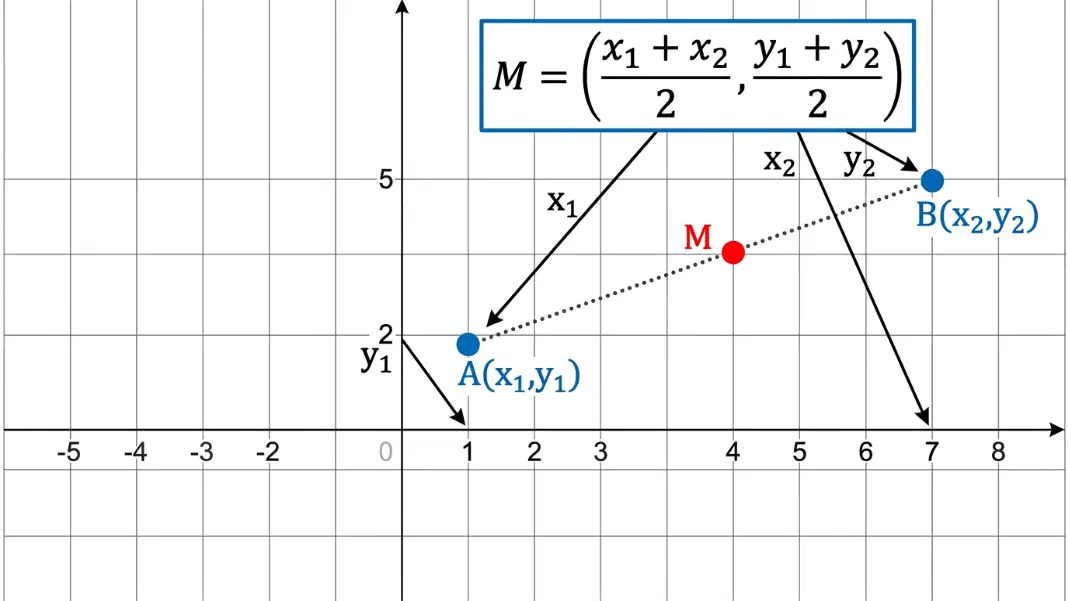
The midpoint between two coordinate points is found by averaging the x-coordinates and averaging the y-coordinates separately.
Midpoint M = ((x₁ + x₂) / 2, (y₁ + y₂) / 2)
The result is an ordered pair (x, y), not a single number. Both the x-midpoint and the y-midpoint are required to identify a specific location on the coordinate plane.
Worked example:
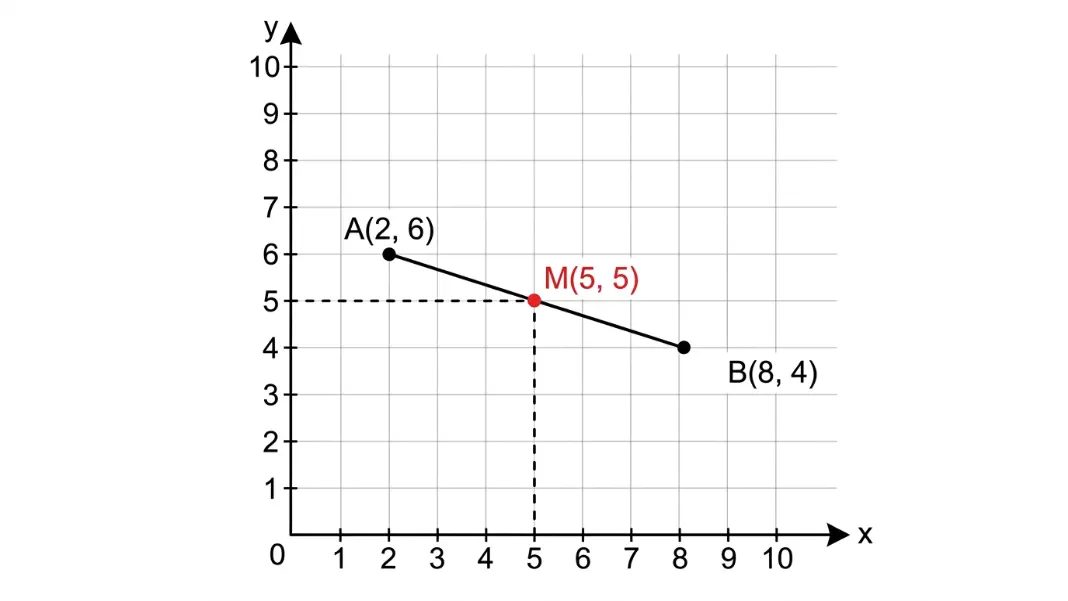
Point A = (2, 6), Point B = (8, 4)
x-midpoint: (2 + 8) / 2 = 10 / 2 = 5
y-midpoint: (6 + 4) / 2 = 10 / 2 = 5
Midpoint M = (5, 5)
You can verify geometrically: M = (5, 5) sits exactly halfway between A = (2, 6) and B = (8, 4) along both axes.
Second example with different value types:
Point A = (-3, 7), Point B = (5, -1)
x-midpoint: (-3 + 5) / 2 = 2 / 2 = 1
y-midpoint: (7 + (-1)) / 2 = 6 / 2 = 3
Midpoint M = (1, 3)
Negative coordinates do not change the operation. You still add the two x-values algebraically and divide by 2. The result can be positive, negative, or zero depending on the inputs.
The geometric meaning is straightforward: the midpoint is the point that divides a segment into two equal halves, equidistant from both endpoints along the segment. The formula gives you its exact coordinate location.
Midpoint and Distance: The Two Calculations Most Geometry Problems Need#
Midpoint and distance use the same four inputs but opposite operations. Most geometry problems that ask for the midpoint also require the segment length, so understanding how the two formulas relate prevents the most common calculation error.
The distance formula:
Distance d = sqrt((x₂ - x₁)² + (y₂ - y₁)²)
The critical difference:
Midpoint formula uses addition: (x₁ + x₂). Distance formula uses subtraction: (x₂ - x₁). Both operate on the same coordinate pairs but with opposite operations. Substituting addition for subtraction in the distance formula, or subtraction for addition in the midpoint formula, produces a number that appears plausible but is wrong.
Worked example using both formulas:
Point A = (1, 2), Point B = (7, 10)
Midpoint: ((1 + 7) / 2,  (2 + 10) / 2) = (4, 6)

Distance: sqrt((7 - 1)² + (10 - 2)²)
        = sqrt(36 + 64)
        = sqrt(100)
        = 10
The segment runs 10 units total with its midpoint at (4, 6). The distance from either endpoint to the midpoint is 5 units, confirming the midpoint divides the segment equally.
Slope as the third companion:
Slope = (y₂ - y₁) / (x₂ - x₁)
Slope describes the direction of the segment between two points. The perpendicular bisector of a segment passes through the midpoint at a right angle and has a slope equal to the negative reciprocal of the original segment's slope. Problems involving perpendicular bisectors, circumcenters, and circles require all three values: midpoint for the location, slope for direction, and often distance for the radius.
For problems in coordinate geometry involving areas and coordinate transformations, the Matrix Determinant Calculator uses coordinate data from points on a plane to compute areas of triangles and parallelograms through determinant methods.
Working With Negative Coordinates and Fractions#
Negative coordinates and non-integer results are where midpoint calculations break down most often in practice.
Negative x or y coordinates:
Point A = (-4, -2), Point B = (6, 8)
x-midpoint: (-4 + 6) / 2 = 2 / 2 = 1
y-midpoint: (-2 + 8) / 2 = 6 / 2 = 3
Midpoint = (1, 3)
The common error here is treating -4 + 6 as -4 - 6 = -10. The negative sign belongs to the first term only. When adding a negative and a positive, you find the algebraic sum, not the combined magnitude.
Both coordinates negative and in the same quadrant:
Point A = (-6, -3), Point B = (-2, -9)
x-midpoint: (-6 + (-2)) / 2 = -8 / 2 = -4
y-midpoint: (-3 + (-9)) / 2 = -12 / 2 = -6
Midpoint = (-4, -6)
When both points are in the same negative quadrant, the midpoint is also in that quadrant. If both x-values are negative, the midpoint x-value will be negative. This is geometrically correct: a midpoint cannot be outside the range bounded by its two endpoints.
Fractional midpoints:
Not every coordinate pair produces an integer midpoint. If the sum of the two x-coordinates is odd, the x-midpoint is a decimal.
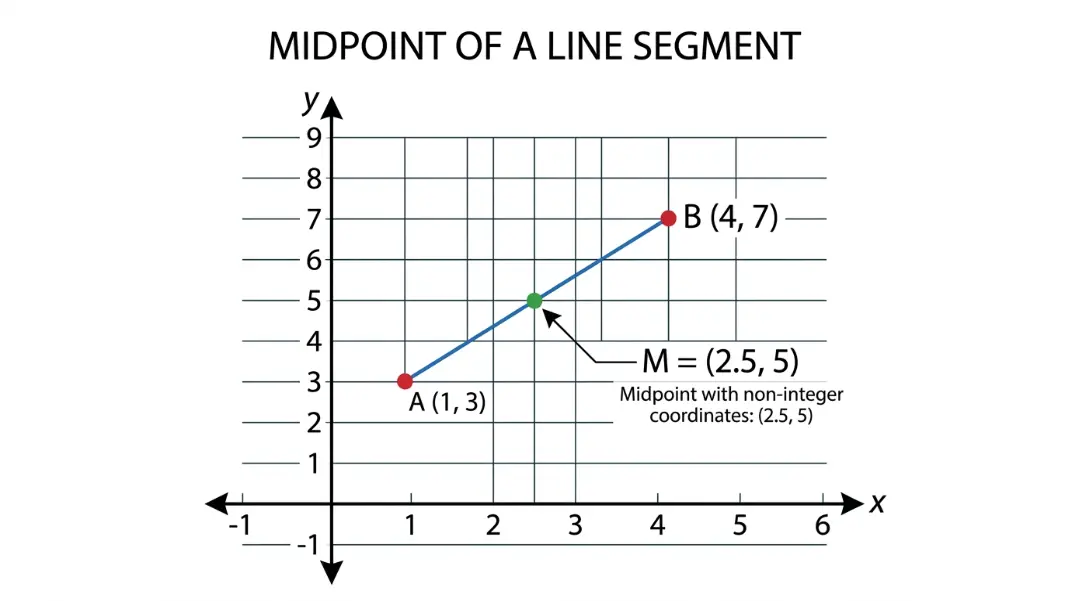
Point A = (1, 3), Point B = (4, 7)
x-midpoint: (1 + 4) / 2 = 5 / 2 = 2.5
y-midpoint: (3 + 7) / 2 = 10 / 2 = 5
Midpoint = (2.5, 5)
A midpoint at x = 2.5 is a valid coordinate. There is no requirement for midpoints to land on integer grid points. In practice, fractional midpoints are more common than whole-number ones when working with arbitrary coordinates.
For applications where functions are defined over coordinate planes and rates of change in multiple directions are needed, the Partial Derivative Calculator handles functions of two variables across the same xy-plane framework used in coordinate geometry.
Midpoint in Geometry: Bisectors, Diagonals, and Triangle Medians#
The midpoint formula appears in three geometry applications more than any other.
Perpendicular bisector:
The perpendicular bisector of a segment passes through the midpoint at a 90-degree angle to the segment. To write its equation, you need two things: the midpoint (as the point the bisector passes through) and the slope of the original segment (to invert and negate for the perpendicular slope).
Segment from A = (2, 1) to B = (8, 5):
- Midpoint: M = (5, 3)
- Slope of AB: (5 - 1) / (8 - 2) = 4/6 = 2/3
- Perpendicular slope: -3/2
- Bisector equation: y - 3 = -3/2 × (x - 5)
Perpendicular bisectors are the tool for finding the circumcenter of a triangle, the center of the circle passing through all three vertices.
Diagonal of a parallelogram:
The diagonals of any parallelogram bisect each other, meaning both diagonals share the same midpoint. To confirm whether a four-sided figure is a parallelogram from coordinates, verify that both diagonals produce the same midpoint.
Quadrilateral with vertices A = (0, 0), B = (6, 0), C = (8, 4), D = (2, 4):
- Diagonal AC midpoint: ((0+8)/2, (0+4)/2) = (4, 2)
- Diagonal BD midpoint: ((6+2)/2, (0+4)/2) = (4, 2)
Both midpoints match, confirming the figure is a parallelogram.
Triangle medians and centroid:
A median connects a vertex to the midpoint of the opposite side. Every triangle has 3 medians, and all three intersect at the centroid. The centroid coordinates are the average of the three vertex coordinates: ((x₁+x₂+x₃)/3, (y₁+y₂+y₃)/3). This is a direct extension of the midpoint averaging principle to three points.
The centroid always lies exactly 2/3 of the way from each vertex to the midpoint of the opposite side. This ratio holds for every triangle regardless of shape.
Midpoint Formula in Three Dimensions#
The 2D midpoint formula extends directly to three coordinates by adding a z-component.
Midpoint (3D) = ((x₁ + x₂) / 2, (y₁ + y₂) / 2, (z₁ + z₂) / 2)
The operation is identical: average each coordinate pair independently across all three axes.
Worked example:
Point A = (2, 4, 6), Point B = (8, 2, 10)
x-midpoint: (2 + 8) / 2 = 5
y-midpoint: (4 + 2) / 2 = 3
z-midpoint: (6 + 10) / 2 = 8
Midpoint M = (5, 3, 8)
The 3D distance formula follows the same extension:
Distance (3D) = sqrt((x₂-x₁)² + (y₂-y₁)² + (z₂-z₁)²)
Three-dimensional midpoints appear in structural engineering (center of mass between two nodes), computer graphics (interpolation between vertices), and physics (midpoint of displacement vectors). The add-vs-subtract distinction carries through: midpoint uses addition across all three coordinate pairs, distance uses subtraction.
For displacement and motion problems in one and two dimensions where distance, velocity, and time interact, the Acceleration Calculator covers the kinematics relationships that use the same spatial framework as coordinate geometry.
The Midpoint Calculator at the top of this guide handles 2D coordinate pairs and returns midpoint, distance, and slope together. For coursework or manual calculation verification, entering both points and reading all three outputs at once gives you everything most standard geometry problems require from a single segment.
The midpoint formula is M = ((x₁ + x₂) / 2, (y₁ + y₂) / 2). You average the x-coordinates to get the x-midpoint, and average the y-coordinates to get the y-midpoint. The result is an ordered pair (x, y) representing the center of the segment. For example, the midpoint of (2, 4) and (8, 10) is ((2+8)/2, (4+10)/2) = (5, 7). The midpoint is equidistant from both endpoints along the line segment.
Add the two x-coordinates and divide by 2, then add the two y-coordinates and divide by 2. The midpoint is the resulting pair (x-result, y-result). For points (1, 3) and (5, 9), the midpoint is ((1+5)/2, (3+9)/2) = (3, 6). The operation is addition, not subtraction. Subtracting the coordinates produces the component lengths used in the distance formula, not the midpoint.
The midpoint formula finds the center point of a segment: M = ((x₁+x₂)/2, (y₁+y₂)/2). The distance formula finds the length: d = sqrt((x₂-x₁)² + (y₂-y₁)²). Midpoint uses addition to average the coordinates. Distance uses subtraction to find the differences, then squares and sums them. Both use the same four input values, making it easy to apply the wrong formula. If you subtract in the midpoint formula, the result will be wrong and will not equal the geometric midpoint.
Fractional midpoints are valid and common. If the sum of two x-coordinates is odd, the x-midpoint will be a decimal. For example, the midpoint of (1, 0) and (4, 0) is (2.5, 0). There is no requirement for midpoints to fall on integer grid points. In geometry problems with arbitrary coordinates, fractional midpoints are the rule rather than the exception. Do not round a midpoint to a nearby integer unless the problem specifically instructs you to.
Apply the same formula. Add the two x-values algebraically (including their signs) and divide by 2. For example, midpoint of (-4, -2) and (6, 8): x-midpoint = (-4 + 6) / 2 = 1, y-midpoint = (-2 + 8) / 2 = 3, midpoint = (1, 3). The common error is treating -4 + 6 as -4 - 6. When one coordinate is negative, you add a negative number, not subtract twice. If both x-coordinates are negative, the midpoint x-value will also be negative.
In three dimensions, add a z-component: M = ((x₁+x₂)/2, (y₁+y₂)/2, (z₁+z₂)/2). You average each of the three coordinate pairs independently. For points (2, 4, 6) and (8, 2, 10), the 3D midpoint is (5, 3, 8). The operation is identical to 2D with one additional averaging step. The 2D Midpoint Calculator handles xy-plane problems; for 3D problems, apply the z-component extension manually using the same averaging approach.
Written by
Hassaan Rasheed
Web Developer & Content Researcher
Hassaan builds calculators and writes source-linked guides across the site's subject areas. Calculator methods and reference data are documented in each guide so readers can verify the underlying sources.
About the author and methods