How to Calculate a Matrix Determinant: 2x2 and 3x3 Methods (2026)
A determinant shows if a matrix has an inverse and if a linear system has a unique solution. Step-by-step 2x2 and 3x3 methods with examples.
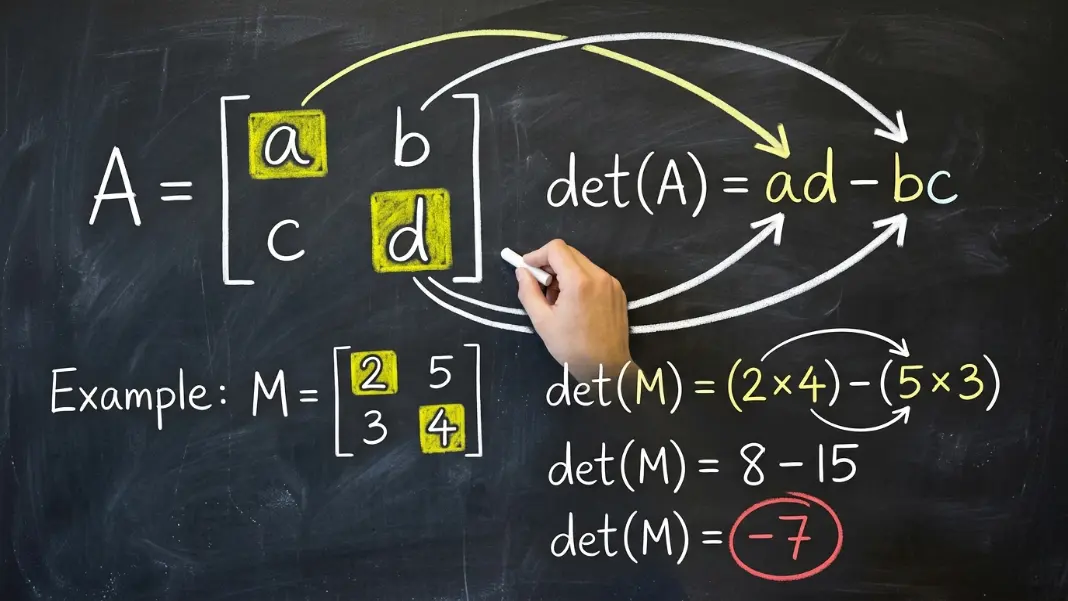
The determinant of a matrix is a single number. For a 2x2 matrix it takes about four seconds to compute by hand. For a 3x3 it takes a minute. What that number tells you is considerably more useful than its size suggests: a nonzero determinant means the matrix has an inverse and the corresponding system of equations has exactly one solution. A zero determinant means neither is true.
Use the Matrix Determinant Calculator for larger matrices or to check your work. This guide covers the hand calculation methods for 2x2 and 3x3 matrices, explains what the determinant means geometrically, and covers properties that make calculation faster.
How to Calculate a 2x2 Determinant#
For any 2x2 matrix:
A = | a  b |
    | c  d |

det(A) = ad - bc
Multiply the entries on the main diagonal (top-left times bottom-right), then subtract the product of the anti-diagonal (top-right times bottom-left).
Worked example 1:
A = | 5   3 |
    | 2   8 |

det(A) = (5)(8) - (3)(2) = 40 - 6 = 34
Worked example 2 with a negative entry:
B = | 4  -1 |
    | 6   2 |

det(B) = (4)(2) - (-1)(6) = 8 - (-6) = 8 + 6 = 14
Subtracting a negative number adds it. Watch the signs closely when entries are negative.
When the determinant is zero:
C = | 2  4 |
    | 1  2 |

det(C) = (2)(2) - (4)(1) = 4 - 4 = 0
Row 2 of C is exactly half of row 1. The rows are linearly dependent, which always produces a zero determinant. You can also see this geometrically: the two row vectors point in the same direction and cannot span a two-dimensional space.
How to Calculate a 3x3 Determinant#
Two methods work for 3x3: cofactor expansion and the Sarrus rule. Cofactor expansion generalizes to any size matrix. Sarrus is a shortcut that only works for 3x3.
Method 1: Cofactor Expansion Along Row 1
A = | a  b  c |
    | d  e  f |
    | g  h  i |

det(A) = a(ei - fh) - b(di - fg) + c(dh - eg)
Take each entry in the first row. Multiply it by the determinant of the 2x2 matrix formed by deleting that entry's row and column. Alternate the signs: positive, negative, positive.
Worked example:
A = | 2  -1   3 |
    | 1   4  -2 |
    | 5   0   1 |
Step 1: Entry a = 2, delete row 1 and column 1:
Minor = | 4 -2 | = (4)(1) - (-2)(0) = 4 + 0 = 4 | 0 1 |
Step 2: Entry b = -1, delete row 1 and column 2:
Minor = | 1 -2 | = (1)(1) - (-2)(5) = 1 + 10 = 11 | 5 1 |
Step 3: Entry c = 3, delete row 1 and column 3:
Minor = | 1 4 | = (1)(0) - (4)(5) = 0 - 20 = -20 | 5 0 |
Apply signs (+, -, +) and sum:
det(A) = 2(4) - (-1)(11) + 3(-20) = 8 + 11 - 60 = -41
Method 2: Sarrus Rule
Write out the matrix, then copy columns 1 and 2 to its right:
2  -1   3 | 2  -1
1   4  -2 | 1   4
5   0   1 | 5   0
Downward diagonals (multiply three entries going down-right):
- 2 x 4 x 1 = 8
- (-1) x (-2) x 5 = 10
- 3 x 1 x 0 = 0
Sum of downward diagonals: 8 + 10 + 0 = 18
Upward diagonals (multiply three entries going up-right):
- 3 x 4 x 5 = 60
- 2 x (-2) x 0 = 0
- (-1) x 1 x 1 = -1
Sum of upward diagonals: 60 + 0 + (-1) = 59
det(A) = 18 - 59 = -41
Both methods give the same result. The Sarrus rule is faster for hand calculation; cofactor expansion generalizes to 4x4 and larger.
What the Determinant Means Geometrically#
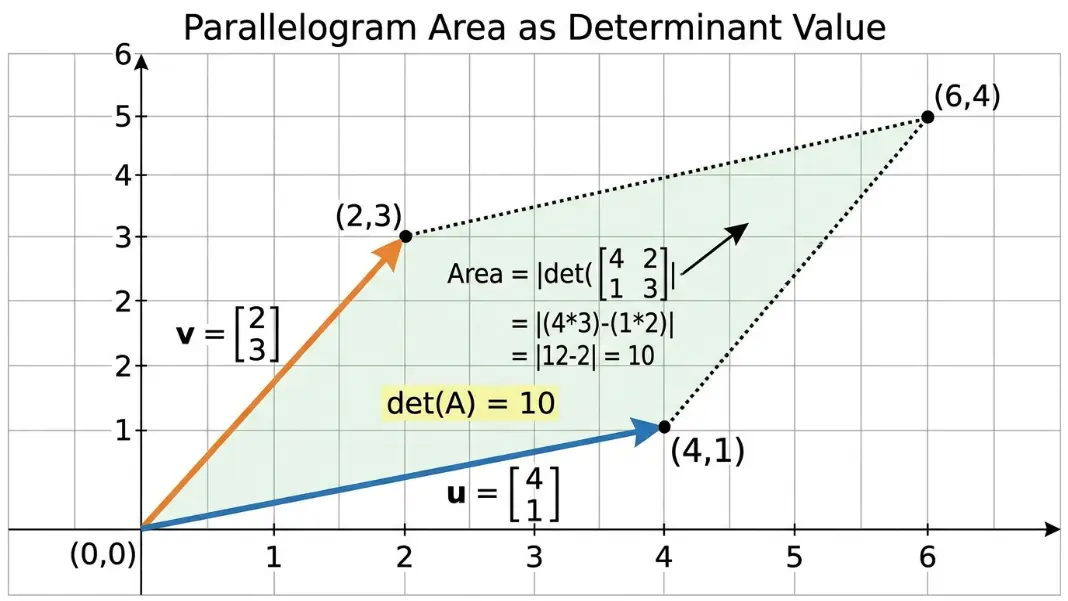
For a 2x2 matrix, the determinant equals the signed area of the parallelogram formed by the two column vectors.
Take a matrix with columns [3, 0] and [0, 2]. The parallelogram formed by these vectors is a 3 by 2 rectangle. Area = 6. And det = (3)(2) - (0)(0) = 6. They match.
The sign tells you orientation. A positive determinant means the second column vector is counterclockwise from the first (standard orientation). A negative determinant means it is clockwise (reflected orientation). A zero determinant means the vectors are parallel and form no parallelogram at all; they collapse to a line.
For a 3x3 matrix, the determinant equals the signed volume of the parallelepiped formed by the three column vectors.
Why this matters in practice:
A transformation matrix tells you how a shape changes when multiplied. If det = 2, areas double. If det = -1, the shape is reflected with no size change. If det = 0, the transformation squashes the plane (or space) down to a lower dimension; nothing can be reversed from that state, which is why a zero determinant means no inverse exists.
This geometric interpretation is why the determinant appears in integration change-of-variables (the Jacobian), in physics (cross products and volumes), and in computer graphics (checking whether a transformation preserves or reverses handedness).
Properties That Speed Up Calculation#
Several properties let you simplify a matrix before computing its determinant.
Row operations and their effects:
| Operation | Effect on det |
|---|---|
| Swap two rows | Multiplies det by -1 |
| Multiply a row by scalar k | Multiplies det by k |
| Add a multiple of one row to another | No change to det |
The third property is the most useful. You can add or subtract multiples of rows freely to create zeros without affecting the determinant. The goal is to produce a triangular matrix, where the determinant is simply the product of the diagonal entries.
Additional properties:
- det(AB) = det(A) x det(B) for square matrices of the same size
- det(A^T) = det(A) (transposing does not change the determinant)
- det(kA) = k^n x det(A) for an n x n matrix
- If any row or column consists entirely of zeros, det = 0
- If two rows are identical, det = 0
Triangular matrices are the fastest case:
Upper triangular:
| 3  7  2 |
| 0  4  5 |
| 0  0  1 |

det = 3 x 4 x 1 = 12
For any triangular matrix, multiply the diagonal entries. No expansion needed. This is why reducing to triangular form via row operations is the standard strategy for computing determinants of large matrices.
Singular Matrices and What a Zero Determinant Means#
A singular matrix has det = 0. This has direct consequences in every application where matrices appear.
In linear systems (Ax = b):
- det(A) is not zero: exactly one unique solution exists
- det(A) = 0, b is in the column space of A: infinitely many solutions
- det(A) = 0, b is not in the column space of A: no solution at all
In matrix inverses:
The inverse of A equals (1 / det(A)) times the adjugate matrix. When det = 0, this formula requires dividing by zero, which is undefined. A singular matrix has no inverse.
In eigenvalues:
The eigenvalues of a matrix A are the values of λ satisfying det(A - λI) = 0. This is the characteristic equation. Setting the determinant of (A - λI) to zero and solving the resulting polynomial gives the eigenvalues. For a 2x2 matrix the polynomial is quadratic; for 3x3 it is cubic.
Example: Find eigenvalues of the matrix with rows [5, 3] and [2, 4].
det(A - λI) = det | (5-λ) 3 | = (5-λ)(4-λ) - (3)(2) = 0 | 2 (4-λ)|
= λ^2 - 9λ + 20 - 6 = λ^2 - 9λ + 14 = 0
(λ - 7)(λ - 2) = 0 → eigenvalues: λ = 7 and λ = 2
For a 2x2 matrix with entries a, b (first row) and c, d (second row): det = ad - bc. Multiply the main diagonal entries together, then subtract the product of the off-diagonal entries. Example: matrix with rows [5, 3] and [2, 8] gives det = (5)(8) - (3)(2) = 40 - 6 = 34. Watch the sign when any entry is negative: subtracting a negative number adds it.
Use cofactor expansion along the first row. For each of the three entries in row 1, multiply that entry by the determinant of the 2x2 submatrix formed by deleting its row and column. Apply alternating signs (+, -, +) and sum the three terms. Alternatively, use the Sarrus rule: copy columns 1 and 2 to the right of the matrix, sum the three downward diagonal products, subtract the three upward diagonal products. Both methods give identical results. Sarrus is faster for 3x3 only; cofactor expansion works for any size.
A zero determinant means the matrix is singular: it has no inverse and its rows (or columns) are linearly dependent. In a system of linear equations, a singular coefficient matrix means there is no unique solution. The system either has infinitely many solutions (if consistent) or no solution at all (if inconsistent), depending on the right-hand side. Geometrically, the transformation collapses space to a lower dimension, which cannot be reversed.
The determinant measures oriented area or volume. Swapping two rows changes the orientation of the vectors defining that area or volume, flipping it from counterclockwise to clockwise (or vice versa). The magnitude stays the same but the sign reverses. This is why a matrix with two identical rows has det = 0: swapping those identical rows produces the same matrix but should negate the determinant, so the only consistent value is zero.
The Sarrus rule is a shortcut for 3x3 determinants only. Copy the first two columns to the right of the 3x3 matrix, creating a 3x5 array. Sum the three products along the downward diagonals, then subtract the three products along the upward diagonals. It gives the same result as cofactor expansion and is slightly faster to execute. The Sarrus rule does not extend to 4x4 or larger matrices; for those, use cofactor expansion or row reduction.
Eigenvalues of a matrix A are found by solving det(A - λI) = 0, called the characteristic equation. Subtract λ from each diagonal entry, compute the determinant of the resulting matrix, set it equal to zero, and solve the polynomial. For a 2x2 matrix the polynomial is quadratic, giving up to 2 eigenvalues. For 3x3 it is cubic, giving up to 3 eigenvalues. These eigenvalues describe how the matrix stretches or compresses space along its principal axes.
Written by
Hassaan Rasheed
Web Developer & Content Researcher
Hassaan builds calculators and writes source-linked guides across the site's subject areas. Calculator methods and reference data are documented in each guide so readers can verify the underlying sources.
About the author and methods