Acceleration Calculator: Formula, Units, and Worked Examples (2026)
Acceleration calculator: find acceleration from velocity change and time, or use any of the 3 kinematic equations. All units supported. Free, no signup.
A car goes from 0 to 60 mph in 5.8 seconds. A ball thrown upward at 15 m/s slows, stops, and falls back. A rocket stage burns for 12 seconds before separation. In each case, velocity is changing over time, and that rate of change is acceleration. The Acceleration Calculator solves for any one of five variables (acceleration, initial velocity, final velocity, time, displacement) given the other four, using any combination of standard kinematic equations.
The basic formula is division: change in velocity divided by elapsed time. Most introductory problems use this directly. The three kinematic equations extend it to cases where displacement is involved or one variable is unknown and you need to work backward from what you know.
The Acceleration Formula: Change in Velocity Over Time#
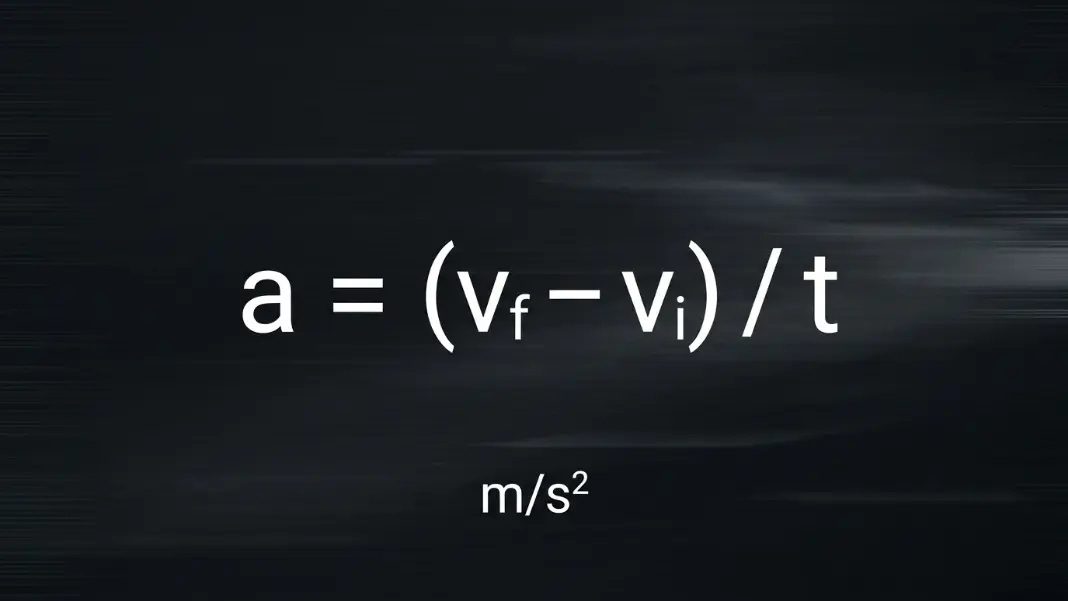
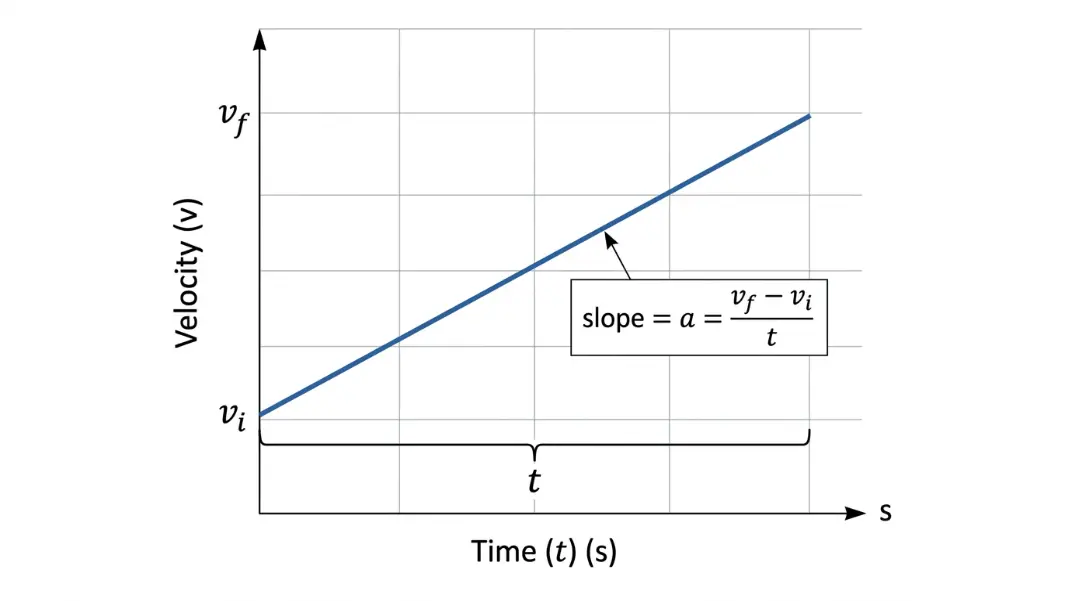
Average acceleration equals the change in velocity divided by the time interval:
a = (vf - vi) / t
Where:
- a = acceleration (m/s², ft/s², or any velocity/time unit)
- vf = final velocity
- vi = initial velocity
- t = time elapsed
Worked example: from rest to 27 m/s in 6 seconds
a = (27 - 0) / 6
a = 27 / 6
a = 4.5 m/s²
The object accelerates at 4.5 m/s². Each second adds 4.5 m/s to the speed.
Deceleration is negative acceleration. A car slowing from 20 m/s to 8 m/s in 4 seconds:
a = (8 - 20) / 4
a = -12 / 4
a = -3 m/s²
Deceleration is not a separate physical concept. It is acceleration with a negative sign, meaning the acceleration vector points opposite to the direction of motion.
Choosing the Right Equation: Which Variable Is Missing?#
Every kinematics problem gives you three known values and asks for a fourth. Identifying which variable is missing tells you which equation to reach for before you calculate anything.
Map your knowns first.
List what you have from the problem: initial velocity (vi), final velocity (vf), time (t), displacement (d), acceleration (a). The missing variable is your answer.
Match to the equation that contains it.
- Missing a, know vi, vf, t: use a = (vf - vi) / t
- Missing vf or d, know vi, a, t: use vf = vi + at and d = vi·t + (1/2)·a·t²
- Missing a or t, know vi, vf, d: use vf² = vi² + 2·a·d
Convert units before calculating. Mixing mph with meters or km/h with feet produces a dimensionally inconsistent result with no obvious arithmetic error. Convert all velocities to the same unit before substituting values.
Check the sign in your answer. Positive acceleration means velocity increases in the chosen positive direction. Negative means the acceleration opposes that direction. Problem phrasing like "decelerates at 3 m/s²" means a = −3 m/s² if the object moves in the positive direction — the magnitude is given, you supply the sign from context.
Example: ball rolling to a stop
A ball moving at 4 m/s decelerates uniformly and stops after traveling 8 meters. Find the acceleration.
Using vf² = vi² + 2ad:
0² = 4² + 2 · a · 8
0 = 16 + 16a
16a = -16
a = -1 m/s²
The ball decelerates at 1 m/s². The negative sign confirms the acceleration opposes the direction of motion.
The Three Kinematic Equations#
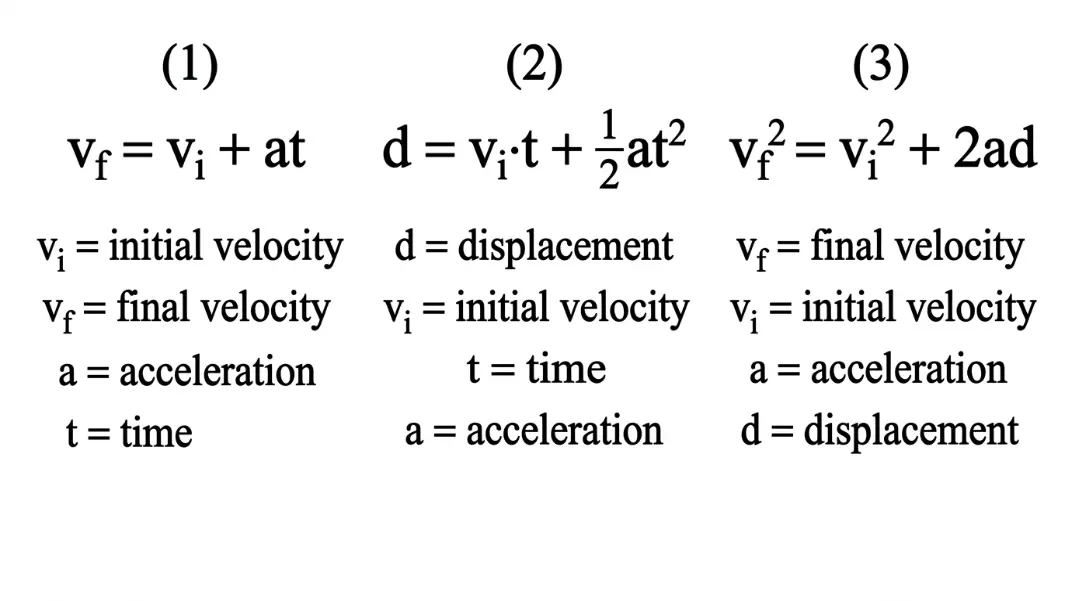
For uniform (constant) acceleration, three equations connect velocity, acceleration, displacement, and time:
1. vf = vi + at
2. d = vi·t + (1/2)·a·t²
3. vf² = vi² + 2·a·d
Each equation uses four of the five variables (vi, vf, a, t, d). When three variables are known, one equation gives the fourth. To find the fifth, use a second equation.
Choosing the right equation:
| Known | Unknown | Use |
|---|---|---|
| vi, a, t | vf and d | Equations 1, then 2 |
| vi, vf, t | a and d | Equation 1 rearranged, then 2 |
| vi, vf, d | a and t | Equation 3, then 1 |
| vi, a, d | vf and t | Equation 3, then 1 |
| vf, a, t | vi and d | Equation 1 rearranged, then 2 |
These equations assume constant acceleration across the entire interval. In physics problems involving gravity, friction on a flat surface, or a constant applied force, acceleration is constant and these equations apply directly.
When acceleration is not constant, calculus is required. Acceleration is the derivative of velocity with respect to time, and velocity is the integral of acceleration. The Antiderivative Calculator handles cases where acceleration is expressed as a function of time and you need to recover the velocity function by integration.
Average vs Instantaneous Acceleration#
Average acceleration describes the overall change in velocity across a time interval: a = (vf - vi) / t. It says nothing about what happened in between. A car that accelerates from 0 to 30 m/s and then brakes back to 10 m/s over 10 seconds has an average acceleration of 1 m/s², even though the actual acceleration was different at every instant.
Instantaneous acceleration is the acceleration at a single point in time. In calculus, it is the derivative of the velocity function: a(t) = dv/dt. For a velocity function v(t) = 3t² + 2t, the instantaneous acceleration is a(t) = 6t + 2. At t = 3 seconds, the acceleration is 6(3) + 2 = 20 m/s².
For most introductory physics problems, constant acceleration is assumed, so average and instantaneous are equal throughout the interval. Projectile motion, free fall, and uniform circular motion (treated in one dimension) all assume constant acceleration.
Variable acceleration appears in engine performance curves, spring-mass systems, and problems with air resistance. In those cases, the kinematic equations do not apply directly, and the instantaneous formula with calculus is required.
Acceleration Units: m/s², ft/s², and g-Force#
Acceleration is expressed as velocity per unit time, meaning distance per time squared.
| Unit | Context | Conversion to m/s² |
|---|---|---|
| m/s² | SI standard, physics | 1 (base) |
| ft/s² | US engineering | 1 ft/s² = 0.3048 m/s² |
| km/h/s | Automotive (speed in km/h) | 1 km/h/s = 0.2778 m/s² |
| mph/s | Automotive (speed in mph) | 1 mph/s = 0.4470 m/s² |
| g-force | Aviation, spacecraft | 1 g = 9.81 m/s² |
Standard gravity (g): 9.81 m/s² is the acceleration due to Earth's gravity at the surface. A freely falling object (no air resistance) accelerates at exactly this rate downward. Most practical acceleration problems reference g as a benchmark.
Converting a car's 0–60 mph time to m/s²:
60 mph = 26.82 m/s. For a 5.8-second run:
a = 26.82 / 5.8 = 4.63 m/s²
In g-force: 4.63 / 9.81 = 0.47g
A typical passenger car under hard acceleration produces 0.3g to 0.5g. Performance cars reach 0.7g to 1.0g. Formula 1 cars under heavy braking exceed 5g.
The Math Calculators section includes tools for kinematics alongside algebra, calculus, and statistical calculations.
Variable Acceleration: When the Kinematic Equations Break Down#
The three kinematic equations apply only when acceleration is constant across the entire interval. Several real scenarios violate this, and applying the equations there produces wrong results.
Rocket motors. As fuel burns, the rocket's mass decreases. With constant thrust, lower mass means higher acceleration (F = ma: same F, smaller m, larger a). Acceleration increases continuously through the burn. The kinematic equations assume a stays fixed and will underestimate final velocity for any significant burn duration.
Air resistance. Drag force increases with the square of velocity. As an object speeds up, drag grows, which reduces net acceleration. A skydiver does not accelerate indefinitely — drag eventually equals gravitational force and acceleration drops to zero at terminal velocity. The equations cannot model this because acceleration changes as a function of speed.
Engine power curves. A car from 0 to 60 mph does not produce constant acceleration. Torque varies across the RPM range, traction limits affect the launch, and gear changes interrupt smooth acceleration. The kinematic equations give only a rough average approximation across the full interval.
What to use instead:
When acceleration is a known function of time — for example, a(t) = 6t − 2 — integrate once to get velocity and again to get position. The Antiderivative Calculator handles the integration step for any polynomial or exponential acceleration function.
When acceleration varies with position, the work-energy theorem is typically more direct than kinematics.
For measured data with no clean function, average acceleration across short sub-intervals is the practical approximation. The shorter the interval, the closer the estimate to the true instantaneous value at that point.
Acceleration equals the change in velocity divided by elapsed time: a = (vf - vi) / t. Subtract the initial velocity from the final velocity, then divide by the time interval. For a car going from rest to 27 m/s in 6 seconds: a = (27 - 0) / 6 = 4.5 m/s². The result is always in velocity per time units (m/s², ft/s², etc.). Negative values mean the acceleration opposes the direction of motion.
The three kinematic equations for constant acceleration are: (1) vf = vi + at, (2) d = vi·t + ½at², and (3) vf² = vi² + 2ad. Each equation connects four of the five variables: initial velocity, final velocity, acceleration, time, and displacement. Identify three known values, choose the equation that contains your unknown, and solve directly.
Average acceleration is the total change in velocity across a time interval divided by that time: a = (vf - vi) / t. Instantaneous acceleration is the acceleration at a single moment, defined as the derivative of velocity with respect to time: a(t) = dv/dt. For problems with constant acceleration throughout the interval, both values are equal. Variable acceleration requires the derivative form.
One g equals 9.81 m/s², the acceleration due to Earth's gravity at the surface. To convert any acceleration to g-force, divide by 9.81. A car accelerating at 4.9 m/s² produces 4.9 / 9.81 = 0.5g. Free-falling objects accelerate at 1g downward (ignoring air resistance). Fighter pilots and Formula 1 drivers routinely experience 4g to 6g under high-load manoeuvres.
Yes. Negative acceleration means the acceleration vector points in the direction defined as negative, not that the object is necessarily slowing down. If upward is positive, gravity is −9.81 m/s². An object already moving downward (negative direction) with negative acceleration is speeding up, not slowing down. The sign describes direction, not magnitude. Only when negative acceleration opposes the direction of motion does the object slow down.
Acceleration is expressed in distance per time squared: m/s² (SI), ft/s² (US customary), km/h/s (automotive), or g-force where 1g = 9.81 m/s². Convert all velocity values to a consistent unit before calculating. For automotive problems, convert mph to m/s by multiplying by 0.4470, then divide by seconds to get m/s². Mixing mph and meters in the same formula gives a dimensionally inconsistent result.
Written by
Hassaan Rasheed
Web Developer & Content Researcher
Hassaan builds calculators and writes source-linked guides across the site's subject areas. Calculator methods and reference data are documented in each guide so readers can verify the underlying sources.
About the author and methods