What Is a HECM Loan: Requirements, Limits, and Payouts (2026)
HECM loan: FHA-insured reverse mortgage rules, lending limit, eligibility requirements, six payout options, and upfront MIP costs explained.

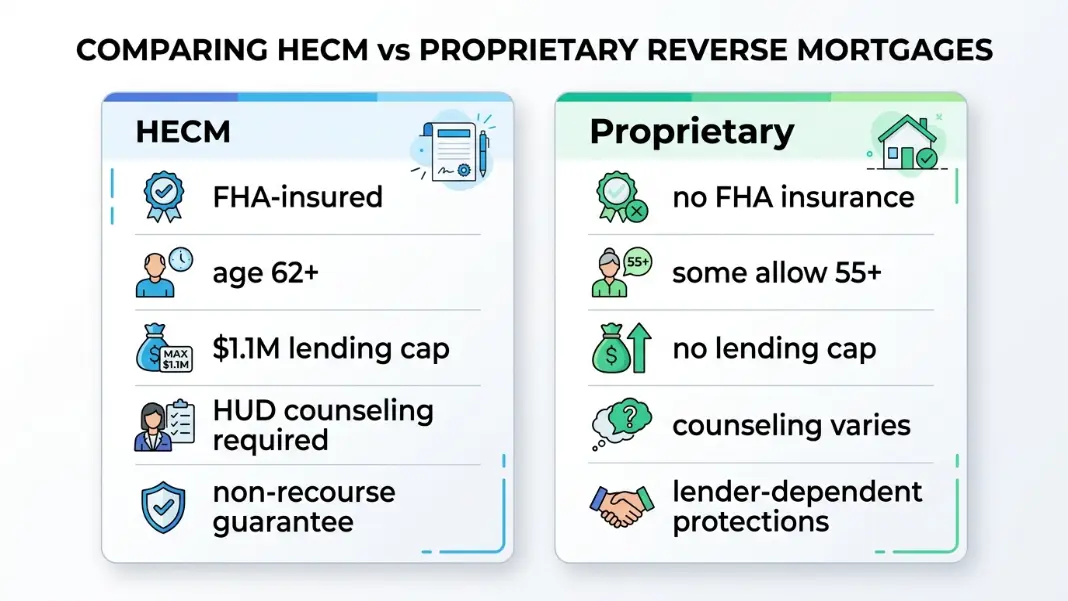
The words "reverse mortgage" and "HECM" appear interchangeably in most conversations, but they describe different things at a legal and structural level. A HECM is a specific government product insured by the FHA under a program administered by HUD. A reverse mortgage is the product category. That distinction matters when you start comparing offers, because proprietary reverse mortgages operate under private lender rules with no FHA insurance and no government-mandated borrower protections. Most borrowers end up with a HECM, but many start the process without knowing what that program actually involves or how it differs from other products.
The Reverse Mortgage Calculator runs HECM estimates based on your age, home value, and interest rate, returning a principal limit, net proceeds, and per-period payment amounts. This guide covers what the HECM program is, how it differs from proprietary reverse mortgages, what makes a borrower eligible, how the lending limit affects higher-value homes, what the six payout options are, and what the full cost structure looks like at closing.
What a HECM Is and How It Differs From a Proprietary Reverse Mortgage#
HECM stands for Home Equity Conversion Mortgage. It is the only reverse mortgage product insured by the Federal Housing Administration, and it accounts for the large majority of reverse mortgages originated in the United States. The program is administered by the US Department of Housing and Urban Development (HUD), which sets the rules governing eligibility, loan limits, costs, and borrower protections.
The FHA insurance on a HECM serves two functions. It protects the lender if the loan balance exceeds the home's value at repayment, which can happen when a borrower lives in the property for a long time or when home values decline after origination. It also protects the borrower: if the lender fails or exits the market, the FHA guarantees that payments and access to the line of credit will continue uninterrupted. Neither protection applies to proprietary (non-HECM) reverse mortgages.
The following table summarizes the key structural differences between the two product types.
| Feature | HECM | Proprietary Reverse Mortgage |
|---|---|---|
| FHA insurance | Yes | No |
| Minimum borrower age | 62 | Varies (some allow 55+) |
| Lending limit cap | $1,149,825 (FHA maximum) | No government cap |
| Mandatory counseling | Yes, HUD-approved | Typically yes, not federally mandated |
| Non-recourse protection | Yes, FHA-backed | Depends on lender terms |
| Primary use case | Homes at or below FHA limit | High-value homes above the FHA cap |
Proprietary reverse mortgages are primarily used when a home's value significantly exceeds the FHA lending limit, since the HECM calculation is capped regardless of how much equity exists above the ceiling. On a $3 million home, a HECM is still calculated against $1,149,825, while a proprietary product can use a larger share of the actual appraised value. For homes at or below the FHA cap, a HECM is almost always the better starting point because the consumer protections, insurance structure, and standardized costs reduce risk significantly compared to proprietary alternatives.
The detailed math of what a HECM will generate for a specific borrower age and interest rate, including the principal limit factor tables and step-by-step net proceeds calculation, is covered in the How to Calculate a Reverse Mortgage guide.
HECM Eligibility: Age, Property Type, and Financial Assessment#
Four requirement categories determine whether a borrower qualifies for a HECM. All four must be satisfied before an application moves forward.
Age:
The youngest borrower named on the loan must be at least 62 years old. If a spouse will not be on the loan (a non-borrowing spouse), their age does not affect the principal limit calculation, but they must be documented before closing to qualify for deferred repayment protections. Since 2014, HUD rules allow an eligible non-borrowing spouse to remain in the home and continue deferring repayment after the borrowing spouse dies or moves permanently to a care facility, as long as the spouse was listed before closing and continues to meet property maintenance and tax obligations.
Property type:
Eligible properties include:
- Single-family homes
- 2 to 4 unit properties where the borrower occupies at least one unit as a primary residence
- HUD-approved condominiums
- Manufactured homes meeting FHA standards on a permanent foundation
Vacation homes and investment properties are not eligible. The property must be the borrower's primary residence: they must occupy it for the majority of each year. A second home or rental property cannot secure a HECM regardless of equity or value.
Financial assessment:
HUD introduced the financial assessment requirement in 2014 after data showed that a significant share of early HECM defaults involved failure to pay property taxes, homeowner's insurance, or HOA fees. These are ongoing obligations the borrower must maintain throughout the loan term. Failure to pay any of them triggers a condition that can make the loan due and payable.
Lenders now review income, credit history, and the borrower's payment track record for housing expenses. If the assessment identifies a meaningful risk of non-payment, the lender may require a Life Expectancy Set-Aside (LESA), which reserves a portion of the principal limit to cover estimated property charges over the borrower's projected remaining years. This reduces net proceeds available to the borrower but does not disqualify them.
Mandatory counseling:
Before a HECM application is accepted, the borrower must complete a session with a HUD-approved housing counselor independent of the lender. The counselor reviews the loan structure, all six payout options, alternatives to a HECM, ongoing obligations, and the financial implications over time. Counseling sessions typically cost $125 to $200 and must be completed before the application is submitted, not after signing.
The equity threshold required to make a HECM viable depends on borrower age, current interest rates, and any existing liens that must be retired at closing. The minimum equity calculation is covered in the How Much Equity Do You Need for a Reverse Mortgage guide, which includes tables showing the practical floor by age and rate environment.
The HECM Lending Limit and Its Effect on Higher-Value Homes#
The FHA sets a maximum home value used in the HECM calculation. This figure is called the HECM lending limit or maximum claim amount. It currently sits at $1,149,825 and is adjusted annually by HUD based on changes to the conforming loan limit.
If your home is worth $800,000, the HECM calculation uses $800,000. If your home is worth $2.5 million, the HECM calculation still uses $1,149,825. Equity above the limit produces no additional loan capacity under the standard HECM program.
This creates a situation where two borrowers at very different home values arrive at the same gross principal limit:
| Home Value | Value Used in Calculation | PLF at Age 72 (6.5% rate) | Gross Principal Limit |
|---|---|---|---|
| $400,000 | $400,000 | 0.550 | $220,000 |
| $800,000 | $800,000 | 0.550 | $440,000 |
| $1,149,825 | $1,149,825 | 0.550 | $632,404 |
| $2,000,000 | $1,149,825 | 0.550 | $632,404 |
| $3,500,000 | $1,149,825 | 0.550 | $632,404 |
A borrower with a $2 million home and one with a $3.5 million home reach exactly the same gross principal limit under HECM because both are capped at $1,149,825. For borrowers in this situation, a proprietary reverse mortgage may access more equity, but at higher costs and without FHA insurance. The breakeven analysis between the two structures requires comparing the additional proceeds against the additional cost and the absence of the FHA non-recourse guarantee.
For most borrowers with homes below the lending limit, the cap is irrelevant. The HECM program calculates against the full appraised value, and the lending limit is not a constraint they encounter.
HECM Payout Options: Six Structures and Which Borrowers Each Serves#
The HECM program offers six payment plan options. The choice between them is one of the most consequential decisions in the process because some options cannot be changed after closing, and some grow the available credit over time in ways that are not immediately obvious.
1. Single disbursement lump sum: Available only with a fixed interest rate. The borrower takes the full available principal limit at closing as a one-time payment. Because the entire amount draws at origination, interest begins accruing on the full balance immediately. This structure suits borrowers who need to retire a large existing mortgage or fund a specific expense at closing and do not expect ongoing cash needs.
2. Tenure: Equal monthly payments from the lender to the borrower for as long as the borrower lives in the property as a primary residence. Payments continue regardless of how long the borrower lives. If the loan balance eventually exceeds the home's value, FHA insurance covers the shortfall. The borrower or heirs owe no more than the sale price of the home at repayment under the non-recourse structure.
3. Term: Equal monthly payments for a fixed number of months chosen at closing. Payments stop at the end of the term even if the borrower still lives in the home. Term payments are higher per month than tenure payments on the same principal limit because the payment window is shorter. This structure suits borrowers who need supplemental income for a defined period, such as while waiting for Social Security eligibility.
4. Line of credit: The borrower draws amounts as needed up to the available principal limit. What many borrowers do not initially realize is that the unused portion of a HECM line of credit grows over time at the same rate as the loan's interest accrues. This growth is not investment income. It is an expansion of available credit. A $200,000 unused line of credit at a 6% rate grows to approximately $212,000 in available credit after one year, even if no draws occur.
The earlier a HECM line of credit is opened and the longer the unused portion compounds, the larger the eventual available draw. For borrowers with adequate equity who do not need cash immediately, opening a HECM line of credit at 63 and leaving it unused for a decade produces substantially more available credit at 73 than waiting to apply at 73.
5. Modified tenure: A combination of a line of credit with monthly tenure payments for life. Part of the principal limit funds the monthly payment, and the remainder is available as a line of credit. This structure provides ongoing income while preserving a reserve for unexpected expenses.
6. Modified term: A combination of a line of credit with monthly term payments for a specified period. Borrowers who want income for a defined window while maintaining a reserve for later use often find this the most flexible structure.
HECM Costs: Upfront MIP, Ongoing MIP, and What Gets Financed#
HECM closing costs are higher than most traditional mortgage products, and the structure of those costs is different from a conventional loan. Most of them can be financed into the loan balance rather than paid out of pocket at closing. Understanding what each cost is and why it exists prevents surprises at the settlement table.
Upfront mortgage insurance premium (MIP):
The FHA charges an upfront MIP of 2% of the lesser of the appraised home value or the HECM lending limit. For an $800,000 home, the upfront MIP is 2% × $800,000 = $16,000. This fee is mandatory regardless of lender and is paid to the FHA at closing. It funds the insurance pool that covers both lenders and borrowers if the loan balance exceeds the home's value or if the lender exits the market.
Ongoing MIP:
After closing, the FHA charges 0.5% per year of the outstanding loan balance. This accrues monthly and compounds into the balance. On a $400,000 principal limit with minimal draws in the first year, the ongoing MIP adds approximately $2,000 to the balance annually, or about $167 per month.
Origination fee:
Lenders charge an origination fee governed by HUD caps: 2% of the first $200,000 of the home's value (or lending limit, whichever is lower) plus 1% of any amount above $200,000, up to a maximum of $6,000. For a $700,000 home: 2% × $200,000 + 1% × $500,000 = $4,000 + $5,000 = $9,000, but the HUD cap brings the fee to $6,000.
Title, settlement, and appraisal:
Third-party costs typically run $2,500 to $4,500 depending on the state and property. An FHA-approved appraisal is required and cannot be waived.
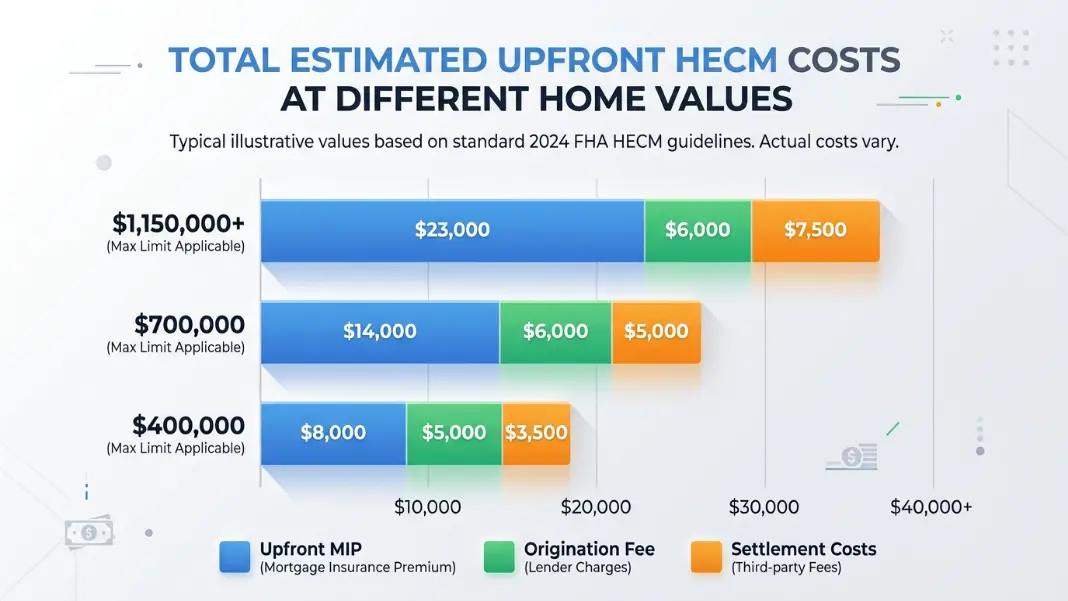
The following table shows estimated total upfront costs at three home values.
| Home Value | Upfront MIP (2%) | Origination Fee | Settlement Costs (est.) | Total Estimated Upfront |
|---|---|---|---|---|
| $400,000 | $8,000 | $5,000 | $3,000 | ~$16,000 |
| $700,000 | $14,000 | $6,000 | $3,500 | ~$23,500 |
| $1,149,825+ | $23,000 | $6,000 | $4,000 | ~$33,000 |
All costs can typically be financed into the loan, meaning no cash is required at closing. They reduce the net proceeds the borrower receives but do not require an out-of-pocket payment. Financed costs accrue interest over the life of the loan, which increases the total balance that eventually reduces the remaining equity or affects the estate.
For borrowers weighing a HECM against a conventional cash-out refinance, the Mortgage Calculator by State runs monthly payment scenarios for traditional mortgages at current rates, which gives a concrete comparison for evaluating whether converting equity through a HECM is more favorable than a standard refinancing alternative.
HECM stands for Home Equity Conversion Mortgage. It is the only reverse mortgage product insured by the Federal Housing Administration (FHA) and represents the large majority of reverse mortgages originated in the United States. The program is administered by HUD. A HECM converts a portion of a homeowner's equity into accessible funds without requiring monthly mortgage payments. The loan becomes due when the borrower sells the home, no longer uses it as a primary residence, or passes away.
To qualify for a HECM, the youngest borrower on the title must be at least 62 years old, the property must be the borrower's primary residence, and there must be sufficient equity to cover closing costs and any existing mortgage balance. Eligible properties include single-family homes, 2 to 4 unit properties where the borrower occupies a unit, HUD-approved condominiums, and qualifying manufactured homes. A session with a HUD-approved counselor must be completed before submitting an application.
The HECM lending limit is $1,149,825, adjusted annually by HUD. This is the maximum home value used in the HECM calculation regardless of actual appraised value. A home worth $2 million is treated as $1,149,825 for the purpose of determining the principal limit. Homes worth less than the limit use their actual appraised value. For high-value homes significantly above this cap, a proprietary reverse mortgage may access more equity, though without FHA insurance.
Tenure payments are equal monthly payments from the lender for as long as the borrower lives in the home as a primary residence, with no end date. Term payments are equal monthly payments for a fixed number of months chosen at closing. Tenure payments are lower per month than term payments on the same principal limit because the payment window is open-ended. Both options can be combined with a line of credit through the modified tenure and modified term structures.
The unused portion of a HECM line of credit expands at the same rate as the loan's interest accrues. This is an expansion of available credit, not investment income. A $200,000 unused line of credit at 6% grows to approximately $212,000 in available credit after one year with no draws. Borrowers who open a HECM line of credit early and leave it unused accumulate significantly more available credit over time than if they had waited to apply at an older age. This makes early origination financially attractive even for borrowers who do not need cash immediately.
The FHA charges an upfront MIP of 2% of the lesser of the home's appraised value or the HECM lending limit ($1,149,825). For a $500,000 home, that is $10,000. The fee is mandatory for all HECM loans and is paid to the FHA at closing, not to the lender. After closing, an ongoing MIP of 0.5% per year of the outstanding loan balance accrues monthly. Both the upfront MIP and other closing costs can typically be financed into the loan rather than paid out of pocket at closing.
Written by
Hassaan Rasheed
Web Developer & Content Researcher
Hassaan builds calculators and writes source-linked guides across the site's subject areas. Calculator methods and reference data are documented in each guide so readers can verify the underlying sources.
About the author and methods