How to Calculate Scrap Silver Value (Step-by-Step Guide 2026)
Step-by-step guide to calculating melt value from purity, weight, and live spot price.
7 min readRead →
Weight, purity and your price
Estimate the silver content of coins, bullion or scrap. Enter a price you have checked, then compare an actual buyer's offer.
Manual pricing · USD · No account needed. The prefilled $30 is an example, not today's market price.
Choose a preset or enter weight and purity, check the example price, then calculate. Results update only after you calculate.
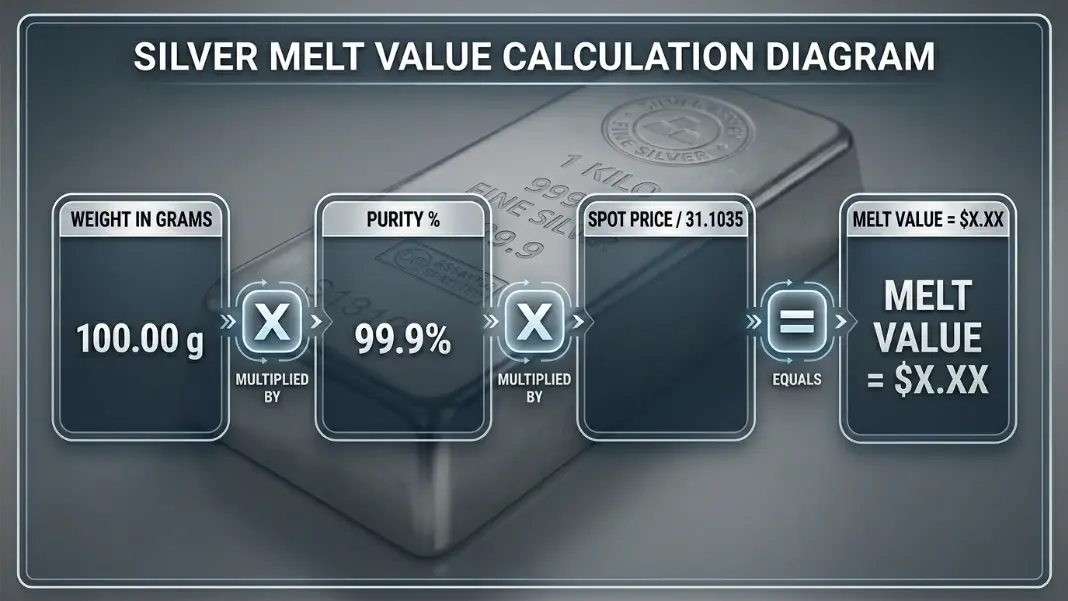
For an item described by its gross weight, convert that weight to fine-silver content before pricing it:
Fine troy ounces = grams × purity ÷ 31.1034768
Melt value = fine troy ounces × entered price × quantity
For a product whose specification already states fine-silver content, multiply that amount directly by the price and quantity. Applying purity again would undercount the silver. NIST gives 31.1034768 grams per troy ounce; an ordinary ounce is 28.349523125 grams.
| Item | Fine silver | Melt value |
|---|---|---|
| One American Silver Eagle | 1 troy oz, as specified by the U.S. Mint | $30.00 |
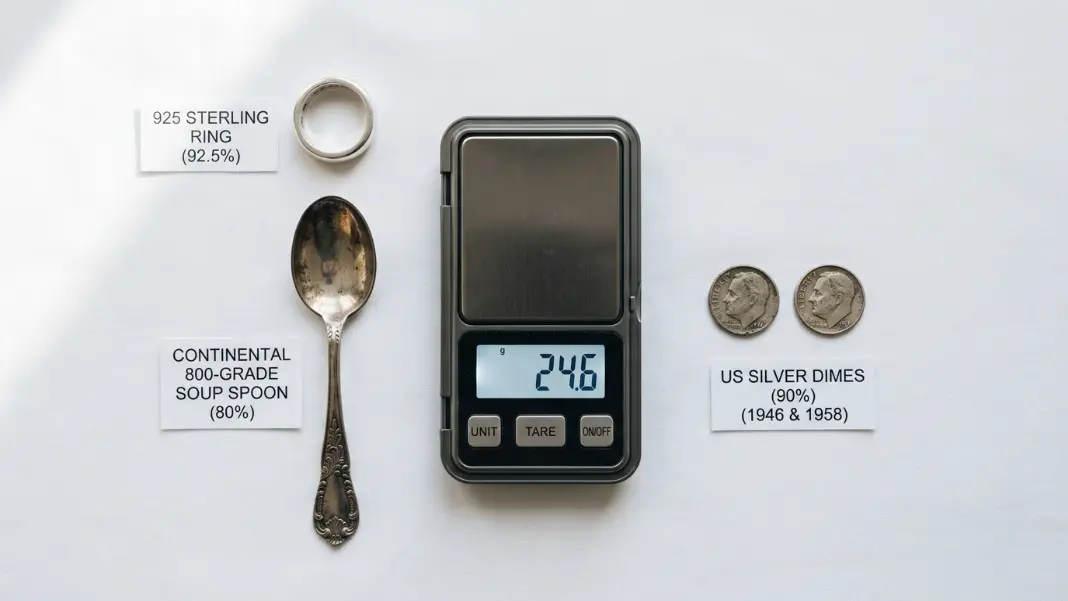
| 45 g of .925 sterling | 45 × 0.925 ÷ 31.1034768 ≈ 1.338275 troy oz | $40.15 |
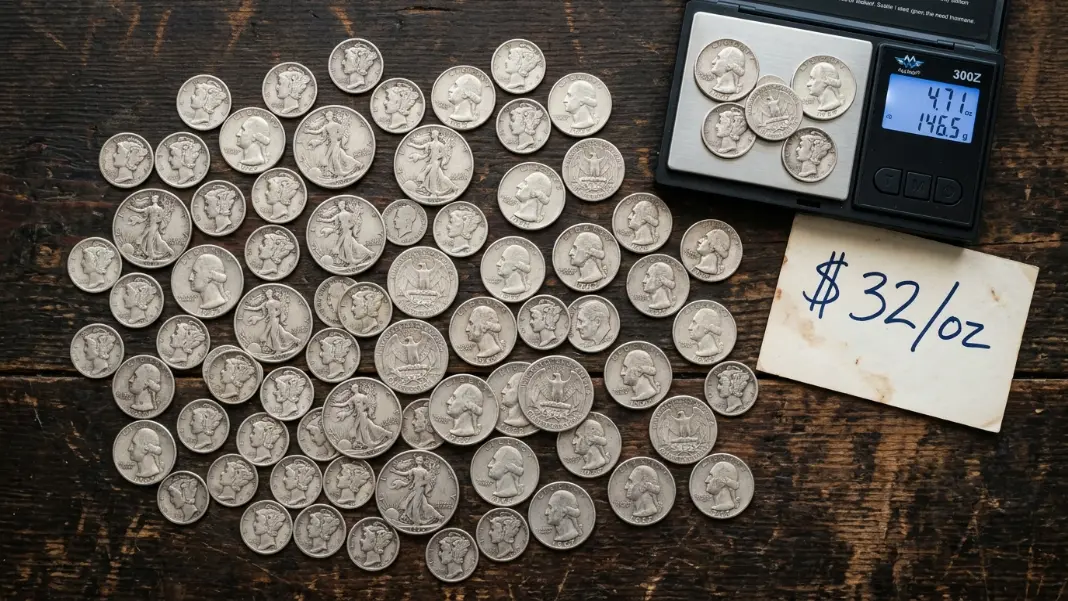
| $1 face value of worn 90% dimes, quarters or halves | 0.715 troy oz, using the circulated-coin convention | $21.45 |
The 0.715 convention is already a fine-silver estimate. Do not multiply it by 90% again, or apply it to Morgan/Peace dollars, 40% halves, nickels or modern clad coins. For a worn or unusual coin, verify the exact date, type, weight and composition. A preset does not establish authenticity or collector value.
Divide the net offer for the whole lot by the calculated melt value, then multiply by 100. For example, a $32 offer against $40 of melt value is 80%. This is a comparison using the figures you supplied; no universal dealer payout percentage is assumed. Zero melt value has no defined offer percentage.
Weighted candlesticks, filled handles and plated pieces need special care: the item's total scale weight may include substantial non-silver material. A hallmark alone does not tell you the recoverable metal weight. Consult the scrap silver guide before entering uncertain weights.
No. Enter your own USD price per fine troy ounce. The prefilled $30 is a worked-example assumption, not a current quote. Check the source, currency, unit and time of any price you enter.
For gross weight, fine silver = weight in grams × purity ÷ 31.1034768. Multiply fine troy ounces by your entered price and quantity. If a product already states its fine-silver content, use that amount directly without multiplying purity again.
The U.S. Mint specifies 1.000 troy ounce of silver content. Its melt value at an example price of $30 per fine troy ounce is $30. The .999 fineness does not need to be applied again to its declared fine-silver weight.
No. The 0.715 fine-troy-ounce-per-face-dollar convention estimates circulated 90% dimes, quarters and halves. Original Morgan and Peace dollars use 26.73 grams at 90% purity, about 0.7734 fine troy ounce before wear. Modern issues have different specifications.
Use custom gross weight and purity 0.925. Exclude stones, filler and other non-silver components from the entered weight. At the hypothetical price of $30 per fine troy ounce, 45 grams of .925 silver has a melt value of $40.15. Purity is applied once.
No. Melt value is a metal-content benchmark at your chosen price. A buyer's net offer may be below or above it because of fees, demand, condition or collector value. Enter an actual total offer to see its percentage of calculated melt value; the calculator does not assume a dealer payout rate.
Method and specifications checked September 6, 2026. Price examples are hypothetical. Coin presets use nominal specifications or the stated circulated-coin convention.
For purchases and sales on different dates, use the IRR and XIRR calculator to analyze the cash-flow return separately.
In-depth guides related to this calculator.