Home›Resources›How to Calculate Scrap Silver Value: Weight, Purity and Net Offers
Finance
How to Calculate Scrap Silver Value: Weight, Purity and Net Offers
Estimate scrap silver melt value from verified alloy weight, purity and your own price. Handle mixed lots, filled pieces and actual buyer fees without invented payout rates.
Hassaan RasheedMay 20, 2026Updated September 7, 2026
5 min read
To estimate scrap silver's metal value, establish the relevant alloy weight, identify its silver fraction, and supply a price per fine troy ounce. Compare the result with a buyer's net offer. Metal value does not guarantee what an item will sell for.
The Silver Calculator accepts manual USD pricing. Its starting $30 is an example, not a live quote. The $33 price and any offers in this guide are hypothetical arithmetic examples.
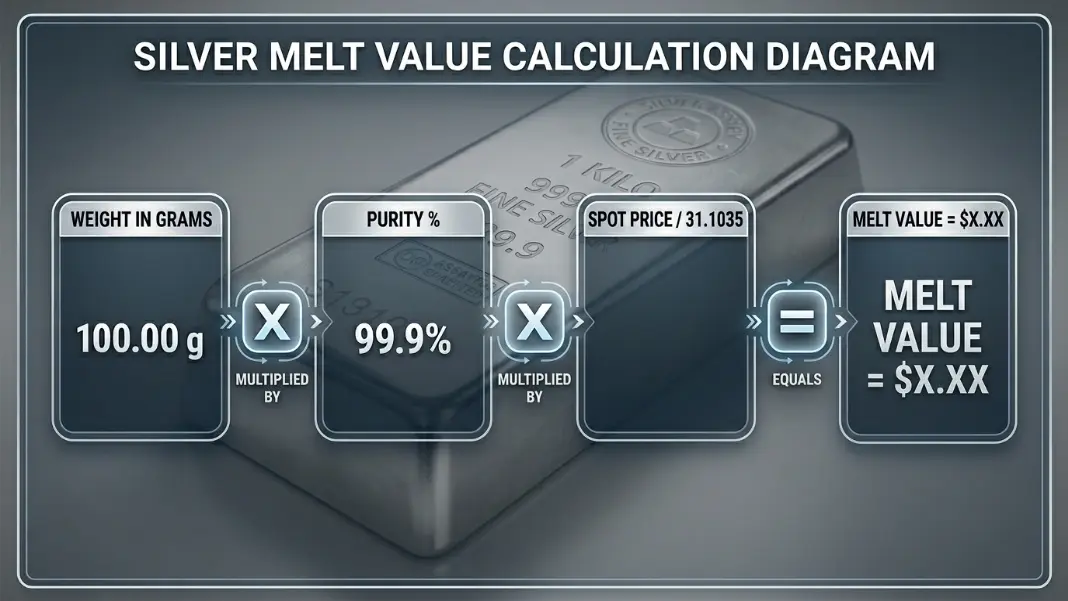
Fine silver grams = Net alloy grams × Purity fraction
Melt value = Fine silver grams / 31.1034768 × Price per fine troy ounce
Net alloy weight means the weight of the silver alloy, after excluding separate stones, filler, steel blades and other non-silver components. Keep the copper or other metal that is actually alloyed into sterling within that alloy weight: the purity multiplier accounts for it.
For a verified 28-gram sterling bracelet with no separate non-silver components:
Fine silver: 28 × 0.925 = 25.9 grams.
Fine troy ounces: 25.9 / 31.1034768 ≈ 0.832704.
Melt value at hypothetical $33: $27.48.
Use full precision until the final money result. If an assay already reports fine silver grams, do not multiply by purity again. NIST provides the mass conversion.
Read a Fineness Mark Without Treating It as an Assay#
Verified fineness
Fraction for gross alloy weight
999
0.999
958
0.958
925 / sterling
0.925
900
0.900
835
0.835
800
0.800
The FTC describes sterling silver and 925 markings. Marks can be incomplete, worn or misleading; an item's age, country or appearance does not substitute for identifying the applicable standard and assessing authenticity. Ask a qualified buyer or assayer how they will test an unfamiliar piece and whether the method changes or damages it.
A magnetic response can reveal some non-silver components, but lack of magnetism does not prove silver content. Plating and nonmagnetic base metals make that shortcut inadequate for assigning a purity. Do not conduct destructive tests on a potentially collectible item without considering its resale value.
A “weighted” candlestick can contain filler; a knife may combine a silver-alloy handle with a steel blade. Their total scale weight is not the weight of recoverable silver alloy. A hallmark on one component does not assign that fineness to the whole object.
Silver plate is a layer over a base material. Entering its whole weight at 0.925 can dramatically overstate metal content. The silver plate guide explains what can and cannot be inferred from those items. Obtain relevant weight and assay information instead of guessing a standard number of silver grams per fork or handle.
Suppose a lot has 28 grams of verified sterling alloy and 100 grams of verified .800 alloy. The fine-silver weights are 25.9 grams and 80 grams. Their combined fine silver is 105.9 grams, giving $112.36 at hypothetical $33.
There is no universal percentage that a pawn shop, coin dealer or refinery pays. Ask for the quote's price basis, assay terms, deductions, settlement date and net amount. A headline percentage may exclude a fixed fee or already include a refining charge.
For a hypothetical lot with exactly $100 of calculated melt value:
Example offer terms
Net amount
Net amount / melt
$85 total with no additional stated fees
$85
85%
90% of melt less a $10 fee
$80
80%
The second headline percentage is higher but its net payment is lower in this example. Neither row claims to represent a current market payout. Enter the net total in the calculator's optional offer field to compare your own quote. The refinery offer guide covers the calculation in more detail.
A maker, pattern, complete set, coin date, condition or provenance can affect resale value independently of silver content. Compare relevant completed sales and qualified appraisals where appropriate, accounting for selling fees and shipping. Do not treat melt as a guaranteed floor, a maximum resale value or an instruction to destroy an item.
An existing buyer quote is more informative than an invented “typical” premium. The sterling jewelry and flatware guide separates metal-content calculations from whole-item resale comparisons.
Multiply relevant alloy grams by the verified silver fraction, divide by 31.1034768, then multiply by your price per fine troy ounce. At a hypothetical $33 input, 28 grams of sterling alloy gives $27.48 of melt value.
No. Supply a price in USD per fine troy ounce and check its source and timestamp. The calculator's prefilled value is a labeled example.
Obtain actual net quotes. Assay terms, fixed fees, price basis and collectible value can change proceeds. The calculator compares the offer you enter; it does not assume a payout percentage.
Only if you have established that the entered weight is the silver alloy being valued. Steel, resin, cement, stones and other separate components must not be counted as sterling alloy.
Tags:scrap silver calculatorscrap silver valuesilver melt value calculatorhow to calculate scrap silversilver price per gramsilver purity chartsterling silver scrap valuecoin silver value
HR
Written by
Hassaan Rasheed
Web Developer & Content Researcher
Hassaan builds calculators and writes source-linked guides across the site's subject areas. Calculator methods and reference data are documented in each guide so readers can verify the underlying sources.