What Is 925 Silver Worth? Price Per Gram and Ounce (2026)
925 silver is 92.5% pure sterling. Value per gram and troy ounce, how a 925 silver calculator works, and comparison to fine silver spot price.
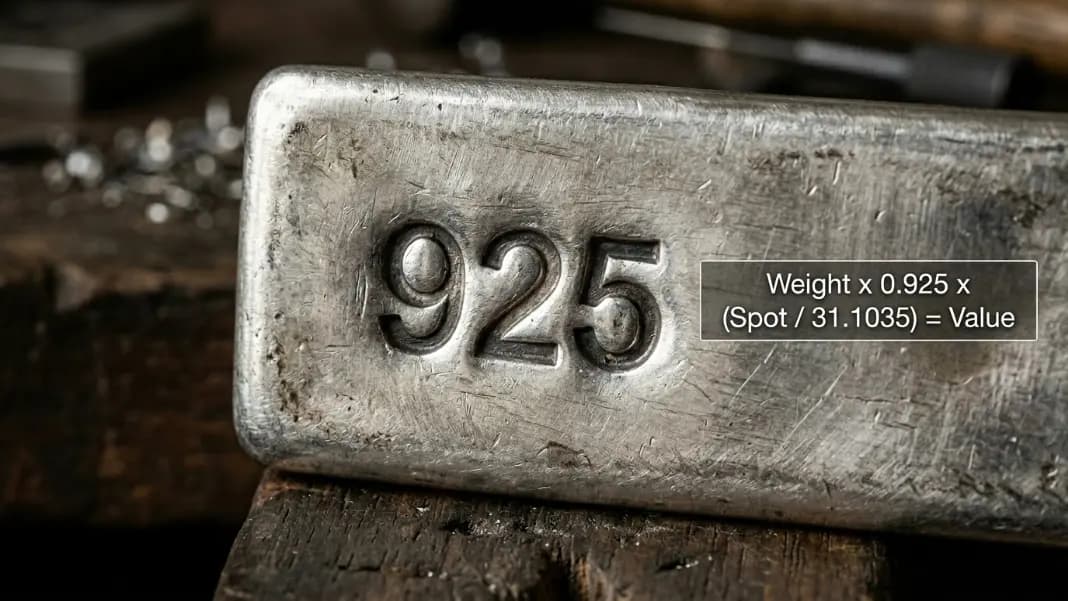
The number 925 stamped on a silver piece means it is 92.5% pure silver and 7.5% copper or other alloy metals. It is the standard for sterling silver worldwide, used in jewelry, flatware, and decorative objects. Understanding what 925 silver is worth requires knowing the live silver spot price and applying a simple formula.
This guide shows how to calculate 925 silver value in real time, what price per gram to expect at different spot price levels, and when 925 silver sells for more than its raw metal content. For a live calculation, use the Silver Calculator.
How to Calculate 925 Silver Value
The formula for 925 silver melt value is:
925 Silver Value = Weight (grams) x 0.925 x (Spot Price per Troy Oz / 31.1035)
The constant 0.925 represents the 92.5% silver content. The divisor 31.1035 converts the troy ounce spot price to a per-gram figure.
Worked example: A 925 sterling silver ring weighing 6 grams. Spot price: $33.00/ozt.
- Spot per gram: $33.00 / 31.1035 = $1.0610
- 925 factor: $1.0610 x 0.925 = $0.9814 per gram
- Ring value: 6 x $0.9814 = $5.89 melt value
For a heavier piece, say a 60-gram sterling bracelet: 60 x $0.9814 = $58.88 melt value at $33/ozt spot.
Two points worth keeping in mind:
First, melt value is what the silver is worth if melted down to pure metal. Scrap dealers do not pay 100% of melt; their offers typically fall between 75-90% of this number. A $58.88 melt value bracelet realistically fetches $44-$53 at a scrap buyer.
Second, 925 silver jewelry in good condition often sells for more than melt value on the secondary market. The markup depends on brand, design, and condition. Tiffany sterling pieces sell at 3-10x melt value on eBay and at estate sales. Unbranded pieces usually sell at 1.1-1.5x melt if in excellent condition.
925 Silver Price Per Gram: Reference Table
The price per gram of 925 silver moves in direct proportion to the silver spot price. The table below gives the melt value per gram at several spot price levels for planning purposes. The actual live value requires the current spot price.
| Spot Price (per troy oz) | 925 Silver (per gram) | Per 10 grams | Per 30 grams |
|---|---|---|---|
| $24.00 | $0.714 | $7.14 | $21.42 |
| $28.00 | $0.833 | $8.33 | $24.99 |
| $31.00 | $0.921 | $9.21 | $27.63 |
| $33.00 | $0.981 | $9.81 | $29.43 |
| $35.00 | $1.041 | $10.41 | $31.23 |
| $38.00 | $1.130 | $11.30 | $33.90 |
| $42.00 | $1.249 | $12.49 | $37.47 |
Reading the table: If the spot price is $35/ozt, a 25-gram sterling silver bracelet has a melt value of 25 x $1.041 = $26.03. Multiply the "per gram" column by your item's weight in grams for any piece.
To get the current price per gram, divide the live spot price by 31.1035 and multiply by 0.925. Silver spot prices are quoted on Kitco, APMEX, and major financial data providers during market hours (typically 6am-5pm New York time, Sunday-Friday).
For a real-time calculation without doing the math manually, the Silver Calculator applies the current spot price automatically when you enter weight and select 925 purity.
925 Silver vs 999 Fine Silver: Value Comparison
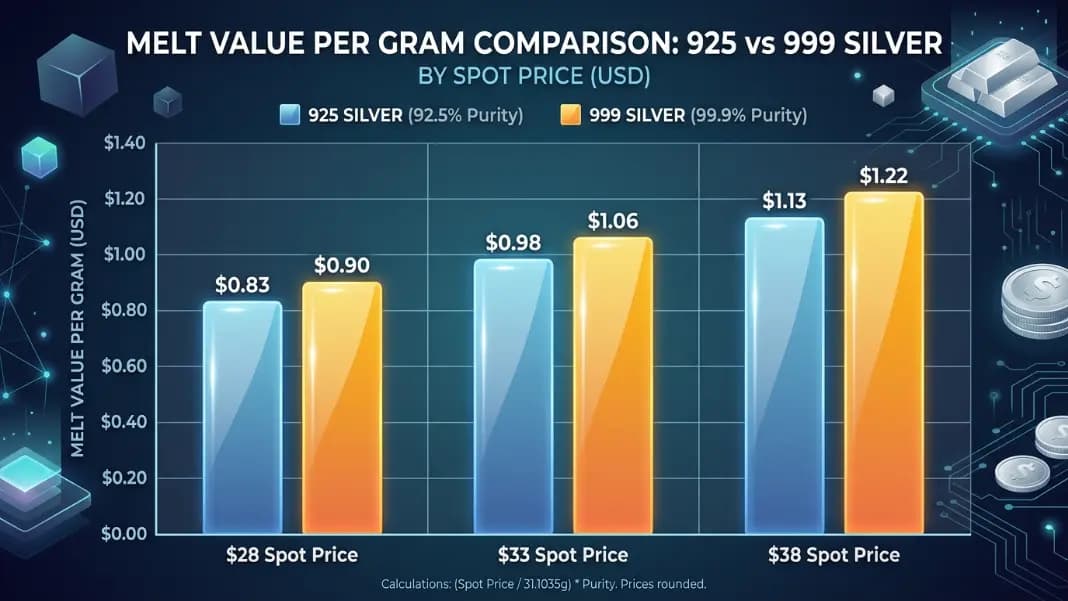
Fine silver (999) is 99.9% pure. Sterling silver (925) is 92.5% pure. The value difference between them is the purity gap: 925 silver is always worth 92.5% of what the same weight of 999 silver would be worth.
| Weight | 999 Value at $33/ozt | 925 Value at $33/ozt | Difference |
|---|---|---|---|
| 10 g | $10.60 | $9.81 | -$0.79 |
| 30 g | $31.83 | $29.43 | -$2.40 |
| 100 g | $106.10 | $98.14 | -$7.96 |
| 1 troy oz (31.1g) | $33.00 | $30.53 | -$2.47 |
The percentage difference (7.5%) stays constant regardless of spot price. If you have a piece of unknown purity and are deciding whether to sell it as 925 or test it for higher content, the financial difference on a 30-gram piece is about $2.40 at $33/ozt. Testing is typically worth it if you have larger quantities or suspect the item might be fine silver (marked 999 or "FS").
Fine silver is softer than sterling because it lacks the copper alloy, which is why most wearable jewelry uses 925. Bullion bars and rounds are commonly struck in 999. Silver coins minted for circulation in the US before 1965 are 900 purity (coin silver), slightly below sterling.
The scrap silver value guide covers the full purity spectrum including 800 and 750 hallmarks common in European silverware.
How to Read the 925 Hallmark on Jewelry
The 925 stamp is pressed into the metal during manufacturing. On a ring, it appears inside the band. On a necklace, check the clasp or a small tag soldered to the chain. On bracelets, look on the inside surface near the clasp. On flatware, check the back of the handle near the stem.
The full sterling silver marking system varies by country:
- USA: 925 or STERLING (the word is legally equivalent to the 925 stamp under US law)
- UK: 925 plus an assay office mark (a lion passant for England, Edinburgh castle for Scotland) and a date letter
- EU / Continental Europe: 925, or older pieces may show country-specific marks
- Mexico: 925 or "Taxco" plus a maker's code (Mexican silver is almost always 925)
- Thailand: 925, often on silver jewelry exported globally
What to look for when the stamp is worn:
Older pieces may have a faint or partially worn stamp. Use a 10x loupe and look at an angle under strong light. The stamp is recessed, so light from the side casts a shadow into the letters or numbers. If the stamp reads "900" or "800" rather than "925," the piece is a different alloy and the calculation changes accordingly.
Stamps that do NOT mean sterling silver:
- "Silver filled" (SF): a thick silver layer over a base metal core. Has some silver value but less than solid sterling.
- "Silver plate" or "SP": a thin plated coating. Negligible scrap value.
- "EPNS": electroplated nickel silver. No silver content.
- "Alpaca" or "Alpacca": a nickel-based alloy, no silver.
When 925 Silver Is Worth More Than Its Melt Value
Melt value is the floor price for 925 silver, not the ceiling. Several factors push the market value of sterling silver items above their intrinsic metal content.
Designer and brand premium: Tiffany & Co. sterling pieces command 3-10x melt value. Georg Jensen, Cartier, and Bulgari pieces at auction frequently sell for 5-15x melt. Even mid-tier American silversmiths like Gorham or Reed and Barton have collector followings that support 2-4x melt for desirable patterns.
Antique and vintage premium: Sterling items made before 1940 carry an age premium. Victorian, Edwardian, and Art Deco sterling jewelry commands a collector market. Pre-1920 American sterling flatware in original patterns (Old English, Repousse, King Richard) sells consistently above melt.
Complete sets: A single flatware piece sells at or near melt. A complete 8-person service for 12 (96 pieces) in a desirable pattern sells for 3-6x melt as a set. The premium is entirely in the completeness.
Condition: Sterling silver polishes well and holds value. Pieces with deep scratches, bent tines, or missing hallmarks sell closer to melt. Pieces in near-original condition with original boxes sell at a significant premium.
How to check quickly: Search eBay for sold listings matching your item description. Use filters: "Sold" only, sterling silver, your approximate weight or size range. The difference between the sold price and the melt value at that weight tells you whether scrapping or selling as an item makes more financial sense.
For most generic 925 chain necklaces, rings, and pendants with no brand name, the resale premium over melt is small (10-20%). For branded or antique pieces, the premium can be substantial.
925 means the item is 92.5% pure silver, with 7.5% copper or other metals added for durability. This alloy is called sterling silver. The number refers to parts per thousand: 925 out of 1000 parts are pure silver. It is the international standard for wearable silver jewelry and the most common silver grade you will encounter.
Multiply the weight in grams by 0.925, then multiply by the current silver spot price per gram. Spot price per gram equals the spot price per troy ounce divided by 31.1035. At $33/ozt, the per-gram factor for 925 silver is $0.981. A 20-gram bracelet is worth 20 x $0.981 = $19.62 in melt value. Use the Silver Calculator for an automatic calculation at the current live price.
At a spot price of $33.00 per troy ounce, 925 silver is worth $0.981 per gram in melt value. At $35/ozt it is $1.041/gram. At $28/ozt it is $0.833/gram. The figure moves proportionally with the silver spot price. To calculate for any spot price: divide the spot price by 31.1035 and multiply by 0.925.
Yes. 925 silver (sterling silver) is a genuine silver alloy containing 92.5% pure silver. It is not silver-plated, not fake, and not a base metal with a silver coating. The 7.5% copper content is added to make the metal harder and more durable for everyday wear. Fine silver (999) is softer and used mainly for bullion; sterling silver is the standard for jewelry and flatware.
It depends on the piece. Branded jewelry (Tiffany, Gorham, Georg Jensen) and antique sterling consistently sell for 2-10x melt value in the secondary market. Generic jewelry with no brand, in average condition, typically sells at 1.1-1.5x melt if it sells at all quickly. Damaged, broken, or mismatched pieces are best scrapped since repair cost often exceeds the resale premium. Check eBay completed listings for your specific item type before deciding.
999 silver is 99.9% pure (fine silver). 925 silver is 92.5% pure (sterling silver). 999 silver is worth approximately 8% more per gram because it has a higher silver content. At $33/ozt, 999 silver is worth $1.060/gram and 925 silver is worth $0.981/gram. Fine silver is softer and used mainly for bullion bars, coins, and some jewelry. Sterling silver is harder and used for most wearable jewelry and flatware.
Written by
Hassaan Rasheed
Web Developer & Content Researcher
Hassaan builds calculators and writes research-backed guides on finance, math, payroll, and construction topics. Every number in his articles is sourced from official data and worked through by hand.
View LinkedIn Profile