HomeResourcesSilver Bar and Bullion Calculator: 1 oz, 10 oz, and 100 oz Value (2026)
Finance

Silver Bar and Bullion Calculator: 1 oz, 10 oz, and 100 oz Value (2026)

Silver bar calculator for 1 oz, 10 oz, and 100 oz bullion. Covers silver bullion value, bar premiums, rounds vs bars, and live spot price calculation.

Hassaan RasheedJune 15, 2026
11 min read
Silver Bar and Bullion Calculator: 1 oz, 10 oz, and 100 oz Value (2026)

The spot price quoted on any silver market site is not the price you will pay for a bar, and it is not what you will receive when you sell. Every bullion transaction carries a premium above spot on the buy side and a discount below spot on the sell side. The gap between those two numbers is the spread, and it eats more of your return than most first-time buyers expect.

The Silver Calculator calculates live silver bar value in real time for any weight and purity. This guide covers how to calculate silver bar value manually, what drives premium differences between bar sizes, how rounds compare to bars in practice, and what the dealer spread actually costs you over time.

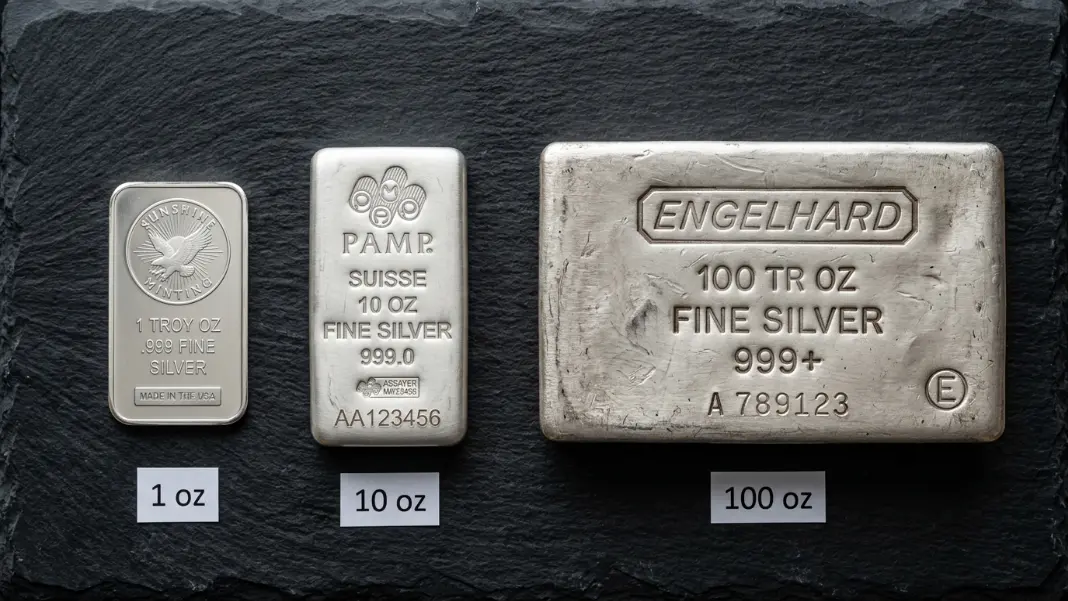
Three silver bullion bars showing 1 oz 10 oz and 100 oz sizes on dark slate surface

How to Calculate Silver Bar Value at Any Spot Price

Silver bar value is calculated by multiplying the bar's weight in troy ounces by the spot price and by the purity decimal. For 999-fine silver bars, the purity decimal is 0.999 and the calculation simplifies to nearly spot times weight.

Bar Melt Value = Weight (troy oz) × Spot Price × Purity Decimal

For 999 fine silver:
Bar Melt Value = Weight (troy oz) × Spot Price × 0.999

Worked examples at $33.00/oz spot:

Bar SizeWeightMelt CalculationMelt Value
1 oz round or bar1.000 troy oz1.000 × $33.00 × 0.999$32.97
10 oz bar10.000 troy oz10.000 × $33.00 × 0.999$329.67
100 oz bar100.000 troy oz100.000 × $33.00 × 0.999$3,296.70
1 kilo bar32.151 troy oz32.151 × $33.00 × 0.999$1,060.53

The 0.001 difference between 999 and 1.000 purity means virtually nothing at retail. A 1 oz bar at $33 spot loses $0.03 to that 0.001 impurity. The number that actually matters is the premium charged above melt.

Most retail silver bars carry 999 or 9999 purity. Generic brand bars and secondary market bars sometimes grade at 999. Premium mint products (Royal Canadian Mint, Perth Mint) grade at 9999. The difference in melt value between 999 and 9999 on a 1 oz bar at $33 is $0.03. The premium difference between the two can be $1-3. Always think about premium, not purity differences at this level.

Silver Bar Sizes: What 1 oz, 10 oz, and 100 oz Actually Cost to Buy

Melt value is the floor. The price you pay is melt plus the dealer premium. Premiums scale inversely with bar size: smaller bars cost more per troy ounce because the manufacturing cost per ounce is higher.

Here is how premiums typically compare at retail for well-known mint bars:

Bar SizeTypical Premium Above SpotPremium % at $33 Spot
1 oz (major mint, new)$2.50-$5.007.6-15.2%
1 oz (secondary market)$1.50-$3.004.5-9.1%
10 oz (major mint, new)$2.00-$3.50/oz6.1-10.6% total
10 oz (secondary market)$1.00-$2.00/oz3.0-6.1% total
100 oz (major brand, new)$0.80-$1.50/oz2.4-4.5% total
100 oz (secondary market)$0.40-$0.80/oz1.2-2.4% total
1 kilo bar$1.00-$2.00/oz3.0-6.1% total

A 1 oz bar at $33 spot with a $3 premium costs $36. To break even on that purchase, spot needs to rise to at least $36 before you sell, plus you'll take another discount when you sell. That is a 9.1% hurdle just to get back to even.

Larger bars reduce that hurdle. A 100 oz bar with a $1/oz premium costs $3,400 total and needs spot to move only 3% to break even on a round-trip sale. That is why experienced silver investors prefer larger bar sizes.

The Silver Price Per Gram Calculator shows how to convert between weight units and purity grades if you are working with bars measured in grams rather than troy ounces.

Silver Rounds vs Bars: What the Premium Difference Means for Buyers

Silver rounds are privately minted coins that look like government coins but carry no face value and no legal tender status. They are functionally identical to silver bars for melt-value purposes. The distinction matters for premiums and resale.

Rounds typically carry slightly higher premiums than bars of the same weight because the pressing and die work on a round costs more per ounce than rolling a flat bar. On a 1 oz unit, the difference is usually $0.25-0.75. That gap narrows on secondary market purchases.

The case for rounds over bars:

  • Rounds are more recognisable to casual buyers and easier to sell quickly
  • American Silver Eagles and Canadian Maple Leafs carry a government guarantee of weight and purity, which many buyers will pay more for
  • Smaller pieces are easier to sell in partial quantities

The case for bars over rounds:

  • Lower premiums per ounce, especially above 10 oz
  • Generic bars from major refiners (Engelhard, Johnson Matthey, Silvertowne) are widely recognised by dealers
  • 100 oz bars are the standard unit for most institutional buyers and refiners

Government-minted coins (American Silver Eagles, British Britannias, Canadian Maple Leafs) are a third category: they carry the highest premiums in new condition, typically $5-8 above spot on a 1 oz coin. They hold their premium well on resale because of the government brand. For investors focused purely on silver content and minimising premium cost, generic 10 oz or 100 oz bars are the more efficient choice.

The Junk Silver Calculator covers pre-1965 US 90% silver coins, which are a separate category from bullion bars and carry their own premium structure.

How Spot Price Moves and What That Means for Bar Timing

Silver spot price trades continuously during market hours and is driven by a combination of industrial demand (60%+ of annual silver consumption goes to solar panels, electronics, and medical devices), investment demand, and currency movements.

The live price you see quoted is the London Bullion Market Association (LBMA) price or the COMEX futures price. Spot is almost always quoted per troy ounce of 999 fine silver for immediate settlement.

Three things most buyers overlook about spot price timing:

Bid and ask spread: Spot price is a mid-market reference. Dealers sell at the ask, which is spot plus premium. Dealers buy at the bid, which is spot minus their buyback margin. The spread between what you pay and what you receive is 5-15% on small bars at most retail dealers.

Spot at time of settlement: Online purchases lock in a price at order time, but if you pay by check or bank transfer, dealers often lock spot for 3-5 business days. Credit card purchases typically lock immediately but add a 3-4% processing fee on top of the premium.

Premium compression in bull markets: When silver is rising fast, dealer premiums on 1 oz items often increase because supply tightens and dealers raise premiums to slow demand. In flat or falling markets, premiums compress. A $5 premium on a 1 oz bar at $20 spot represents 25% of melt. The same $5 at $40 spot is 12.5%. Premiums are sticky; spot is not.

What Dealers Pay When You Sell: The Buy-Back Spread on Bullion Bars

Dealer buy-back prices for silver bars are almost always expressed as a percentage of spot or as spot minus a fixed dollar amount. Here is the typical structure:

ItemTypical Dealer Buy-BackAs % of Spot at $33
100 oz bars (COMEX-eligible brands)Spot minus $0.30-$0.50/oz98-99% of spot
10 oz bars (major brands)Spot minus $0.50-$1.50/oz95-98% of spot
1 oz bars (generic)Spot minus $1.50-$3.00/oz91-95% of spot
1 oz bars (premium mint)Spot minus $0.50-$2.00/oz94-98% of spot
Silver rounds (generic)Spot minus $1.00-$2.50/oz92-97% of spot
Old, damaged, or obscure barsSpot minus $3.00-$5.00+/oz85-91% of spot

COMEX-eligible brands are those approved for delivery on the COMEX futures exchange: Engelhard, Johnson Matthey, PAMP Suisse, Metalor, Valcambi, and a few others. These brands command the tightest buy-back spreads because dealers can resell them into the wholesale market without an assay.

For a 1 oz generic bar bought at a $3 premium and sold at $2 below spot, the round-trip cost is $5 per troy ounce, or 15.2% at $33 spot. Silver needs to gain 18% in dollar terms just to return your purchase price after the full round trip. That is the real cost of owning physical silver in small quantities.

The Scrap Silver Calculator guide covers the calculation for mixed lots that include bars alongside sterling, coins, and jewelry at different purity levels.

Silver bar value equals the bar's weight in troy ounces multiplied by the spot price and the purity decimal. For 999 fine silver at $33.00 spot: a 1 oz bar is worth $32.97, a 10 oz bar is worth $329.67, and a 100 oz bar is worth $3,296.70. The melt calculation gives you the silver content value; add the dealer premium to get the actual purchase price.

A silver bullion calculator takes the current spot price and calculates the melt value of a bar or round based on its weight and purity. You input the weight in troy ounces (or grams) and the purity grade (usually 999 or 9999), and the calculator outputs the silver content value. This gives you the floor price for any bullion piece before dealer premiums are applied.

Smaller bars cost more per ounce because the manufacturing cost per unit does not scale with weight. Minting, assaying, and packaging a 1 oz bar costs nearly as much as a 10 oz bar. Dealers spread that fixed cost over fewer ounces of silver on smaller units, producing a higher premium per troy ounce. At $33 spot, a 1 oz bar might carry a $3.50 premium (10.6%), while a 100 oz bar from the same dealer carries only $0.90 per ounce (2.7%).

A silver round is a privately minted disc that resembles a coin but carries no face value or legal tender status. A silver bar is a rectangular or trapezoidal cast or pressed piece. Both are typically 999 fine silver. Rounds usually carry slightly higher premiums than bars of equal weight because of die work and pressing costs. Neither type carries the government guarantee of weight and purity that American Silver Eagles or Canadian Maple Leafs do.

A live silver calculator pulls the current spot price from a market feed and uses it to compute the melt value of your silver in real time. You enter your bar size or weight, and the calculator updates the displayed value as spot price moves. This is useful for tracking the current value of your holdings or deciding when to buy or sell. The Silver Calculator at CalculatorFlux updates live throughout the trading day.

For pure melt-value efficiency, yes. Larger bars carry lower premiums per troy ounce, which means less spot appreciation required to break even. A 100 oz bar may need only a 3-4% spot price gain to recover round-trip transaction costs. A 1 oz bar may need 15-20%. The trade-off is liquidity: 1 oz units are easier to sell in small quantities and to a wider range of buyers. If you are holding silver as an investment rather than for barter or gift purposes, 10 oz to 100 oz bars are the more cost-efficient choice.

Tags:silver bar calculatorsilver bullion calculatorsilver bullion value calculatorsilver bar value calculatorsilver melt calculatorlive silver calculatorsilver price today calculatorsilver calculator
HR

Written by

Hassaan Rasheed

Web Developer & Content Researcher

Hassaan builds calculators and writes research-backed guides on finance, math, payroll, and construction topics. Every number in his articles is sourced from official data and worked through by hand.

View LinkedIn Profile

Recent Posts