Junk Silver Calculator: How to Value Coins, Dimes, and 800 Silver (2026)
Pre-1965 US coins hold 90% silver. Calculate junk silver value by weight, coin type, and grade. Covers dimes, quarters, and 800-grade European silver.

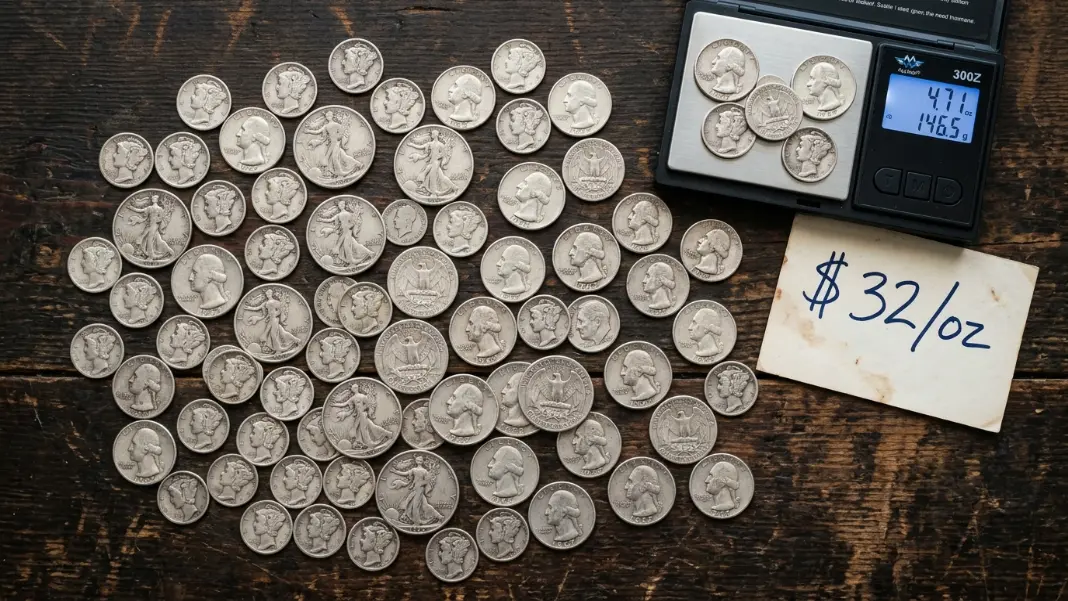
Pre-1965 US coins contain 90% silver and trade at multiples of face value whenever spot prices are above a few dollars per ounce. With silver around $32/troy oz in 2026, a single 1964 Roosevelt dime carries roughly $2.31 in melt value. A $1,000 face bag of 90% coin holds over $23,000 in silver. The Silver Calculator handles this calculation automatically. This guide explains the math behind each coin type, a full coin reference table, how to value 800-grade European silver, and what you can realistically expect from a dealer.
How to Calculate Junk Silver Value by Weight
The formula for any US 90% silver coin is:
Melt Value = Face Value ($) × 0.7234 × Spot Price ($/troy oz)
The constant 0.7234 is the theoretical silver content per $1 of face value. It comes directly from the original coin specs: a pre-1965 dime weighs exactly 2.50 grams with 90% silver content, giving 2.25g of pure silver per coin (0.07234 troy oz). Ten dimes equal $1.00 face, so $1 face = 0.7234 troy oz. The same 90% fineness applies to quarters, halves, and silver dollars, so the ratio holds for all four denominations.
Worked example at $32/troy oz spot:
- Face value on hand: $50 in mixed 90% coin
- Silver content: $50 × 0.7234 = 36.17 troy oz
- Melt value: 36.17 × $32 = $1,157.44
In practice, dealers use 0.715 oz per $1 face rather than the theoretical 0.7234. The difference accounts for wear. Circulated coins lose a small amount of silver through decades of handling, and 0.715 is the industry standard for bag-level transactions. At $32 spot, the practical difference on $1,000 face: 715 oz × $32 = $22,880 versus 723.4 oz × $32 = $23,149. A $269 gap on a standard bag.
For the complete weight-to-value methodology and how it applies to non-coin silver, see How to Calculate Scrap Silver Value.

Junk Silver Coin Reference Table
US 90% silver came in four main denominations. The Kennedy half dollar series added a transitional 40% silver issue from 1965 to 1969 that collectors and dealers handle as a separate category. Several proof and special issue coins from later decades also contain silver, but those are not standard junk silver.
All melt values below use $32/troy oz spot. Scale proportionally for other spot prices by multiplying the troy oz column by your current spot price.
| Coin | Years | Weight (g) | Silver (troy oz) | Melt Value at $32 |
|---|---|---|---|---|
| Roosevelt / Mercury Dime | 1916-1964 | 2.50g | 0.07234 oz | $2.31 |
| Washington Quarter | 1932-1964 | 6.25g | 0.18084 oz | $5.79 |
| Walking Liberty / Franklin Half | 1916-1964 | 12.50g | 0.36169 oz | $11.57 |
| 1964 Kennedy Half | 1964 only | 12.50g | 0.36169 oz | $11.57 |
| Kennedy Half (40% silver) | 1965-1969 | 11.50g | 0.14792 oz | $4.73 |
| Morgan Dollar | 1878-1921 | 26.73g | 0.77344 oz | $24.75 |
| Peace Dollar | 1921-1935 | 26.73g | 0.77344 oz | $24.75 |
| Eisenhower Dollar (40% proofs only) | 1971-1976 | 24.59g | 0.31624 oz | $10.12 |
The 1965 cutoff is the most important date to know. In 1965, the US Mint switched all dimes and quarters to copper-nickel clad with zero silver content. Halves went to 40% silver from 1965 through 1969, then clad from 1970 onward. If a coin's date is 1965 or later and it is not a Kennedy half from 1965-1969, it has no silver.
Morgan and Peace dollars carry a note. Both are 90% silver and worth $24.75 each at $32 spot. However, Morgan and Peace dollars with specific dates and mint marks carry numismatic premiums well above melt. A 1921 Morgan (common date) trades near melt; an 1893-S Morgan can fetch thousands. If you have silver dollars, check dates before melting or selling at melt price.
Silver Dime Calculator: What 10, 50, and 100 Dimes Are Worth
Mercury dimes (1916-1945) and Roosevelt dimes (1946-1964) are the most common junk silver by coin count. Both contain exactly 0.07234 troy oz of silver. Their small face value and uniform weight make them easy to accumulate in standard bank roll quantities.
At $32/troy oz spot, dime melt values by quantity:
| Quantity | Face Value | Silver (troy oz) | Melt Value |
|---|---|---|---|
| 10 dimes | $1.00 | 0.7234 oz | $23.15 |
| 25 dimes | $2.50 | 1.809 oz | $57.87 |
| 50 dimes | $5.00 | 3.617 oz | $115.74 |
| 100 dimes | $10.00 | 7.234 oz | $231.49 |
| 200 dimes | $20.00 | 14.468 oz | $462.98 |
| 500 dimes | $50.00 | 36.170 oz | $1,157.44 |
| 1,000 dimes | $100.00 | 72.34 oz | $2,314.88 |
The ratio of melt value to face value is called the melt multiple. At $32 spot, each $1 of 90% dime face value holds approximately $23.15 in silver, a 23:1 melt multiple. During the 2011 silver peak near $50/oz, the same ratio hit 36:1.
A standard bank roll of dimes holds 50 coins ($5 face). At $32 spot, a 90% silver dime roll contains $115.74 in melt but sells retail for $120-$135 because collector demand for pre-1965 silver rolls adds a small premium. Selling full rolls rather than loose coins typically yields 3-8% more per coin.
For current melt multiples tied to live spot pricing, the Silver Price Per Ounce Explained page covers the troy ounce to dollar and gram conversions in detail.
800 Silver Calculator: European Hallmarks Explained
800 silver (80% purity) is the prevailing standard for German, Dutch, Scandinavian, and much of Eastern European silverware made between roughly 1850 and 1950. The number 800 means 800 parts per 1,000 are pure silver. It appears as a stamp on the back or underside of flatware, trays, candleholders, and decorative pieces.
The formula for any known-fineness silver:
Melt Value = Weight (g) × (Fineness / 1000) × (Spot Price / 31.1035)
At $32 spot, 800 silver works out to:
Value per gram = ($32 / 31.1035) × 0.800 = $0.823 per gram
Worked example: 800 silver serving spoon weighing 42g:
- Pure silver content: 42g × 0.800 = 33.6g
- Troy oz: 33.6 / 31.1035 = 1.0802 oz
- Melt value: 1.0802 × $32 = $34.57
For comparison, 925 sterling at the same 42g: 42 × 0.925 × ($32 / 31.1035) = $39.96. Sterling recovers about 15% more per gram than 800 silver at the same spot price. The What Is 925 Silver Worth page covers sterling calculations in full.
European silver hallmarks vary by country and period. These are the most common you will encounter on antique or imported pieces:
| Hallmark | Fineness | Pure Silver % | Value per Gram at $32 Spot |
|---|---|---|---|
| 800 | 800/1000 | 80.0% | $0.823 |
| 830 | 830/1000 | 83.0% | $0.854 |
| 835 | 835/1000 | 83.5% | $0.859 |
| 875 | 875/1000 | 87.5% | $0.900 |
| 900 | 900/1000 | 90.0% | $0.926 |
| 925 (sterling) | 925/1000 | 92.5% | $0.951 |
| 999 (fine silver) | 999/1000 | 99.9% | $1.029 |

For pieces with no visible hallmark, dealers use acid testing or XRF (X-ray fluorescence) scanning to determine fineness. Unmarked silver typically sells at a discount to compensate for the assay uncertainty. If you have a significant quantity of unmarked silverware (over $500 in estimated melt), a professional assay is worth the cost before committing to a sale price.
What Dealers Pay vs Melt Value
The melt value you calculate is the theoretical maximum, not the price a dealer will offer. Dealers maintain a spread between their buy price and their sell price to cover handling, refining costs, and holding risk while they find a buyer.
Typical dealer buy prices as a percentage of melt:
| Item Type | Buy Price (% of Melt) |
|---|---|
| 90% US coin in $1,000 face bags | 95-98% |
| 90% US coin in rolls | 92-96% |
| Loose mixed 90% coin | 88-94% |
| 40% Kennedy halves | 85-92% |
| Morgan / Peace dollars (common dates) | 97-102% |
| 800 silver flatware (European) | 70-82% |
| 925 sterling silverware | 75-85% |
The tightest spread is on the most liquid items: $1,000 face bags of 90% US coin. Dealers know exactly what they are buying, the secondary market is deep, and refining is straightforward. The 800 silver flatware discount is larger because the market is thinner, assaying takes time, and the buyer pool is smaller.
Premiums on the sell side:
Retail dealers charge buyers 3-8% over melt for 90% US coin. Proof coins, key dates, and uncirculated pieces carry additional numismatic premiums above the silver base.
For larger transactions ($5,000 or more in melt value), getting two or three dealer quotes is worthwhile. A 2% spread difference on a $20,000 lot is $400. The Silver Calculator gives you the melt baseline so you can evaluate any offer against an objective number before walking in.
Junk silver is pre-1965 US circulated currency (dimes, quarters, halves, and silver dollars) that contains 90% silver. The word "junk" describes the numismatic condition, not the metal. These coins carry no collector premium above melt value due to heavy circulation wear, so investors and dealers trade them purely for silver content. A $1,000 face value bag of 90% junk silver contains approximately 715 to 723 troy oz of silver, worth over $22,000 at $32 spot.
Multiply the face value in dollars by 0.7234 to get the theoretical troy oz of silver, then multiply by the current spot price. For $100 face value in mixed 90% coins: $100 × 0.7234 = 72.34 troy oz. At $32 spot, that equals $2,315 in melt value. Dealers use 0.715 instead of 0.7234 to account for coin wear, which reduces the payout by about 1.2% on large quantities.
A pre-1965 Roosevelt or Mercury dime contains 0.07234 troy oz of silver. At $32 spot in 2026, one silver dime holds about $2.31 in melt value. Dealers typically pay $2.10-$2.25 when buying loose dimes (90-97% of melt) and charge $2.40-$2.65 when selling them. A full roll of 50 silver dimes contains $115.74 in melt at $32 spot.
At $32 per troy oz spot price, 800 silver is worth $0.823 per gram. The formula is (spot price / 31.1035) × 0.800. At $40 spot, 800 silver is worth $1.029 per gram. At $50 spot, it reaches $1.286 per gram. For comparison, 925 sterling at $32 spot yields $0.951 per gram, about 16% more per gram than 800 silver.
No. The 1964 Kennedy half is 90% silver (0.3617 troy oz, worth $11.57 at $32 spot). The 1965 to 1969 Kennedy halves are 40% silver (0.1479 troy oz, worth $4.73 at $32). All Kennedy halves from 1970 onward are clad copper-nickel with no silver content. This is the most common identification mistake in junk silver. Always check the date before pricing Kennedy halves.
800 silver is 80% pure (800 parts per 1,000), the standard used widely in Germany, the Netherlands, and Scandinavia for 19th and early 20th century flatware. Sterling (925) is 92.5% pure and is the standard for US and UK jewelry and modern silverware. At $32 spot, 800 silver yields $0.823 per gram versus $0.951 for 925 sterling. Dealers pay a steeper discount below melt for 800 silver because its secondary market is thinner and buyers harder to find.
Written by
Hassaan Rasheed
Web Developer & Content Researcher
Hassaan builds calculators and writes research-backed guides on finance, math, payroll, and construction topics. Every number in his articles is sourced from official data and worked through by hand.
View LinkedIn Profile