Home›Resources›US Silver Coin Melt Value Calculator: Dimes, Quarters, Halves, and Dollars (2026)
Finance
US Silver Coin Melt Value Calculator: Dimes, Quarters, Halves, and Dollars (2026)
US silver coin melt formulas and reference weights, including 40% Kennedy halves, historical dollars, Silver Eagles, and the worn 90% coin shortcut.
Hassaan RasheedJune 24, 2026Updated September 7, 2026
7 min read
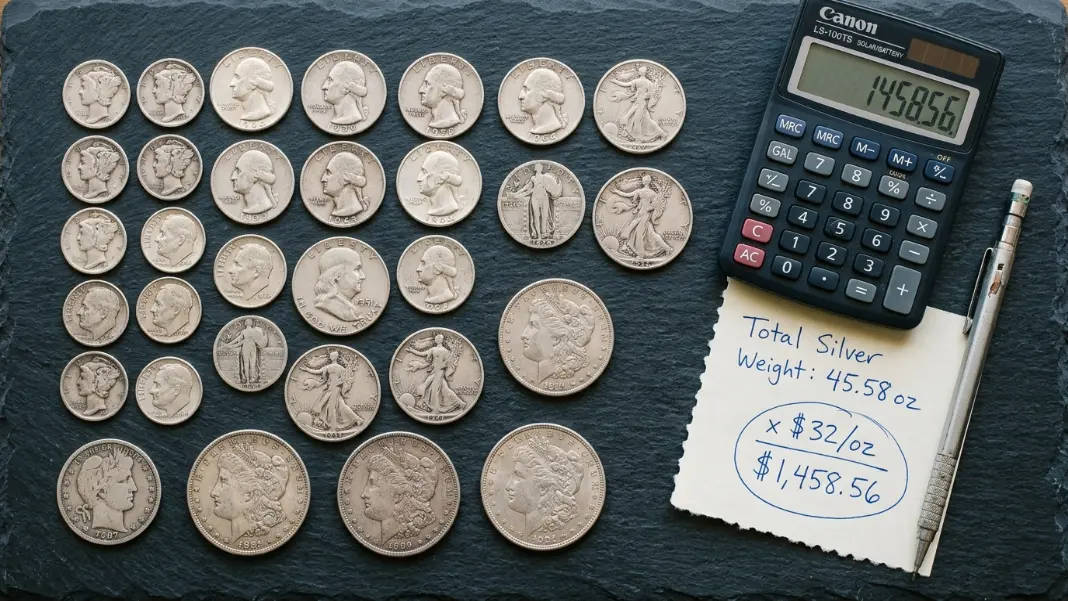
A US silver coin's metal value depends on its silver content and the price used in the calculation. Date and denomination matter: a 1964 Kennedy half dollar is 90% silver, while a 1965 Kennedy half is 40%. A Morgan dollar also contains a different amount of silver per face dollar than dimes and quarters.
The Silver Calculator uses manual price entry in USD per troy ounce. It does not fetch a live quote. Replace its labeled example price before valuing a collection. All $32 prices below are hypothetical examples.
Calculate From Alloy Weight or Fine Silver Weight#
When you know the coin's alloy weight:
Fine silver troy ounces = Alloy weight in grams × Purity ÷ 31.1034768
Melt estimate = Fine silver troy ounces × Entered price per troy ounce
If you already know the coin's fine silver weight, multiply that weight directly by the price. Do not apply purity again. The NIST conversion table gives the troy-ounce conversion; 31.1035 grams is a convenient rounded value.
For a 1964 Washington quarter at its original 6.25-gram weight and the illustrative $32 price:
6.25 × 0.90 ÷ 31.1034768 = approximately 0.180848 fine troy ounces
0.1808479494 × $32 = $5.79, rounded
Worn coins may weigh less than their original specifications. A mint-weight calculation is a reference estimate, not an assay of a particular circulated coin.
Currency results use the weight and purity before rounding the fine-ounce column. The Coinage Act of 1873 established the 12.5-gram half and proportional quarter and dime weights. The US Mint's dollar history documents the historical dollar specification.
The Mint states 1.000 troy ounce of silver weight for the American Silver Eagle. That is already fine silver content; multiplying by 0.999 again would understate it. Modern Morgan and Peace issues have different specifications from the historical 90% coins.
For ordinary worn 90% US dimes, quarters, and half dollars:
Estimated fine silver = Face value in dollars × 0.715
Estimated melt value = Estimated fine silver × Entered silver price
The 0.715 factor is a trading convention for circulated coins, illustrated by APMEX's average-circulated lots. It already includes purity and an allowance for wear. Do not multiply it by 90% again.
Qualifying face value
Estimated fine troy oz
Melt at example $32
$1
0.715
$22.88
$10
7.150
$228.80
$100
71.500
$2,288.00
$1,000
715.000
$22,880.00
The original unworn weights imply about 0.7234 fine troy ounces per face dollar for those denominations. Heavily worn or damaged coins can contain less than the 0.715 estimate.
Morgan and Peace dollars do not belong in this calculation. Neither do 40% Kennedy halves, war nickels, foreign coins, or bullion. The junk silver guide explains sorting and worn-bag estimates.
Identify 40% Kennedy Halves and Later Collector Issues#
The US Mint's 1965 announcement describes 80% silver outer layers and a 21% silver core, producing 40% silver overall. The core is not pure copper.
Kennedy halves dated 1965 through 1970 are 40% silver. The Mint's 1971 release explains that 1970 pieces were made for collector sets and that circulating production resumed in copper-nickel clad composition in 1971.
At the hypothetical $32 price, an original-weight 40% half gives $4.73 in metal versus $11.57 for a 1964 half. Calculate the two groups separately.
Later silver collector issues include both proof and uncirculated products. Standard circulating dimes and quarters changed to copper-nickel clad in 1965, but that does not mean every later dime or quarter lacks silver. Check the exact issue and product specifications; an S mint mark alone does not prove silver content.
Melt value is a metal-content baseline, not a guaranteed payout or maximum resale price. Date, mint mark, condition, collector demand, and bullion premiums may put an intact coin above melt. Fees and buyer terms can put a scrap offer below it.
For each coin group, record the calculation basis, price and timestamp, gross offer, deductions, and net proceeds. Compare net quotes using the same reference price. There is no universal dealer payout percentage.
Before selling an old coin for metal, check comparable completed sales or obtain a coin-specific assessment. The scrap silver guide covers net offer comparisons for mixed material.
Multiply alloy grams by verified silver purity, divide by 31.1034768, then multiply by your entered price per fine troy ounce. If using a published fine silver weight, skip the purity step.
At its original 6.25-gram weight and 90% purity, it contains about 0.180848 fine troy ounces. Its illustrative melt estimate at $32 is $5.79. Wear can reduce the actual weight.
The 1964 issue is 90% silver. Issues dated 1965–1970 are 40%. Standard circulating halves became copper-nickel clad in 1971, while later silver collector issues need separate identification.
No. It estimates fine silver per face dollar for ordinary worn 90% dimes, quarters, and halves only. Historical Morgan and Peace dollars contain about 0.7734 fine troy ounces each at original weight.
No. The stated one troy ounce is silver content already. One Silver Eagle has an illustrative metal value of $32 when the entered price is $32 per fine troy ounce.
Obtain a dated net quote for the actual coins. Premiums, deductions, and acceptance terms vary; this guide does not publish current payout ranges.
Tags:silver coin melt value calculatormelt value of silver coinssilver quarter melt value calculatorsilver dime melt value calculatorsilver half dollar melt value calculatorus silver coin melt value calculatorcalculate value of silver coinssilver dollar melt value calculator
HR
Written by
Hassaan Rasheed
Web Developer & Content Researcher
Hassaan builds calculators and writes source-linked guides across the site's subject areas. Calculator methods and reference data are documented in each guide so readers can verify the underlying sources.