Constitutional Silver Calculator: Face Value, Bag Prices, and Current Value (2026)
Constitutional silver value calculator by face value. What a $1,000 bag contains, current value, and how pre-1965 coin silver compares to silver bars.
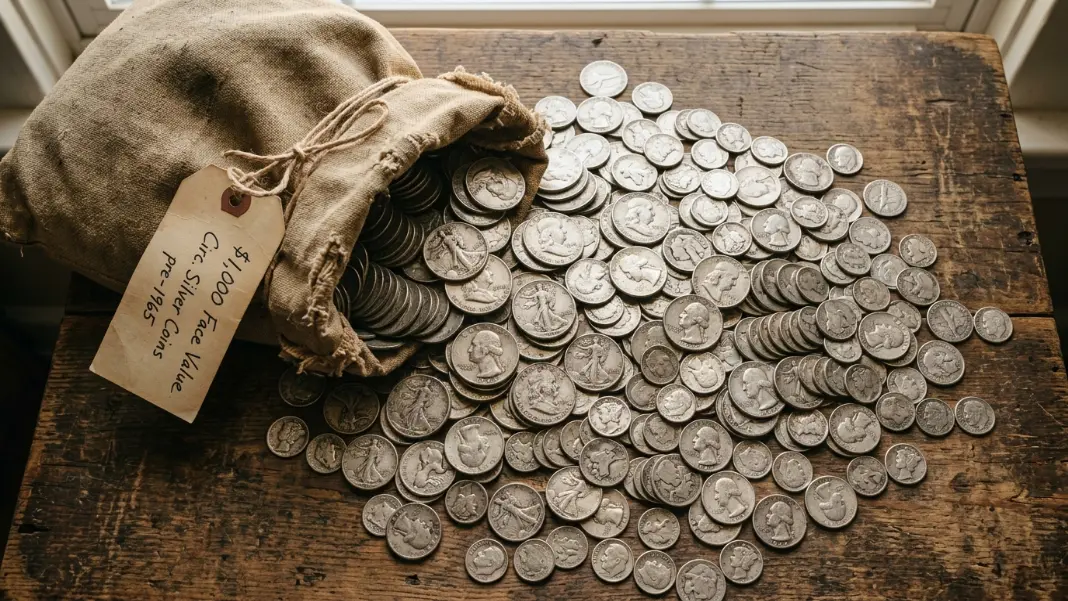
Most people in the coin and bullion world call them junk silver. But a growing segment of investors and preppers specifically use the term constitutional silver, and the distinction matters. These coins, dimes, quarters, half dollars, and dollar coins minted before 1965, were legal US currency composed of 90% silver. They were literally part of the constitutional monetary system that governed American coinage for nearly 200 years.
Calling them "junk" undersells what they are. The silver content is real, the face value is real, and the coins remain legal tender. That's why the constitutional silver label has stuck among investors who view these coins as more than scrap. If you want a fast melt value calculation, use the Silver Calculator to run any face value at today's spot price.
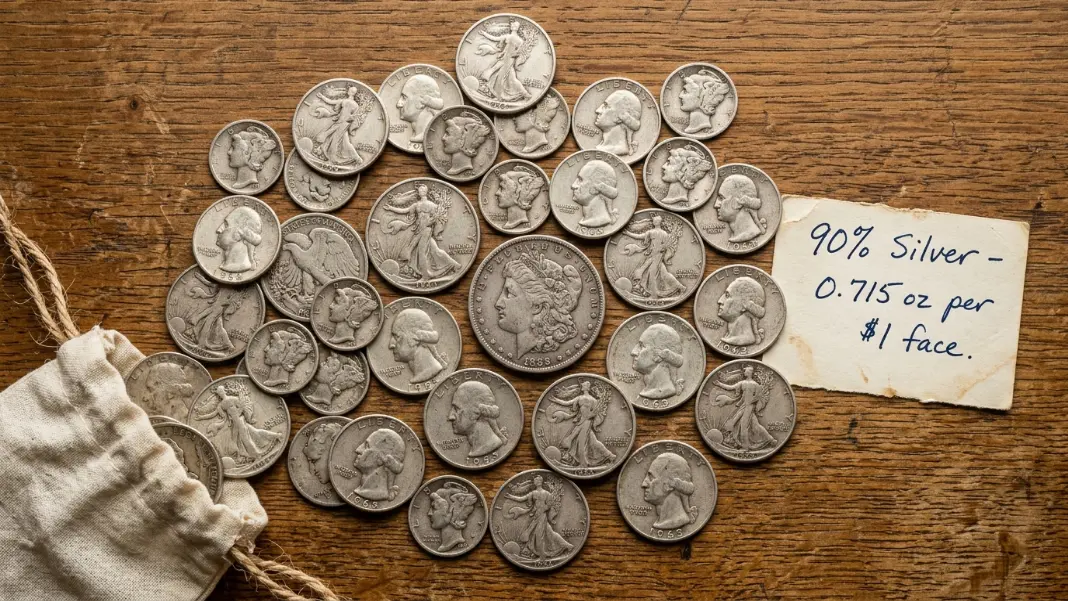
Understanding constitutional silver value starts with one number: 0.715. That's the troy ounce equivalent per dollar of face value in a standard circulated 90% silver coin lot. Everything else follows from that.
How to Calculate Constitutional Silver Value from Face Value
The formula is direct. Multiply your face value in dollars by 0.715 to get troy ounces, then multiply by the current silver spot price.
Constitutional Silver Value = Face Value × 0.715 × Spot Price
Worked example: You have a $500 face value bag and silver is trading at $32/oz.
- $500 × 0.715 = 357.5 troy oz
- 357.5 × $32 = $11,440 melt value
That's the raw melt value before any dealer premium. What you actually pay or receive will be higher (buying) or lower (selling) depending on the market spread.
You can also run the same calculation for smaller amounts using the Junk Silver Calculator, which breaks down value by coin type and handles mixed lots.
The table below shows melt values across common face value amounts at three spot prices:
| Face Value | Troy Oz Content | Value at $28/oz | Value at $32/oz | Value at $36/oz |
|---|---|---|---|---|
| $1 | 0.715 | $20.02 | $22.88 | $25.74 |
| $10 | 7.15 | $200.20 | $228.80 | $257.40 |
| $100 | 71.5 | $2,002 | $2,288 | $2,574 |
| $500 | 357.5 | $10,010 | $11,440 | $12,870 |
| $1,000 | 715 | $20,020 | $22,880 | $25,740 |
These are melt values only. In a normal retail market, expect to pay 8-12% above these numbers when buying from a dealer.
The $1,000 Face Value Bag: What It Contains and What It's Worth Now
The $1,000 face value bag is the standard trading unit in constitutional silver markets. Dealers quote it, wholesalers trade it, and most price references you'll see are built around it.
Here's what that bag actually contains. The 715 troy ounces figure comes from the 0.715 multiplier applied to $1,000 in face value. In coin count terms, that works out to roughly 720 coins if the bag is all quarters, or approximately 1,440 coins if the bag is all dimes. In weight, a full $1,000 face bag runs 55 to 56 pounds depending on coin composition and wear level.
At $32/oz spot, the current melt value is approximately $22,880. That's a significant amount of physical silver in a relatively portable package, which is part of the appeal for investors who want bulk silver without storage complexity.
Why 0.715 and not 0.7234? A theoretical $1,000 bag of uncirculated 90% silver quarters contains exactly 723.4 troy oz of pure silver. But pre-1965 coins spent years in circulation, and decades of handling wear away metal. The dealer standard of 0.715 accounts for that wear across a typical circulated lot. If you're buying truly uncirculated coins, the 0.7234 figure is more accurate. For market purposes, including any calculator or dealer quote you'll encounter, use 0.715.
This distinction matters when you're comparing offers. A dealer quoting "715 oz per $1,000 bag" is using the industry standard. A dealer who says "720 oz" may be rounding up, which inflates the apparent value slightly.
Constitutional Silver vs Silver Bars: Cost Per Ounce Compared
Here's the direct answer: silver bars are cheaper per troy ounce than constitutional silver in most market conditions. But cost per ounce is not the only variable.
The Silver Bar and Bullion Calculator can show you the exact math on bars, but the general premium structure looks like this:
| Form | Typical Premium Over Spot | Cost at $32/oz Spot |
|---|---|---|
| Constitutional silver coins | 5-15% over spot | $33.60-$36.80/oz |
| 1 oz silver rounds | 3-8% over spot | $33.00-$34.56/oz |
| 10 oz silver bars | 2-5% over spot | $32.64-$33.60/oz |
| 100 oz silver bars | 1-3% over spot | $32.32-$32.96/oz |
Constitutional silver carries a higher premium per ounce than bars for two reasons. First, divisibility: individual coins can be spent, bartered, or sold in small increments without breaking up a larger piece. A 100 oz bar is indivisible without melting it. Second, prepper and survivalist demand adds a layer of retail premium that bars simply don't have. People buying for emergency preparedness scenarios specifically want small, recognizable, spendable coins.
For a pure accumulation strategy where you're buying silver to hold and sell back to a dealer later, bars win on efficiency. You pay less over spot and your buyback spread is typically tighter. Constitutional silver makes more sense if divisibility or recognizability in a barter context matters to you.
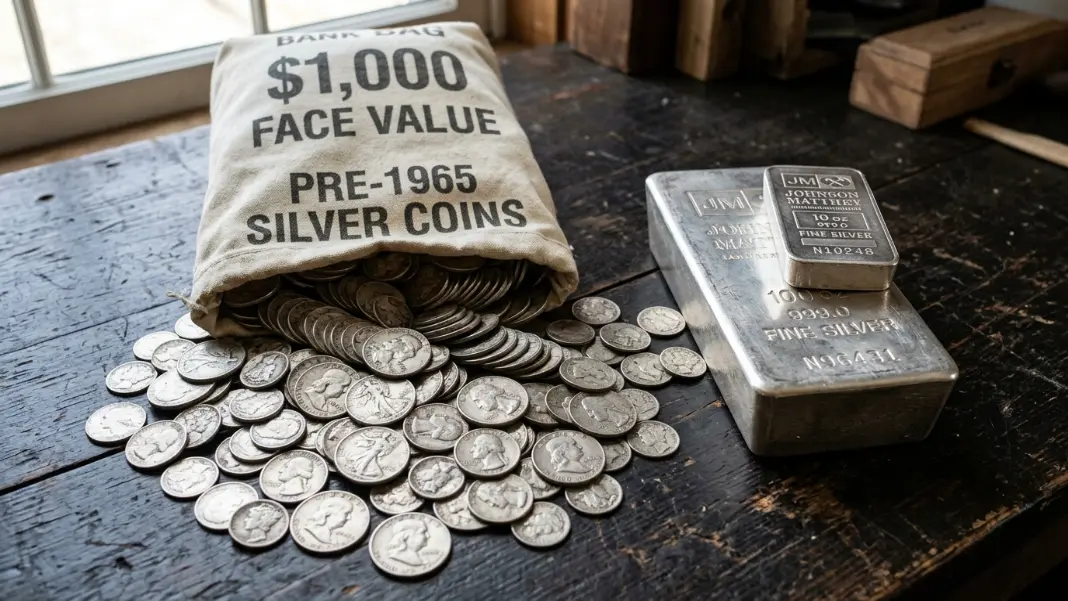
The Face Value Premium: When Constitutional Silver Trades Above Melt
Constitutional silver does not always trade at a stable 8-12% over melt. The premium is volatile, and understanding when it spikes and when it compresses directly affects your entry and exit prices.
The premium widens when divisibility matters most. During the March-April 2020 period, when silver supply chains were disrupted and coin dealers were backlogged, constitutional silver premiums jumped to 30-40% over melt. At $16/oz spot, a $1,000 face bag that should have been worth roughly $11,440 at melt was trading at $14,000 to $16,000 in retail. The premium was pure demand.
Low dealer inventory accelerates this. When major online dealers run out of stock simultaneously, secondary market premiums from eBay and private sellers push well above normal levels. This is the constitutional silver market behaving like any commodity with constrained supply.
In normal markets, the range is 5-15% over melt. In quiet, well-supplied markets, premiums can compress below 5%. In crisis periods, premiums above 25% are possible and have been documented.
This is part of why some investors accept the higher cost per ounce versus bars. The premium itself can appreciate independently of the spot price. If you buy at a 10% premium and market conditions push premiums to 25%, you've gained 15% in premium appreciation on top of any spot price movement.
You can track where premiums stand at any moment by comparing dealer ask prices against the current melt value. The Silver Price Per Ounce Explained reference gives you the underlying spot price context. If a dealer is quoting 20% over melt in a calm market, that's worth pausing on.
The friction here is real: premiums compress when you sell. A dealer buying back your coins will typically pay 2-5% under melt, regardless of what premium you paid to acquire them. Your net return depends on spot price appreciation outpacing your entry premium plus the buyback spread.
Buying Constitutional Silver: Bag Sizes, Coin Mix, and Dealer Premiums
Standard bag sizes in the constitutional silver market are $100 face, $250 face, $500 face, and $1,000 face. The $1,000 bag is the most liquid and typically carries the lowest percentage premium per dollar of face value. Smaller bags are more accessible for buyers with less capital but come with a slight per-ounce premium increase because dealers incur similar handling costs on smaller lots.
Coin mix varies by lot. Most bags are mixed, containing a combination of Roosevelt dimes, Washington quarters, and Franklin or Kennedy half dollars. Some dealers offer denomination-specific bags, all dimes or all quarters. The silver content is identical per dollar of face value regardless of denomination, so the mix matters mainly for practical reasons. Dimes are more divisible for barter; quarters are more convenient for moderate transactions; halves are easier to count and verify.
Condition is a common point of confusion for new buyers. Worn coins are standard in circulated lots, and the 0.715 factor already accounts for that wear. You are not losing silver by buying heavily circulated coins. What you should avoid is cleaned coins. Cleaning removes the natural patina that forms on silver over decades. Cleaned coins are harder to sell to coin dealers who specifically avoid them for numismatic purposes and can actually trade at a slight discount to unclean circulated coins in collector markets.
Where to buy:
APMEX and JM Bullion are the largest online dealers. Pricing is transparent and inventory is usually available. Compare their stated premium over spot, not just the dollar price. Local coin dealers often have lower premiums than large online retailers because they have less overhead. Estate sale lots frequently surface at below-market prices.
The question to ask any dealer before buying: What percentage over spot is your ask price, and what percentage under spot is your buyback price? The spread between those two numbers is your cost of doing business with that dealer. A dealer buying at 3% under melt and selling at 12% over melt has a 15-point spread. A dealer with a 10-point spread gives you a better net position on a round trip.
One practical note: if you're buying bags above $10,000 in a single transaction, most US dealers will require a Form 1099-B for certain silver transactions. Know the reporting thresholds before you buy so the paperwork isn't a surprise.
Constitutional silver is one of the more tangible ways to hold silver. You can count it, weigh it, recognize it by sight, and spend it at face value if needed. The 90% silver content has been the same since these coins were minted, the 0.715 formula has been the industry standard for decades, and the $1,000 face bag remains the benchmark unit in the market.
To run the melt value calculation for any face value you're considering, use the Silver Calculator with today's live spot price. Enter your face value, apply the 0.715 multiplier, and you have your baseline melt number before accounting for any dealer premium.
Constitutional silver refers to pre-1965 US coins made of 90% silver, including dimes, quarters, half dollars, and dollar coins. The term comes from the fact that these coins were official US currency under the constitutional monetary system. They are sometimes called "junk silver" in the bullion market, though many investors prefer the constitutional silver label because it reflects the coins' legitimate monetary history rather than implying low quality.
Multiply the face value in dollars by 0.715 to get troy ounces of silver, then multiply by the current spot price. For example, a $100 face value lot contains 71.5 troy oz of silver. At $32/oz spot, that's $2,288 in melt value. This formula applies to all standard 90% silver US coins minted before 1965 and accounts for typical circulation wear.
A standard $1,000 face value bag contains approximately 715 troy ounces of silver using the industry-standard 0.715 multiplier. Theoretically, uncirculated coins would contain 723.4 troy oz, but the 0.715 figure is the dealer standard that accounts for metal loss from decades of circulation wear. At $32/oz spot, a $1,000 face bag has a melt value of approximately $22,880.
They refer to the same coins. "Junk silver" is the traditional bullion market term for pre-1965 US 90% silver coins that have no numismatic premium above their silver content. "Constitutional silver" is a preferred term among investors who want to emphasize the coins' status as legitimate US legal tender rather than scrap metal. The silver content, formulas, and market pricing are identical regardless of which term you use.
It depends on your goals. Constitutional silver provides divisibility that bars cannot match, which matters if you value the ability to sell or barter in small increments. The premium over melt can also appreciate independently during high-demand periods, as happened in 2020 when premiums reached 30-40%. The drawbacks are a higher per-ounce cost versus bars and a buyback spread that requires meaningful spot price appreciation to break even. For pure silver accumulation, bars are more cost-efficient. For diversified physical silver holdings, constitutional silver has a role.
A $100 face value bag contains 71.5 troy oz of silver (100 × 0.715). At $28/oz spot the melt value is $2,002; at $32/oz it is $2,288; at $36/oz it is $2,574. Add the dealer's premium over spot (typically 8-15% in normal markets) to get the actual retail price. To calculate the current value at today's live spot price, use the Silver Calculator and enter 71.5 oz as your quantity.
Written by
Hassaan Rasheed
Web Developer & Content Researcher
Hassaan builds calculators and writes research-backed guides on finance, math, payroll, and construction topics. Every number in his articles is sourced from official data and worked through by hand.
View LinkedIn Profile