How to Calculate Chronological Age: Exact Method for Assessments and Testing (2026)
How to calculate chronological age by hand, in years and months, for Pearson assessments, speech therapy, and prematurity adjustment. Free guide.
Chronological age is the exact elapsed time between a person's date of birth and a reference date, expressed in years, months, and days. The calculation is more involved than subtracting birth years, months have different lengths, borrowing across date components is required, and many assessment tools need the result formatted in a specific way (years:months, months only, or adjusted for prematurity).
For an instant result in years, months, days, total weeks, and a birthday countdown, use the Chronological Age Calculator. The sections below explain how the calculation works, how to do it by hand, and how different professional contexts use the result.
How to Calculate Chronological Age#
The formula works by subtracting the birth date from the reference date across three components: years, months, and days. Because months have different lengths, you cannot simply subtract the day and month numbers directly when the birth day is greater than the reference day.
Formula:
Step 1: Subtract birth year from reference year (preliminary year count)
Step 2: Check if the birthday has passed yet in the reference year
         If not: subtract 1 from the year count
Step 3: Count full months from birth month to reference month
Step 4: Count remaining days
         If birth day > reference day: borrow one month,
         add the number of days in that borrowed month
Worked example:
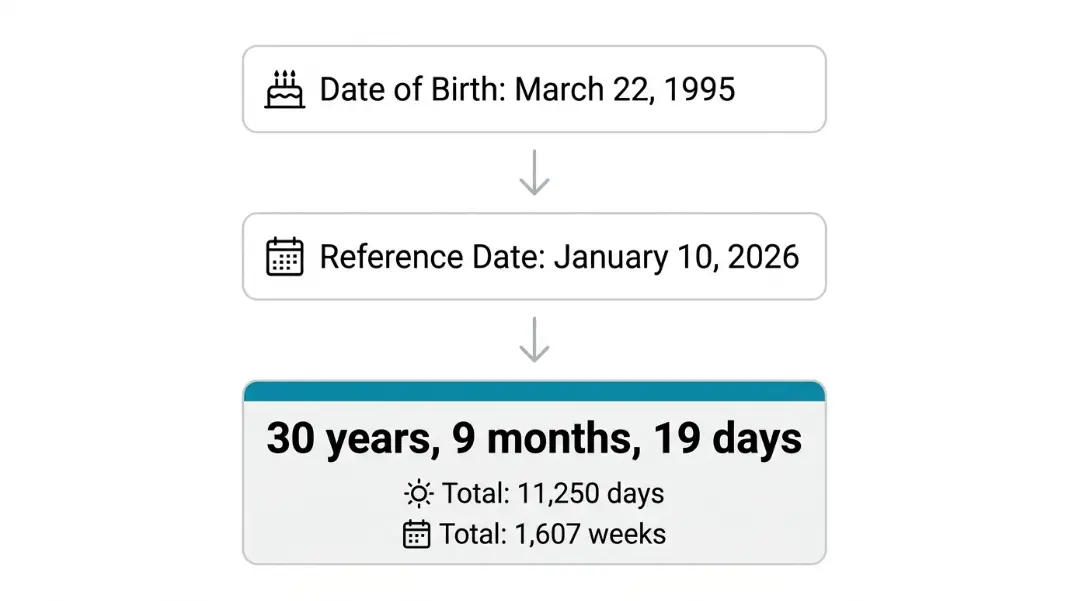
- Date of birth: March 22, 1995
- Reference date: January 10, 2026
Step 1: 2026 - 1995 = 31 years (preliminary)
Step 2: The birthday (March 22) has not yet passed in 2026, January 10 is before March 22. Subtract 1. Year count = 30 years.
Step 3: From March to January going forward (March 22, 2025 to January 10, 2026): April, May, June, July, August, September, October, November, December = 9 full months. But we have not yet finished January (only 10 days in). So full months = 9 months.
Step 4: From March 22 to the equivalent day in January. Since 10 (reference day) is less than 22 (birth day), borrow one month. December has 31 days. (31 - 22) + 10 = 19 days.
Result: 30 years, 9 months, 19 days
The Chronological Age Calculator handles all borrowing automatically and also returns total days lived, total weeks, and days until the next birthday.
How to Calculate Chronological Age by Hand#
The vertical subtraction method is taught in most speech-language pathology, occupational therapy, and school psychology training programs. It makes the borrowing steps visible and is easier to verify than mental arithmetic.
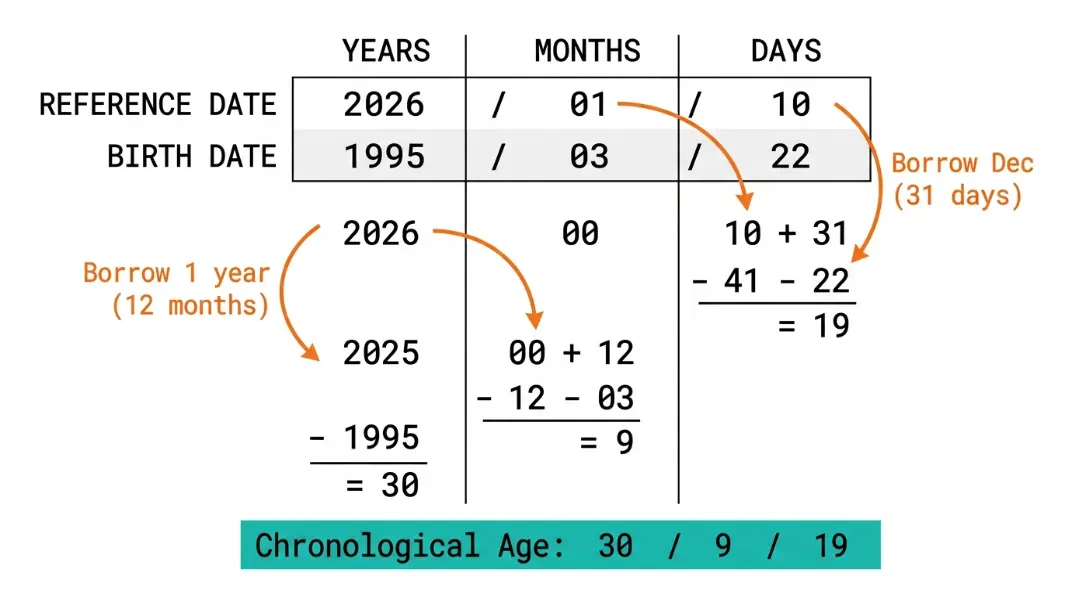
Write the dates vertically with the reference date on top:
Reference:  2026  /  01  /  10
Birth:      1995  /  03  /  22
            ----     --     --
Result:       ?       ?      ?
Subtract right to left: days first, then months, then years. When the top number is smaller than the bottom, borrow from the column to the left.
Days column: 10 - 22. Cannot subtract. Borrow 1 month from the months column. The borrowed month is December (the month before January), which has 31 days. New calculation: (31 + 10) - 22 = 19 days. Reduce the months column by 1 to account for the borrow: 01 becomes 00.
Months column: 00 - 03. Cannot subtract. Borrow 1 year from the years column. Add 12 months: (12 + 00) - 03 = 9 months. Reduce the years column by 1: 2026 becomes 2025.
Years column: 2025 - 1995 = 30 years.
Result: 30 years, 9 months, 19 days
The most common mistake when calculating chronological age by hand is borrowing a flat 30 days instead of the actual number of days in the specific borrowed month. December has 31 days, February has 28 (or 29), and so on. Using the wrong day count shifts the result by 1-3 days, which can move a child into a different age band on an assessment norm table.
A second common error is forgetting to decrement the months or years column after borrowing. Write each step out in full rather than doing it mentally to avoid this.
Pearson Chronological Age Calculator and Assessment Tools#
Many standardized tests require exact chronological age expressed in years and months to look up age-normed scores. A child who is 7 years 4 months scores against different norms than one who is 7 years 5 months. Most norm tables list age bands of one month, and placing a child in the wrong band produces an incorrect standard score.
The format used across most Pearson assessments is years:months, for example, 8:3 means 8 years and 3 months.
Common assessments that require chronological age in this format:
| Assessment | Publisher | Age Format | Age Range |
|---|---|---|---|
| CELF-5 (language) | Pearson | years:months | 5:0 to 21:11 |
| WISC-V (intelligence) | Pearson | years:months | 6:0 to 16:11 |
| WPPSI-IV (preschool) | Pearson | years:months | 2:6 to 7:7 |
| BASC-3 (behavior) | Pearson | years:months | 2:0 to 21:11 |
| BOT-2 (motor) | Pearson | years:months | 4:0 to 21:11 |
| Brigance (readiness) | Curriculum Associates | years:months | Birth to 7:11 |
| ASQ-3 (developmental) | Brookes Publishing | Months only | 1 to 66 months |
Rounding rule: Days are not included in the final score lookup, but the current month is counted only if the child has completed a minimum number of days in that month. Pearson's standard rule is that 16 or more days in a month counts as a full month. Some publishers use 15 days as the cutoff. Always verify in the specific test manual before scoring.
Example: A child aged 7 years, 4 months, and 10 days. Under Pearson's 16-day rule, the 10 days do not count as a full month. The age used for scoring is 7:4. If the child were 7 years, 4 months, and 17 days, the scoring age would be 7:5.
Pearson's online calculator applies this 16-day rounding automatically. The Chronological Age Calculator returns exact years, months, and days, so you can apply whichever rounding rule your specific test requires.
Calculating Chronological Age for Prematurity#
Premature babies are assessed using adjusted age (also called corrected age) rather than chronological age until approximately 24 months. Adjusted age accounts for the fact that the child's development started later than a full-term infant.
Formula:
Adjusted age = Chronological age - Weeks premature
Convert weeks to months by dividing by 4.33 (average weeks per month).
Example:
- Baby born 10 weeks early
- Chronological age: 8 months
- Weeks adjustment: 10 weeks / 4.33 = 2.3 months (round to 2 months)
- Adjusted age: 8 - 2 = 6 months
This adjusted age is what clinicians use on the ASQ-3 developmental screening, WHO growth charts, and most infant motor and language assessments. The adjustment is typically discontinued at 24 months chronological age, after which most children have caught up developmentally regardless of prematurity degree.
For tracking infant growth percentiles by corrected age, the Baby Percentile Calculator accepts both chronological and adjusted age inputs.
Calculating Chronological Age in Months#
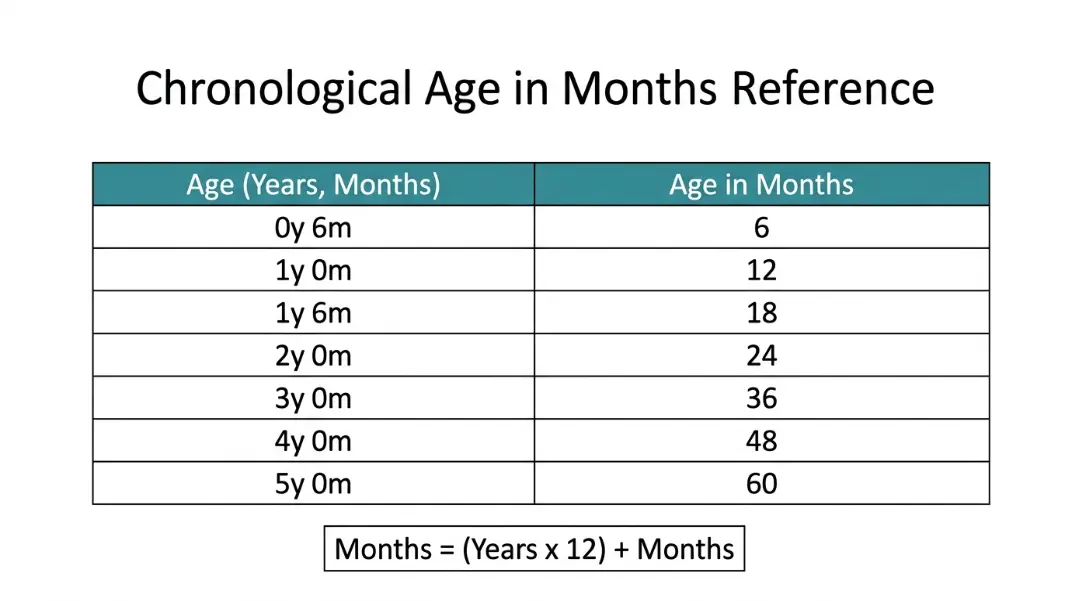
Some assessment tools and research contexts express age entirely in months rather than years and months. This is standard for the ASQ-3 (1-66 months), WHO growth charts (0-60 months), and most infant feeding and motor milestone tools.
Formula:
Age in months = (Years x 12) + Months
For a more precise fractional value (used in some research tools):
Age in months (precise) = (Years x 12) + Months + (Days / 30.44)
Example: A child aged 3 years, 5 months, and 22 days.
- Whole months: (3 x 12) + 5 = 41 months
- Precise: 41 + (22 / 30.44) = 41.72 months
Most clinical tools use the whole number (41 months). The ASQ-3 uses age intervals of one month, so a child at 41.72 months is assessed using the 42-month questionnaire if they are within 1 week of that interval, or the 48-month questionnaire otherwise, the manual specifies exact cutoffs for each age interval.
Chronological age in months is also used when calculating adjusted age for premature infants, since subtracting weeks from months is simpler when both values are expressed in the same unit.
Biological Age vs Chronological Age#
Chronological age counts elapsed calendar time from birth and is fixed. Biological age reflects how the body has physically aged based on measurable markers and can differ substantially from chronological age.
| Dimension | Chronological Age | Biological Age |
|---|---|---|
| Definition | Elapsed time from date of birth | Physical condition and aging of the body |
| How measured | Calendar subtraction | Biomarkers, blood tests, imaging |
| Can it change? | No, only increases | Yes, improves or worsens with lifestyle |
| Used for | Legal, clinical, standardized testing | Longevity research, preventive health |
| Who uses it | Clinicians, schools, courts | Researchers, health optimization programs |
Common biological age markers include telomere length, epigenetic methylation patterns (Horvath clock), VO2 max, grip strength, resting heart rate, blood pressure, HbA1c, and inflammatory markers such as CRP.
Two people who are both 50 years old chronologically can have biological ages ranging from the late 30s to the mid-60s depending on genetics, diet, exercise, sleep quality, and health history. Chronological age is the input used in every standardized assessment tool. Biological age tools are used in preventive health and longevity research contexts, not in clinical scoring.
For people tracking biological age markers, HbA1c is one of the most clinically relevant metabolic indicators. The A1C Calculator converts an HbA1c percentage to estimated average blood glucose, a key marker used in both diabetes management and biological age research.
Chronological age is the exact elapsed time between a person's date of birth and a reference date, expressed in years, months, and days. To calculate it, subtract the birth date from the reference date starting with days, then months, then years. When the birth day is larger than the reference day, borrow one month and add its actual day count before subtracting. The result for a person born March 22, 1995, measured on January 10, 2026, is 30 years, 9 months, and 19 days.
The Pearson chronological age calculator is an online tool provided by Pearson Clinical Assessments for use when scoring standardized tests such as the CELF-5, WISC-V, and WPPSI-IV. It calculates a child's exact age in years and months and applies Pearson's rounding rule: 16 or more days in the current month counts as a full month. A child who is 8 years, 3 months, and 10 days scores as 8:3. A child who is 8 years, 3 months, and 17 days scores as 8:4. Always verify the rounding rule in the specific test manual before scoring.
For premature babies, clinicians use adjusted age (corrected age): subtract the number of weeks born early from the chronological age. A baby born 8 weeks early who is 6 months old chronologically has an adjusted age of approximately 4 months (6 months minus 8 weeks, converted to roughly 2 months). Adjusted age is used on the ASQ-3 developmental screening, WHO growth charts, and infant motor assessments until approximately 24 months chronological age, after which the adjustment is typically discontinued.
The classic ratio IQ formula from Lewis Terman (1916) is: IQ = (Mental Age / Chronological Age) x 100. A child with a mental age of 10 who is chronologically 8 years old has a ratio IQ of (10 / 8) x 100 = 125. A score of 100 means mental age exactly equals chronological age. This ratio IQ formula has been largely replaced by deviation IQ, which compares a person's performance to age peers using standard deviation units. Most modern tests including the WISC-V use deviation IQ, not ratio IQ, for scoring.
For speech-language pathology assessments such as the CELF-5, GFTA-3, or PPVT-5, calculate chronological age in years and months using the vertical subtraction method. Write the test date above the birth date, subtract right to left (days, months, years), borrow when needed using actual month lengths. Drop the days from the final result and apply the publisher's rounding rule (typically 16 days = full month for Pearson tests). Enter the resulting years:months value into the age norm table to look up standard scores and percentile ranks.
Chronological age is the total elapsed time since birth, measured by the calendar, and increases at a fixed rate for everyone. Biological age reflects how the body has physically aged based on markers such as telomere length, HbA1c, cardiovascular fitness, and inflammatory markers. Two people with the same chronological age of 45 can have biological ages ranging from 35 to 60 depending on genetics and lifestyle. Chronological age is used in every standardized assessment, legal, and clinical context. Biological age is used in longevity research and preventive health programs, and there is no single universally accepted method for measuring it.
Written by
Hassaan Rasheed
Web Developer & Content Researcher
Hassaan builds calculators and writes source-linked guides across the site's subject areas. Calculator methods and reference data are documented in each guide so readers can verify the underlying sources.
About the author and methods