Canadian Silver Coin Melt Value: Purity, Formula, and Table (2026)
Canadian silver coin melt value: 80% pre-1968 dimes, quarters, halves, 1967 transition, Silver Maple Leaf purity, formula, and reference table.

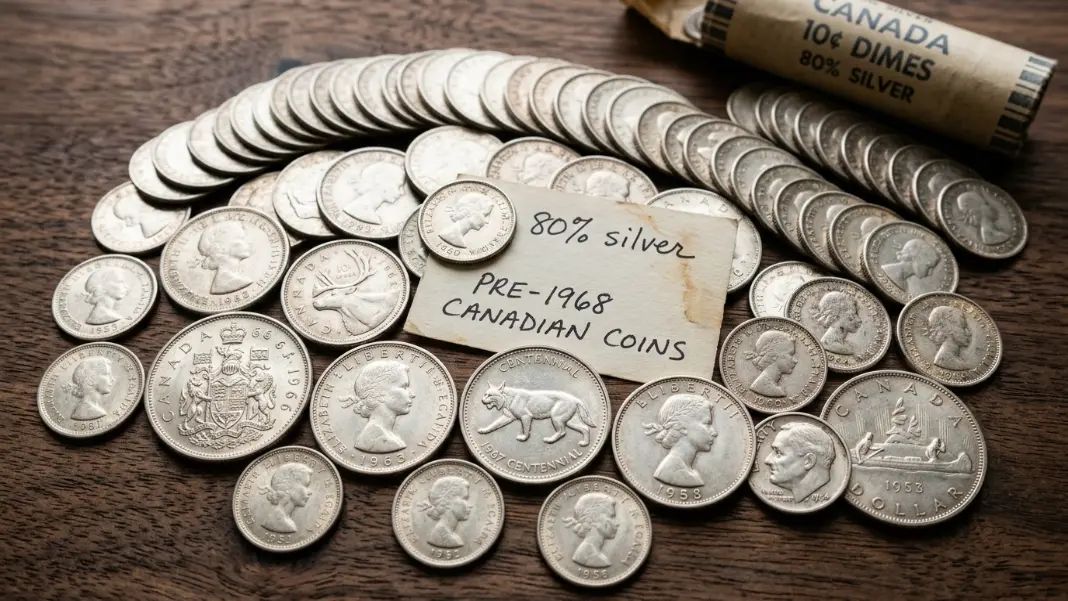
Canadian silver coins are 80% silver, not 90%. That one percentage point difference from US coins means each Canadian denomination contains less silver by weight, producing a lower melt value for the same face value. If you have a mixed lot of North American silver from an estate sale, treating Canadian pieces as equivalent to their US counterparts will overstate what you hold.
The distinction matters most when calculating a lot's total silver content or deciding which coins to sell first. The Silver Calculator handles both Canadian and US coins, but the purity inputs are different. This guide covers exactly which Canadian coins contain silver, what years to look for, the melt value formula with worked examples, a reference table at current spot prices, and what dealers typically pay relative to melt.
Which Canadian Coins Contain Silver and When They Were Made
Canadian silver coinage breaks into two distinct eras, with a complicated single year in between that requires extra attention before you calculate anything.
1858 to 1919: Sterling silver at 92.5%
Canadian dimes (10¢), quarters (25¢), half dollars (50¢), and dollars ($1) struck between 1858 and 1919 are 92.5% silver. Canada followed the British sterling standard at the time, making these coins identical in purity to British sterling silver. They are less common in circulation-era lots, but they appear regularly in estate collections and at coin shows. Their silver content per coin is higher than the later 80% pieces despite sharing the same weights and denominations.
Standard weights used in both eras:
- Dime (10¢): 2.33g
- Quarter (25¢): 5.83g
- Half Dollar (50¢): 11.66g
- Silver Dollar ($1): 23.33g
1920 to 1966: The 80% silver era
In 1920, Canada reduced silver content from 92.5% to 80% across all circulation denominations. This is the composition most dealers and collectors mean when they refer to Canadian junk silver. The coins are physically identical to their pre-1920 predecessors in size and weight; only the internal silver-to-copper ratio changed.
1967: The transition year
1967 requires extra attention. Canada was phasing out silver coinage entirely, and the Royal Canadian Mint struck some denominations in both 80% silver and 50% silver compositions during that single year. The two versions are visually identical: no marking on the coin separates them. An 80% 1967 dime and a 50% 1967 dime are the same diameter, weight, and appearance.
The practical approach: treat all 1967 Canadian dimes, quarters, and half dollars as 80% unless you have independent verification that a specific coin is the higher-content version. This slightly undervalues any genuine 80% pieces in your estimate, but prevents overstating the worth of the 50% ones.
1968 and later:
Dimes and quarters switched to pure nickel starting in 1968. The 50¢ piece followed. Canadian circulation silver coinage effectively ended with 1967. Commemorative and collector silver dollars continued after that year as numismatic products, but their market is collector-driven rather than melt-based, and they are distinct from the circulation coins in this guide.
The Melt Value Formula: Three Inputs, One Calculation
Canadian silver coin melt value uses three inputs: coin weight in grams, silver purity as a decimal, and the current silver spot price in USD per troy ounce.
Silver Content (troy oz) = Weight (g) × Purity ÷ 31.1035
Melt Value (USD) = Silver Content (troy oz) × Spot Price per Troy Oz
Worked example: 80% Canadian quarter
- Coin weight: 5.83g
- Purity: 0.80
- Spot price: $30.00 per troy oz
- Silver content: 5.83 × 0.80 ÷ 31.1035 = 4.664 ÷ 31.1035 = 0.1500 troy oz
- Melt value: 0.1500 × $30.00 = $4.50
Worked example: Pre-1920 quarter at 92.5%
- Coin weight: 5.83g
- Purity: 0.925
- Spot price: $30.00 per troy oz
- Silver content: 5.83 × 0.925 ÷ 31.1035 = 5.393 ÷ 31.1035 = 0.1734 troy oz
- Melt value: 0.1734 × $30.00 = $5.20
The formula is identical for every denomination. The weight depends on denomination; the purity depends on the date range.
Currency conversion: Silver spot price is always quoted in USD globally. To get melt value in Canadian dollars, calculate in USD first and multiply by the current USD/CAD exchange rate. The exchange rate changes the CAD figure without affecting the underlying silver content.
Scaling for multiple coins: Multiply single-coin silver content by the number of coins before applying spot price. For 50 Canadian quarters from the 1920 to 1966 era: 50 × 0.1500 = 7.500 troy oz total. At $30/oz spot, total melt value = $225.00.
Canadian Silver Coin Melt Value Reference Table
The table below shows silver content and melt values at $30.00 USD per troy ounce. Melt values scale linearly: at $25/oz multiply the $30 figure by 0.833; at $35/oz multiply by 1.167.
The US Silver Coin Melt Value Calculator runs the same calculation for 90% US coins, and the side-by-side comparison shows exactly where the 80% versus 90% purity gap shows up in dollar terms by denomination.
| Coin | Years | Purity | Weight | Silver Content | Melt @ $30/oz |
|---|---|---|---|---|---|
| Dime (10¢) | 1858 to 1919 | 92.5% | 2.33g | 0.0694 troy oz | $2.08 |
| Dime (10¢) | 1920 to 1966 | 80% | 2.33g | 0.0599 troy oz | $1.80 |
| Dime (10¢) | 1967 | 80% or 50% | 2.33g | 0.0599 / 0.0375 oz | $1.80 / $1.12 |
| Quarter (25¢) | 1858 to 1919 | 92.5% | 5.83g | 0.1734 troy oz | $5.20 |
| Quarter (25¢) | 1920 to 1966 | 80% | 5.83g | 0.1500 troy oz | $4.50 |
| Quarter (25¢) | 1967 | 80% or 50% | 5.83g | 0.1500 / 0.0938 oz | $4.50 / $2.81 |
| Half Dollar (50¢) | 1858 to 1919 | 92.5% | 11.66g | 0.3469 troy oz | $10.41 |
| Half Dollar (50¢) | 1920 to 1966 | 80% | 11.66g | 0.2998 troy oz | $8.99 |
| Half Dollar (50¢) | 1967 | 80% or 50% | 11.66g | 0.2998 / 0.1874 oz | $8.99 / $5.62 |
| Dollar ($1) | 1935 to 1967 | 80% | 23.33g | 0.5997 troy oz | $17.99 |
| Silver Maple Leaf | 1988 to present | 99.99% | 31.1035g | 1.0000 troy oz | $30.00 |

Silver Maple Leaf vs Circulation Coins: Why the Purity Gap Matters
The Silver Maple Leaf (SML) is 99.99% pure silver, compared to 80% for Canadian circulation coins. That 19.99-percentage-point gap creates three concrete differences when you hold both.
Silver content per coin:
A single 1 oz Silver Maple Leaf holds exactly 1.0000 troy oz of silver. Five Canadian 80% half dollars hold 5 × 0.2998 = 1.499 troy oz combined. The five half dollars outweigh the SML in silver content because their aggregate weight is higher. But a single 80% dime holds only 0.0599 troy oz: you need 17 dimes to match one SML.
Dealer pricing and liquidity:
Silver Maple Leafs carry a premium above spot price on both purchase and sale. A dealer selling a 1 oz SML when silver is at $30 might price it at $32 to $34. The same dealer buying an SML back pays $29 to $31. The spread is relatively tight because SMLs are standard, globally recognized bullion with an established secondary market.
Pre-1968 Canadian circulation coins trade closer to melt, at 85 to 95% of melt value when selling. Dealers buying junk silver factor in their time for sorting, the variability of coin wear, and a slightly less liquid resale channel than government bullion. Large, well-sorted lots get the tighter spread.
Refinery behavior:
Silver Maple Leafs are already four-nines purity. Refineries buy them at near-spot because no assaying or separation processing is required. Pre-1968 circulation coins are 80% silver in a copper alloy. Refineries process the alloy to extract the silver, which costs time and chemicals. That processing margin is one reason refinery bids on junk silver run at a steeper discount than bids on SMLs, even when both are expressed as a percentage of silver spot.
The Junk Silver Calculator covers how face value, bag weight, and spot price interact in the junk silver market, including what refineries and coin dealers typically offer per face dollar of pre-1968 Canadian silver.
What Dealers Pay on Canadian Silver vs Spot
Understanding the buy-side structure tells you what your coins are actually worth when you go to sell, which is a different number from the melt value the calculator produces.
Dealer margin on circulation coins:
Coin dealers buying pre-1968 Canadian silver typically offer 85 to 95% of melt value on the contained silver. At $30/oz spot, that translates to $25.50 to $28.50 per troy oz of silver in the coins. The remaining margin covers their cost of doing business and their exposure to price movement between purchase and resale.
What tightens the spread in your favor:
- Lots over 100 oz of contained silver (dealers process large lots more efficiently)
- Coins sorted by denomination and year range rather than mixed
- Selling at coin shows where dealers compete for the same inventory
- Coins without heavy wear or damage
What widens the spread against you:
- Small lots under 20 oz where the dealer's per-transaction cost is high relative to value
- Mixed bags of US, Canadian, and foreign coins that require sorting
- Retail walk-in shops in high-traffic areas with higher overhead
- Selling during a sharp silver price decline, when dealers hedge bids conservatively
The premium on Silver Maple Leafs:
SMLs trade with a premium on both sides of every transaction. If you bought an SML at $33 when silver was at $30 and spot has since moved to $35, a dealer buying at $34 still shows you a gain. If spot has dropped to $27, the same dealer might pay $26.50, below your purchase price. The premium cushion absorbs some downside movement but does not eliminate price risk; it just shifts the breakeven point.
For the full calculation of what any silver item returns at the sell side, including dealer bids, refinery offers, and the factors that determine how much of spot price you actually receive, the How to Calculate Scrap Silver Value guide covers the complete seller-side framework.
A pre-1968 Canadian quarter (80% silver, 5.83g) has a melt value of approximately $4.50 at $30 per troy ounce spot price. A dime melts at about $1.80, a half dollar at $9.00, and a dollar coin at $18.00 at the same spot price. The formula is weight in grams times purity divided by 31.1035 to get troy ounces, then multiply by spot price. Pre-1920 coins at 92.5% purity run about 15% higher per coin at any given spot price.
Pre-1968 Canadian circulation coins struck from 1920 onward are 80% silver, not 90%. Canadian coins struck before 1920 are 92.5% silver following the British sterling standard. The 90% purity is the standard for US dimes, quarters, and half dollars struck before 1965. The difference means each Canadian denomination contains less silver by weight than its US equivalent, producing a lower melt value per coin despite the same physical size and face value.
Canadian coins struck between 1858 and 1967 contain silver and carry melt value above face. Pre-1920 coins are 92.5% silver; 1920 through 1966 coins are 80% silver. In 1967, some coins were struck in 80% silver and others in 50% silver as the mint transitioned compositions. From 1968 onward, dimes, quarters, and half dollars switched to nickel with no silver content. Commemorative silver dollars continued after 1967 but are collector items priced above melt, not circulation coins.
A Canadian silver dollar struck between 1935 and 1967 weighs 23.33g at 80% purity, containing 18.664g of silver or approximately 0.600 troy ounces. At $30 per troy ounce spot price, the melt value is about $18.00. At $35/oz, melt value rises to $21.00. Key-date dollars from the 1940s and 1950s in high grades can trade above melt based on numismatic demand, independent of the silver content calculation.
Canadian junk silver refers to pre-1968 circulation coins at 80% purity, bought and sold primarily by contained silver weight at or slightly below melt value. Silver Maple Leafs are modern government-issued bullion coins at 99.99% purity, globally recognized, and priced at a premium above spot. Junk silver costs less per ounce of silver to acquire than new Silver Maple Leafs but trades at a wider discount to spot when you sell, because refineries and dealers charge more to process the lower-purity alloy.
Multiply the coin's weight in grams by its silver purity, divide by 31.1035 to convert to troy ounces, then multiply by the current spot price in USD per troy ounce. Coin weights: dime 2.33g, quarter 5.83g, half dollar 11.66g, dollar 23.33g. Purity: 0.80 for 1920 to 1966 coins; 0.925 for pre-1920 coins. At $30/oz: dime $1.80, quarter $4.50, half dollar $9.00, dollar $18.00.
Written by
Hassaan Rasheed
Web Developer & Content Researcher
Hassaan builds calculators and writes research-backed guides on finance, math, payroll, and construction topics. Every number in his articles is sourced from official data and worked through by hand.
View LinkedIn Profile