DSCR Loan Requirements: What Lenders Check Before Approving (2026)
DSCR loan minimum requirements by lender type, how income and debt are calculated, and how DSCR loans differ from conventional investment property loans.
Most real estate investors hit their first DSCR rejection not because the property performs badly, but because they calculated the ratio the wrong way. Gross rents pulled from a listing site, operating expenses estimated from a forum, and a number that looked fine on paper. Then the lender runs their version and comes back 0.2 points lower, which is enough to close the door on several programs.
DSCR stands for Debt Service Coverage Ratio. It measures whether a rental property's income covers its own debt obligations without depending on the borrower's personal income. Lenders use it to qualify investment property loans without requiring W-2s or tax returns. The DSCR Loan Calculator runs both the ratio and the maximum loan amount from your rental income and proposed loan terms. This guide covers how lenders actually calculate the ratio, what their minimum requirements are, how income and debt are counted, and when DSCR financing beats conventional alternatives.
How DSCR Is Calculated and What the Number Represents#
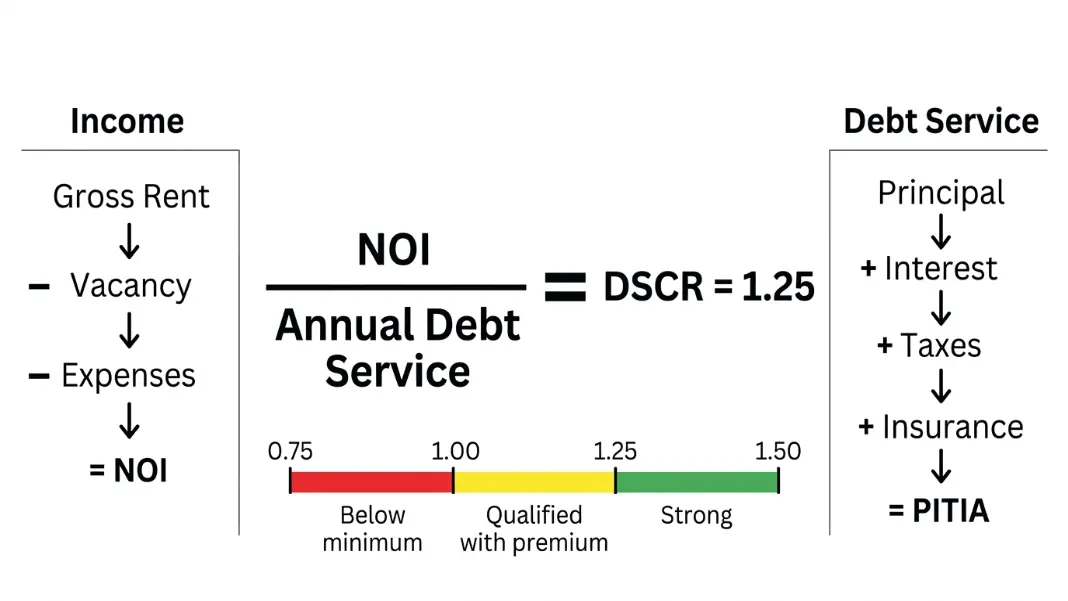
DSCR is a single division: net operating income divided by annual debt service.
DSCR = Net Operating Income / Annual Debt Service
Expanded to the inputs lenders actually use:
DSCR = (Gross Annual Rent × (1 - Vacancy Rate)) - Operating Expenses
       _______________________________________________
       Annual Principal + Interest + Taxes + Insurance (PITIA)
Worked example:
- Monthly gross rent: $2,800
- Vacancy rate assumed by lender: 5%
- Effective annual income: $2,800 × 12 × 0.95 = $31,920
- Annual operating expenses (maintenance, property management, HOA): $4,800
- Net Operating Income: $31,920 - $4,800 = $27,120
- Annual PITIA: $24,000
- DSCR: $27,120 / $24,000 = 1.13
A DSCR of 1.0 means income exactly covers debt. A DSCR of 1.25 means income is 25% above debt service. A DSCR below 1.0 means the property cannot cover its own mortgage from rental income alone.
The number that most investors get wrong is gross rental income. Lenders use the lower of: the current executed lease rate, the appraiser's market rent opinion from a rent schedule (Form 1007), or a 12-month average from verified bank deposits. They do not use your projected rents post-renovation, estimated rents from listing sites, or any number you provide without third-party verification. The appraiser's market rent opinion is the most common input because it is independent and documented.
Minimum DSCR Requirements by Loan Type and Lender#
The minimum DSCR varies by lender type, property class, and the strength of the overall file. The ranges below apply to 1 to 4 unit residential investment properties. Commercial properties (5+ units, retail, industrial, self-storage) typically require 1.25 or higher, with many banks holding at 1.30 as a hard floor.
| Lender Type | Minimum DSCR | Notes |
|---|---|---|
| Non-QM / DSCR-specific lenders | 1.0 to 1.10 | Some accept 0.75 for strong files |
| Portfolio lenders (community banks) | 1.15 to 1.25 | More flexibility on income calc method |
| Agency conforming investment | 1.20 or higher | Follows Fannie/Freddie investor guidelines |
| Commercial bank small balance | 1.20 to 1.30 | Often 1.25 as the hard floor |
| SBA 7(a) owner-occupied | 1.25 | Based on business cash flow, not rent |
Some DSCR lenders market acceptance down to 0.75. Those programs exist, but they come with a higher interest rate (often 1.5% above standard DSCR pricing), a lower LTV cap (65% or less), larger reserve requirements (12 months PITIA), and tighter credit score minimums. A 0.75 DSCR means the property covers only 75 cents of every dollar it owes. The lender is assuming borrower strength and appreciation will compensate. Most experienced investors avoid these programs unless the deal economics are otherwise exceptional.
For the majority of DSCR loan applications, a ratio of 1.20 to 1.25 is the practical target. Below 1.0, options narrow to a handful of specialty programs. Between 1.0 and 1.20, you qualify for most programs but pay a pricing premium.
Short-term rental income is handled differently. Airbnb and VRBO income carries added risk in lender eyes because it is not guaranteed by a lease. Some DSCR lenders accept 12 months of documented STR revenue from bank statements or AirDNA reports. Others apply a discount, using 75 to 80% of the STR income or converting to an equivalent long-term rent. A few programs exclude STR income entirely and underwrite to market long-term rent only. If the property's DSCR depends on short-term rental rates rather than a long-term lease equivalent, confirm the lender's STR policy before ordering an appraisal.
For properties with 5 or more units, the Commercial Mortgage Calculator covers how lenders size multifamily and commercial loans, including the debt service mechanics that feed DSCR analysis.
What Counts as Income and Debt in a DSCR Calculation#
This is where investor calculations diverge most often from lender calculations.
Income: what lenders include
Residential rent from executed leases or appraiser market rent opinion, whichever is lower. For multi-unit properties, each unit is assessed separately. A vacant unit at the time of application typically receives a market rent assumption from the appraiser, but lenders also apply a vacancy factor (usually 5 to 10%) across all units including occupied ones.
Documented ancillary income (parking, laundry, storage) is sometimes included but requires a signed lease or documented history. Lenders typically cap it as a percentage of gross residential rent, often 15 to 20%. Verbal arrangements or informal payments do not count.
Income: what lenders exclude
Projected rents after planned improvements. Future rental increases. Owner-occupied unit income if the borrower is living in one unit. Any income that cannot be verified through an appraisal, lease, or bank statement.
Debt service: what lenders include
Annual principal and interest on the subject loan, property taxes (from county records or escrow estimate), hazard insurance, flood insurance if required, and HOA dues if applicable. This full stack is PITIA. Some lenders include a reserves line in their calculation; others count reserves separately as a post-closing requirement.
Debt service: what lenders exclude
Your personal debts. Other investment property mortgages. Car loans, student loans, credit cards. DSCR loans underwrite the property, not the borrower's full debt picture. This is the single most important structural difference between DSCR and conventional investment lending.
The Cap Rate Calculator uses the same net operating income figure that feeds the DSCR numerator. Running cap rate and DSCR together on the same deal gives you a simultaneous read on investment performance and financing capacity, which is useful when comparing multiple properties.
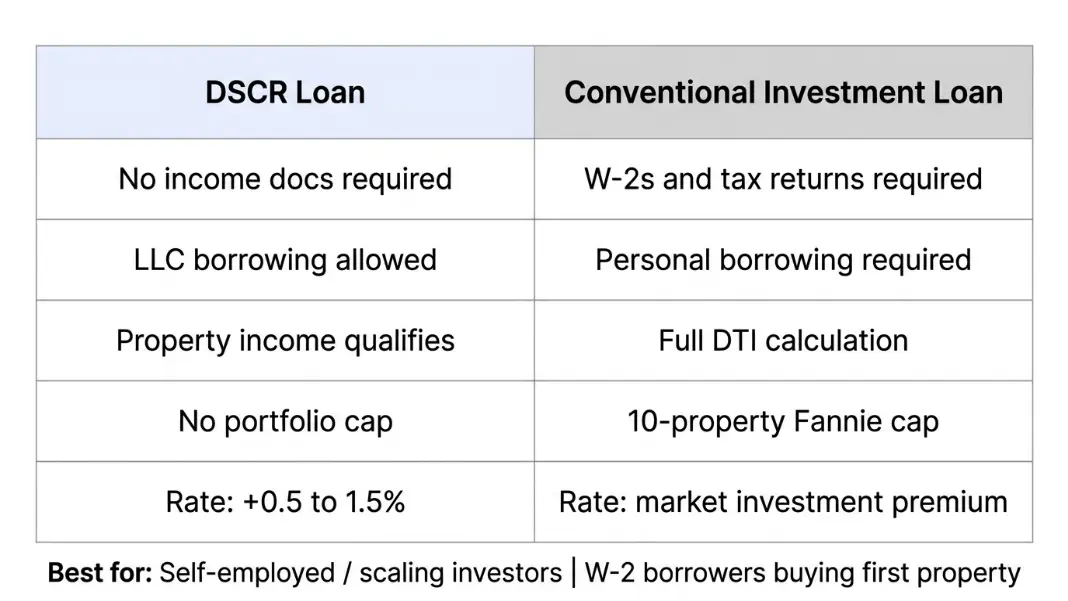
DSCR Loans vs Conventional Investment Property Loans#
Both DSCR loans and conventional investment property loans finance single-family rentals and 2 to 4 unit properties, but they qualify you through completely different mechanisms.
| Feature | DSCR Loan | Conventional Investment Loan |
|---|---|---|
| Income documentation | Property rental income only | Full W-2s, tax returns, pay stubs |
| Personal income required | No | Yes |
| DTI calculation | Not applicable | Usually capped at 45 to 50% |
| Minimum DSCR | 1.0 to 1.25 depending on program | 1.20 or higher (implicit) |
| Rate premium vs primary | 0.5 to 1.5% above conventional | Standard investment premium |
| Conforming loan limit | No cap on most programs | $806,500 conforming (2026) |
| LLC borrowing | Routinely allowed | Usually requires personal borrowing |
| Portfolio property cap | None | 10 financed properties (Fannie limit) |
When DSCR loans are the stronger choice:
Self-employed borrowers are the clearest case. A business owner running significant expenses through their company may show adjusted gross income that looks insufficient for a conventional DTI calculation, even if their actual cash flow is strong. DSCR lending ignores their personal income entirely, qualifying solely on the property.
Investors building a large portfolio hit the Fannie Mae 10-property conventional limit. DSCR lenders have no such ceiling. This is why most investors scaling beyond their first few properties shift to DSCR as their primary acquisition financing.
LLC borrowing: most conventional investment programs require the individual to borrow personally. DSCR lenders routinely accept LLC applications, which matters for liability protection and portfolio organization.
When conventional financing is the better choice:
If your personal income is well-documented and your debt-to-income ratio is clean, conventional investment lending typically prices 0.5 to 1.0% below a comparable DSCR loan. Over a 30-year hold, that rate difference compounds. The first property in a portfolio with W-2 income usually costs less to finance through conventional channels.
The returns metrics underlying either decision, cap rate and IRR for the deal itself, are covered in depth in the Cap Rate vs IRR in Real Estate guide. Understanding both before choosing a financing structure keeps you from selecting a loan based on what qualifies rather than what optimizes long-term returns.
How to Improve Your DSCR Before Applying#
If your calculation comes in below the lender minimum, four levers exist: increase income, reduce debt service, change the purchase structure, or strengthen reserves.
Increase income:
Re-price a below-market lease at the next renewal. A $150 per month increase adds $1,800 annually to the numerator. On a property with $24,000 in annual debt service, that moves the DSCR from 1.05 to 1.13.
Document ancillary income formally. If tenants are using parking, storage, or laundry and paying informally, put it in a signed agreement before applying. Lenders can count documented income; they cannot count informal arrangements regardless of how consistent the payments are.
Fill vacancies before the appraisal is ordered. An occupied unit at market rate is counted at full value. A vacant unit draws a market rent assumption but still triggers the vacancy haircut, which reduces it below that market rate in the NOI calculation.
Reduce debt service:
A larger down payment lowers the loan amount and the annual P&I. On a $400,000 purchase at a 5% rate and 30-year term, moving from 20% to 25% down reduces annual P&I from $20,448 to $17,892. That $2,556 difference improves DSCR by roughly 0.10 points on a $25,000 NOI property.
Buying the rate down permanently through discount points also reduces annual debt service. In rate environments above 6%, 1 to 2 points for a 0.25 to 0.5% reduction can shift a borderline DSCR above the qualifying threshold.
Adjust the purchase structure:
If the deal does not work at the asking price, map out what DSCR it produces at different purchase prices or down payment amounts before negotiating. A seller concession toward closing costs frees up cash that could go toward a larger down payment, which improves both DSCR and rate pricing simultaneously.
Build reserves:
Several DSCR programs allow lower ratio minimums (down to 1.0) for borrowers with 12 months of post-closing PITIA in documented reserves. If your DSCR is at 1.05 and the program floor is 1.0, the question is whether you meet the reserves threshold. Strong liquidity and a marginal DSCR often combine to a qualifying file where either metric alone would not.
The minimum DSCR for most residential DSCR loan programs is 1.0 to 1.10, meaning the property's net operating income must cover at least 100% of its annual debt service. Standard portfolio and agency programs typically require 1.20 to 1.25. Specialty programs accept DSCR as low as 0.75 for strong borrowers, but these carry higher rates, lower LTV limits, and stricter reserve requirements. For the widest access to competitive programs, target a DSCR of 1.25 or above before applying.
DSCR equals net operating income divided by annual debt service. Net operating income is gross annual rent minus vacancy allowance and operating expenses. Annual debt service is principal, interest, taxes, insurance, and any HOA dues (PITIA). Example: a property renting at $2,800 per month with a 5% vacancy factor, $4,800 in annual expenses, and $24,000 annual PITIA: NOI = ($2,800 x 12 x 0.95) - $4,800 = $27,120. DSCR = $27,120 / $24,000 = 1.13.
DSCR loans qualify based on the rental property's income only, with no personal income documentation required. Conventional investment loans require W-2s, tax returns, and a full DTI calculation. DSCR loans typically carry a 0.5 to 1.5% rate premium and allow LLC borrowing without a portfolio property cap. Conventional loans price lower for borrowers with clean income documentation but cap out at 10 financed properties under Fannie Mae guidelines. Investors scaling beyond 10 properties typically shift to DSCR financing as their primary acquisition vehicle.
No. DSCR loans qualify based on the rental property's income, not the borrower's personal income. You provide no W-2s, tax returns, or pay stubs. The lender orders a rent schedule appraisal (Form 1007) that establishes market rent. The lower of market rent or current lease rate is used as the income input. You will provide bank statements for reserves verification and documentation of any existing lease if the property is occupied.
Yes. Most DSCR lenders allow and often prefer LLC borrowing. This is a primary reason investors use DSCR financing over conventional investment loans, which typically require personal borrowing. The LLC must be organized in the property's state or registered there as a foreign entity. Most lenders require a personal guarantee from the managing member even when the LLC is the borrower of record. Verify the specific documentation requirements with your lender before forming or using an entity.
A DSCR of 1.25 or above is considered strong for residential rental properties and provides access to the widest lender selection at competitive pricing. Between 1.0 and 1.25 qualifies for most DSCR programs with minor rate adjustments. Below 1.0 the property cannot cover its own debt from income, and qualifying options narrow significantly. For commercial properties (5+ units, retail, industrial), most lenders hold 1.25 as the minimum and view 1.35 or higher as a well-underwritten deal.
Written by
Hassaan Rasheed
Web Developer & Content Researcher
Hassaan builds calculators and writes source-linked guides across the site's subject areas. Calculator methods and reference data are documented in each guide so readers can verify the underlying sources.
About the author and methods