FERS Sick Leave Retirement Credit: How Hours Convert to Annuity (2026)
FERS sick leave converts at 2,087 hours per year. Dollar value by High-3 salary, the 1.1% multiplier at 62, and what sick leave cannot do for retirement eligibility.
Most federal employees approaching retirement know their sick leave balance to within a few hours. Fewer know the exact dollar amount that balance adds to their monthly pension check for the rest of their lives. The answer is smaller than many hope and larger than most realize, and it depends entirely on two variables: your High-3 average salary and whether you retire before or after your 62nd birthday with at least 20 years of service.
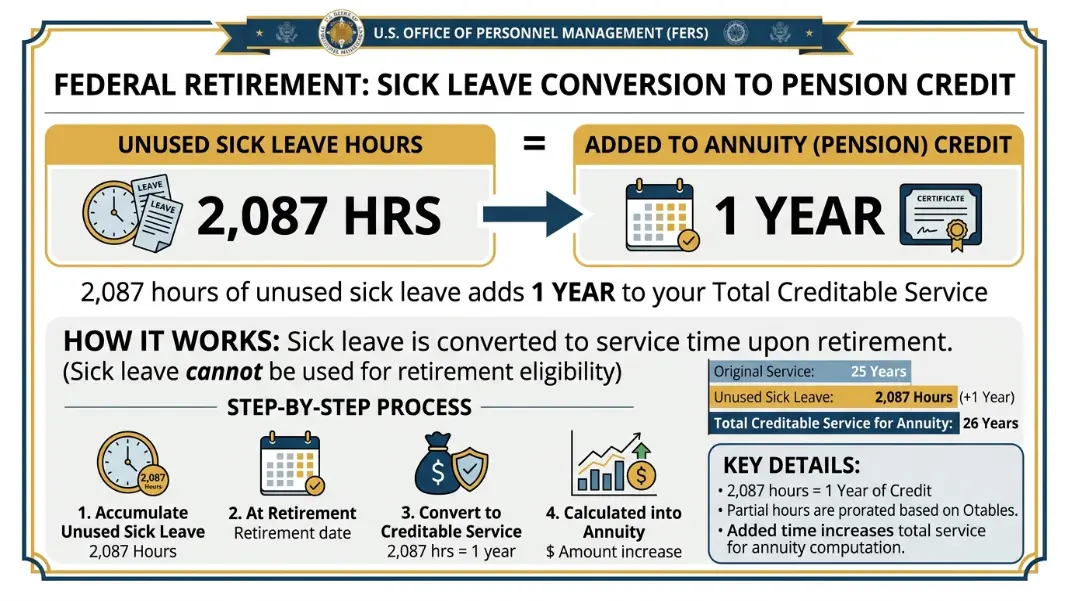
Under FERS, every unused sick leave hour at retirement converts to additional creditable service using OPM's rate of 2,087 hours per year. The FERS Retirement Calculator computes the full annuity with sick leave credit for any balance, High-3 salary, and retirement age combination. This guide covers exactly how OPM runs the conversion, what each month of sick leave is worth in annual pension income by salary bracket, and why the 1.1% multiplier at age 62 makes accumulated leave worth materially more if you can wait.
How OPM Converts Sick Leave Hours to Creditable Service#
OPM treats sick leave in complete months for the annuity calculation. The conversion rate is 2,087 hours equals one full year of creditable service. One month of credit is 174 hours (2,087 divided by 12, rounded to the nearest whole number).
Sick Leave Months = Total Sick Leave Hours ÷ 174
(round down to the nearest complete month)

Sick Leave Years = Complete Months ÷ 12
Hours below the 174-hour threshold for a complete additional month are discarded. They do not carry over, cannot combine with annual leave, and cannot be rounded up. If you have 350 hours of sick leave at retirement, OPM credits you with 2 months (348 hours used), and the remaining 2 hours disappear with no effect on your annuity.
The table below shows how common sick leave balances translate to additional creditable service months.
| Sick Leave Hours | Additional Creditable Service |
|---|---|
| 87 | 0 months (below threshold) |
| 174 | 1 month |
| 348 | 2 months |
| 522 | 3 months |
| 696 | 4 months |
| 870 | 5 months |
| 1,044 | 6 months |
| 1,218 | 7 months |
| 1,392 | 8 months |
| 1,566 | 9 months |
| 1,740 | 10 months |
| 1,914 | 11 months |
| 2,087 | 12 months (1 full year) |
The 2,087-hour threshold is slightly more than a standard federal work year of 2,080 hours (52 weeks × 40 hours). The extra 7 hours account for the quarter-day that accumulates in a 365.25-day calendar year. OPM's leave administration rules use this figure because federal creditable service is measured in calendar years, not work years.
One critical limitation: sick leave credit does not help you reach minimum retirement eligibility. If you need to reach your Minimum Retirement Age with a specific number of years to qualify for an immediate annuity, sick leave does not count toward that threshold. It adds to your service time only after you are already retirement-eligible. This distinction is explained in full in the FERS Retirement Formula Guide, which covers the MRA requirements and years-of-service thresholds in detail.
The FERS Annuity Formula with Sick Leave: Worked Examples#
The FERS basic annuity calculation uses one of two multiplier rates depending on retirement age and service length:
Before age 62, or age 62+ with fewer than 20 years:
Annual Annuity = High-3 × Total Creditable Service × 1.0%

Age 62 or older with 20 or more years of total creditable service:
Annual Annuity = High-3 × Total Creditable Service × 1.1%

Total Creditable Service = Years Worked + Sick Leave Years
Example 1: Retiring before 62 with 1,044 hours of sick leave (6 months credit)
- High-3 average salary: $80,000
- Years of actual service: 28 years
- Sick leave converted: 1,044 hours = 6 months = 0.5 years
- Total creditable service: 28.5 years
- Annual annuity: $80,000 × 28.5 × 0.01 = $22,800/year ($1,900/month)
- Without sick leave: $80,000 × 28 × 0.01 = $22,400/year ($1,867/month)
- Sick leave contribution: $400/year ($33/month)
Example 2: Retiring at age 62 with 20+ years and 2,087 hours of sick leave (1 full year credit)
- High-3 average salary: $95,000
- Years of actual service: 25 years
- Sick leave converted: 2,087 hours = 12 months = 1.0 year
- Total creditable service: 26 years
- Annual annuity: $95,000 × 26 × 0.011 = $27,170/year ($2,264/month)
- Without sick leave: $95,000 × 25 × 0.011 = $26,125/year ($2,177/month)
- Sick leave contribution: $1,045/year ($87/month)
The 1.1% multiplier in Example 2 makes one full year of sick leave credit worth $1,045/year in additional annuity. The same year of sick leave at the 1.0% rate would add only $950/year (High-3 $95,000 × 1.0 × 0.01). The gap between the two rates is 10% of the annuity value of every year of service, including the sick leave credit.
Dollar Value of Sick Leave by High-3 Salary#
Each month of sick leave credit is worth 0.0833 years of additional creditable service (1 divided by 12). Multiplied by your High-3 and the applicable multiplier, that produces the annuity increase per month of sick leave accumulated.
Annual Value per Month of SL (1.0%) = High-3 × 0.0833 × 0.01
Annual Value per Month of SL (1.1%) = High-3 × 0.0833 × 0.011
Monthly Annuity Increase = Annual Value ÷ 12
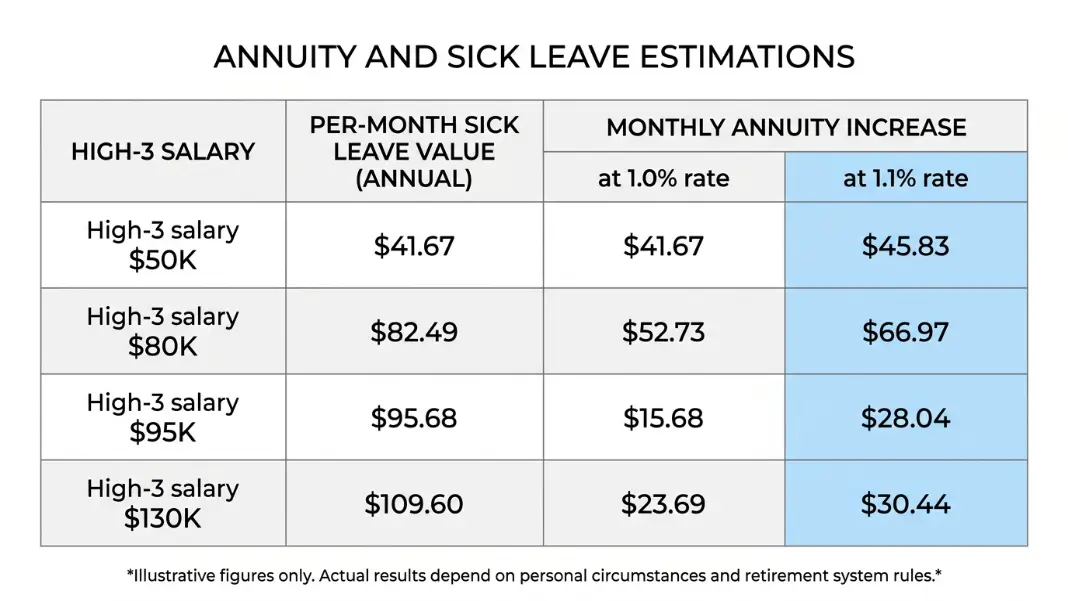
The table below shows the annuity increase per month of sick leave credit at six High-3 salary levels and both multiplier rates.
| High-3 Salary | Per SL Month @ 1.0% (annual) | Per SL Month @ 1.0% (monthly) | Per SL Month @ 1.1% (annual) | Per SL Month @ 1.1% (monthly) |
|---|---|---|---|---|
| $50,000 | $41.65 | $3.47 | $45.83 | $3.82 |
| $65,000 | $54.14 | $4.51 | $59.58 | $4.97 |
| $80,000 | $66.64 | $5.55 | $73.30 | $6.11 |
| $95,000 | $79.14 | $6.60 | $87.05 | $7.25 |
| $110,000 | $91.63 | $7.64 | $100.79 | $8.40 |
| $130,000 | $108.29 | $9.02 | $119.12 | $9.93 |
These amounts are per month of sick leave credit, not per hour. The jump from 173 to 174 hours crosses a threshold and adds one complete month of credit. Managing your balance to land above each 174-hour increment before retirement is where the practical value is captured.
For a federal employee at a $95,000 High-3 retiring at 62 with the 1.1% multiplier, accumulating 2,087 hours of sick leave, which adds 12 months of credit, adds $87.05 × 12 = $1,044.60 per year in annuity income. Over a 20-year retirement, that single behavioral choice of preserving sick leave rather than spending it casually adds more than $20,000 in lifetime pension payments.
The FERS Supplement Calculator Guide covers the separate temporary supplement paid between your FERS retirement date and age 62. That supplement is calculated on actual creditable service and is not affected by sick leave credit, which makes it a distinct calculation from the basic annuity.
Why Sick Leave Is Worth More If You Retire at Age 62 with 20+ Years#
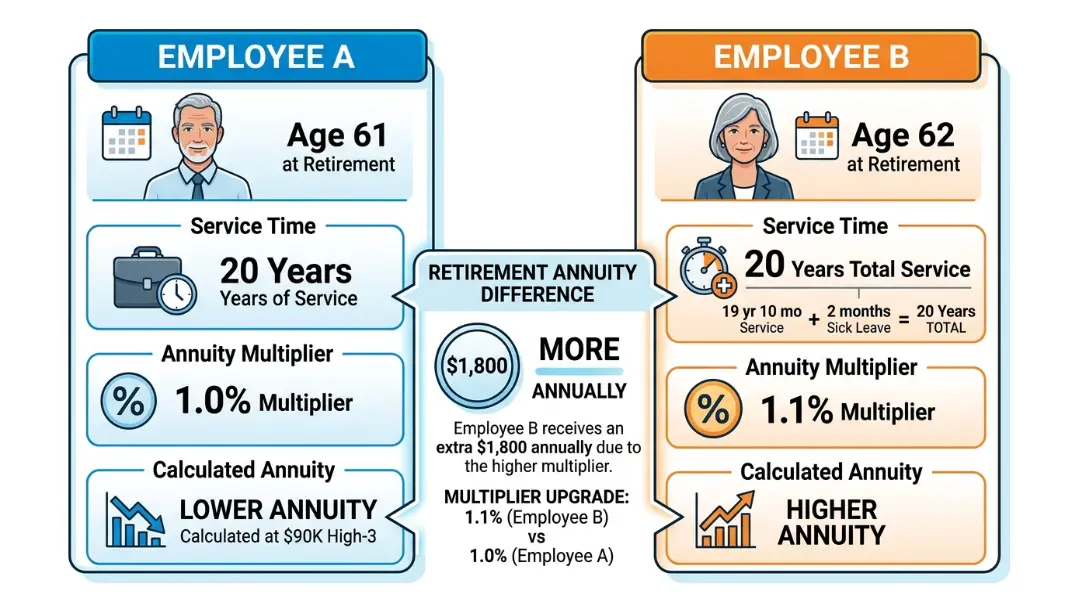
The 1.1% multiplier applies to employees who retire at age 62 or older and carry at least 20 years of total creditable service, including sick leave credit, at the time of retirement. Every year of service, not just the sick leave portion, is calculated at 1.1% instead of 1.0%. That 10% difference in the rate compounds across the entire service history.
The threshold scenario:
Consider an employee who reaches age 62 with exactly 19 years and 11 months of actual service. Without sick leave credit, they retire one month short of the 20-year threshold and receive the 1.0% multiplier on all 19.917 years.
If that same employee carries 174 or more hours of sick leave, the one month of credit pushes total creditable service to exactly 20 years. They now qualify for the 1.1% multiplier on all 20 years.
At a $90,000 High-3:
- Without sick leave (19.917 years at 1.0%): $90,000 × 19.917 × 0.01 = $17,925/year
- With 1 month sick leave credit (20 years at 1.1%): $90,000 × 20 × 0.011 = $19,800/year
- Annual difference: $1,875/year from a single month of sick leave credit
In that scenario, 174 hours of sick leave did not just add one month of service value. It unlocked the higher multiplier for 20 years of service. The individual month at 1.1% would have been worth $7.25/month more than at 1.0%. But the multiplier switch across 20 years added $156.25/month in permanent annuity income.
Not every employee will be in this exact position. But tracking your service total and sick leave balance against the 20-year threshold in the years before 62 is worth calculating specifically, not estimating.
What Sick Leave Cannot Do in FERS#
It does not create retirement eligibility. The most common misconception is that sick leave hours can close a gap in years-of-service eligibility. If you need 10 years of service to retire under the MRA+10 provision and you have 9 years and 11 months of actual service, 174 hours of sick leave will not make up the difference. OPM applies sick leave credit only after you are already eligible to retire under your applicable FERS provision.
It cannot be paid out as cash. Annual leave is paid out in a lump sum at retirement based on your final daily rate. Sick leave is not. The only monetary value of sick leave at retirement comes through the annuity calculation. Employees who spend down their sick leave before retirement in hopes of not "wasting" it are making a direct financial trade: short-term leave availability for permanent annuity reduction.
It does not affect the FERS supplement. The temporary supplement, paid from your FERS retirement date until age 62 and based on estimated Social Security benefit, is calculated on actual creditable service only. Adding sick leave credit does not increase the supplement amount or extend the period it is paid.
CSRS Offset employees follow the same conversion. If you have a CSRS component from service before January 1, 1984, sick leave credit applies to that portion under the same 2,087-hour rate. A CSRS Offset annuity with sick leave credit uses the same conversion table shown above for the CSRS portion.
For employees running comprehensive retirement projections that include TSP distributions alongside the basic annuity, understanding how federal pension income interacts with contribution room in other vehicles matters. The Roth IRA Contribution Limits Guide covers how earned income thresholds and phase-outs apply to federal employees who want to contribute to an IRA alongside TSP during working years and after retirement.
Unused sick leave at FERS retirement converts to additional creditable service at OPM's rate of 2,087 hours per year (174 hours per month). Complete months are added to your actual service years in the annuity formula: High-3 × total creditable service × 1.0%, or 1.1% if you retire at age 62 or older with 20 or more total years. Each month of sick leave credit adds between $3.47 and $9.93 per month to your annuity depending on your High-3 salary. The credit is permanent and paid for the full length of your retirement.
OPM uses a rate of 2,087 hours per year, or 174 hours per month. Only complete months count. Hours below the 174-hour threshold for the next complete month are dropped and carry no value. If you retire with 520 hours of sick leave, OPM credits you with 2 months (348 hours), and the remaining 172 hours produce no credit. There is no rounding up. The only way to capture hours near a threshold is to reach the next 174-hour increment before separating.
At the 1.0% multiplier, one full year (2,087 hours) of sick leave credit adds 1.0% of your High-3 to your annual annuity. At an $80,000 High-3, that is $800/year ($66.64/month). At the 1.1% multiplier for retiring at 62 with 20+ years, the same year adds $880/year ($73.33/month). Each month of sick leave credit adds approximately 1/12 of those amounts, so $5.55 per month to your annuity check at an $80,000 High-3 with the 1.0% rate.
No. Sick leave credit is applied to the annuity calculation only after you are already eligible to retire. It cannot be used to meet your Minimum Retirement Age plus years-of-service threshold, the 5-year vesting requirement, or any other eligibility criteria. If you are one month short of the years needed to qualify for an immediate annuity, sick leave does not close that gap. Eligibility requires actual creditable civilian or qualifying military service.
Sick leave converts to creditable service at the same 2,087-hour rate regardless of retirement age. The difference is which multiplier applies to the resulting total. Before age 62, or at 62 with fewer than 20 years of total service, all service including sick leave months calculates at 1.0%. At 62 or older with 20 or more total years including sick leave, the 1.1% multiplier applies. Retiring before 62 does not eliminate sick leave credit; it reduces the per-credit-month annuity value by approximately 10%.
Save it. Sick leave used before retirement produces no annuity credit. Sick leave carried to retirement converts to permanent monthly income that pays for the rest of your life. The only defensible reason to use sick leave before retirement is a genuine medical need, since that is what the leave exists for. Deliberately depleting your balance before separation to avoid perceived waste is a direct trade of permanent annuity income for short-term convenience. Every hour above the next 174-hour threshold has measurable dollar value at the annuity calculation table.
Written by
Hassaan Rasheed
Web Developer & Content Researcher
Hassaan builds calculators and writes source-linked guides across the site's subject areas. Calculator methods and reference data are documented in each guide so readers can verify the underlying sources.
About the author and methods