How to Calculate Your FERS Retirement: Annuity, Sick Leave, and Supplement
How to calculate your FERS retirement annuity, High-3 salary, sick leave credit, FERS supplement, and early retirement reduction rules. Step-by-step.
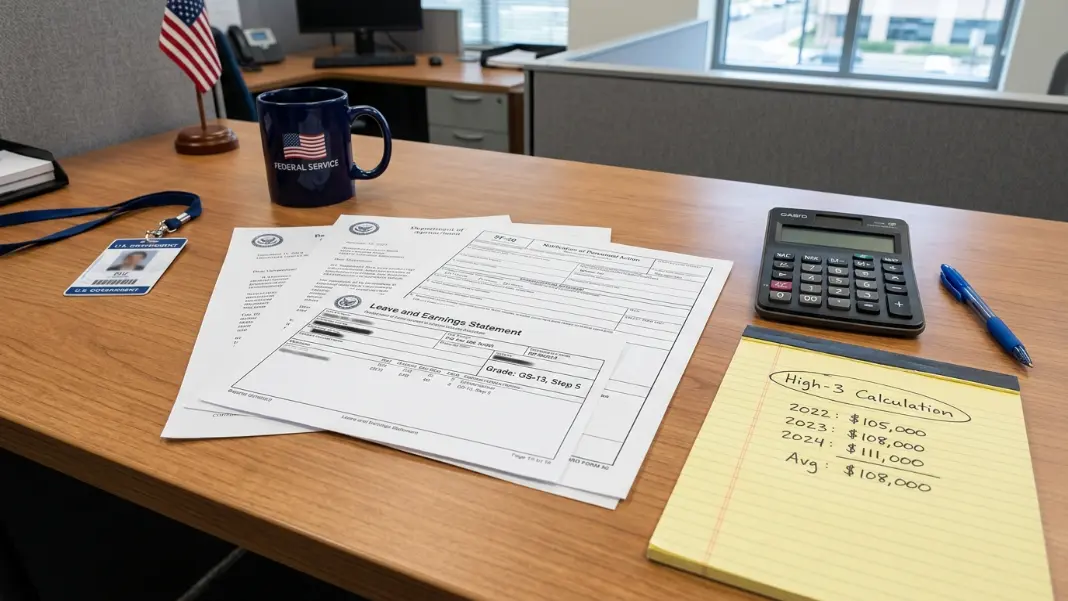
Federal employees under FERS (Federal Employees Retirement System) receive one of the more structured retirement packages in the US workforce: a defined annuity, a supplement that bridges income to Social Security eligibility, and credit for unused sick leave. Each piece has its own formula and eligibility rules.
The FERS retirement calculation looks complicated at first because it combines three separate components. Once you understand each one independently, the full picture comes together quickly. This guide walks through the complete calculation with real numbers, including how sick leave is credited, how the FERS supplement works, and what early retirement does to your annuity.
The FERS Annuity Formula#
The core FERS annuity formula is:
Annual Annuity = High-3 Average Salary x Years of Creditable Service x Multiplier
The multiplier depends on your age at retirement:
| Retirement Condition | Multiplier |
|---|---|
| Under age 62, or age 62 with less than 20 years | 1.0% |
| Age 62 or older with 20+ years of service | 1.1% |
The 1.1% multiplier is worth noting. Retiring at 62 with exactly 20 years versus 19 years and 11 months produces a permanently higher annuity because the multiplier increases from 1.0% to 1.1%. That 0.1% applies to every year of service, so on a $100,000 High-3 with 25 years of service, the difference is $2,500 per year for life.
Use the FERS Retirement Calculator to run your exact numbers with both multipliers side by side.
What Is the High-3 Average Salary?#
The High-3 is the average of your three consecutive highest-earning years of federal service, not necessarily your final three years. Most federal employees reach their High-3 in their final three years since GS pay scales increase with time in grade, but this is not always the case.
What counts toward High-3:
- Basic pay (your GS or equivalent base salary)
- Locality pay
- Within-grade step increases
- Promotions that increase your basic pay
What does not count:
- Overtime pay
- Bonuses or awards
- Premium pay (night differential, hazard pay)
- Allowances
Example: An employee earning $95,000 in year one, $97,000 in year two, and $100,000 in year three has a High-3 of ($95,000 + $97,000 + $100,000) / 3 = $97,333.
If you received a promotion late in your career, check whether a different three-year window produces a higher average. Your High-3 does not have to be your most recent three years, only the highest consecutive three.
Step-by-Step FERS Retirement Calculation#
Here is a complete example for a typical federal employee.
Employee profile:
- Age at retirement: 60
- Years of creditable service: 28
- High-3 average salary: $97,333
Step 1: Identify the multiplier
Age 60 with 28 years does not meet the age-62-with-20-years threshold, so the multiplier is 1.0%.
Step 2: Apply the formula
Annual Annuity = $97,333 x 28 x 0.01
              = $97,333 x 0.28
              = $27,253/year
              = $2,271/month (before deductions)
Step 3: Add sick leave credit (covered in the next section)
If this employee had 1,040 hours of unused sick leave at retirement, that converts to 6 months of additional service credit, bringing effective service to 28.5 years.
Adjusted Annuity = $97,333 x 28.5 x 0.01 = $27,739/year
The difference: $486 per year for life, just from sick leave.
Calculating Sick Leave for FERS Retirement#
One of the least understood parts of the FERS retirement calculation is sick leave credit. Since January 1, 2014, FERS employees receive 100% credit for unused sick leave at retirement. Every hour of unused sick leave converts directly into additional service time.
The conversion table:
| Unused Sick Leave Hours | Additional Service Credit |
|---|---|
| 174 hours | 1 month |
| 348 hours | 2 months |
| 522 hours | 3 months |
| 696 hours | 4 months |
| 870 hours | 5 months |
| 1,044 hours | 6 months |
| 2,087 hours | 1 full year |
How the calculation works:
OPM uses a factor of 2,087 hours per year (the standard federal work year). Divide your unused sick leave hours by 2,087 to get additional years, then multiply the remainder by 12/2,087 to get additional months.
Example:
An employee retires with 1,500 hours of unused sick leave.
1,500 / 2,087 = 0.719 years
0.719 x 12 = 8.6 months (rounds down to 8 months)
Additional credit: 8 months
That 8 months of additional service adds directly to the annuity calculation. On a $97,333 High-3 at 1.0%, 8 months equals 0.667 years, adding $649/year to the annuity for life.
Key point: Sick leave credit does not count toward the 20-year threshold that unlocks the 1.1% multiplier, and it does not count toward eligibility for retirement itself. It only increases the service credit used in the annuity formula after you are already eligible to retire.
The FERS Retirement Supplement#
The FERS Supplement (also called the Special Retirement Supplement or SRS) is an additional monthly payment that bridges the income gap between retirement and age 62, when Social Security eligibility begins. Not every FERS retiree qualifies.
Who receives the FERS supplement:
- Employees who retire at their Minimum Retirement Age (MRA) with 30 or more years of service
- Employees who retire at age 60 with 20 or more years of service
- Employees who qualify for early-out or discontinued service retirement
Employees who retire under MRA+10 provisions (covered below) do not receive the supplement.
How the supplement is calculated:
The formula estimates what your Social Security benefit would be at age 62, then prorates it based on your years of FERS service relative to 40 years.
Estimated SS benefit at 62 x (Years of FERS service / 40)
Example:
An employee retires at 57 with 30 years of FERS service. Their estimated Social Security benefit at 62 is $1,800/month.
Supplement = $1,800 x (30 / 40) = $1,800 x 0.75 = $1,350/month
The supplement pays until you reach age 62, at which point it stops regardless of whether you claim Social Security. It is subject to an earnings test: if your earned income exceeds the Social Security earnings limit ($22,320 in 2025), the supplement is reduced dollar-for-dollar above the threshold.
If you are planning retirement timing around the supplement and want to model whether your savings and annuity cover living expenses during the bridge period, the Coast FIRE Calculator can help you determine whether your investment portfolio is large enough to cover any gap before Social Security begins.
FERS Minimum Retirement Age and Early Retirement#
Minimum Retirement Age (MRA) by birth year:
| Birth Year | MRA |
|---|---|
| Before 1948 | 55 |
| 1948 | 55 years, 2 months |
| 1949 | 55 years, 4 months |
| 1950 | 55 years, 6 months |
| 1951 | 55 years, 8 months |
| 1952 | 55 years, 10 months |
| 1953-1964 | 56 |
| 1965 | 56 years, 2 months |
| 1966 | 56 years, 4 months |
| 1967 | 56 years, 6 months |
| 1968 | 56 years, 8 months |
| 1969 | 56 years, 10 months |
| 1970 or later | 57 |
Standard retirement options:
- MRA + 30 years: Full annuity with FERS supplement, no reduction
- Age 60 + 20 years: Full annuity with FERS supplement, no reduction
- Age 62 + 5 years: Full annuity, no supplement (Social Security available)
- Age 62 + 20 years: Full annuity at 1.1% multiplier, no supplement
MRA + 10 early retirement:
Employees who reach their MRA with at least 10 but fewer than 30 years of service can retire early, but the annuity is reduced by 5% for each year under age 62.
Reduction = (62 - your age at retirement) x 5%
Example: Retiring at MRA (age 57) under MRA+10 with 15 years:
- Reduction = (62 - 57) x 5% = 25%
- Annuity = $97,333 x 15 x 0.01 = $14,600
- After 25% reduction = $14,600 x 0.75 = $10,950/year
The MRA+10 reduction is permanent. No FERS supplement is paid with MRA+10 retirement.
One option to avoid the reduction: separate from federal service at MRA+10 eligibility but postpone the annuity start date until closer to age 62. This is called a postponed retirement. The annuity reduction decreases for every month you delay the start date.
Federal employees should also consider how Roth contributions to TSP fit alongside the FERS annuity. The Roth IRA Contribution Calculator shows how much you can contribute to a Roth account each year based on your income, which is worth modeling separately from TSP contributions.
FERS Disability Retirement#
FERS disability retirement is available to employees who become unable to perform the essential functions of their position due to a medical condition and have completed at least 18 months of creditable federal service.
How FERS disability retirement is calculated:
For the first 12 months: 60% of the High-3 salary, minus 100% of any Social Security disability benefit received.
After the first 12 months (until age 62): 40% of the High-3 salary, minus 60% of any Social Security disability benefit.
At age 62, OPM recalculates the annuity as if the employee had continued working until 62 at the same High-3, using the standard FERS formula with all creditable service including the disability period.
Example (first 12 months):
- High-3: $85,000
- SSDI benefit: $1,200/month ($14,400/year)
- Disability annuity: (60% x $85,000) - $14,400 = $51,000 - $14,400 = $36,600/year
FERS disability retirement requires OPM approval and a separate application process from standard retirement. The calculation here is illustrative; actual benefits depend on SSDI approval and OPM determination.
Common Mistakes in the FERS Retirement Calculation#
Using base salary instead of High-3. The formula uses the average of your three highest consecutive earning years, not your final salary or current salary. These are often close but not identical, especially if you received a large promotion recently.
Forgetting locality pay in the High-3. Locality pay is included in the High-3 calculation. Federal employees in high-cost areas like Washington DC, San Francisco, or New York receive significant locality adjustments that meaningfully increase the High-3 average.
Not counting sick leave. Many federal employees underestimate how much sick leave they have accumulated and overlook the service credit it provides. Pull your leave balance from your agency's HR system and run the conversion before finalizing retirement projections.
Assuming the supplement continues after 62. The FERS supplement stops at age 62 regardless of whether you claim Social Security. Budget for this income drop starting at 62 even if you plan to delay Social Security until 67 or 70.
Calculating the MRA+10 reduction incorrectly. The 5% per year reduction applies from the annuity start date, not the separation date. If you separate at your MRA but postpone the annuity, the reduction is smaller. Many employees separate from service and begin the annuity on the same date without realizing postponement is an option.
Not accounting for survivor benefit premium. If you elect a survivor benefit for a spouse, the annuity is reduced by up to 10% for a full survivor benefit. This reduction is permanent and should be factored into retirement income projections.
Frequently Asked Questions#
The formula is: Annual Annuity = High-3 Average Salary x Years of Creditable Service x Multiplier. The multiplier is 1.0% for most retirees and 1.1% for employees who retire at age 62 or older with at least 20 years of service. For example, a $90,000 High-3 with 25 years of service at 1.0% produces a $22,500 annual annuity ($1,875/month before deductions).
OPM converts unused sick leave hours into additional service credit using a factor of 2,087 hours per year. Divide your sick leave balance by 2,087 to get additional years of service, then apply the remainder as months (rounding down). That additional service credit is added to your years of service in the annuity formula. For example, 1,044 hours of sick leave equals roughly 6 months of additional credit, which increases the annuity proportionally.
The FERS Supplement is an additional monthly payment designed to replace the Social Security income you cannot collect before age 62. It is calculated as your estimated Social Security benefit at 62, multiplied by your years of FERS service divided by 40. Employees must retire at MRA with 30 years, at age 60 with 20 years, or under involuntary/early-out provisions. MRA+10 retirees do not qualify. The supplement stops at age 62.
The FERS Minimum Retirement Age ranges from 55 to 57 depending on your birth year. Employees born in 1970 or later have an MRA of 57. With 30 years of service at MRA, you can retire with a full unreduced annuity and the FERS supplement. With 10 to 29 years at MRA, you can retire early but face a 5% reduction per year under age 62 unless you postpone the annuity start date.
No. The High-3 is the highest three consecutive years of basic pay in your federal career, which is usually but not always your final three years. If you received a large promotion late in your career, your last three years are likely your High-3. But if your pay was higher at a different point in your career, OPM uses whichever three consecutive years produce the highest average, regardless of when they occurred.
Written by
Hassaan Rasheed
Web Developer & Content Researcher
Hassaan builds calculators and writes source-linked guides across the site's subject areas. Calculator methods and reference data are documented in each guide so readers can verify the underlying sources.
About the author and methods