ABV Meaning: What Alcohol by Volume Tells You About Any Drink (2026)
ABV stands for alcohol by volume, the universal standard for measuring alcohol strength. What the percentage means, legal tolerances, and ranges by drink type.
The three letters printed on every beer can, wine label, and liquor bottle do a lot of work in a small space. ABV tells you one specific thing: what fraction of the liquid is pure ethanol. That number is regulated, standardized, and calculated the same way whether the product is a $2 light beer or a $200 single malt. Two drinks can look identical in size and taste completely different, but if they share the same ABV and serving size, they deliver the same amount of alcohol.
The ABV Calculator computes ABV from your starting and final gravity readings for any homebrew batch. This guide covers what the percentage actually represents, how it is regulated in the US, what typical ranges look like across all drink categories, and why the stated ABV on a label is a legal estimate rather than a precise measurement.
What ABV Stands For and How It Is Defined#
ABV stands for Alcohol by Volume. The definition is literal: it is the percentage of a drink's total volume that is pure ethyl alcohol (ethanol). A drink with 5% ABV contains 5 milliliters of pure ethanol in every 100 milliliters of liquid, 50 milliliters in a liter, and so on. The ratio holds regardless of serving size.
The calculation that produces this number starts with fermentation. Yeast converts sugars into ethanol and carbon dioxide. The more sugar present at the start and the more completely fermentation runs, the higher the ABV in the finished product. For homebrewers and commercial producers alike, the standard approach uses the change in specific gravity from before fermentation (original gravity) to after fermentation (final gravity). The ABV formula and worked examples cover both the simple and extended formulas, when each applies, and how to use a gravity reading to calculate ABV for any fermented beverage.
ABV vs proof: In the US, proof is exactly twice the ABV. A spirit at 40% ABV is labeled 80 proof. A spirit at 50% ABV is 100 proof. Most countries outside the US use ABV exclusively on labels and do not use the proof system at all. The ABV vs Proof Guide covers the history behind the two systems and the full conversion table.
In the United States, the Alcohol and Tobacco Tax and Trade Bureau (TTB) requires ABV disclosure on all beverage alcohol labels sold commercially. The label must state ABV as a percentage. For imported products, the same TTB labeling rules apply before a product can be distributed in the US market.
How ABV Translates to a Standard Drink#
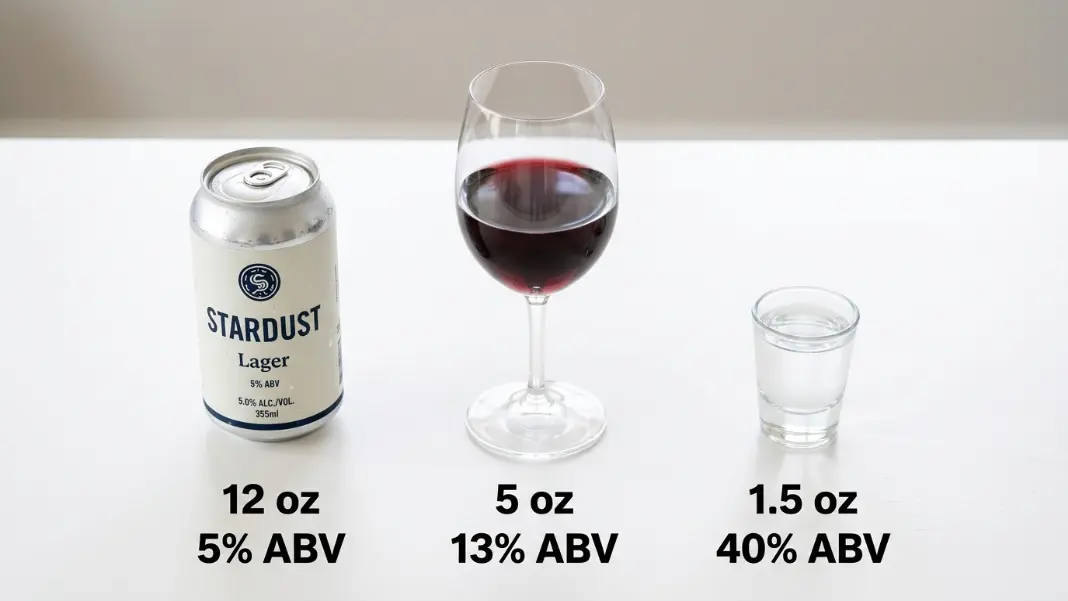
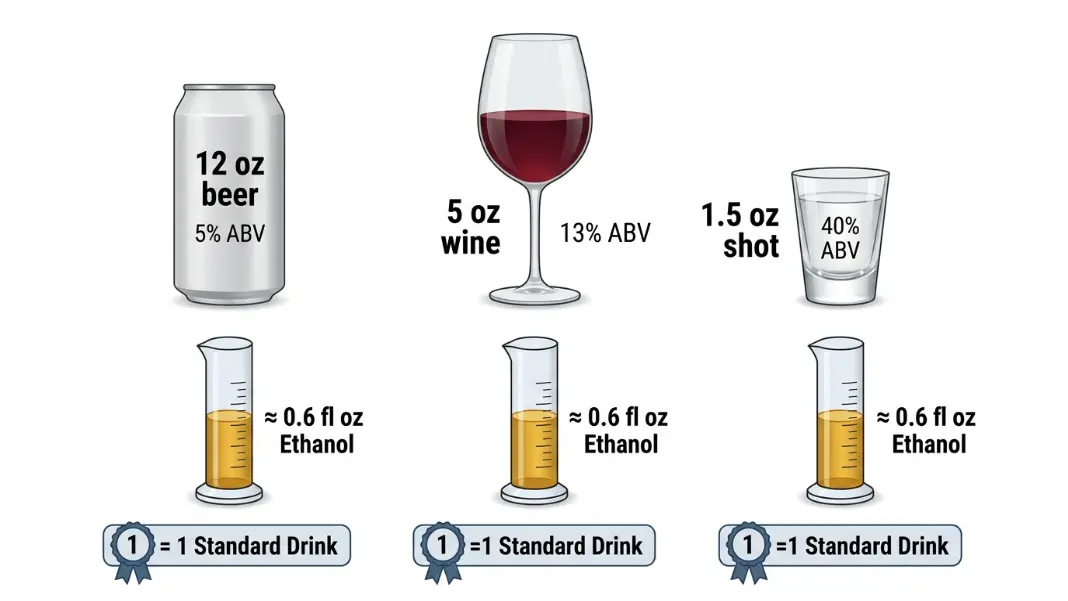
A standard drink is defined by ethanol content, not by volume or ABV. In the US, one standard drink contains 14 grams of pure ethanol, equivalent to approximately 0.6 fluid ounces of pure alcohol. Different drinks reach that 0.6-ounce threshold at different volumes depending on ABV.
Standard Drinks = (Serving Size in oz x ABV as decimal) / 0.6

12 oz beer at 5.0% ABV:   (12 x 0.050) / 0.6 = 1.0 standard drink
5 oz wine at 13.0% ABV:   (5  x 0.130) / 0.6 = 1.08 standard drinks
1.5 oz spirits at 40% ABV: (1.5 x 0.400) / 0.6 = 1.0 standard drink
The standard drink definition exists to make consumption across drink types directly comparable. A pint (16 oz) of 7.5% ABV craft IPA calculates to: (16 x 0.075) / 0.6 = 2.0 standard drinks, despite arriving in a single glass. A 9-ounce pour of 14% wine equals: (9 x 0.14) / 0.6 = 2.1 standard drinks.
These equivalencies help explain why comparing drinks purely by ABV percentage is incomplete without also accounting for serving size. A 4.2% beer and a 14% wine look very different by ABV alone, but when served in standard pours of 12 ounces and 5 ounces respectively, both deliver close to one standard drink.
ABV Ranges by Drink Category#
ABV varies across a wide range depending on the type of beverage and how it is produced. Fermented beverages like beer and wine are limited by how much alcohol yeast can tolerate before it stops functioning, typically below 20%. Distilled spirits remove water to concentrate alcohol far above that ceiling.
The table below shows typical ABV ranges by drink category, along with the common examples that anchor each range.
| Category | Typical ABV Range | Common Examples |
|---|---|---|
| Non-alcoholic beer/kombucha | Under 0.5% | O'Doul's (0.4%), GT's Synergy |
| Ultra-light beer | 2.4% to 3.5% | Bud Select 55 (2.4%), Miller 64 (2.8%) |
| Light beer | 3.5% to 4.5% | Coors Light (4.2%), Bud Light (4.2%), Michelob Ultra (4.2%) |
| Standard beer | 4.5% to 6.0% | Budweiser (5.0%), Modelo (4.4%), Guinness Draught (4.2%) |
| IPA and craft ale | 6.0% to 9.0% | Lagunitas IPA (6.2%), Voodoo Ranger (7.0%) |
| Malt liquor and high-ABV beer | 6.0% to 15.0% | Steel Reserve (8.1%), Four Loko (14%) |
| Low-alcohol wine | 5.5% to 10.0% | Moscato (5-7%), German Riesling Kabinett |
| Table wine | 11.0% to 14.5% | Chardonnay, Pinot Noir, Cabernet Sauvignon |
| Fortified wine | 15.0% to 22.0% | Port (19-22%), Sherry (15-20%) |
| Sake | 14.0% to 17.0% | Most commercial sake |
| Standard spirits | 35.0% to 47.0% | Vodka (40%), Gin (40-47%), Tequila (38-40%) |
| High-proof spirits | 50.0% to 95.0% | Everclear (75.5% or 95%), overproof rum |
For a deeper breakdown by spirit category, the Liquor ABV Chart lists every major spirit type from gin and vodka through overproof rum and absinthe. For wine styles specifically, Wine ABV Percentage by Style covers the full range from Moscato to fortified Port.
The 0.5% ABV threshold is significant in US law. Products under 0.5% ABV are classified as non-alcoholic and are not subject to the same federal labeling and distribution regulations as beverage alcohol. This is why kombucha, which can produce alcohol as a byproduct of fermentation, must remain below 0.5% ABV to be sold in standard grocery channels without an alcohol license.
What ABV Tells You and What It Does Not#
Higher ABV means more ethanol per volume, but the relationship between ABV and how you experience a drink is more nuanced than a single number captures.
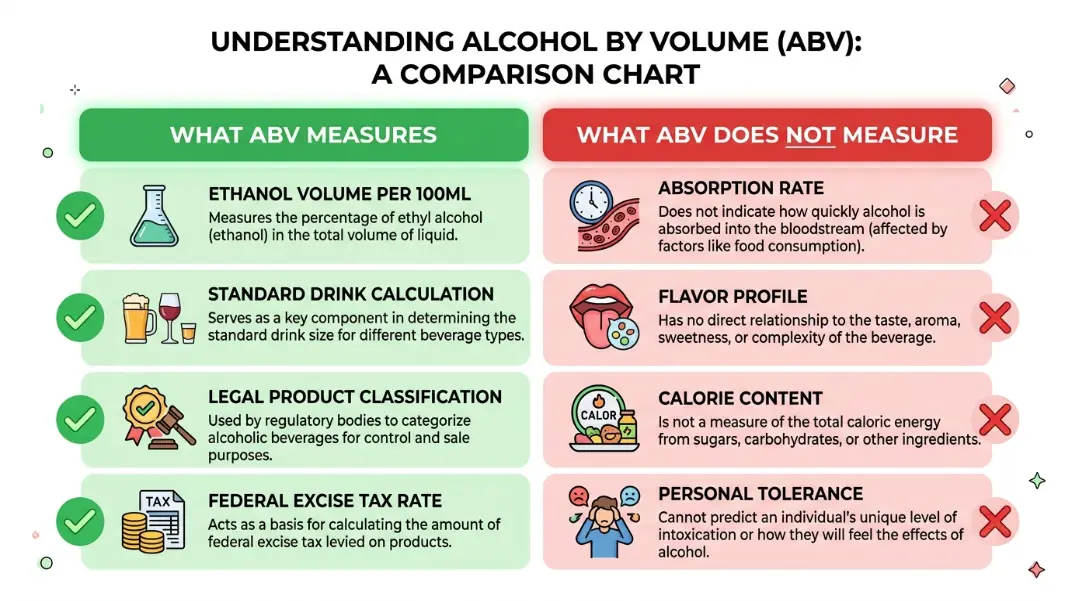
What ABV tells you directly:
The ethanol content per unit volume of liquid. This determines how much alcohol is in each serving, how the drink is categorized and taxed under federal law, and how the serving size relates to the standard drink definition.
What ABV does not tell you:
How quickly the alcohol is absorbed. Carbonation accelerates gastric emptying and speeds alcohol absorption into the bloodstream. Two drinks at 5% ABV can produce different effects on the same person depending on whether one is carbonated and the other is flat. Food in the stomach slows absorption regardless of ABV.
How the drink will taste. A 14% Zinfandel and a 14% dry Riesling share identical ABV but taste completely different. ABV captures alcohol concentration, not sweetness, tannins, acidity, or any other flavor component.
Calorie content per ounce. Calories from alcohol come primarily from ethanol (approximately 7 calories per gram), but sugar and carbohydrate content adds additional calories that vary widely at the same ABV. A 5% light lager and a 5% hard seltzer have similar ABVs but different calorie counts depending on residual sugar.
Tolerance and personal effect. Body weight, metabolic rate, hydration, food intake, and individual variation all affect how a person responds to a given amount of alcohol. ABV standardizes the amount of ethanol; personal response to that ethanol is not standardized.
Legal ABV Tolerances and Why the Label Is an Estimate#
The ABV on a US beverage label is a legal statement, not a laboratory measurement rounded to the exact decimal. Federal TTB rules allow manufacturers to label ABV within a tolerance of the actual measured value because fermentation is a biological process with natural variation between batches.
The table below shows the allowed tolerances by product type.
| Product Type | Allowed Tolerance |
|---|---|
| Malt beverages (beer, hard seltzer) | +/- 0.3% from stated ABV |
| Distilled spirits | +/- 0.3% from stated ABV |
| Table wine (7% to 14% ABV) | +/- 1.5% from stated ABV |
| Table wine (above 14% ABV) | +/- 1.0% from stated ABV |
A beer labeled 5.0% could contain anywhere from 4.7% to 5.3% actual alcohol. A wine labeled 13.5% could range from 12.0% to 15.0%. For most people comparing drinks in everyday use, this tolerance is not meaningful. For people tracking consumption precisely for health purposes, the tolerance means stated ABV should be treated as an approximation rather than an exact figure.
Tax structure also influences labeling. Table wines below 14% ABV are taxed at a lower federal excise rate than wines at 14% and above. A winemaker with a batch that measures at 14.2% has an incentive to label at 13.9% if the measurement tolerance allows it, shifting the product into the lower tax bracket. This is legal within the TTB tolerance rules.
The hydrometer guide explains how homebrewers and small producers measure actual ABV using specific gravity, and where each measurement method introduces its own tolerance for error. Commercial producers use more precise methods such as near-infrared spectroscopy, but even those carry a small measurement uncertainty.
ABV stands for Alcohol by Volume. It is the percentage of a drink's total liquid volume that is pure ethanol. A drink at 5% ABV contains 5 milliliters of ethanol in every 100 milliliters of liquid. ABV is the universal standard for measuring and labeling alcohol concentration on beverage products worldwide. In the United States, the Alcohol and Tobacco Tax and Trade Bureau requires ABV to be stated on all beverage alcohol labels sold or imported for commercial distribution.
A 5% ABV beer contains 5 milliliters of pure ethanol for every 100 milliliters of liquid. In a standard 12-ounce (355 ml) can, that equals approximately 17.75 milliliters, or 0.6 fluid ounces, of pure alcohol. That amount is the US definition of one standard drink. A 5% ABV beer, a 5-ounce glass of 13% wine, and a 1.5-ounce shot of 40% spirits all deliver approximately one standard drink because the serving sizes are calibrated to match despite the very different ABV percentages.
In the United States, proof is exactly double the ABV. A spirit at 40% ABV is 80 proof. A spirit at 50% ABV is 100 proof. To convert: multiply ABV by 2 to get proof, or divide proof by 2 to get ABV. The proof system is a US-specific historical measurement. Most other countries use ABV exclusively and do not label products with proof. If you see a proof figure on a US spirit label and want the ABV equivalent, simply divide the proof number by 2.
A standard drink in the US contains 0.6 fluid ounces (14 grams) of pure ethanol. The ABV and serving size that reaches this amount depends on the drink type: 12 ounces at 5% ABV for regular beer, 5 ounces at 12% ABV for wine, and 1.5 ounces at 40% ABV for spirits. Higher-ABV drinks require smaller serving sizes to equal one standard drink. A 7% ABV IPA in a 12-ounce pour delivers 1.4 standard drinks, not one, because the higher ABV pushes the ethanol content above the 0.6-ounce threshold.
Beer ranges from 2.4% ABV for ultra-light lagers to 9% or higher for strong IPAs and imperial ales, with most standard commercial beers between 4.2% and 5.0%. Wine ranges from around 5.5% for sweet low-alcohol styles like Moscato to 22% for fortified wines like Port, with most table wines between 11% and 14.5%. Spirits start around 35% for lighter liqueurs and most standard commercial products sit at 40% (80 proof), with high-proof options reaching 50% to 95%.
US federal law allows beverage producers to label ABV within a legal tolerance of the measured value, because fermentation produces slightly different results between batches. Malt beverages and spirits may vary by plus or minus 0.3% from the stated ABV. Table wines under 14% may vary by plus or minus 1.5%. A wine labeled 13.0% could legally contain anywhere from 11.5% to 14.5% actual alcohol. This tolerance exists to accommodate natural biological variation in fermentation without requiring every batch to be relabeled.
Written by
Hassaan Rasheed
Web Developer & Content Researcher
Hassaan builds calculators and writes source-linked guides across the site's subject areas. Calculator methods and reference data are documented in each guide so readers can verify the underlying sources.
About the author and methods