Liquor ABV Chart: Alcohol Content by Spirit Category (2026)
Spirits ABV chart: most liquor at 40% (80 proof), overproof rum to 75.5%, barrel bourbon to 65%. Why 40% became the standard and what changes above 50% ABV.
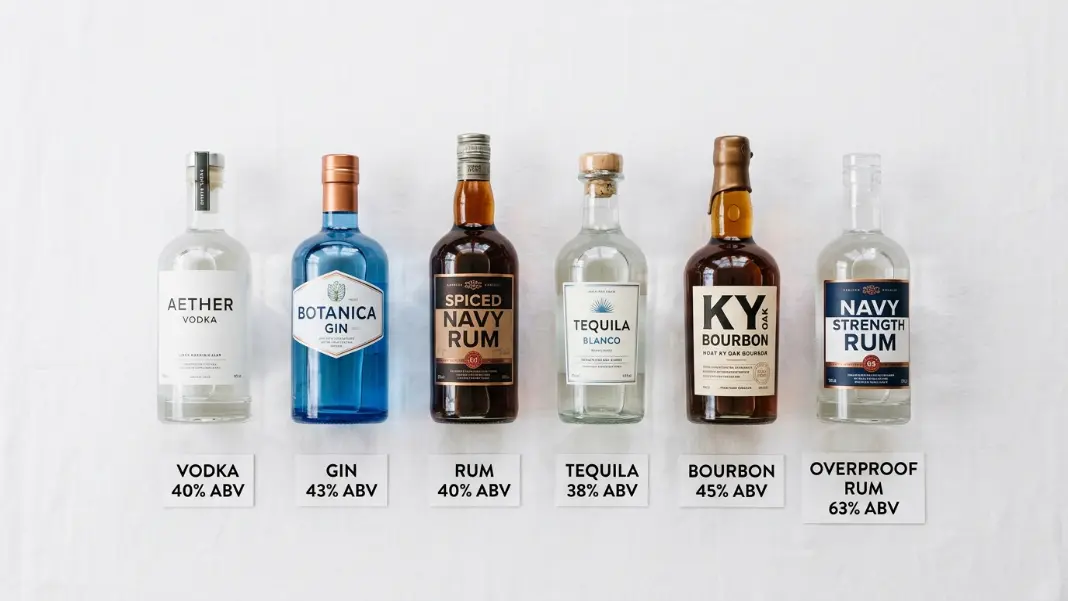
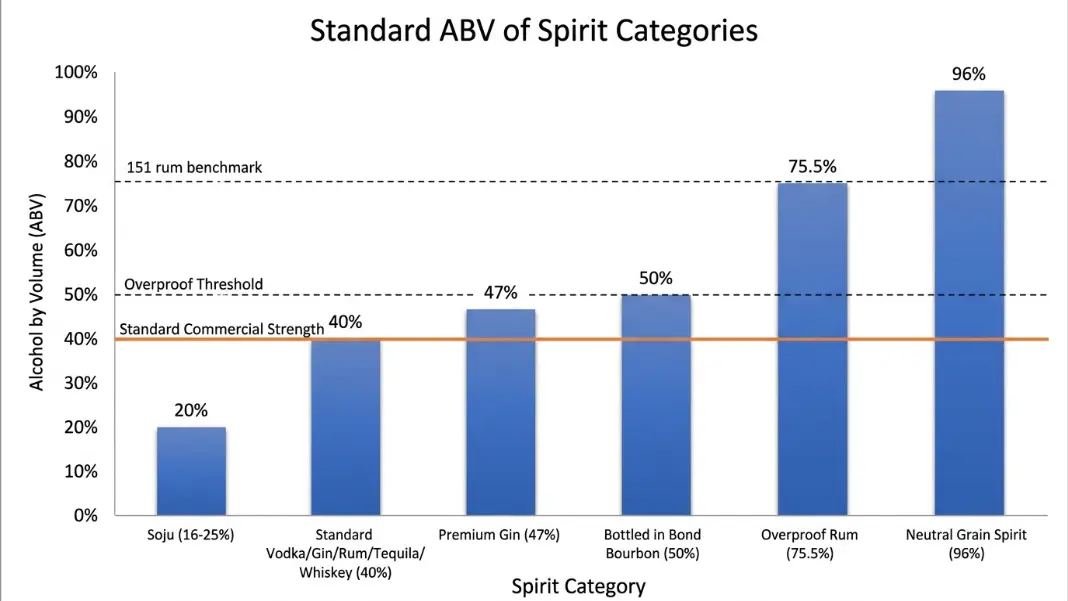
The fact that vodka, gin, rum, tequila, and most whiskeys all land at 40% ABV is not accidental. It is the result of regulatory minimums, taxation history, and a market consensus on what standard strength means for a distilled spirit. The 40% figure survived because it represents the point at which most spirits retain their flavor and aroma compounds in solution while still qualifying as full-strength for US federal excise purposes.
The ABV Calculator computes alcohol content from gravity readings for fermented beverages and provides the framework for understanding how distillation concentrates that fermented liquid into spirit. This guide covers every major spirit category in a single ABV reference chart, explains how distillation pushes ABV above what fermentation alone can achieve, and shows what changes when spirits move above 50% ABV.
Why Almost Every Bottle of Spirits Is 40% ABV#
Regulatory minimums are the short answer. The European Union sets 37.5% ABV as the minimum for spirits sold as vodka, gin, rum, or whiskey in commercial channels. The US TTB sets similar category minimums. The practical market floor ended up at 40% because producers found that going below 40% (80 proof) created quality perception problems with consumers, regardless of whether the product cleared the legal minimum.
The taxation structure reinforces this convergence. US federal excise tax on spirits is assessed per proof gallon, defined as one gallon at 100 proof (50% ABV). The tax rate per proof gallon creates an incentive to bottle at the standard strength rather than dilute further, since consumers associate lower ABV with lower-quality product in the spirits category.
There is also a sensory argument. Ethanol acts as a solvent for the aromatic compounds in whiskey, gin, and rum. Below roughly 38% ABV, some volatile flavor compounds begin to dissociate from solution, affecting nose and mouthfeel. The 40% standard sits approximately at the point where most production-strength spirits maintain their full sensory profile without further dilution affecting the experience.
Liquor ABV Chart: Every Major Spirit Category#
The table below shows verified ABV ranges for all major spirit categories, from standard commercial expressions to high-proof specialty products.
| Spirit Category | Standard ABV | High-Proof Range | Common Examples |
|---|---|---|---|
| Vodka (standard) | 40% | 45% to 50% | Absolut (40%), Belvedere (40%), Ketel One (40%) |
| Vodka (high-proof) | -- | 50% to 96% | Spirytus (96%), Everclear 190-proof (95%) |
| Gin (standard) | 40% to 43% | 47% to 57% | Hendrick's (41.4%), Tanqueray (43.1%), Beefeater (47%) |
| Rum (standard) | 40% | 43% to 46% | Bacardi Superior (40%), Havana Club 3yr (40%) |
| Rum (overproof) | -- | 57.5% to 75.5% | Wray and Nephew (63%), Bacardi 151 (75.5%) |
| Blended Scotch whisky | 40% to 43% | 46% to 50% | Johnnie Walker Black (40%), Chivas Regal 12yr (40%) |
| Single malt Scotch | 40% to 46% | 50% to 65% | Glenfiddich 12yr (40%), Laphroaig Quarter Cask (48%) |
| Cask-strength Scotch | -- | 55% to 65% | GlenDronach Cask Strength, various independent bottlers |
| Irish whiskey | 40% | 43% to 46% | Jameson (40%), Bushmills Black Bush (40%) |
| Bourbon (standard) | 40% to 45% | 50% to 57% | Jim Beam (40%), Maker's Mark (45%) |
| Bourbon (Bottled in Bond) | 50% | -- | Evan Williams Bottled in Bond (50%), Old Fitzgerald BiB |
| Bourbon (barrel proof) | -- | 56% to 67% | Booker's (approx. 63%), Wild Turkey Rare Breed (58.4%) |
| Rye whiskey | 40% to 45% | 50% to 57% | Rittenhouse Bottled in Bond (50%), Sazerac Rye (45%) |
| Tequila (standard) | 38% to 40% | 43% to 46% | Patron Silver (40%), Don Julio Blanco (38%) |
| Mezcal | 40% to 46% | 46% to 55% | Del Maguey Vida (42%), various artisanal producers |
| Brandy and Cognac | 40% | 42% to 46% | Hennessy VS (40%), Courvoisier VSOP (40%) |
| Armagnac | 40% | 45% to 48% | Most commercial Armagnac |
| Grappa | 37.5% to 60% | 50% to 60% | Various Italian producers |
| Calvados | 40% to 45% | -- | Most commercial Calvados |
| Absinthe | 45% to 74% | -- | Most commercially sold absinthe |
| Aquavit | 37.5% to 50% | -- | Most commercial aquavit |
| Soju | 16% to 25% | -- | Most South Korean domestic soju brands |
| Chinese baijiu | 38% to 65% | -- | Kweichow Moutai (53%), Erguotou (56%) |
The ABV vs Proof Guide shows how to convert between ABV percentage and proof for any number in this table. For US spirits, the conversion is always ABV multiplied by 2 equals proof. A 50% bourbon is 100 proof; a 63% barrel-proof bourbon is 126 proof.
How Distillation Concentrates Alcohol Above Fermentation Limits#
Fermentation produces ethanol from sugar, but yeast tolerance limits the concentration achievable. Standard brewing yeast strains die at roughly 12% to 14% ABV. Wine yeast may survive to 16%. Even with the most tolerant strains, fermentation-only ABV tops out around 18% to 20%.
Distillation breaks through that ceiling by exploiting the boiling point differential between ethanol and water. Ethanol boils at 78.37 degrees Celsius (173.1 degrees Fahrenheit). Water boils at 100 degrees Celsius (212 degrees Fahrenheit). When a fermented liquid is heated in a still, ethanol vaporizes at a lower temperature and rises through the still before water does. Collecting and condensing those vapors produces a liquid with a much higher ethanol concentration than the original fermented base.
Single pot still distillation of 8% fermented wash:
Output: approximately 25% to 35% ABV

Second distillation of that distillate:
Output: approximately 60% to 70% ABV

Column still continuous distillation:
Output: 95% to 96% ABV in a single pass
Most spirits go through two to three distillation passes before being diluted to bottling strength with purified water. Column stills can produce near-neutral spirits at 95% to 96% ABV in a single continuous run, which is how neutral grain spirit and high-proof vodka bases are made.
The dilution step: Nearly all commercial spirits are distilled to a higher ABV than the final bottling strength, then cut with demineralized water before bottling. US regulations require straight bourbon to enter the barrel at no more than 62.5% ABV (125 proof) and be bottled at minimum 40% (80 proof). The difference between those numbers is water the distillery adds. The source and mineral content of that water can affect flavor, which is why some producers reference their water source specifically in marketing.
Overproof Spirits: What Changes Above 50% ABV#
The practical uses of overproof spirits differ from the standard commercial range, and the effect on the drinker scales with the ABV.
Barrel-proof and cask-strength expressions: When a spirit is bottled directly from the barrel without dilution, the ABV reflects the concentration after years of aging. Evaporation through the barrel staves, called the angel's share, typically raises the concentration over time because water evaporates at a slightly faster rate than ethanol at cellar temperatures. A bourbon barreled at 62.5% may come out at 65% to 70% after several years. Barrel-proof bottlings capture that concentration without intervention.
The argument for cask-strength spirits is that the distillery's standard dilution ratio, optimized for a broad market, may not match any individual drinker's preferred concentration. Buyers of barrel-proof expressions typically add a few drops of water or a single ice cube to reach the ABV they prefer. Tasting the spirit across a range of dilutions, from cask-strength down to 40%, reveals how the aroma and flavor profile shifts with each dilution step.
Overproof rum for cocktails and culinary use: Overproof rum at 57.5% to 75.5% ABV is designed for applications where a standard 40% rum would be too diluted by other ingredients. A floating layer of overproof rum on top of a cocktail creates a visual separation and concentrates the rum's aroma at the surface. A 750 ml bottle of 75.5% rum contains approximately 89% more ethanol than a 40% bottle of the same size; the pricing difference reflects that ethanol content.
Safety at high proof: Above roughly 50% ABV, spirits can sustain combustion when exposed to an open flame. This property underlies absinthe flambé presentations and the use of overproof rum in some flaming cocktail preparations. Pure ethanol at 96% ABV is highly flammable. Most standard 40% spirits will not catch fire under normal conditions; the water content is sufficient to prevent ignition.
For the gravity-based method of measuring actual alcohol content before the distillation step, see How to Calculate ABV for Homebrewers, which covers both the simple Pearson formula and the extended formula for high-gravity fermented bases used as distillation feeds.
Reading ABV and Proof Together on Spirit Labels#
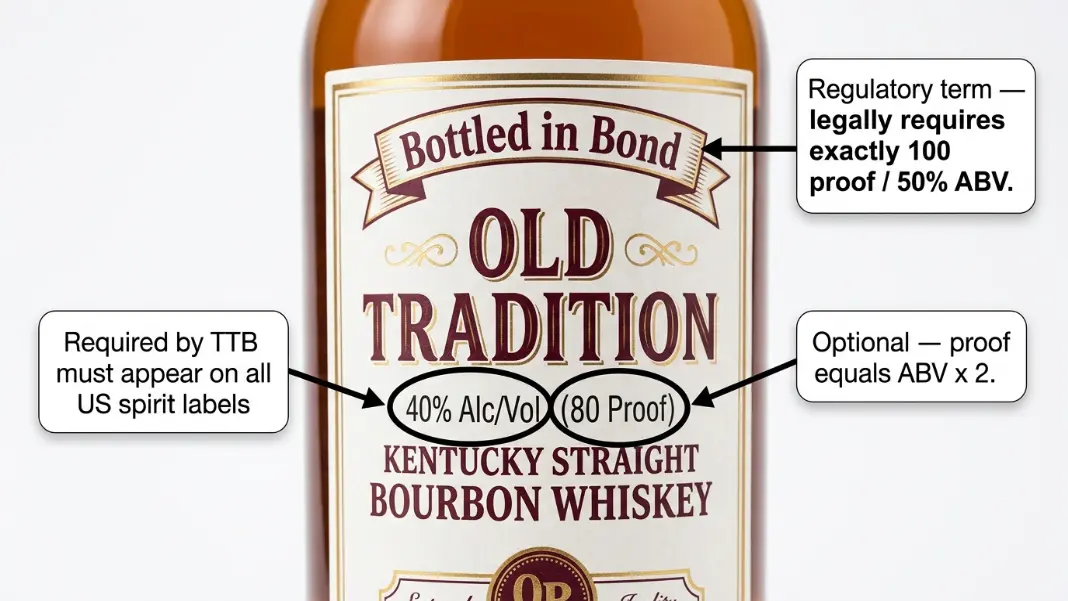
US federal regulations require the alcohol content of distilled spirits to appear on labels as a percentage of alcohol by volume. Proof is permitted as an additional statement but is not required. In practice, most US distilled spirits show both, typically formatted as "40% Alc/Vol (80 Proof)" or similar.
Some craft distillers list only ABV, which is fully compliant with TTB regulations. A label cannot display proof without the corresponding ABV percentage. The inverse is not true: ABV alone satisfies the requirement.
Why producers keep using proof:
The proof designation carries specific legal weight in some categories. Bottled in Bond bourbon must be exactly 100 proof (50% ABV) under the Bottled in Bond Act of 1897. Barrel-proof expressions communicate to buyers that no water was added after the barrel. These proof designations convey production information in a way that a plain ABV percentage may not convey as immediately to experienced spirits buyers.
International labels:
Outside the US, proof is not used. The European Union, Canada, Australia, and most other markets use ABV only. An imported Scotch whisky labeled for the UK market shows only 40% Alc/Vol, not 80 proof. The same whisky exported to the US may carry both designations to serve US consumers who recognize the proof scale.
The ABV Meaning Guide covers the full definition of what ABV measures, what the TTB tolerance rules allow on labels, and how ABV translates to standard drink calculations for any serving size, including the 1.5-ounce standard pour for spirits that underlies the one standard drink definition at 40% ABV.
Most commercially sold spirits in the US are 40% ABV (80 proof). Vodka, gin, rum, tequila, bourbon, and blended Scotch all cluster at 40% as the standard commercial strength. This is the result of regulatory minimums (the EU and US both set 37.5% as the floor for most spirit categories), market convention, and sensory considerations around flavor compound solubility below 38% ABV. Higher-proof expressions at 45% to 65% exist for barrel-proof whiskey, overproof rum, and some gin styles.
The highest commercially available spirit is pure neutral grain spirit at 95% to 96% ABV. Spirytus Rektyfikowany from Poland reaches 96% in markets that permit it. Everclear 190-proof (95% ABV) is available in some US states. These are not conventional drinking spirits; they are used for extraction, blending, and pharmaceutical applications. Among spirits intended for direct consumption, overproof rum reaches 75.5% ABV and some absinthe expressions reach 72% to 74%.
Most commercial whiskey is sold at 40% ABV (80 proof). Bourbon, Scotch, Irish whiskey, and rye whiskey all use 40% as the standard commercial expression. Premium expressions commonly run 43% to 46%. Bottled in Bond bourbon is legally required to be exactly 50% ABV (100 proof) under the 1897 Bottled in Bond Act. Cask-strength and barrel-proof expressions range from 55% to 65% or higher depending on barrel conditions and aging time before bottling.
They are identical. In the US, proof equals ABV multiplied by 2. So 40% ABV multiplied by 2 equals 80 proof. Every standard commercial spirit labeled 80 proof contains 40% alcohol by volume. The proof statement is optional under TTB regulations; the ABV percentage is required. Some distilleries print only ABV, others print both. Dividing any US proof number by 2 gives the ABV percentage.
Several categories routinely sell above 40% ABV. Gin ranges from 40% to 47%, with some expressions at 50% or above. Barrel-proof bourbon runs 56% to 67%. Cask-strength single malt Scotch reaches 55% to 65%. Overproof rum sits at 57.5% to 75.5%. Absinthe typically ranges from 45% to 74%. Chinese baijiu spans 38% to 65% depending on style. Most higher-ABV expressions are meant to be diluted with water or ice rather than consumed at full strength.
Soju, a Korean distilled spirit, commonly falls in the 16% to 25% ABV range in the modern South Korean domestic market, down from traditional expressions above 30%. Some soju products sold in the US run even lower. Most spirits sold under legal category definitions in the US must meet a minimum ABV threshold set by TTB regulations: 37.5% for vodka, gin, rum, and whiskey. Products below those minimums cannot be sold under those category names, though some lower-ABV products are sold as spirit-based ready-to-drink beverages under different category labels.
Written by
Hassaan Rasheed
Web Developer & Content Researcher
Hassaan builds calculators and writes source-linked guides across the site's subject areas. Calculator methods and reference data are documented in each guide so readers can verify the underlying sources.
About the author and methods