Wine ABV Percentage: Alcohol Content by Style and Region (2026)
Wine ABV ranges from 5.5% Moscato to 17% Zinfandel. Full chart by grape and region, how fermentation controls alcohol percentage, and what the label tolerance allows.
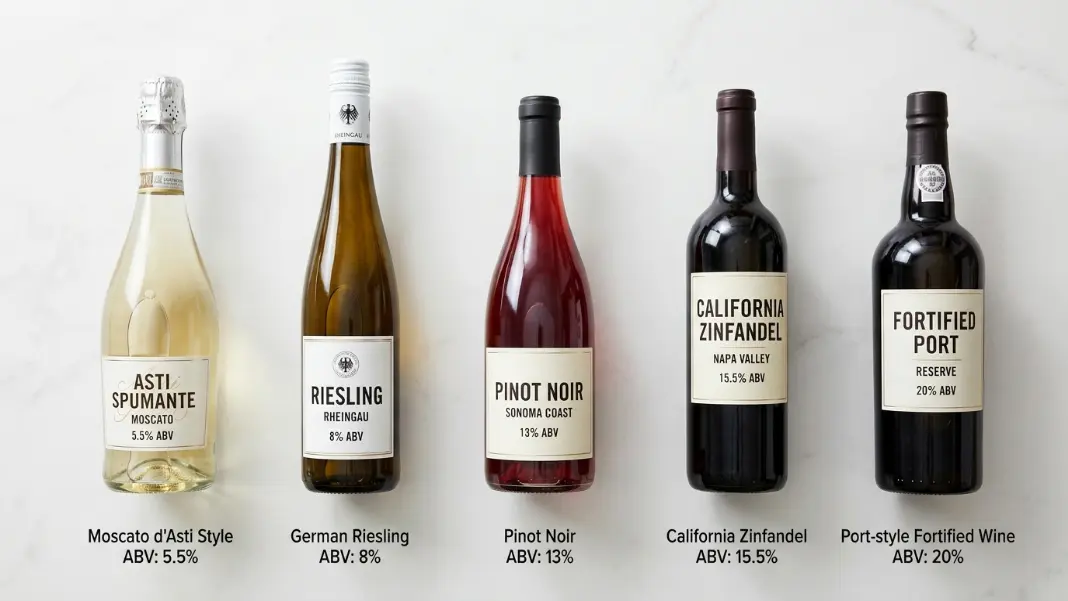
A bottle of Moscato d'Asti at 5.5% and a California Zinfandel at 16% are both wine. That 10.5 percentage point spread is wider than the gap between a light beer and a standard IPA. Wine ABV varies more than any other major beverage category because fermentation, not distillation, is the only process at work, and the variables that control fermentation outcomes, including grape sugar content, yeast strain, and winemaker decisions about when to stop fermentation, all pull in different directions.
The ABV Calculator computes alcohol content from gravity readings for any fermented beverage, including wine. This guide covers the full wine alcohol percentage range by style and region, explains how winemakers influence ABV during production, and shows where the stated percentage on a label can legally vary from the measured content.
Wine Alcohol Content: What the Percentage Range Actually Covers#
Wine ABV is the proportion of total liquid volume that is pure ethanol, stated as a percentage. A wine at 13% ABV contains 13 ml of ethanol per 100 ml of liquid.
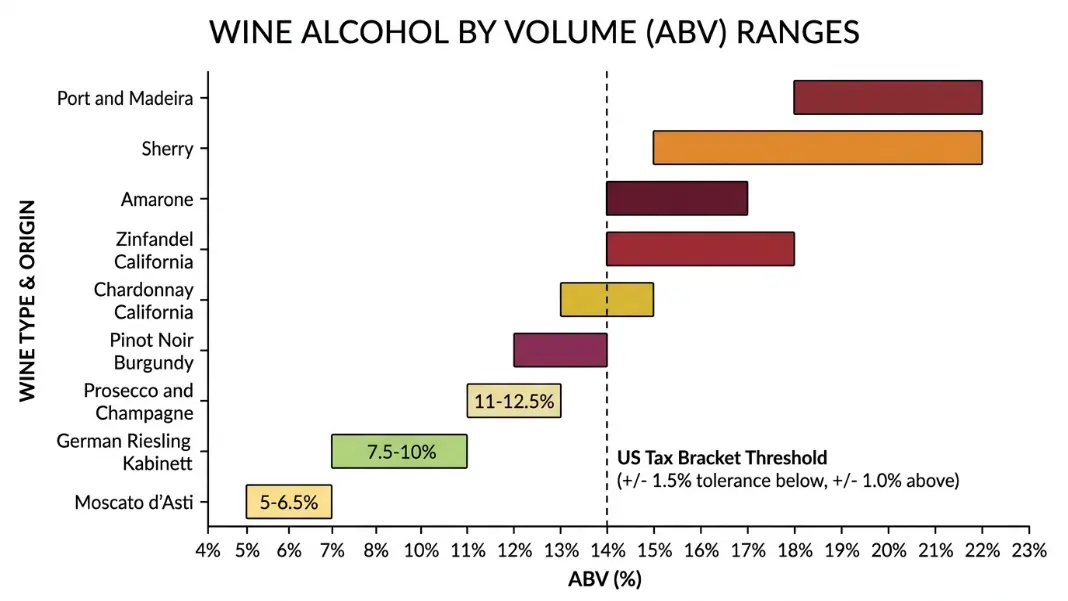
US federal TTB rules allow table wines between 7% and 14% ABV a labeling tolerance of plus or minus 1.5%. A wine labeled 13.0% can legally contain anywhere from 11.5% to 14.5% actual alcohol. Wines above 14% have a tighter tolerance of plus or minus 1.0%. This tolerance matters more for wine than for beer or spirits because the range is wider and the stated number can diverge further from the measured content without violating the law.
The ABV Meaning Guide covers the full federal tolerance table for all beverage categories and explains the tax incentive that can lead winemakers to label at 13.9% rather than 14.1%, since wines at or above 14% are taxed at a higher federal excise rate.
Wine ABV Chart: By Style and Region#
The table below shows ABV ranges by wine style and category, with common examples anchoring each range.
| Wine Style | ABV Range | Common Examples |
|---|---|---|
| Moscato d'Asti (DOCG) | 5.0% to 6.5% | Most Italian Moscato d'Asti producers |
| German Riesling Kabinett | 7.5% to 10.0% | Mosel region Kabinett |
| German Riesling Spatlese | 9.0% to 12.0% | Mosel region Spatlese |
| Italian Prosecco DOC | 10.5% to 12.0% | Most commercial Prosecco |
| Spanish Cava | 11.0% to 12.5% | Codorniu, Freixenet |
| French Champagne | 11.5% to 12.5% | Most commercial Champagne houses |
| Pinot Grigio (Friuli, Trentino) | 11.0% to 12.5% | Northern Italian Pinot Grigio |
| Vinho Verde | 9.0% to 11.5% | Most commercial Portuguese Vinho Verde |
| Pinot Noir (Burgundy) | 12.0% to 13.5% | Cote de Nuits, Cote de Beaune |
| Chardonnay (Burgundy / Chablis) | 13.0% to 14.0% | White Burgundy |
| Chardonnay (California) | 13.5% to 15.0% | Napa, Sonoma producers |
| Merlot (Bordeaux) | 12.5% to 14.0% | Saint-Emilion, Pomerol |
| Merlot (California) | 13.5% to 15.0% | Most California Merlot |
| Cabernet Sauvignon (Bordeaux) | 12.5% to 14.0% | Left Bank Bordeaux |
| Cabernet Sauvignon (California) | 14.0% to 16.0% | Napa Valley producers |
| Zinfandel (California) | 14.0% to 17.0% | Sonoma, Amador County |
| Syrah / Shiraz (Barossa, McLaren) | 13.5% to 15.5% | Australian Shiraz |
| Amarone della Valpolicella | 14.0% to 17.0% | Valpolicella DOCG |
| Sherry (Fino, Manzanilla) | 15.0% to 17.0% | Jerez DO |
| Sherry (Oloroso, Pedro Ximenez) | 17.0% to 22.0% | Jerez DO, aged styles |
| Port (Ruby, Tawny) | 18.0% to 22.0% | Douro Valley producers |
| Madeira | 17.0% to 22.0% | Madeira DO |
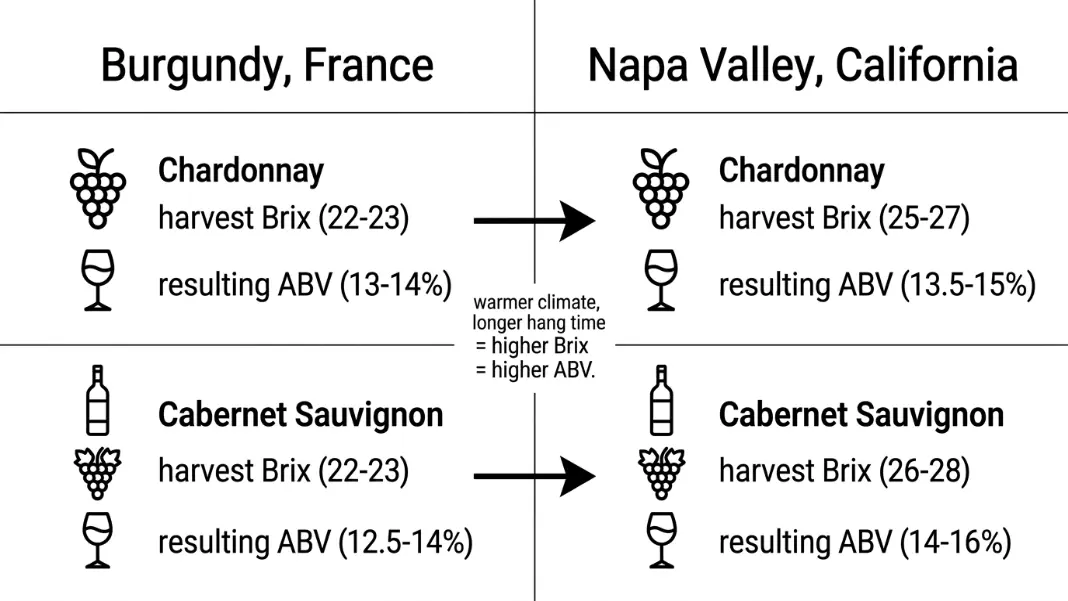
The regional split for the same grape variety is significant. California Cabernet Sauvignon routinely lands 1.5 to 2 percentage points above equivalent Bordeaux production from the same variety. Warmer growing seasons in California allow grapes to accumulate more sugar before harvest, which converts directly to more alcohol during fermentation.
How Grape Sugar and Fermentation Decisions Create the ABV Range#
Wine ABV is determined before and during fermentation, not after the wine is made. Three variables control the outcome.
Grape sugar content (Brix at harvest): Yeast converts sugar to ethanol. More sugar at harvest means more potential alcohol. A grape harvested at 24 Brix produces roughly 14% potential ABV if fermented to dryness. A grape harvested at 27 Brix has 16% potential. Warm climates that allow grapes to hang longer on the vine accumulate higher Brix before harvest.
Fermentation termination: Winemakers can stop fermentation before all sugar is consumed by lowering temperature, filtering out yeast, or adding sulfur dioxide. The remaining unconverted sugar stays in the wine as residual sweetness, reducing the final ABV below the maximum possible. Moscato d'Asti stops fermentation intentionally at 5% to 6% ABV, preserving significant sweetness. A dry Zinfandel runs fermentation to completion, producing 15% or higher.
Chaptalization: Adding sugar to grape must before fermentation to increase potential ABV is called chaptalization. It is legal in cool-climate wine regions, including Burgundy, Champagne, and Germany in off-vintage years, where grapes may not accumulate enough natural sugar to reach desired ABV. It is prohibited in warm-climate regions like California and Australia where natural ripeness is not a limiting factor.
For homebrewers or small-scale winemakers measuring actual ABV from a batch, the Brix to ABV Refractometer Guide covers how to use a refractometer on the must before fermentation and on the finished wine, including the correction formula needed because ethanol throws off refractometer readings in fermented samples.
High-ABV Table Wines vs Fortified Wines: Where the Category Splits#
The practical ceiling for wine produced purely by grape fermentation is approximately 15% to 17% ABV. Above that threshold, the ethanol concentration typically kills or suppresses the yeast enough to slow or stop fermentation naturally.
Fortified wines reach 18% to 22% ABV by a completely different mechanism: adding a neutral spirit, usually grape brandy, to the wine during or after fermentation. This is not fermentation pushing past the limit. It is distilled alcohol added directly.
When you see Port at 20% ABV, that number does not mean the wine fermented to 20%. The winemaker stopped fermentation intentionally, typically at 9% to 10% ABV, by adding brandy to kill the yeast. The remaining grape sugar and the added spirit together produce the characteristic sweetness and high alcohol of the finished wine. A dry table wine at 15% is a more extreme fermentation product than a Port at 20%, because the table wine reached that level without any added alcohol.
The warm-climate table wine plateau: California Zinfandel, Australian Shiraz, and Amarone from the Veneto regularly push 15% to 17% ABV from natural fermentation alone. These wines are not fortified. They reach those levels because warm growing conditions allow late-harvest, highly ripe fruit, and because winemakers in those regions specifically cultivate that style. A 16% Zinfandel from Amador County and a 20% Tawny Port have nearly the same effect per ounce of wine, but arrived there through entirely different production paths.
The ABV vs Proof Guide explains why wine is never labeled in proof in the US, while distilled spirits routinely carry both ABV percentage and proof on the same label. Port and Sherry are wine products, not spirits, so they follow wine labeling rules despite ABV levels that overlap with the lower range of commercial liqueurs.
Low-ABV Wine: What the Market Looks Like Below 10%#
Low-ABV wines occupy a specific and growing segment of the market. These are wines that never fermented to high ABV due to grape variety, climate, or intentional fermentation management. They are different from dealcoholized wines, which have alcohol removed after the fact.
German Riesling Kabinett (7.5% to 9% ABV): Mosel Riesling producers harvest at relatively low Brix because the cool climate limits sugar accumulation, and many producers stop fermentation intentionally to preserve residual sweetness. A Mosel Kabinett at 8% ABV with light sweetness is a legitimate wine style grounded in centuries of regional practice, not a compromise product.
Moscato d'Asti (5% to 6.5% ABV): The DOCG rules for Moscato d'Asti require partial fermentation. The wine is bottled with active carbonation while still sweet and low-alcohol. It is one of the few wines in which the regulated production method mandates a specific ABV ceiling as part of the appellation definition.
Vinho Verde (9% to 11.5% ABV): Portuguese Vinho Verde from northern sub-regions tends toward the lower end of the table wine range due to the cool maritime climate and the region's characteristic high natural acidity. Not all Vinho Verde is low-ABV; some reds and regional styles reach 12% to 13%, but the white versions most exported to the US run closer to 9% to 11%.
Dealcoholized wine (under 0.5%): A distinct category from low-alcohol wine. Dealcoholized wine starts as full-strength wine and has alcohol removed through spinning cone technology or vacuum distillation. The flavor profile differs from wines that never reached high ABV. These products are not regulated as wine in the US if they fall below 0.5% ABV; they are classified as non-alcoholic beverages under different TTB rules.
Most table wines fall between 11% and 15% ABV. Light styles like German Riesling Kabinett and Prosecco range from 7.5% to 12%. Most Chardonnay, Pinot Noir, Merlot, and Cabernet Sauvignon sits between 12% and 15%. Warm-climate wines like California Zinfandel and Amarone can reach 15% to 17%. Fortified wines like Port and Sherry range from 15% to 22% because they have spirit added during production. A typical restaurant pour falls between 12% and 14.5%.
A 5-ounce pour of 13% ABV wine contains approximately 120 to 130 calories. Around 100 of those come from alcohol (ethanol at 7 calories per gram), with the remainder from residual sugar and other carbohydrates. A higher-ABV wine like a 15% Zinfandel in a 5-ounce pour runs closer to 145 to 155 calories. A sweet wine with significant residual sugar adds further calories beyond what ABV alone predicts, since the sugar that did not convert to alcohol adds carbohydrate content.
California's warmer growing climate allows grapes to accumulate more sugar before harvest. More sugar converts to more ethanol during fermentation. A California Cabernet Sauvignon harvested at 27 Brix has significantly higher potential alcohol than a Bordeaux Cabernet harvested at 23 Brix from the same variety. California winemakers also tend to favor riper, later-harvested fruit as a style preference. Some French appellations also cap permissible ABV or set minimum natural Brix thresholds that limit the upper end of the range.
In the US, one standard drink of wine is a 5-ounce pour at approximately 12% ABV. That pour contains 0.6 fluid ounces of pure ethanol, the US standard drink definition. A 5-ounce pour of 14% ABV wine delivers 1.17 standard drinks. A 6-ounce pour of 15% ABV wine equals 1.5 standard drinks. Restaurant pours vary from 5 to 6 ounces depending on the establishment, which affects the actual standard drink count per glass served.
Moscato d'Asti DOCG is among the lowest-ABV commercially sold wines, typically ranging from 5.0% to 6.5% ABV. German Mosel Riesling Kabinett commonly falls between 7.5% and 9.0%. Some Vinho Verde from Portugal's northern sub-regions runs as low as 9%. Dealcoholized wines can be under 0.5% ABV but are produced through post-fermentation alcohol removal rather than low-fermentation winemaking, which makes them a separate category from wines that naturally ferment to low alcohol.
Table wine ferments from grape juice alone and reaches 9% to 17% ABV depending on grape sugar content and fermentation management. Fortified wine has a neutral grape spirit added during or after fermentation, which pushes ABV above the 15% to 17% ceiling that yeast fermentation can typically reach on its own. Port ranges from 18% to 22%, Sherry from 15% to 22%, and Madeira from 17% to 22%. The spirit addition also stops fermentation, preserving residual sugar that creates the characteristic sweetness of most fortified wines.
Written by
Hassaan Rasheed
Web Developer & Content Researcher
Hassaan builds calculators and writes source-linked guides across the site's subject areas. Calculator methods and reference data are documented in each guide so readers can verify the underlying sources.
About the author and methods