What Does 99th Percentile Mean: Definition, Examples, and Context (2026)
The 99th percentile means scoring higher than 99% of the group. One in 100 people reach this rank. Applies to test scores, height, IQ, and baby weight.
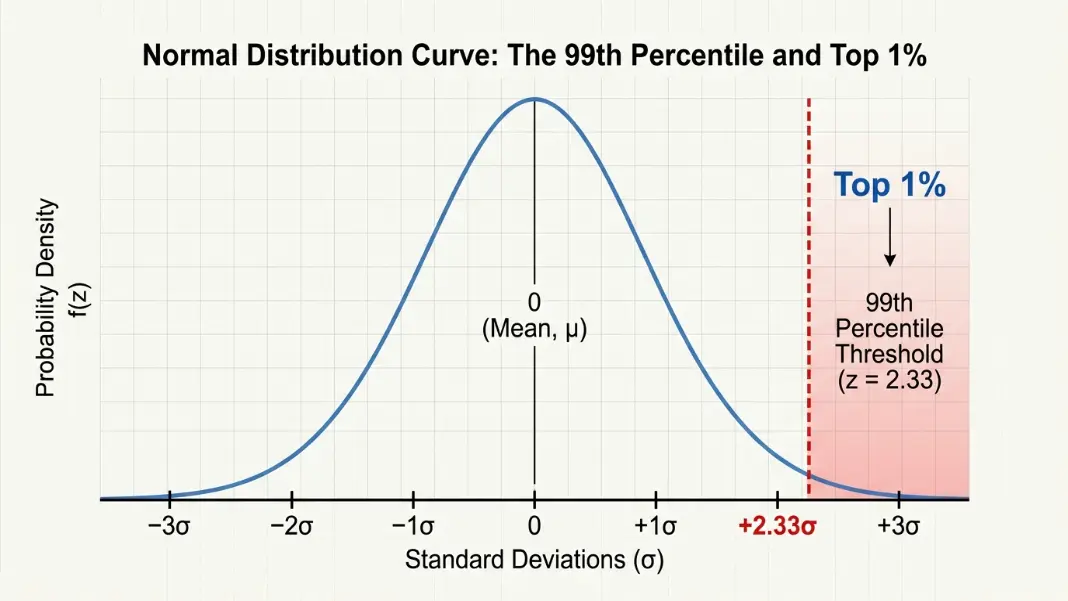
What does 99th percentile mean, exactly? The definition is precise: if your score is at the 99th percentile, you scored higher than 99% of all people in the comparison group. One percent scored at or above you. The term comes from descriptive statistics and applies across any measurable quantity where a large population produces a reference distribution.
This matters in practice because the 99th percentile appears everywhere. Pediatricians track it on growth charts for newborn weight. Colleges report it as the SAT threshold for merit scholarships. IQ tests use it to set the admission bar for high-IQ societies. In each case, the underlying mathematics are the same. If you want to see how a specific measurement compares against the WHO reference population for infants, the Baby Percentile Calculator does that calculation automatically for weight, length, and head circumference at any age.
What Percentile Means: The Statistical Definition#
A percentile rank tells you the percentage of observations in a reference distribution that fall at or below a given value. A score at the 99th percentile sits above 99% of the data. The formula for calculating a percentile rank from raw data is:
Percentile rank = (Number of values below your score / Total number of values) × 100
For example, if 34 people scored below you on a test with 35 total participants, your percentile rank is (34/35) × 100 = 97.1. You are at the 97th percentile.
That formula works on any dataset regardless of the underlying distribution. You do not need a normal distribution to calculate a percentile. You need the ranked dataset and your score's position within it.
Why the 99th percentile is unusual by definition:
For every 100 people measured in the reference population, one falls at or above the 99th percentile. In a large dataset of 1,000 people, approximately 10 fall there. In 10,000 people, approximately 100. The extreme nature of the 99th percentile is built into the definition, not a separate judgment about what is impressive or concerning.
The normal distribution context:
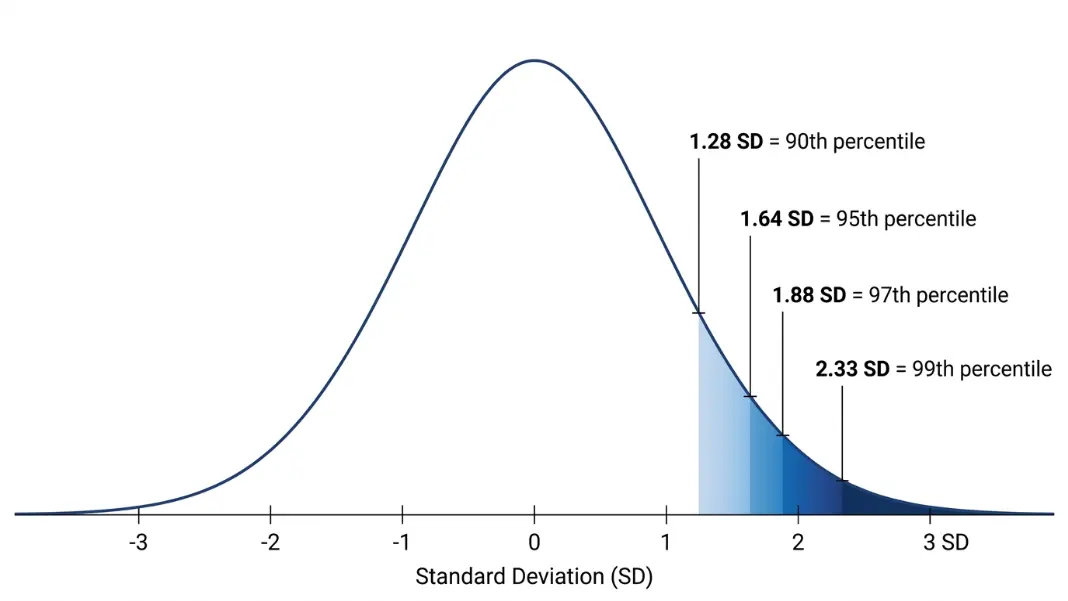
Most biological measurements, test scores, and other population-level quantities follow an approximately normal (bell-shaped) distribution. On a normal distribution, every percentile corresponds to a specific number of standard deviations (SDs) above or below the mean. The 99th percentile corresponds to 2.326 standard deviations above the mean.
The formula for finding the value at any percentile on a normal distribution is:
Value = Mean + (z-score × Standard Deviation)
For the 99th percentile: Value = Mean + (2.326 × SD)
The table below shows how percentile position maps to standard deviations, which lets you convert between the two systems for any normally distributed measurement.
| Percentile | Standard Deviations Above Mean | Top X% of Population | 1 in X People |
|---|---|---|---|
| 90th | 1.28 SD | Top 10% | 1 in 10 |
| 95th | 1.64 SD | Top 5% | 1 in 20 |
| 97th | 1.88 SD | Top 3% | 1 in 33 |
| 99th | 2.33 SD | Top 1% | 1 in 100 |
What 99th Percentile Looks Like in Practice#
Abstract statistics become clearer with real measurement examples. The following figures show what the 99th percentile translates to across four commonly referenced domains.
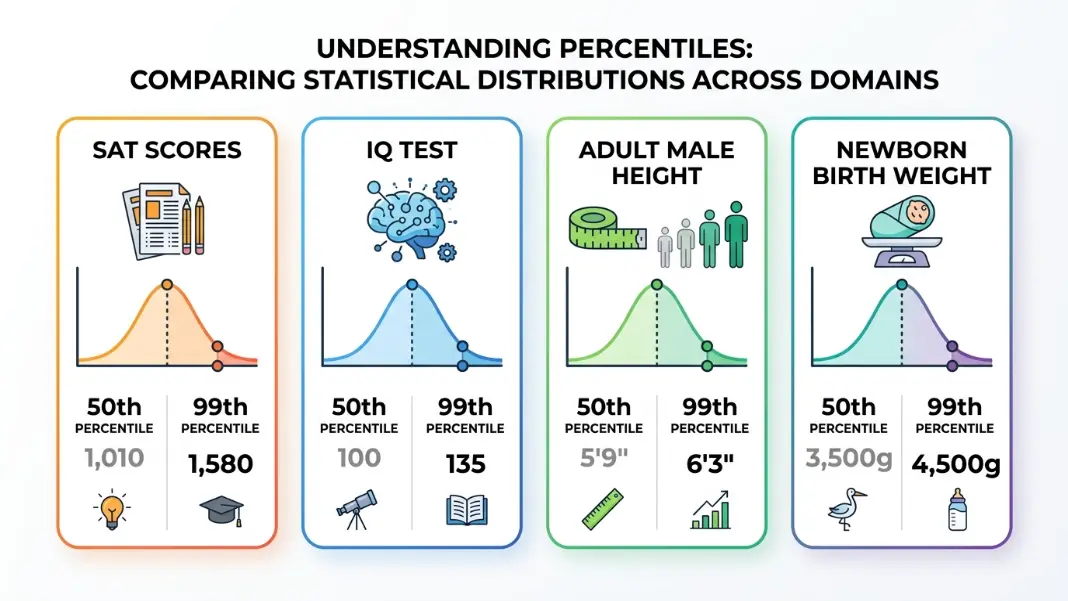
SAT scores:
The SAT is scored on a 1,600-point scale. In recent testing cycles, approximately 3.4 million students take the SAT each year. The 99th percentile score sits at approximately 1,580 out of 1,600. That means only about 34,000 of those 3.4 million test-takers meet or exceed that threshold in a given year. A score of 1,560 typically falls around the 99th percentile depending on the specific test administration, as the exact cutoff shifts slightly each year based on the score distribution.
The SAT is not normally distributed at the extremes because of ceiling effects, meaning very high scorers cluster near the maximum. This compresses the upper percentile differences: the gap between the 95th and 99th percentile in SAT points is smaller than it would be if the test had no maximum score.
IQ scores:
IQ is explicitly designed as a normally distributed scale with a mean of 100 and a standard deviation of 15. Applying the formula:
99th percentile IQ = 100 + (2.326 × 15) = 100 + 34.9 = approximately 135
A score of 135 is frequently cited as the threshold for organizations like Mensa, which require 98th percentile on standardized tests rather than strictly the 99th. High-IQ societies with 99th percentile requirements typically set the threshold at 135 to 137 depending on which IQ test is used.
Adult male height in the United States:
US adult male height follows an approximately normal distribution with a mean of roughly 5'10" (177.8 cm) and a standard deviation of about 3 inches (7.6 cm). Applying the formula:
99th percentile height = 177.8 + (2.326 × 7.6) = 177.8 + 17.7 = approximately 195.5 cm, or 6'5"
The commonly cited figure for the 99th percentile of US adult male height is approximately 6'3" to 6'5" (190 to 196 cm) depending on the dataset used. The CDC National Health and Nutrition Examination Survey places the 99th percentile for men at roughly 190 cm (6'3").
Newborn birth weight:
For newborns, the 99th percentile birth weight is approximately 4,500 grams (about 9 lb 15 oz). This value is clinically significant because 4,500g is the threshold for macrosomia as defined by the American College of Obstetricians and Gynecologists. Macrosomia refers to a fetus or newborn that is significantly above the expected size for gestational age and can affect delivery planning. Pediatric growth monitoring picks up where birth weight measurements leave off, tracking whether a large newborn grows along a consistent curve or crosses percentile lines unexpectedly after birth.
Understanding what percentile lines mean across the first two years of infancy, and how growth velocity interacts with percentile position, is covered in depth in the What Does Baby Percentile Mean guide, which explains how the WHO reference chart is constructed and how individual readings are interpreted across visits.
99th Percentile vs 97th, 95th, and 90th#
In everyday use, people treat the 99th percentile as dramatically different from the 95th or 97th. Statistically, the differences are meaningful but often smaller than assumed.
The table below shows the four most commonly referenced high percentiles and their precise relationship to the population, standard deviations, and the comparison to the 99th.
| Percentile | SD Above Mean | Top % of Population | 1 in X People | Gap from 99th (in SD) |
|---|---|---|---|---|
| 90th | 1.28 | Top 10% | 1 in 10 | 1.05 SD |
| 95th | 1.64 | Top 5% | 1 in 20 | 0.69 SD |
| 97th | 1.88 | Top 3% | 1 in 33 | 0.45 SD |
| 99th | 2.33 | Top 1% | 1 in 100 | Reference |
In practical terms: the gap between the 90th and 99th percentile is just over one standard deviation. In IQ points that is 15 points (a 135 vs a 120). In SAT points it is roughly 60 to 80 points depending on the year. On a growth chart, the gap between the 97th and 99th percentile in infant weight at 6 months is approximately 500 grams for boys.
Why the 97th percentile matters in pediatrics:
The WHO growth reference charts use the 97th percentile as the upper outer boundary rather than the 99th. Readings above the 97th are flagged for clinical review. This is partly because the reference study had a finite sample size, making extreme percentile estimation less precise, and partly because the 97th is a practical threshold that captures the 1 in 33 readings that are statistically unusual enough to warrant documentation.
For clinical reference on infant growth, a reading above the 97th on a WHO chart corresponds to roughly the 98th to 99th percentile on a larger reference dataset. If your infant is above the 97th WHO line, they are effectively in the 99th percentile territory for infant weight. The 99th Percentile Baby guide covers what that means clinically, how the reading changes depending on whether it is consistent or sudden, and what pediatricians actually assess at visits where a baby tracks at the upper extreme of growth charts.
How Percentile Rank Is Calculated From Any Distribution#
The percentile formula described in the first section works directly for ranked datasets. For continuous distributions, the calculation uses the cumulative distribution function (CDF), which describes the probability that a randomly selected value falls at or below a given point.
For a normal distribution, the calculation proceeds as:
- Take the raw score (X)
- Subtract the mean (mu)
- Divide by the standard deviation (sigma): this produces the z-score
- Look up the cumulative probability for that z-score in a standard normal table
Example: Finding the percentile for an IQ score of 130
z = (130 - 100) / 15 = 30 / 15 = 2.0
The cumulative probability for z = 2.0 is 0.9772, meaning a score of 130 is at the 97.7th percentile on a standard IQ scale. An IQ of 135 gives z = 2.333 and a cumulative probability of approximately 0.990, confirming the 99th percentile position.
For non-normal distributions:
Not every measurable quantity follows a normal distribution. Income is right-skewed: the top 1% earner holds dramatically more than 99 times the median income, because there is no practical upper limit. Athletic performance metrics like 100-meter sprint times are left-skewed at the elite end. Birth weight is slightly right-skewed at the upper extreme.
For skewed distributions, the percentile calculation still uses the ranked dataset approach, but the SD-based formula breaks down. A 99th percentile income is not predictable from "mean + 2.33 SDs" because the distribution shape violates the normal assumption.
The role of the reference population:
Every percentile is relative to its reference group. A 99th percentile SAT score among a regional cohort of test-takers may not be the 99th percentile nationally. A 99th percentile marathon time at a local race may be the 95th nationally. The reference population is always part of the definition.
For pediatric growth, the WHO reference population comes from the Multicentre Growth Reference Study, which tracked breastfed infants under optimal health conditions across six countries. A baby's percentile on the WHO chart is relative to that international reference population, which is why the same weight can produce slightly different percentile readings on a CDC chart (based on US survey data).
What the 99th Percentile Tells You and What It Does Not#
The 99th percentile tells you one thing precisely: a measurement is higher than 99% of the comparison group. It does not tell you whether that is good, bad, optimal, or concerning. Context determines that.
In test performance:
A 99th percentile SAT score opens scholarship doors and is competitive for highly selective universities. But a 99th percentile score on a workplace stress index is not something to pursue. The number is the same type of statistical fact in both cases. The value judgment comes entirely from the domain.
In pediatric growth:
A baby at the 99th percentile for birth weight is not automatically at risk. Macrosomia monitoring exists because very large newborns have elevated risk for specific delivery complications and metabolic outcomes, but the threshold is a population-level signal, not a guarantee of problems. A baby of two large-framed parents tracking at the 97th to 99th percentile across multiple visits, with proportionate length-for-weight, is most likely expressing their genetic size potential.
What the 99th percentile does not tell you in pediatrics is trajectory. A single 99th percentile reading at one visit is less informative than a pattern of consistent readings at that level. A baby who was at the 55th percentile two months ago and is now at the 99th has crossed multiple major percentile lines rapidly, which is more clinically relevant than whether the final reading is the 95th or the 99th. Tracking tools and reference tables for infant weight monitoring by age are available in the Baby Weight Percentile Chart by Age guide.
What it does not measure:
- It does not measure performance relative to the ideal, only relative to a specific comparison group
- It does not remain stable: a child at the 99th percentile for height at age 5 may be at the 85th at age 15 as peers catch up
- It does not account for measurement error: a weighed baby who squirmed during the measurement may have a slightly inaccurate reading that shifts the percentile by a few points
- It does not translate across measurement types: 99th percentile height and 99th percentile weight are independent readings that happen to use the same percentile scale
Practical takeaway:
When you see a 99th percentile number in any context, the first question to ask is: what is the reference group, and is this a measurement where high values are desirable, neutral, or concerning? The statistical definition is fixed and precise. The interpretation requires the context.
The 99th percentile means a score or measurement is higher than 99% of the values in the comparison group. Only 1% of the reference population scores at or above that level. On a normal distribution, the 99th percentile sits 2.326 standard deviations above the mean. Whether a 99th percentile reading is positive, neutral, or concerning depends entirely on the domain being measured: it is a statistical position, not a judgment.
That depends entirely on what is being measured. For test scores, athletic performance, or cognitive assessments where higher is better, yes. For measurements where extreme values indicate risk, such as blood pressure or newborn weight approaching macrosomia thresholds, a 99th percentile reading warrants careful interpretation rather than celebration. The number describes a position in a distribution. The context determines whether that position is desirable.
These are two different things. A score of 99% means you answered 99 out of 100 questions correctly, or achieved 99% of the maximum possible score. A 99th percentile rank means you scored higher than 99% of the people who took the same test. A student who scores 99% on an easy test may only reach the 70th percentile if most other students also scored above 90%. Percentile rank describes your position relative to other people, not your absolute performance level.
On standard IQ scales with a mean of 100 and a standard deviation of 15, the 99th percentile is approximately 135. The calculation is 100 + (2.326 x 15) = 134.9, rounded to 135. Some IQ tests use slightly different standard deviations, which shifts the exact score by a few points. Mensa accepts applicants at the 98th percentile or above, which corresponds to an IQ of approximately 131 on the same scale.
For adult men in the United States, the 99th percentile height is approximately 190 to 196 cm (6 feet 3 inches to 6 feet 5 inches), depending on the dataset used. The CDC NHANES data places the 99th percentile close to 190 cm (6'3"). The exact value shifts by a few centimeters depending on age cohort and data source. US men have an average height of approximately 177.8 cm (5'10"), with a standard deviation near 7.6 cm.
By definition, 1 in every 100 people in the reference population falls at or above the 99th percentile. In a school of 1,000 students, about 10 would score at or above the 99th percentile on a standardized test. In a national SAT cohort of 3.4 million test-takers, approximately 34,000 score at the 99th percentile threshold. Rare by common standards, but not vanishingly rare like the 99.9th percentile, which occurs in only 1 in 1,000 people.
Written by
Hassaan Rasheed
Web Developer & Content Researcher
Hassaan builds calculators and writes source-linked guides across the site's subject areas. Calculator methods and reference data are documented in each guide so readers can verify the underlying sources.
About the author and methods