Beer ABV Chart: Alcohol Content by Style From Light to Imperial (2026)
Beer ABV ranges from 2.4% ultra-light to 15% imperial stout. Full chart by style with verified examples, standard drink math, and why craft brewing expanded the range.
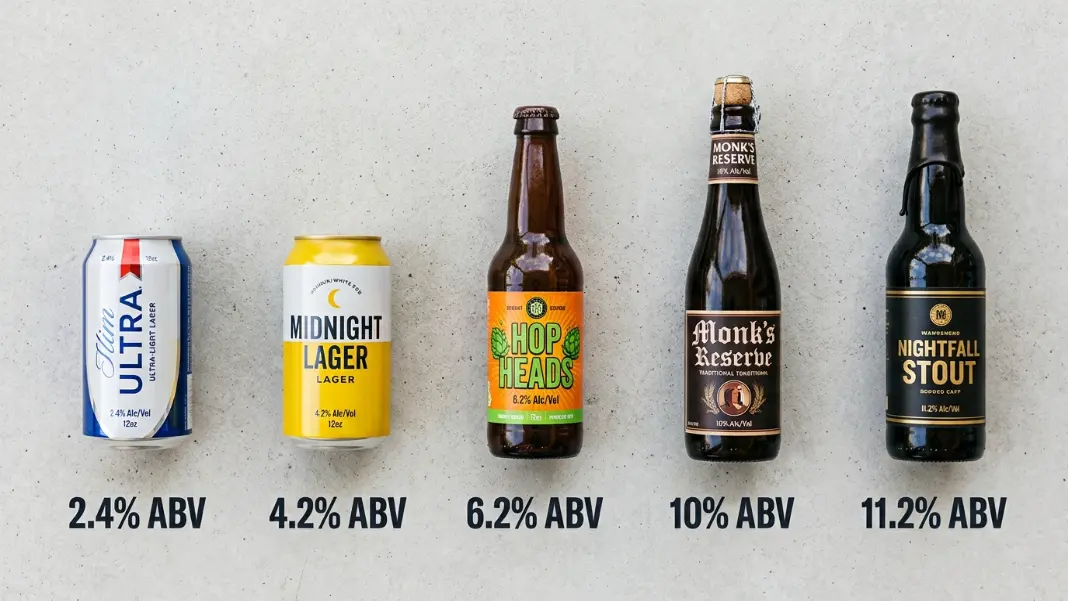
Most people carry a mental model of beer as 5% alcohol. That model made sense in the 1990s when light lagers dominated the American market. Today the beer ABV range runs from 2.4% for ultra-light lagers to 15% and above for imperial stouts brewed with adjunct sugars to push yeast past its normal tolerance limits. The two ends of that range look nothing alike in terms of how they affect the person drinking them.
The ABV Calculator computes alcohol content from original and final gravity readings for any homebrew batch. This guide covers the full beer ABV spectrum across styles with verified examples, explains why craft brewing expanded the high end of the range, and shows how alcohol content interacts with flavor and carbonation in ways the percentage number alone does not tell you.
What the ABV Numbers on Beer Labels Actually Mean#
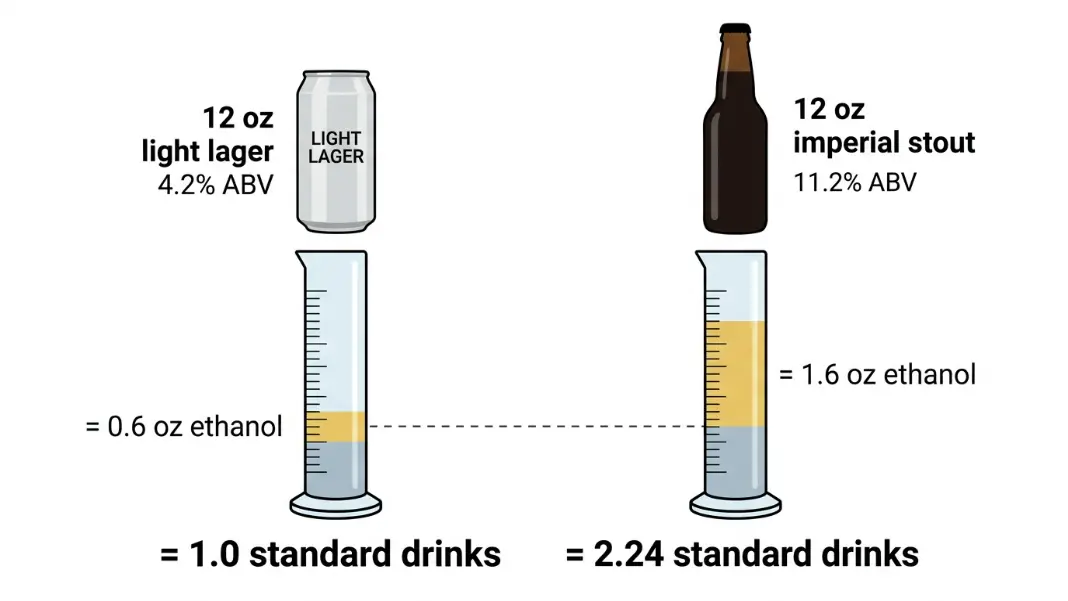
Beer ABV is the percentage of total liquid volume that is pure ethanol. A 5.0% ABV beer contains 5 milliliters of ethanol per 100 milliliters of liquid. In a standard 12-ounce (355 ml) can, that equals approximately 17.8 ml, or 0.6 fluid ounces, of pure alcohol. That amount is the US standard drink definition.
Higher ABV does not automatically mean more hops, more flavor, or more bitterness. A 9% double IPA and a 9% barleywine have identical alcohol content but completely different flavor profiles. ABV measures one variable: the proportion of liquid that is ethanol.
US federal TTB rules allow malt beverages a labeling tolerance of plus or minus 0.3% from the stated ABV. A can labeled 5.0% could legally contain anywhere from 4.7% to 5.3% actual alcohol. The ABV Meaning Guide covers the full federal tolerance table across all beverage categories and explains how the tolerance affects consumption tracking for anyone monitoring intake precisely.
Beer ABV Chart: Light Lagers to Imperial Ales#
The table below shows verified ABV ranges and common examples across all major beer categories, ordered from lowest to highest alcohol content.
| Beer Style | ABV Range | Common Examples |
|---|---|---|
| Non-alcoholic | Under 0.5% | O'Doul's (0.4%), Heineken 0.0 (0.03%) |
| Ultra-light lager | 2.4% to 3.5% | Bud Select 55 (2.4%), Miller 64 (2.8%) |
| Light lager | 3.5% to 4.5% | Coors Light (4.2%), Bud Light (4.2%), Michelob Ultra (4.2%) |
| Session IPA | 3.0% to 5.0% | Founders All Day IPA (4.7%), Stone Go To IPA (4.8%) |
| Standard American lager | 4.5% to 5.5% | Budweiser (5.0%), Coors Banquet (5.0%), PBR (4.74%) |
| German and European lager | 4.6% to 5.4% | Heineken (5.0%), Stella Artois (5.0%), Modelo Especial (4.4%) |
| Wheat beer | 4.3% to 5.5% | Blue Moon (5.4%), Weihenstephan Hefeweissbier (5.4%) |
| Pale ale | 4.5% to 6.5% | Sierra Nevada Pale Ale (5.6%), Deschutes Mirror Pond (5.0%) |
| IPA | 5.5% to 7.5% | Lagunitas IPA (6.2%), Stone IPA (6.9%), Dogfish Head 60 Minute (6.0%) |
| Hard seltzer | 4.0% to 6.0% | White Claw (5.0%), Truly Hard Seltzer (5.0%) |
| Stout | 4.0% to 7.0% | Guinness Draught (4.2%), Left Hand Milk Stout (6.0%) |
| Malt liquor | 6.0% to 8.5% | Steel Reserve (8.1%), Colt 45 (5.6%), Olde English 800 (5.9%) |
| Belgian dubbel | 6.0% to 8.0% | Chimay Red (7.0%), Westmalle Dubbel (7.0%) |
| Belgian tripel | 7.0% to 10.0% | Chimay White (8.0%), St. Bernardus Tripel (8.0%) |
| Double IPA | 7.0% to 10.0% | Dogfish Head 90 Minute (9.0%), Pliny the Elder (8.0%) |
| Belgian quad | 9.0% to 13.0% | St. Bernardus Abt 12 (10.0%), Rochefort 10 (11.3%) |
| Imperial stout | 8.0% to 15.0% | Founders KBS (11.2%), Goose Island Bourbon County (14.1%) |
| Barleywine | 8.0% to 15.0% | Anchor Old Foghorn (9.0%), Sierra Nevada Bigfoot (9.6%) |
The width of this range is over 14 percentage points from the ultra-light to the imperial stout category. No other beverage category outside distilled spirits covers that much ground at retail. The Liquor ABV Chart shows how spirits compare, and Wine ABV Percentage covers the full table wine and fortified wine range side by side.
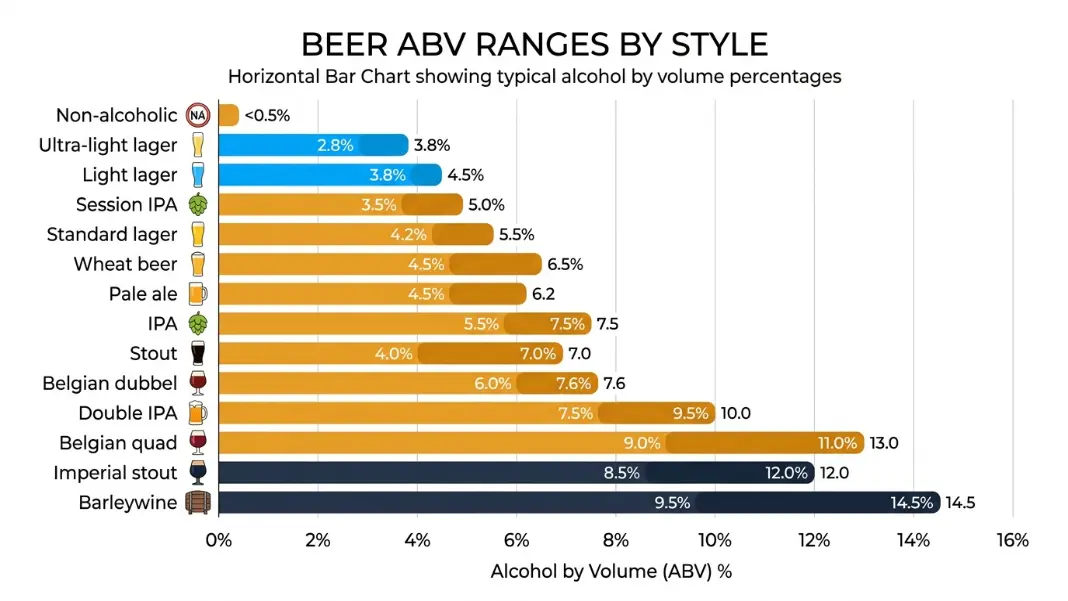
Why Light Beer and Craft Beer Live on Opposite Ends#
The two poles of the beer ABV range exist for completely different commercial and brewing reasons.
The light beer pole (2.4% to 4.5%) exists because brewers engineered alcohol out of the product. Bud Light and Coors Light are technically difficult to produce, not simple. Making a beer that ferments out cleanly, stays shelf-stable, and still tastes like something at 4.2% requires careful malt selection and process control. The goal is to minimize alcohol content as a selling point, because a segment of consumers specifically wants a drink they can have across several hours with a lower cumulative effect.
The craft beer pole (7.0% to 15.0%) exists because brewers maximized fermentable sugar content to push yeast to its tolerance limits. An imperial stout starts with a grain bill three to four times the size of a standard beer's, producing a wort dense enough to challenge most yeast strains. Some high-ABV beers use champagne or wine yeasts that tolerate higher alcohol concentrations than standard brewing strains. The goal is intensity: more alcohol, more residual malt character, more flavor compounds from the concentrated base.
For homebrewers who want to measure where their own batch lands on this range, the How to Calculate ABV for Homebrewers Guide explains the specific gravity method and both the simple and extended formulas, with worked examples for standard and high-gravity batches.
High-ABV Beers and Where the Brewing Process Hits a Wall#
Most standard brewing yeast strains die at roughly 10% to 12% ABV. Above that concentration, the ethanol becomes toxic enough to shut fermentation down. Getting a beer to 14% or 15% requires specific strategies.
Using tolerant yeast: Belgian abbey yeast strains and some wine or champagne yeasts can function in environments up to 13% to 15% ABV. Breweries targeting high-ABV beers select these strains specifically during recipe development.
Step fermentation: Some brewers start with a standard malt base, then add fermentable adjuncts, including sugar, honey, or fruit juice, in stages after fermentation is already underway. This approach introduces new food sources gradually, keeping the yeast functional longer and achieving higher terminal ABV without shocking the yeast with an initially overwhelming sugar load.
Freeze concentration (Eisbier): A traditional German technique that freezes the beer and removes the ice crystals, which are mostly water, leaving a more concentrated liquid behind. Ice distillation is restricted or regulated differently depending on jurisdiction because it can push ABV into territory that crosses regulatory lines between beer and spirit.
The practical ceiling for commercially sold beer without special process modifications is around 12% to 14%. Above that, the product often crosses into a regulatory gray area with licensing and tax implications that vary by state.
Standard Drink Math for Common Beer Serving Sizes#
The standard drink equivalents shift significantly as beer ABV increases. The formula is straightforward:
Standard Drinks = (Serving Size in oz x ABV as decimal) / 0.6
The table below shows how that math plays out for several common scenarios.
| Beer | Serving Size | ABV | Standard Drinks |
|---|---|---|---|
| Bud Light | 12 oz | 4.2% | 0.84 |
| Budweiser | 12 oz | 5.0% | 1.00 |
| Voodoo Ranger IPA | 16 oz pint | 7.0% | 1.87 |
| Dogfish Head 90 Min | 12 oz | 9.0% | 1.80 |
| Founders KBS | 12 oz | 11.2% | 2.24 |
| Goose Island Bourbon County | 12 oz | 14.1% | 2.82 |
A single 12-ounce can of Bourbon County Stout delivers nearly three standard drinks. Most people who order a pint of 7.0% IPA at a bar are consuming close to two standard drinks in a single glass. The serving size and the ABV multiply each other, which is why comparing beers by ABV percentage alone understates the difference between styles.
How Alcohol Content Changes Beer Flavor and Feel#
ABV percentage interacts with the sensory experience in several ways that the number itself does not communicate.
Carbonation and absorption: Carbonated beer accelerates gastric emptying, which speeds alcohol absorption into the bloodstream relative to a flat drink at the same ABV. A 5% carbonated lager may feel different from a 5% still cider, even with identical ethanol content per volume.
Sweetness and residual sugar: High-ABV beers often retain more residual sugar than lower-ABV styles, because the volume of fermentable substrate required to hit 10% ABV also produces a denser, sweeter base. Imperial stouts and barleywines tend to taste sweeter than their percentage suggests, because alcohol concentration and residual malt sweetness increase together when the grain bill scales up.
Bitterness perception: Alcohol suppresses some bitterness perception at higher concentrations. A 9% IPA with 80 IBU of hop bitterness often tastes less harsh than a 5% IPA with 70 IBU, despite the higher hop load. Brewers targeting drinkable high-ABV IPAs compensate by increasing the hop bill beyond what the bitterness units alone suggest.
Calorie density: Beer calories come from two sources: ethanol at 7 calories per gram, and residual carbohydrates. At 5% ABV, a 12-ounce beer runs approximately 150 to 180 calories depending on residual sugar. At 10% ABV, the same serving is roughly 250 to 300 calories before accounting for the larger grain bill's additional carbohydrates.
For taking specific gravity readings on a homebrew batch to calculate actual ABV, see Using a Hydrometer to Measure ABV, which covers instrument calibration, temperature correction, and how to account for the reading errors refractometers produce in fermented samples.
Most commercially sold beer in the US falls between 4.2% and 5.5% ABV. Standard American lagers like Budweiser and Coors sit at 5.0%. Light beers like Bud Light and Coors Light are 4.2%. The category average has shifted upward slightly as craft beer gained market share, because IPAs and Belgian ales typically run 6.0% to 9.0%. Across all beer styles sold in the US, the volume-weighted average is approximately 5.0% to 5.2%.
Commercially available beers regularly reach 12% to 14% ABV through standard fermentation. Goose Island Bourbon County Brand Stout runs approximately 14.1%. Extreme beers using freeze concentration have exceeded 20% ABV, though those products cross into regulatory territory that differs from standard beer in many jurisdictions. For standard brewery production using fermentation only, imperial stouts and barleywines in the 10% to 14% range represent the practical ceiling for most producers.
Light beer in the US typically falls between 3.5% and 4.5% ABV. Coors Light, Bud Light, and Michelob Ultra all measure 4.2% ABV. Ultra-light beers like Bud Select 55 and Miller 64 drop to 2.4% and 2.8% respectively. Non-alcoholic beers must stay below 0.5% ABV to meet the US regulatory threshold for non-alcoholic classification and avoid the distribution requirements that apply to alcoholic beverages.
A 12-ounce beer at 5% ABV equals exactly one US standard drink. The calculation is (12 oz x 0.05) / 0.6 = 1.0 standard drink, where 0.6 oz is the US definition of one standard drink of pure ethanol. A 12-ounce beer at 7% ABV equals 1.4 standard drinks. A 22-ounce bottle at 8.0% ABV equals approximately 2.9 standard drinks.
Most IPAs fall between 5.5% and 7.5% ABV, with session IPAs at 3.5% to 5.0% and double or imperial IPAs reaching 7.0% to 10.0%. Lagunitas IPA is 6.2%, Dogfish Head 60 Minute IPA is 6.0%, and Stone IPA is 6.9%. Double IPAs like Dogfish Head 90 Minute (9.0%) and Russian River Pliny the Elder (8.0%) represent the upper end of the standard commercial double IPA range.
Yes. Imperial stouts and barleywines at 13% to 14% ABV sit at or above most table wines. Some extreme beers using freeze concentration exceed 20% ABV, which is above the range of most table wines. The distinction between beer and distilled spirits at the high end becomes regulatory rather than purely technical: spirits achieve high ABV through distillation, while extreme beers reach it through fermentation alone or through concentration methods like Eisbier freezing.
Written by
Hassaan Rasheed
Web Developer & Content Researcher
Hassaan builds calculators and writes source-linked guides across the site's subject areas. Calculator methods and reference data are documented in each guide so readers can verify the underlying sources.
About the author and methods