Illinois Hourly Paycheck Calculator: Overtime, Pay Frequency, and Take-Home Pay (2026)
Illinois hourly paycheck after taxes: flat 4.95% state rate, overtime rules, and take-home at $15 to $30 per hour for weekly and biweekly pay periods.
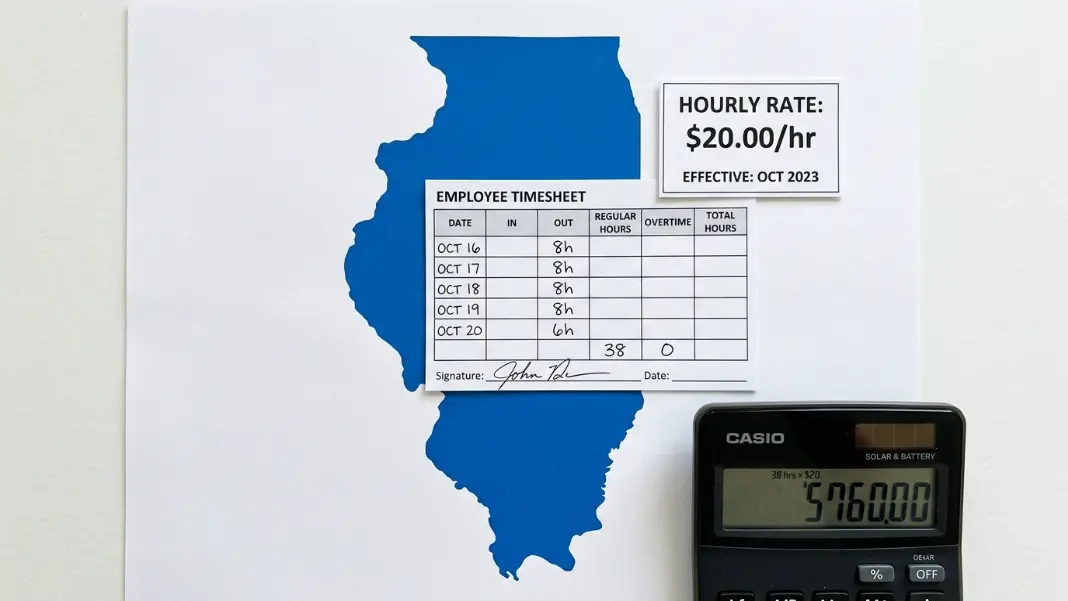
Hourly pay in Illinois has one thing working in your favor that progressive-tax states do not: the flat 4.95% state rate applies identically to your 40th hour and your 50th. There is no bracket that makes overtime money less valuable in state tax terms. Every dollar above the personal exemption gets taxed at the same rate, whether it comes from a regular shift or a weekend overtime run.
The Illinois Paycheck Calculator handles the full calculation for any hourly rate, hours worked, and filing status. This guide shows how the tax math works for hourly workers specifically, what the 2026 minimum wage landscape looks like, how Illinois overtime rules compare to other states, how pay frequency affects each paycheck, and what every line on an Illinois hourly pay stub represents.
How Illinois Taxes an Hourly Paycheck#
Illinois applies its flat 4.95% state income tax to all taxable wages after subtracting the personal exemption: $2,775 for single filers, $5,550 for married filing jointly, and $2,775 per dependent. For a full-time hourly worker, the prorated exemption reduces the Illinois portion of each biweekly check by roughly $5 to $6. The state tax is the smallest of the three withholding categories; federal income tax and FICA each exceed it at every common hourly rate.
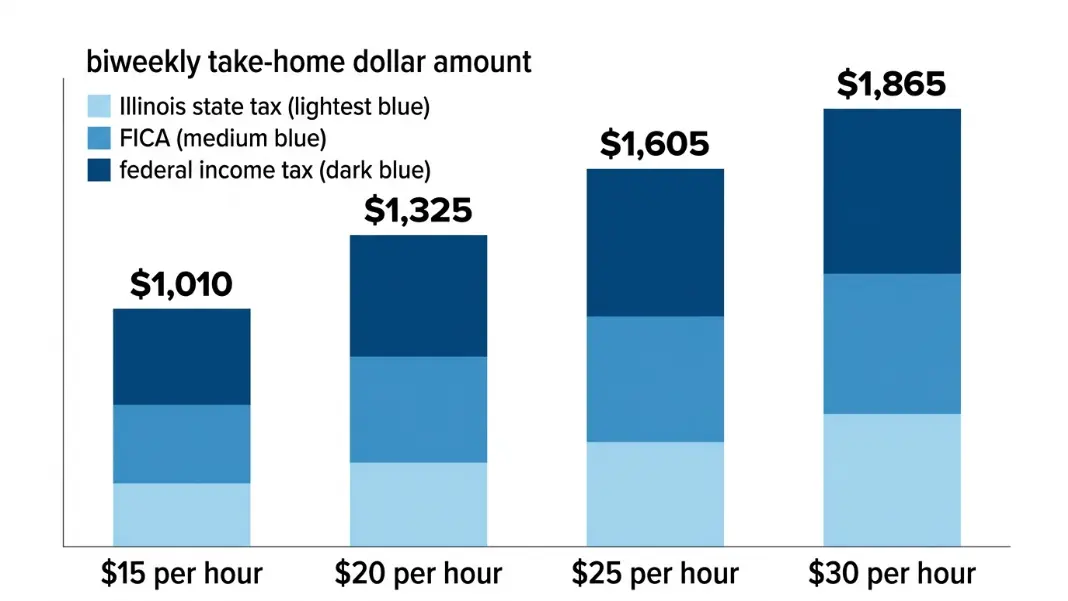
The table below shows annual Illinois state tax, estimated federal income tax, FICA, and biweekly take-home at five common hourly rates for a single filer working 40 hours per week with no pre-tax deductions.
| Hourly Rate | Annual Gross | IL State Tax | Federal Tax (est.) | FICA | Biweekly Take-Home |
|---|---|---|---|---|---|
| $15.00 | $31,200 | $1,407 | $1,754 | $2,387 | $987 |
| $18.00 | $37,440 | $1,716 | $2,502 | $2,864 | $1,168 |
| $20.00 | $41,600 | $1,922 | $3,002 | $3,182 | $1,288 |
| $25.00 | $52,000 | $2,438 | $4,250 | $3,978 | $1,590 |
| $30.00 | $62,400 | $2,951 | $5,498 | $4,774 | $1,891 |
Single filer, standard W-4, no pre-tax deductions, 26 biweekly pay periods. Federal tax estimated using 2025 brackets and standard deduction of $14,600.
The Illinois state tax column stays below $3,000 at $30/hr because a flat rate with a small fixed exemption produces a near-constant 4.77% to 4.81% effective rate across all income levels. The federal column grows faster because federal brackets are progressive: most of a $31,200 income sits in the 10% and 12% federal brackets, while $62,400 pushes further into the 22% bracket.
Pre-tax 401k contributions reduce both federal and Illinois taxable income simultaneously. Every $1,000 contributed to a 401k saves approximately $49.50 in Illinois taxes in addition to the federal savings at your marginal rate.
Illinois Minimum Wage in 2026: $15 State Floor and the Chicago Rate#
Illinois reached $15 per hour on January 1, 2025, completing a phased schedule that started with the 2019 amendment to the Minimum Wage Law. The state rate covers all private-sector employees 18 or older who work more than 650 hours per year. Workers under 18 or logging fewer than 650 hours in a calendar year may be paid $13 per hour during a 90-day training period.
Chicago maintains a separate municipal minimum wage that is adjusted annually above the state floor on a July-to-July schedule. The Chicago rate for employers with 21 or more employees has exceeded the state minimum since Chicago began phasing in its own schedule years before the state reached $15. Workers at Chicago employers should check the city's Office of Labor Standards for the current rate. Cook County also maintains a county ordinance minimum that typically falls between the state floor and the Chicago city rate.
The minimum wage affects overtime math directly. A 45-hour week at the $15 state minimum with 5 overtime hours produces:
Regular pay: 40 hours x $15 = $600
Overtime pay: 5 hours x $22.50 (1.5x) = $112.50
Gross weekly pay: $712.50
Effective blended rate: $712.50 / 45 hours = $15.83/hr
That $712.50 weekly gross annualizes to $37,050, which lands in the same federal bracket as the pure $31,200 base. The overtime premium is taxed at the same Illinois rate, but the larger gross slightly increases the weekly federal withholding.
Illinois Overtime Rules: 1.5x After 40 Hours and What Employers Cannot Do#
Illinois follows the federal Fair Labor Standards Act overtime standard: any hours beyond 40 in a single workweek must be paid at a minimum of 1.5 times the regular rate. The workweek is a fixed recurring 7-day period defined by the employer. It does not need to be a calendar week (Monday through Sunday), but it must be consistent and not change to avoid overtime liability.
The regular rate is not simply your base wage if you receive any additional compensation. Non-discretionary bonuses, shift differentials, and earned commissions factor into the regular rate before the 1.5x multiplier applies. If you earn $20/hr plus a $100 weekly production bonus and worked 45 hours, the regular rate calculation works like this:
Base wages (45 hours at straight time): 45 x $20 = $900
Bonus: $100
Total straight-time compensation: $1,000

Adjusted regular rate: $1,000 / 45 hours = $22.22/hr
Overtime premium (0.5x for 5 OT hours): 5 x ($22.22 x 0.5) = $55.56
Total gross pay: $1,000 + $55.56 = $1,055.56
Employers cannot average hours across two workweeks to dodge overtime liability. A 35-hour week followed by a 45-hour week does not cancel the 5 overtime hours in week two. Each workweek stands alone under the FLSA.
Illinois also has the One Day Rest in Seven Act, which requires at least 24 consecutive hours of rest in every calendar week for most workers, separate from overtime rules.
Illinois vs California on overtime: California requires daily overtime after 8 hours in a day, plus double time after 12 hours or on the 7th consecutive day. Illinois has no daily overtime requirement. The California model is significantly more complex for hourly workers and generates larger overtime paychecks for long shifts. The California Hourly Paycheck Calculator Guide shows how that double-time rule changes take-home for workers clocking 10-hour shifts.
Salaried exempt employees under the FLSA white-collar exemptions do not receive overtime. The federal salary threshold for exemption is $684 per week ($35,568/year) under current rules. Illinois does not set a separate higher threshold for state-law exemption purposes.
Weekly, Biweekly, and Semimonthly: How Pay Frequency Changes Your Per-Check Amount#
Pay frequency does not change annual gross pay, but it determines how much hits your account on any given payday and affects how overtime is distributed across paychecks. Illinois employers can choose any standard frequency; biweekly is the most common for hourly workers.
The table below shows per-paycheck gross at $20/hr full-time across four pay schedules.
| Pay Frequency | Paychecks Per Year | Gross Per Check ($20/hr) | Notes |
|---|---|---|---|
| Weekly | 52 | $800 | Smallest checks, most frequent |
| Biweekly | 26 | $1,600 | Standard for most hourly workers |
| Semimonthly | 24 | $1,733 | Fixed dates, misaligns with workweeks |
| Monthly | 12 | $3,467 | Unusual for hourly positions |
The practical difference between biweekly and semimonthly matters when overtime is involved. A semimonthly schedule splits the calendar month into two fixed periods that do not align with 7-day workweeks. If a workweek straddles two pay periods, overtime must still be calculated by workweek under the FLSA, not by pay period. This creates payroll complexity that most employers resolve by standardizing on biweekly pay for hourly staff.
Biweekly workers receive 26 paychecks per year versus 24 for semimonthly workers. Because 26 does not divide evenly into 12 months, two calendar months each year will have three pay dates instead of two. That is not extra income; it is the same annual salary arriving faster in those months.
The Illinois Paycheck Tax Guide covers how pay frequency interacts with the 4.95% flat rate for salaried workers and includes the full take-home at $50K, $75K, and $100K, useful if you are converting between an hourly offer and a salaried one.
What Every Line on an Illinois Hourly Pay Stub Means#
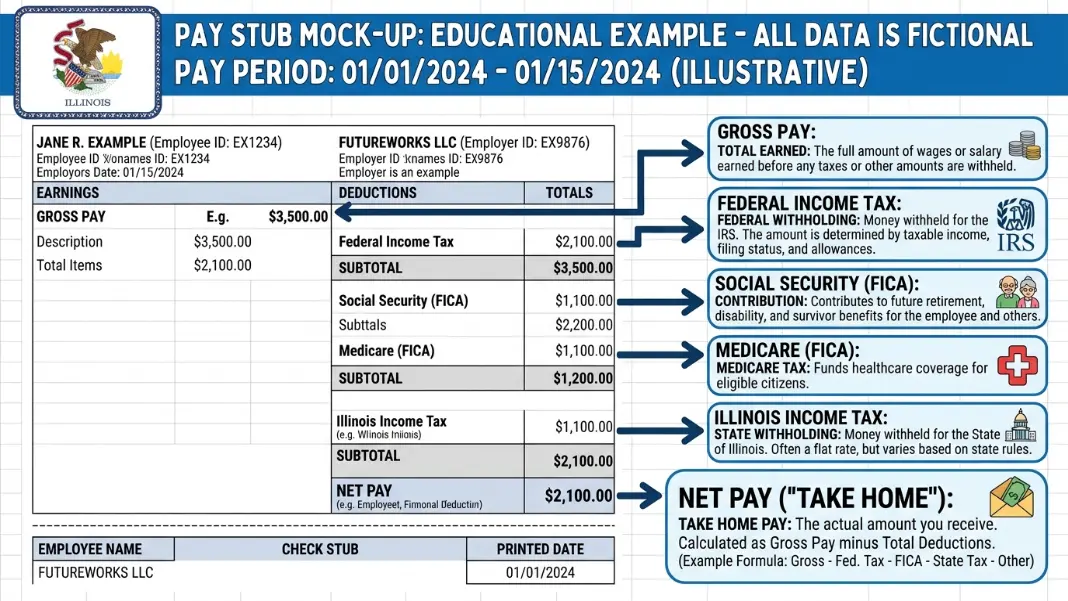
An Illinois hourly pay stub shows more categories than most workers initially expect. Here is what each line represents and what drives the number.
Gross Pay: Total earnings before any deductions. For hourly workers, this is regular hours times the hourly rate, plus any overtime hours times 1.5x. Many stubs break out "Regular" and "Overtime" as separate gross lines.
Federal Income Tax: Calculated from your W-4 elections and the IRS wage bracket withholding tables. Payroll software annualizes each paycheck to determine the withholding rate, which means an overtime-heavy week produces higher federal withholding on that check than a standard one. This does not mean you owe more federal tax for the year; it is a timing effect that usually resolves when you file.
Social Security: 6.2% of gross wages up to the annual wage base ($176,100 for 2025). Once you cross that threshold during the year, this line disappears from your stub for the remaining paychecks.
Medicare: 1.45% on all gross wages, no cap. Workers who earn over $200,000 annually also see an Additional Medicare Tax of 0.9% on wages above that level.
Illinois Income Tax: 4.95% of wages minus the prorated personal exemption. On a biweekly paycheck, the exemption applied each period equals $2,775 divided by 26, or $106.73. Your taxable Illinois wages for the period are gross minus $106.73. For a $20/hr worker on a standard 40-hour biweekly schedule, the Illinois tax per check is approximately $74.
Pre-tax deductions: Health insurance premiums, 401k contributions, HSA or FSA contributions appear before the tax lines because they reduce the taxable base. Every $100 in pre-tax deductions per check reduces your Illinois tax by approximately $4.95 and your federal tax at your marginal rate.
Net Pay: What hits your account. The sum of all deductions above subtracted from gross.
When you see an unexpected change on a pay stub, the most common causes are: a week with more or fewer hours than usual, a W-4 change processed mid-payroll, or a benefit enrollment that shifted pre-tax deduction amounts. The Illinois Final Paycheck Law Guide covers specifically what your employer must include on your last pay stub, including which accrued benefits become wages on separation.
Multiply your hourly rate by hours worked for gross pay. Subtract pre-tax deductions such as 401k or health insurance. Apply FICA: 6.2% for Social Security and 1.45% for Medicare on all wages. Estimate federal income tax based on your W-4 status and the IRS withholding tables. For Illinois state tax, subtract $2,775 divided by your annual pay periods from gross, then multiply the remainder by 4.95%. Subtract all deductions from gross to get net pay. The Illinois Paycheck Calculator at /illinois-paycheck runs all steps simultaneously.
Illinois minimum wage is $15 per hour as of January 1, 2025, when the phased schedule established by the 2019 Minimum Wage Law amendment reached its final level. Workers under 18 or working fewer than 650 hours per year may be paid $13 per hour during a 90-day training period. Chicago maintains a separate municipal minimum wage adjusted annually above the state floor, and Cook County also sets its own rate that typically falls between the state and city levels. Outside Chicago and Cook County, the $15 state minimum applies.
Overtime pay is taxed at the same Illinois rate as regular pay: a flat 4.95% on all wages above the personal exemption. Federal withholding on an overtime-heavy paycheck can appear higher than usual because payroll software annualizes each check to estimate the withholding rate. A larger gross in one period suggests a higher annual income to the withholding formula. This creates a timing mismatch that typically resolves when you file your annual return. Actual tax liability is based on annual income, not individual paychecks.
No. Illinois follows the federal FLSA standard: overtime is required after 40 hours in a workweek, not after 8 hours in a single day. A worker who clocks 10 hours Monday through Thursday, reaching 40 total hours, and does not work Friday owes no overtime for that week. Daily overtime after 8 hours is a California requirement, not an Illinois one. Illinois employers may voluntarily offer daily overtime through policy or union contract, but state law does not require it.
Biweekly pay produces 26 paychecks per year, every two weeks on a fixed day. Semimonthly produces 24 paychecks, on fixed calendar dates such as the 1st and 15th. At $20/hr full-time, a biweekly check is $1,600 gross versus $1,733 semimonthly. The annual gross is identical; only the distribution differs. Biweekly workers receive two months each year with three paydays. For hourly workers with variable hours, biweekly aligns more cleanly with 7-day overtime workweeks than semimonthly does.
The Illinois Wage Payment and Collection Act requires employers to pay workers on a regular schedule at least semimonthly. Weekly, biweekly, semimonthly, and monthly schedules all satisfy this requirement. Employers must notify employees of the designated paydays and may not change the schedule without advance notice. Most Illinois hourly workers are paid biweekly. Employers cannot use irregular or unpredictable payment schedules; the Act requires a consistent, predictable payday cycle for all employees.
Written by
Hassaan Rasheed
Web Developer & Content Researcher
Hassaan builds calculators and writes source-linked guides across the site's subject areas. Calculator methods and reference data are documented in each guide so readers can verify the underlying sources.
About the author and methods