Iowa, New Hampshire, Tennessee, and New Mexico Paycheck Tax Guide (2025)
Iowa paycheck tax at flat 3.8%, Tennessee and New Hampshire take zero from wages, New Mexico progressive brackets up to 5.9%. Take-home at $50K, $75K, $100K.
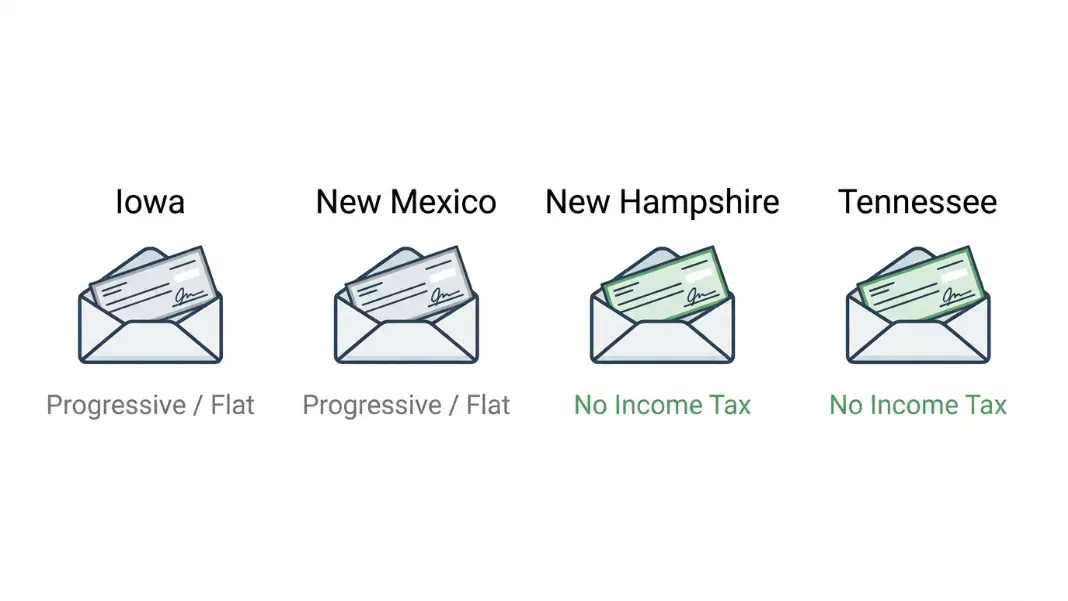
Paycheck calculators for New Hampshire and Tennessee often produce a result that looks like a display error: the state income tax line shows $0.00. That is not a rounding issue. Both states take nothing from wages for state income tax. Iowa runs a flat 3.8% and New Mexico applies a progressive structure from 1.7% to 5.9%, making these four states a clean comparison of how different state tax designs affect the same paycheck.
The Iowa Paycheck Calculator applies the current flat rate and school district surtax to your salary at any pay frequency and returns exact per-period take-home. This guide covers how each state's income tax structure works, what withholding looks like in practice for each, and how take-home compares across all four states at three salary levels.
Iowa's Flat 3.8%: How Withholding Changed After the Rate Simplification#
Iowa spent decades running a multi-bracket income tax with a top rate above 8%. That system ended with HF 2317, which phased Iowa down to a flat 3.8% rate by 2025. For employees, the simplification means withholding math is now straightforward: Iowa employers withhold 3.8% of gross wages per period for state income tax.
Iowa State Tax = Gross Wages × 0.038
Worked example at $75,000 annual salary ($6,250/month gross):
- Monthly gross: $6,250
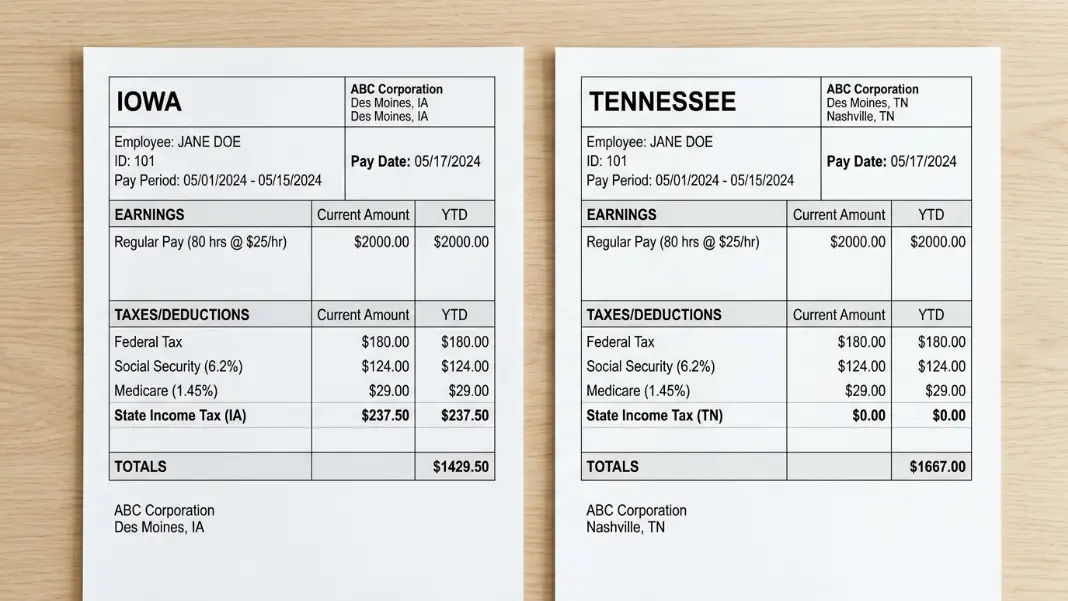
- Iowa state withholding: $6,250 × 3.8% = $237.50/month
- Annual Iowa state tax: $237.50 × 12 = $2,850
School district surtax:
Iowa layers a local school district surtax on top of state income tax. The surtax is set by each school district as a percentage of your Iowa state tax liability, not as a percentage of income. Most rates fall between 0% and 10% of the state tax amount. At a 9% school surtax on the $2,850 above, that adds $256.50 annually, bringing total Iowa state and local tax to roughly $3,107.
This surtax is the detail most national paycheck calculators skip. The actual state-level deduction from an Iowa paycheck is typically 3.8% plus 0.1% to 0.4% depending on your district of residence, not 3.8% alone. Your district of residence (not your workplace) determines the rate.
Iowa's flat structure makes the state-only calculation simple. The federal side remains progressive: Social Security, Medicare, and federal income tax withholding all apply on top regardless of state, and those are covered in detail later.
New Hampshire and Tennessee: Paycheck Math in States With No Wage Tax#
No state income tax on wages means exactly that. For both states, your W-2 wages are not subject to any state income tax withholding. Your employer does not deduct a state tax line for wage income. Every dollar earned above your federal obligations stays with you at the state level.
The Tennessee Paycheck Calculator confirms this regardless of salary: the state income tax line is $0.
New Hampshire's path to zero:
New Hampshire never taxed wages but did tax investment income (interest and dividends) through the I&D Tax. That tax has been on a scheduled phase-out: 5% in 2023, 4% in 2024, 3% in 2025, 2% in 2026, then eliminated after 2027. For W-2 employees earning only wage income, New Hampshire has been effectively a zero-income-tax state on paychecks for years. The I&D tax only applies if you have significant interest or dividend income outside your wages.
Tennessee's complete elimination:
Tennessee eliminated the Hall Tax on investment income on January 1, 2021, completing its transition to a full zero-income-tax state. Tennessee had no wage tax before that change either. The result is the same as New Hampshire for W-2 employees: no state withholding on wages, no state tax line on the paystub.
A $75,000 earner in either state keeps the full $75,000 before federal deductions. That is roughly $2,850 more per year in take-home than an Iowa worker at the same salary, with no change to the employee's W-4 or retirement contributions.
The tradeoff is that both states fund public services through other mechanisms. New Hampshire carries some of the highest effective property tax rates in the country. Tennessee applies a state sales tax of 7%, and combined state-local sales tax typically reaches 9.5% to 10%. Zero income tax on the paycheck does not mean zero overall tax burden.
New Mexico Income Tax: Five Brackets and How Withholding Works#
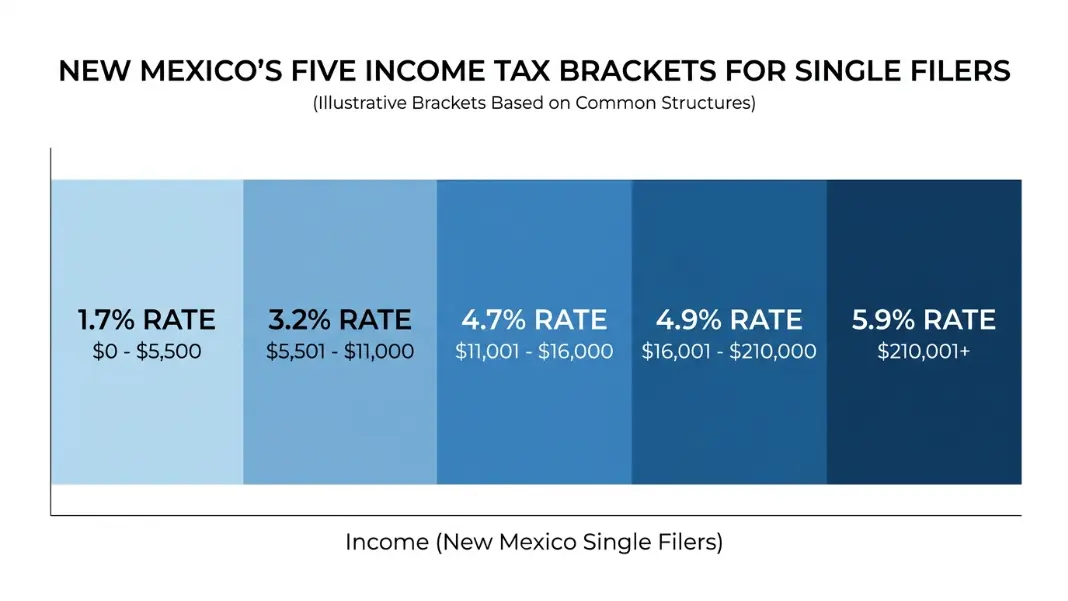
New Mexico uses a five-bracket progressive structure, with rates from 1.7% at the low end to 5.9% at the top. For a single filer in 2026:
| Taxable Income | Rate |
|---|---|
| $0 to $5,500 | 1.7% |
| $5,501 to $11,000 | 3.2% |
| $11,001 to $16,000 | 4.7% |
| $16,001 to $210,000 | 4.9% |
| Over $210,000 | 5.9% |
New Mexico's standard deduction tracks the federal standard deduction: $14,600 for single filers and $29,200 for married filing jointly in 2026. Most workers subtract this from gross income before applying the brackets.
Worked example at $75,000 single:
- Gross income: $75,000
- NM standard deduction: $14,600
- NM taxable income: $60,400
Applying the brackets to $60,400:
- $0 to $5,500 at 1.7%: $93.50
- $5,501 to $11,000 ($5,500) at 3.2%: $176.00
- $11,001 to $16,000 ($5,000) at 4.7%: $235.00
- $16,001 to $60,400 ($44,400) at 4.9%: $2,175.60
- Total NM state tax: $2,680
Annual effective rate: $2,680 / $75,000 = 3.6%. Despite a 5.9% top bracket, most middle-income earners in New Mexico have an effective state rate between 3% and 5% because the standard deduction removes the first $14,600 from the tax base.
New Mexico withholding during the year uses annualized income to estimate which brackets will apply each period. If you have multiple jobs or additional income sources, adjust your NM state withholding separately to prevent underpayment at filing time.
New Mexico also provides a low-income tax rebate for single filers earning under $36,000 and married couples under $72,000, reducing effective state tax further at lower income levels.
Federal Deductions: The Same Baseline for All Four States#
State residency changes the state tax line only. Federal income tax, Social Security, and Medicare are calculated identically regardless of whether you live in Iowa or Tennessee.
Social Security:
6.2% on gross wages up to the Social Security wage base, approximately $176,100 for 2026. Earnings above that threshold are exempt from the 6.2% Social Security tax for the rest of the calendar year. Medicare has no earnings cap.
Medicare:
1.45% on all wages. An additional 0.9% applies to wages over $200,000 for single filers ($250,000 for married filing jointly). Employers withhold the additional 0.9% automatically once your wages cross the $200,000 threshold in a calendar year.
Combined FICA at three salary levels:
| Annual Salary | Social Security (6.2%) | Medicare (1.45%) | Total FICA |
|---|---|---|---|
| $50,000 | $3,100 | $725 | $3,825 |
| $75,000 | $4,650 | $1,088 | $5,738 |
| $100,000 | $6,200 | $1,450 | $7,650 |
Federal income tax withholding:
Based on W-4 elections and the federal brackets. A single filer with the 2026 standard deduction faces a 22% marginal rate on income between roughly $47,150 and $100,525. Effective federal rates are lower because lower brackets apply to the first portions of income before reaching 22%.
Take-Home Pay in All Four States at $50K, $75K, and $100K#
The following table shows estimated annual take-home pay for a single filer claiming the standard deduction with no other adjustments or pre-tax contributions. Federal income tax is estimated using 2026 brackets at standard withholding. State tax uses each state's rates from the sections above.
| Annual Salary | Iowa (3.8% flat) | New Hampshire (0%) | Tennessee (0%) | New Mexico (up to 5.9%) |
|---|---|---|---|---|
| $50,000 | ~$38,800 | ~$40,650 | ~$40,650 | ~$39,200 |
| $75,000 | ~$55,600 | ~$58,450 | ~$58,450 | ~$55,820 |
| $100,000 | ~$71,500 | ~$75,300 | ~$75,300 | ~$71,350 |
Values are approximate. Single filer, standard deduction, no retirement contributions, no supplemental income. Use the state calculators for exact per-paycheck figures.
New Hampshire and Tennessee produce the highest take-home at every salary level because zero state tax applies to all wage income. Iowa and New Mexico are close to each other, with Iowa slightly more favorable at lower incomes (3.8% flat vs New Mexico's progressive structure beginning at 1.7% but reaching effective rates above 3% quickly) and New Mexico slightly more favorable at higher incomes where Iowa's flat rate exceeds New Mexico's effective rate.
At $75,000, the gap between Iowa and Tennessee is approximately $2,850 per year. That is roughly equivalent to one additional biweekly paycheck in state tax savings annually. At $100,000, the gap widens to about $3,800 because Iowa's flat 3.8% scales proportionally with income while Tennessee remains at zero.
The New Mexico Paycheck Calculator runs the full bracket calculation for any salary, pay frequency, and filing status, returning exact per-period figures. For Iowa workers factoring in the school district surtax, the Iowa calculator applies the correct rate for your selected county.
Iowa uses a flat income tax rate of 3.8% on all wage income for 2026. This replaced Iowa's previous multi-bracket structure with a top rate above 8%. Iowa employers withhold 3.8% of gross wages per pay period for state income tax. Some Iowa workers also pay a school district surtax, which is a percentage of your Iowa state tax liability (not of income) set by your district of residence, typically ranging from 0% to 10% of the state tax amount.
Tennessee has no state income tax on wages or salaries. The Hall Tax on investment income (interest and dividends) was eliminated on January 1, 2021. Tennessee residents pay no state income tax of any kind on W-2 wage income. Federal income tax and FICA (Social Security and Medicare) still apply normally. Your Tennessee paystub will show $0 on the state income tax line for any wage level.
New Hampshire has no income tax on wages or salaries. The state's Interest and Dividends Tax, which applied to investment income only, is being phased out: 3% in 2025, 2% in 2026, and eliminated after 2027. W-2 employees earning wage income in New Hampshire pay no state income tax on those wages. Only investment income such as interest and dividends was ever subject to New Hampshire tax, and that tax is nearly gone.
New Mexico applies five brackets for single filers: 1.7% on the first $5,500, 3.2% on $5,501 to $11,000, 4.7% on $11,001 to $16,000, 4.9% on $16,001 to $210,000, and 5.9% above $210,000. New Mexico's standard deduction for single filers is $14,600 in 2026. After the deduction, most middle-income earners have an effective state rate between 3% and 5%, well below the 5.9% top rate.
At $75,000 annual salary for a single filer, a Tennessee worker takes home approximately $2,850 more per year than an Iowa worker with the same deductions and federal situation. Tennessee's $0 state income tax versus Iowa's 3.8% flat rate accounts for the entire difference. At $100,000, the gap widens to approximately $3,800 because Iowa's flat 3.8% scales directly with income while Tennessee stays at zero.
Iowa's school district surtax is an additional local income tax set by each school district as a percentage of your Iowa state income tax liability. Most rates fall between 0% and 10% of the state tax amount, not 10% of income. If you owe $2,000 in Iowa state income tax and live in a district with a 9% surtax, that adds $180 in annual tax. The surtax is based on your district of residence, not where you work. The Iowa Paycheck Calculator applies the correct surtax rate when you select your county.
Written by
Hassaan Rasheed
Web Developer & Content Researcher
Hassaan builds calculators and writes source-linked guides across the site's subject areas. Calculator methods and reference data are documented in each guide so readers can verify the underlying sources.
About the author and methods