Illinois Final Paycheck Law: Timing, Penalties, and Employee Rights (2026)
Illinois final paycheck: IWPCA requires payment by next regular payday. 2% monthly late penalty, PTO payout rules, and steps if your employer withholds.
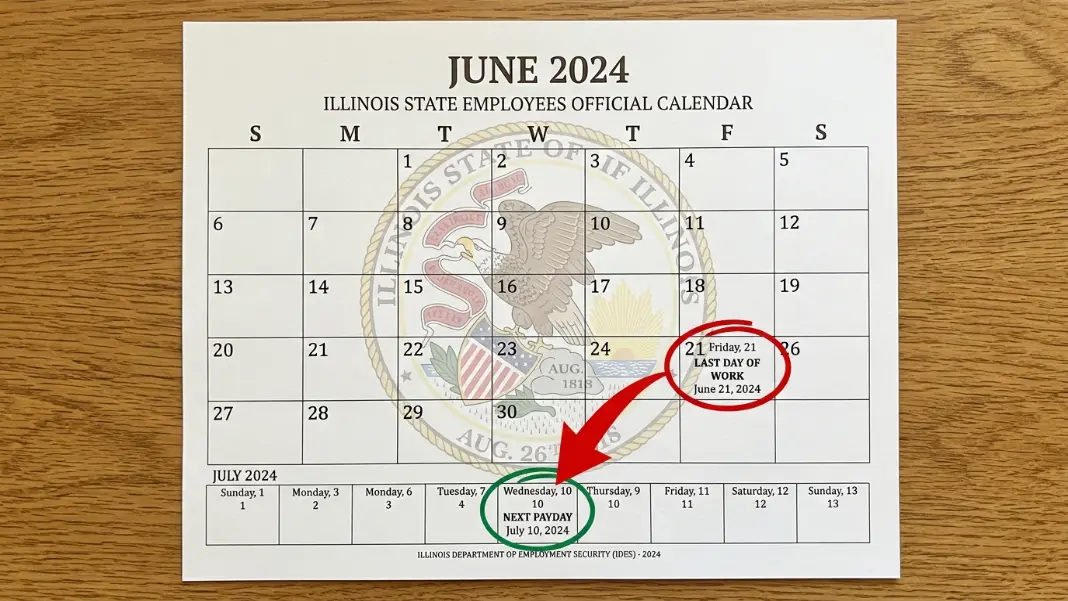
Most Illinois workers who are fired on a Friday assume their final paycheck is coming that day or at the latest the following Monday. That assumption is wrong, and acting on it can waste time that should be spent understanding exactly what you are owed and when.
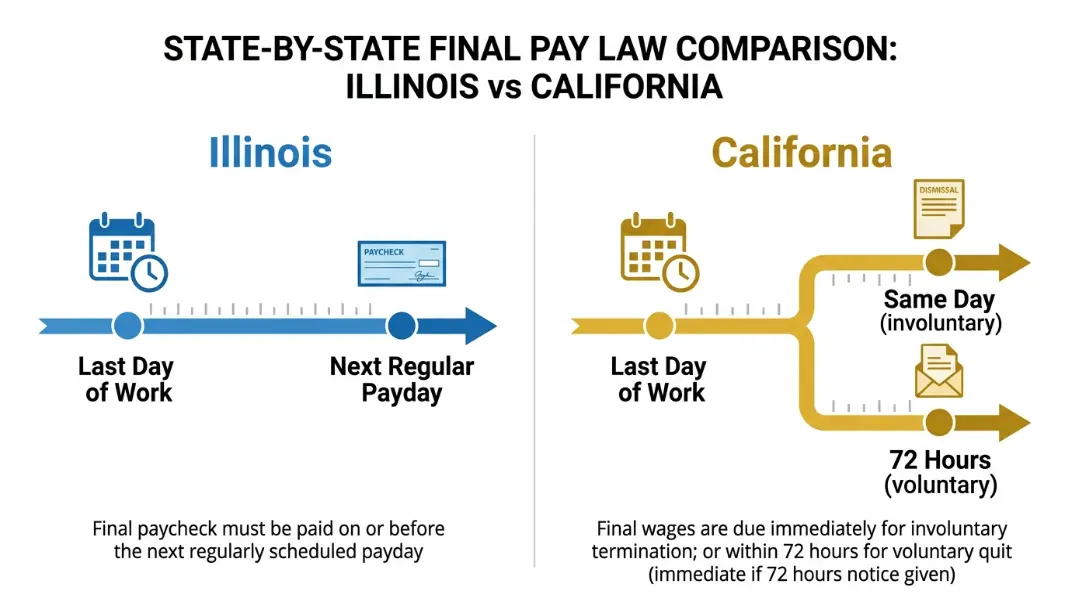
Under the Illinois Wage Payment and Collection Act, the legal deadline for a final paycheck is the next regularly scheduled payday following the last day of employment. Not same-day. Not 72 hours. The next payday. This rule applies whether you were terminated, laid off, or resigned. The same timing standard governs all separation types, which is one of the most consequential differences between Illinois final paycheck law and California's, where involuntary termination triggers an immediate same-day payment requirement with automatic waiting time penalties.
The Illinois Paycheck Calculator handles the tax calculation on your final paycheck for any income level and filing status. This guide covers the timing rules under the IWPCA, the late penalty structure when an employer misses the deadline, which compensation must be included, how voluntary and involuntary separations differ in practice, and the specific steps to take if payment is not made.
Illinois Final Paycheck Timing: What the Wage Payment Act Requires#
The Illinois Wage Payment and Collection Act (IWPCA), codified at 820 ILCS 115, is the primary statute governing final paycheck obligations. Section 4 requires that all wages earned through the last day of employment be paid on the employee's next regularly scheduled payday after separation.
The IWPCA makes no distinction between voluntary and involuntary separations for timing purposes. A worker who quits and a worker who is fired both face the same legal deadline: the next regular payday. If your employer runs biweekly payroll and your last day falls two days before a payday, the final check can arrive in two days. If your last day falls the day after a payday, the employer has up to 12 days to pay. Both outcomes are legal under Illinois law.
The IWPCA defines wages broadly to include:
- All compensation for work performed, including hourly wages and salaries
- Earned commissions due under the terms of the employment agreement
- Non-discretionary bonuses that have a defined earning formula or trigger
- Accrued PTO if the employer's written policy promises payout on separation
The same-day rule is a California requirement, not an Illinois one. Employees who expect same-day payment on termination because they have worked in California or heard about California rules are applying the wrong standard. Illinois employers who pay on the next scheduled payday are complying fully with the law.
The IWPCA covers all private-sector employees in Illinois, including part-time workers, temporary workers, and independent contractors classified as employees. It applies regardless of how long the employee worked for the company. A worker on day two of their employment has the same final paycheck rights as someone who has been there for fifteen years.
One nuance on timing for commissions: commissions that are earned before separation but not yet due under the commission schedule (for example, a quarterly commission plan where the quarter has not closed) must be paid when they become due under the plan, even if that date falls after the employee's separation. The next-payday rule applies to wages already due; separately scheduled commissions follow their own contractual schedule.
Late Final Paycheck Penalty in Illinois: The 2% Monthly Rule and Attorney Fees#
When an employer fails to pay final wages by the next regularly scheduled payday, the IWPCA creates a penalty structure that compounds the longer payment is delayed.
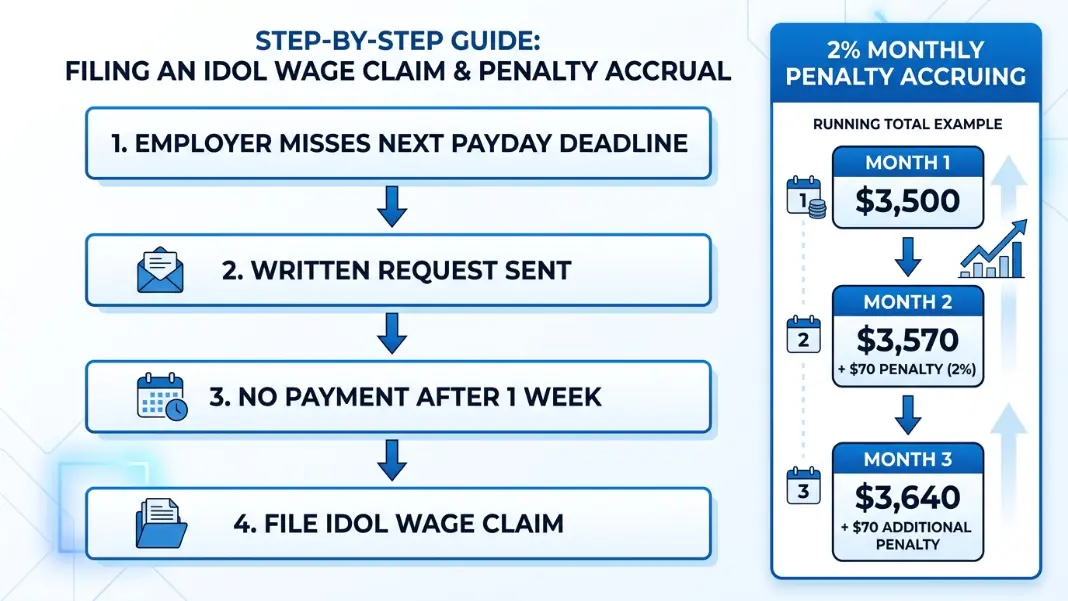
2% monthly penalty: Wages that remain unpaid past the next regular payday can trigger a penalty of 2% of the unpaid amount per month from the date the wages were due. This accrues on top of the wages owed, not instead of them.
Attorney fees: A successful lawsuit under the IWPCA entitles the employee to attorney fees and court costs paid by the employer. This fee-shifting provision makes IWPCA claims viable for amounts that would otherwise not justify the cost of hiring a lawyer, because the employer funds the legal representation when the employee prevails.
Civil penalties (IDOL enforcement): The Illinois Department of Labor can assess civil penalties against employers found to have violated the IWPCA. First offenses typically result in penalties up to $500 per violation; repeat or willful violations face higher assessments.
Example: Final wages of $3,500 unpaid past the next payday.

Month 1: $3,500 x 2% = $70 penalty
Month 2: $3,500 x 2% = $70 penalty
Month 3: $3,500 x 2% = $70 penalty

After 3 months: $3,500 wages + $210 penalty = $3,710 owed, plus attorney fees if the case goes to court.
The penalty timeline begins from the date the wages were due, which is the next regular payday. An employer who claims they did not know the employee had earned unpaid wages is not protected from penalty accrual from that original due date.
The combination of monthly penalties and attorney fee-shifting makes prolonged withholding expensive for employers. A claim worth $4,000 in wages that drags on for 6 months becomes $4,000 plus $480 in penalties plus whatever attorney fees are awarded. Employers who delay because they think the employee will give up are taking on real financial exposure.
PTO, Commissions, and Bonuses: What Your Illinois Final Paycheck Must Include#
The most common disputes over Illinois final paychecks involve not base wages, which are straightforward to calculate, but additional compensation categories that employees believe they are owed.
Accrued PTO: Illinois does not require PTO payout on separation by default. However, if the employer's written policy promises PTO payout when an employee leaves, that promise elevates accrued PTO to a wage under the IWPCA. The employer must pay it on the next regular payday. If the written policy explicitly states PTO is forfeited on separation, that forfeiture provision is enforceable in Illinois.
This is a direct contrast with California, where all accrued vacation is a wage by law regardless of what the policy says. In Illinois, the policy language governs. Read your employee handbook carefully before separation to understand what the employer has committed to in writing.
Earned commissions: Any commission that has been earned under the terms of your agreement before your separation date is a wage under the IWPCA. A commission plan that pays quarterly does not allow the employer to refuse payment simply because the quarter has not closed if the commission has already been earned by the pre-close criteria. Commissions from sales in a pipeline that had not yet hit earning triggers as of separation are a different matter; those are not yet wages.
Non-discretionary bonuses: A bonus tied to a specific formula, metric, or earning trigger in a written plan is a wage once earned. A bonus the employer decides to give at their sole discretion, with no defined criteria, is not a wage under the IWPCA and is not required in the final paycheck.
Severance: Severance is not a final paycheck. Severance is separate compensation offered in exchange for signing a release of claims, typically negotiated at the time of separation. Employers sometimes delay final wages under the pretense of processing them together with severance, which is not permissible. Final wages for hours worked are due at the next regular payday regardless of whether severance is being discussed or whether the employee has signed any separation agreement.
Expense reimbursements: Business expense reimbursements are not wages under the IWPCA and are handled separately. A wage claim does not resolve expense disputes; those are pursued through different channels.
The Illinois Hourly Paycheck Calculator Guide covers how overtime hours, bonus pay, and shift differentials affect the final paycheck calculation for hourly workers specifically, including how each component is taxed.
Illinois Final Paycheck Law for Involuntary Termination vs Resignation#
The IWPCA applies the same next-payday timing to both separation types, but the practical risks differ depending on which side initiated the separation.
Involuntary termination: The employer has all payroll records and typically processes termination payroll as a routine function. The primary risk of late or incomplete payment comes from disputes about commissions, PTO payout policy, or the employer incorrectly folding final wages into a delayed severance process.
Employers sometimes use final paycheck processing as indirect pressure to return company equipment or sign separation documents promptly. This is not legally permissible. Final wages cannot be conditioned on returning a laptop, signing a non-compete, or completing any post-employment action. The wages were earned before the separation event and must be paid on the next regular payday regardless of anything that happens afterward.
Voluntary resignation: You are owed all wages for hours actually worked up to your last working day. If you gave two weeks' notice and were walked out after one, you are not owed wages for the remaining notice period you were available to work but were not allowed to work. You are owed every hour actually worked, plus any earned commissions and any PTO the policy promises to pay.
If you were in a commissioned role and resigned mid-quarter, earned commissions from closed deals up to your last day are wages. Open deals in your pipeline that had not yet met the earning criteria under your plan are not wages and are not included in the final paycheck.
Layoff: Treated identically to involuntary termination under the IWPCA. The next regular payday is the deadline. If the layoff covers multiple employees and the employer is offering severance as part of a group reduction, the final wages for time worked remain due at the next payday. The WARN Act may impose additional notice or payment obligations for large group layoffs, but those are separate from the IWPCA final paycheck requirement.
Deceased employee: Wages owed to an employee who dies while employed must be paid to the estate. Illinois law allows employers to pay amounts under $15,000 directly to a surviving spouse or heir without probate proceedings, which simplifies the process for small final paycheck amounts. The employer should obtain a signed affidavit confirming the heir's relationship to the deceased before making payment. The standard next-payday timing still applies; the employee's death does not extend the deadline.
What to Do If Your Illinois Employer Withholds Your Final Paycheck#
Start with a written request to HR or payroll at your former employer. Specify the dates of your last pay period, the amount you believe you are owed, and the legal deadline that has passed. Email or a written letter creates a record with a timestamp. Most missed final paychecks result from payroll processing errors rather than intentional withholding, and a written request resolves the issue within a few days without further action.
If written contact produces no payment within one week of the missed deadline, file a wage claim with the Illinois Department of Labor (IDOL). Claims can be submitted online, by mail, or in person at IDOL regional offices. File as soon as the deadline passes rather than waiting; the monthly penalty accrual starts from the due date, and filing sooner preserves more of that penalty in any resolution.
IDOL will investigate the claim, contact the employer, and attempt mediation. If the employer disputes the claim, IDOL can hold a hearing and, if it finds in the employee's favor, issue a demand for payment and assess civil penalties. IDOL enforcement is most effective for straightforward wage disputes involving clear amounts.
For larger amounts or cases involving commission disputes, bonus claims, or retaliation, consulting an employment attorney before filing makes strategic sense. The IWPCA's attorney fee-shifting means a lawyer can take a strong case on contingency. The statute of limitations for a civil suit under the IWPCA is 5 years from the date the wages became due. Filing with IDOL does not toll the civil statute of limitations, so both remedies can run in parallel.
An employer who retaliates against an employee for filing a wage claim violates both the IWPCA and Illinois anti-retaliation statutes. Retaliation includes negative references, filing a false counterclaim, or any adverse action taken because the employee complained about wages. Retaliation claims carry their own damages and attorney fee provisions.
The California Final Paycheck Law Guide shows how California's same-day rule, mandatory Labor Code 203 waiting time penalties, and stricter PTO payout requirements compare to Illinois's framework. The differences are significant for employees who have worked in both states or employers with workers in multiple states.
Under the Illinois Wage Payment and Collection Act, the employer must pay all final wages by the employee's next regularly scheduled payday following the last day of work. Illinois does not require same-day payment on termination. The next regular payday is the legal deadline for both voluntary resignations and involuntary terminations. If your employer runs biweekly payroll and your last day is two days before a payday, the check is due in two days. If your last day is the day after a payday, the employer legally has up to 12 days.
Wages that remain unpaid past the next regular payday can accrue a penalty of 2% of the unpaid amount per month under the IWPCA. A successful lawsuit entitles the employee to attorney fees and court costs paid by the employer. The Illinois Department of Labor can also assess civil penalties of up to $500 per violation for first offenses, with higher amounts for willful or repeat violations. The combination of monthly accrual and attorney fee-shifting makes prolonged withholding financially costly for employers.
Not automatically. Illinois law does not require PTO payout on separation unless the employer's written policy promises it. If the policy commits to paying accrued PTO when an employee leaves, that promise becomes a wage obligation enforceable under the IWPCA. If the policy explicitly states PTO is forfeited on separation, that forfeiture is enforceable in Illinois. Employees should read their employee handbook carefully before separation, because the policy language determines the outcome, not a general assumption about how PTO works.
No. An employer cannot legally withhold a final paycheck because an employee owes money, failed to return company equipment, refused to sign a separation agreement, or for any other post-employment reason. Final wages are owed for work already performed and cannot be conditioned on actions taken after the last day. If an employer claims the employee owes money for damaged property or a training repayment agreement, those are separate claims that must be pursued independently. The wages themselves are due on the next regular payday regardless.
Illinois requires final wages by the next regular payday for all separation types. California requires same-day payment when an employer terminates an employee involuntarily, and payment within 72 hours for voluntary resignations unless the employee gave 72 hours notice in advance. California also imposes automatic waiting time penalties of up to 30 days of daily wages for late final paychecks without requiring a lawsuit. Illinois penalties require a complaint or civil action to trigger. California's rules are stricter on timing and more automatic on penalties.
Wages owed to a deceased employee must be paid to the estate. For amounts under $15,000, Illinois law allows the employer to pay directly to a surviving spouse or heir without probate proceedings. The employer should obtain a signed affidavit from the recipient confirming their relationship to the deceased before making payment. For amounts above $15,000, the wages must go through the formal estate process. The next regular payday timing still applies; the employee's death does not extend the payment deadline.
Written by
Hassaan Rasheed
Web Developer & Content Researcher
Hassaan builds calculators and writes source-linked guides across the site's subject areas. Calculator methods and reference data are documented in each guide so readers can verify the underlying sources.
About the author and methods