California Final Paycheck Law: Timing Rules, Penalties, and Employee Rights (2026)
California final paycheck law: termination means same-day pay, resignation with notice means last day, without notice means 72 hours. Labor Code 203 penalties explained.
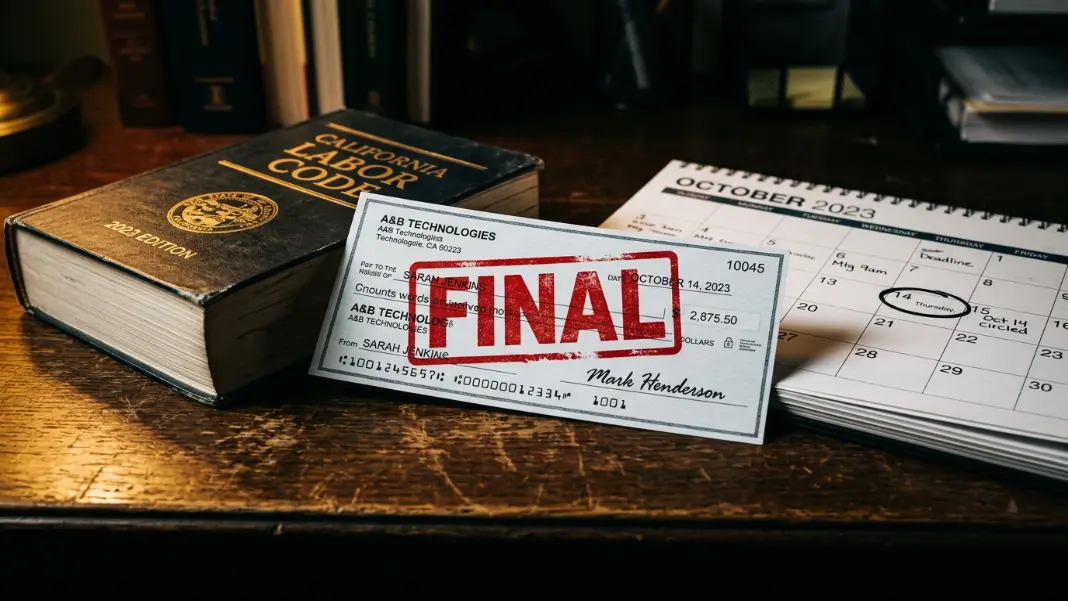
California has some of the strictest final paycheck rules in the country, and most employees only find out how strict after something goes wrong. The rules are not complicated once you know them, but employers who miss the deadlines face real financial consequences, and employees who do not know their rights often leave money on the table. This guide covers every scenario in plain terms, including the penalty calculations that can turn a late paycheck into a much larger problem for the employer.
Before your last day arrives, it is worth knowing exactly what your gross wages and deductions look like. The California Paycheck Calculator lets you model any salary, hourly rate, or pay period and see your full federal and state withholding breakdown. That number becomes your baseline for checking whether the final check is accurate.
When Your Final Paycheck Is Due: Termination vs Resignation Under California Law#
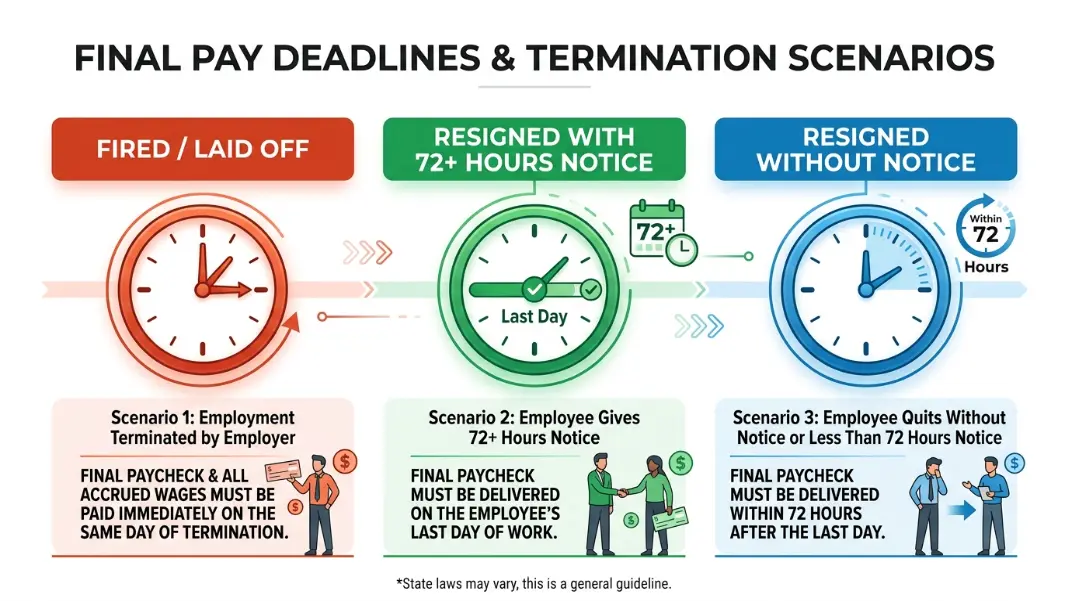
California Labor Code 201 and 202 set separate deadlines depending on how employment ends, and those deadlines are hard rules, not suggestions.
If you are fired or laid off:
Labor Code 201 requires the employer to pay all wages earned immediately on the last day of work. This means at the moment of termination, not at the end of the week, not at the next regular payday. If your employer calls you into a meeting and hands you a termination notice, your paycheck should be ready in that meeting or available for pickup before you leave the building. This rule applies whether the termination is for cause or not, whether it is a layoff affecting one person or hundreds.
A company that fires you on a Friday afternoon cannot hand you a check the following Monday simply because the payroll department was closed for the weekend. Having a check prepared in advance is standard practice for any employer handling a termination, and failing to do so triggers the waiting time penalties covered in the next section.
If you resign with 72 or more hours of notice:
When you give at least 72 hours of advance written notice before your last day, the employer must pay you on that last day. The 72-hour clock runs from when the employer receives the notice, not from when you plan to stop working.
If you resign without notice or with less than 72 hours of notice:
Under Labor Code 202, if you quit without giving 72 hours of notice, the employer has 72 hours from the time you quit to pay all wages owed. The 72-hour period runs from the moment you stop working. If you walk off the job on a Tuesday morning, the employer has until Friday morning to pay you in full.
One scenario that confuses people: you quit without notice and ask the employer to mail your check. The employer must mail the check within that same 72-hour window. The postmark date is what counts, not when you receive it.
Termination on a holiday or weekend:
Some employers try to use a weekend or holiday to buy extra time. The law does not allow it. If you are terminated on a Saturday, the paycheck is due Saturday. Employers who anticipate terminations scheduled on non-business days are expected to prepare checks in advance.
Temporary, seasonal, and remote workers:
The same Labor Code 201 and 202 rules apply to temporary workers, seasonal workers, and remote employees. The only exception is workers covered by a collective bargaining agreement that explicitly provides different timing rules. Remote employees can receive their final pay via direct deposit if authorization is already in place, or by mail upon request.
California Waiting Time Penalties: How Labor Code 203 Calculates What You're Owed#
This is where California law has real teeth. Labor Code 203 imposes what are commonly called "waiting time penalties" on employers who do not pay final wages on time. The penalty structure is easy to calculate and can be substantial.
The formula:
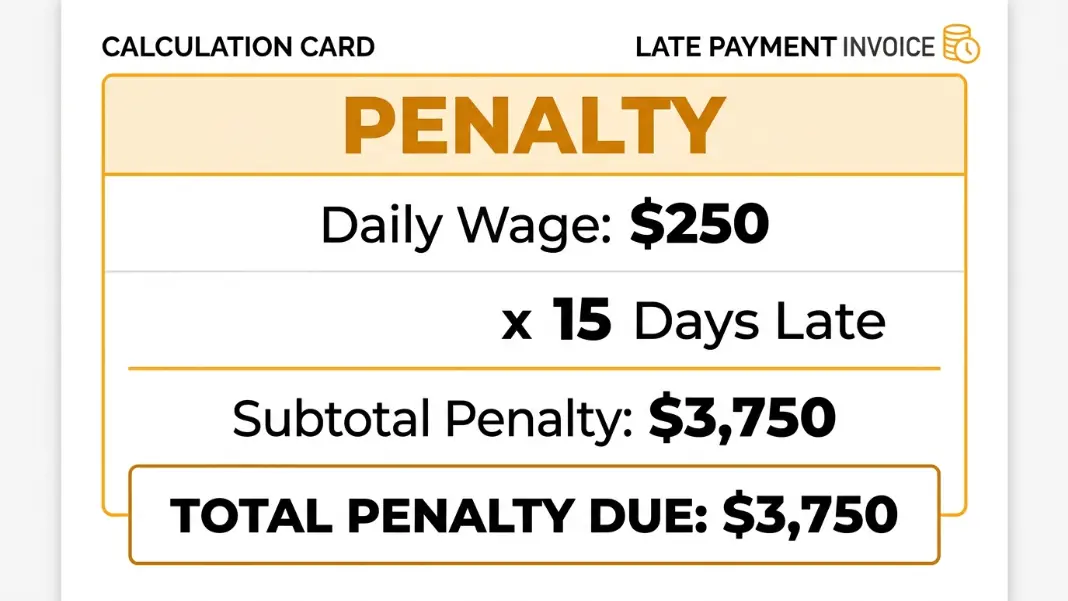
The penalty equals one full day's wages for each calendar day the employer is late, up to a maximum of 30 calendar days.
To find the daily wage, divide the employee's total compensation by the number of days in the pay period, or use the regular daily rate for hourly employees. For salaried employees, the daily rate is the monthly salary divided by 30, or the annual salary divided by 365.
Worked example:
An employee earns $75,000 per year. Their daily wage is $75,000 / 365 = $205.48. Their employer fires them on a Monday and does not issue the final check until 15 calendar days later.
Daily wage: $205.48
Days late: 15
Waiting time penalty: $205.48 x 15 = $3,082.20
That $3,082.20 is owed on top of whatever wages were in the final paycheck. It is not a fine paid to the state; it goes directly to the employee.
At the 30-day cap, the same employee would accumulate $6,164.40 in waiting time penalties. The penalty stops accruing at 30 days even if the wages still have not been paid.
The "willful" standard and what it actually means in practice:
Labor Code 203 only imposes penalties when the employer "willfully" failed to pay. In theory, this might sound like a protection for employers who genuinely made an honest mistake. In practice, California courts interpret "willfully" broadly. Any employer that knew wages were owed and did not pay them on time is acting willfully. Not knowing about the law, or being unsure of the exact amount, does not excuse the delay. Disputes about how much is owed do not suspend the penalty clock either.
The California Supreme Court has confirmed that "willful" does not require malicious intent. If an employer simply chooses not to pay because of a cash flow problem, an administrative oversight, or a belief that they can wait for the next regular payday, the penalty applies.
How to use this in practice:
If you are dealing with a late final paycheck, keep records of the exact date employment ended and the date the check was received or a deposit appeared. Those dates determine how many penalty days you are owed. The California Paycheck Tax Guide explains how gross pay is calculated from hourly rates and salary, which helps you verify that the underlying wage amount in the check is also correct before calculating penalties.
What Must Be Included in Your California Final Paycheck#
Getting paid on time is only part of what California law requires. The final paycheck must also include everything you have earned. Employers sometimes issue a check for regular wages and assume that other components can wait. They cannot.
Accrued, unused vacation time:
This is the most common surprise for California employees. California Labor Code 227.3 treats accrued, unused vacation as earned wages. Once vacation time is earned, it belongs to the employee. California does not allow "use it or lose it" vacation policies. If you have 80 hours of accrued vacation and your daily rate is $200, your final paycheck must include $2,000 in vacation payout, regardless of whether you were fired or resigned.
Employers cannot impose a waiting period before vacation pays out, cannot cap the payout at a number lower than actual accrued hours, and cannot have a policy that forfeits vacation at termination. Any such policy violates Labor Code 227.3 and makes the unpaid vacation wages subject to the same waiting time penalties under Labor Code 203.
If your company has a combined PTO policy that pools vacation and sick leave into one bucket, California courts generally treat the entire balance as vacation wages if the policy does not distinguish between the two. That means the full PTO balance is typically owed at termination. Companies that create policies deliberately labeling everything as "sick leave" to avoid the payout obligation face scrutiny, and the label alone is not determinative if the time functioned like vacation in practice.
Sick leave:
Standard California sick leave under the Healthy Workplaces Healthy Families Act does not have to be paid out at termination unless the company's own policy says it will be. If the company policy is silent or explicitly excludes sick leave from payout, you generally have no right to cash it out. The exception is when sick leave is bundled into a PTO bank, as noted above.
Overtime pay:
All earned, unpaid overtime must be included in the final paycheck. If your last two weeks of work included 10 hours of overtime that have not yet been processed through payroll, those hours must be included at the appropriate rate. California overtime runs at 1.5x for hours over 8 in a day or over 40 in a week, and at 2x for hours over 12 in a day. A Time and a Half Calculator can help you verify the correct amount if you tracked your own hours and need to confirm what the employer should owe.
Commissions:
If you earned a commission before your termination date and the amount is calculable at the time of termination, it must be included in the final paycheck. Some commission plans have quarterly or annual settlement periods, and employers sometimes try to argue that unpaid commissions are not yet "earned" at termination. Whether a commission is earned depends on when the triggering event (usually a closed sale or collected payment) occurred, not when the commission would normally have been settled. If the sale happened and the amount is determinable, it is owed in the final paycheck.
Expense reimbursements:
Legitimate business expenses that you submitted before termination should be reimbursed at the time of the final check or very shortly after. Unreimbursed business expenses are not wages under the final paycheck statute, but they are still owed under California Labor Code 2802 and can be recovered separately.
Direct Deposit, Mailing, and Pickup Rules for Final Paychecks in California#
The method of delivering the final paycheck has its own set of rules, and they matter because the deadline is tied to delivery, not just to whether the employer initiated payment.
Direct deposit:
An employer can deliver the final paycheck via direct deposit only if the employee previously authorized direct deposit and has not rescinded that authorization. When employment ends, the employer cannot force a direct deposit if the employee prefers a physical check. If the employee wants to be paid by direct deposit, the existing authorization covers it without any new paperwork.
If an employer initiates a direct deposit on time and the bank posting takes one extra business day, that does not make the employer late, provided the transfer was initiated on the due date.
Mailing:
If you request in writing that your final check be mailed, the employer must mail it by the due date. A check that is postmarked on the last allowable day is considered timely delivered. Note that this applies when you request mailing; the employer cannot unilaterally decide to mail your check to delay payment when you are physically accessible and could receive the check in person.
For employees who quit without giving notice and request mailing, the employer has 72 hours to get the check postmarked and in the mail.
Pickup:
If no special arrangement is made, the check should be available for pickup at the place of employment or wherever the employer normally issues wages. An employee should not have to drive to a location that is unreasonable or significantly different from the normal worksite to retrieve a final check.
What California Employers Cannot Deduct from Your Final Paycheck#
California law limits what an employer can take out of a final paycheck, and these protections exist because employers sometimes try to recover losses by docking the last check.
Forbidden deductions:
Cash register shortages cannot be deducted from your final paycheck unless you were grossly negligent or acted with clear dishonest intent, and even then the employer needs documentation. An unexplained cash shortage is not enough to justify a wage deduction.
Breakage or damage to employer equipment cannot be deducted from your final check in most cases. The same standard applies: gross negligence or intentional misconduct might justify a deduction, but ordinary accidents at work are a cost of doing business, not a cost that can be transferred to the employee's wages.
The cost of uniforms, tools, or equipment that the employer requires you to use cannot be charged against your final paycheck. If you return a uniform at termination, there is nothing to deduct. If the employer claims you did not return it, they would need to pursue a separate civil claim, not a unilateral payroll deduction.
Training costs that the employer required you to attend cannot be deducted. If you signed an agreement saying you would repay training costs if you left within a certain period, those agreements are generally unenforceable in California because they function as unlawful wage deductions.
Allowed deductions:
Court-ordered wage garnishments remain in effect through and including the final paycheck. Child support withholding orders, tax levies, and other valid garnishments are deducted as normal.
Written authorizations that you previously signed for specific, legitimate deductions remain valid for the final check. For example, if you authorized a deduction for a health insurance premium, that deduction continues through your last pay period.
What to do if you believe an illegal deduction was made:
If you believe your employer took an unauthorized deduction from your final paycheck, you can file a wage claim with the California Labor Commissioner's office, which operates through the Division of Labor Standards Enforcement (DLSE). The DLSE handles wage claims without requiring you to hire an attorney, though you have the right to bring a civil lawsuit as well.
For waiting time penalty claims, the statute of limitations is three years if you file a wage claim or four years if the claim is based on a written employment contract. For most W-2 employees without a written contract specifying their wage rate, the three-year period applies. Missing the deadline means losing the right to the penalty, so document the late payment as soon as it happens.
The DLSE process: file online or in person at a local labor commissioner office, describe the wages owed and the late payment, and the agency will schedule a conference with the employer. Many claims settle at the conference stage. If not, the case goes to a hearing that functions like a small claims proceeding.
Knowing what your paycheck should look like before your last day removes any ambiguity about what is owed. Run your numbers through the California Paycheck Calculator to see gross wages, federal and state withholding, and your expected net amount. When the final check arrives, you can compare the gross figure against your own calculation and immediately spot whether wages are missing before time-sensitive deadlines start running.
If you are fired or laid off, your employer must pay you immediately on your last day of work under Labor Code 201. If you resign and gave at least 72 hours of advance notice, the final paycheck is due on your last day. If you quit without giving 72 hours of notice, the employer has 72 hours from the time you stopped working to pay all wages owed. These are hard deadlines, not targets.
Under Labor Code 203, the penalty is one full day's wages for each calendar day the employer is late, up to a maximum of 30 days. For example, if your daily wage is $250 and the employer pays you 12 days late, you are owed $3,000 in waiting time penalties on top of the wages themselves. The penalty applies when the failure to pay was willful, which courts interpret broadly. Not knowing the law is not a valid excuse.
Yes. California Labor Code 227.3 treats accrued, unused vacation as earned wages. It cannot be forfeited at termination, and employers cannot have policies that eliminate vacation balances when employment ends. Your full accrued vacation balance must be paid at your final rate of pay, whether you were fired or you resigned. If your company uses a combined PTO bank, the same rule generally applies to the full balance.
Yes, but only if you previously authorized direct deposit and have not revoked that authorization. An employer cannot force direct deposit on a departing employee who prefers a physical check. If you want direct deposit and the authorization is already in place, it continues for the final payment without any extra paperwork needed.
Allowed deductions include court-ordered wage garnishments, child support orders, tax levies, and any deductions you previously authorized in writing for specific purposes. Employers cannot deduct cash register shortages, equipment damage from ordinary accidents, uniform costs, or required training expenses. Any deduction not explicitly authorized by law or by a valid written agreement is illegal, and unauthorized deductions can be recovered through a DLSE wage claim.
File a wage claim with the California Division of Labor Standards Enforcement (DLSE), also called the Labor Commissioner's office. You can file online or in person at a local office. The DLSE will schedule a settlement conference with your employer. If no agreement is reached, the case goes to a hearing. You do not need an attorney to file a DLSE claim. The statute of limitations for waiting time penalties is three years for wage claims and four years if you had a written employment contract.
Written by
Hassaan Rasheed
Web Developer & Content Researcher
Hassaan builds calculators and writes source-linked guides across the site's subject areas. Calculator methods and reference data are documented in each guide so readers can verify the underlying sources.
About the author and methods