California Hourly Paycheck Calculator: Overtime, Double Time, and Take-Home Pay (2026)
California hourly paycheck calculator: how daily overtime after 8 hours works, double time after 12, SDI on hourly wages, and take-home at $18, $25, and $35/hr.
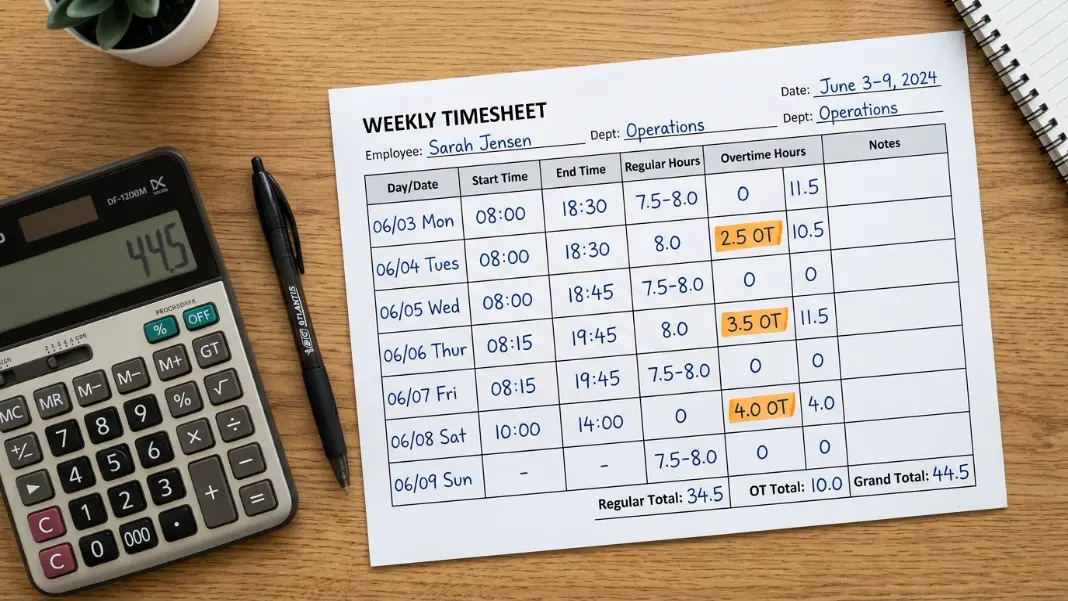
California has the most demanding overtime rules in the country for hourly workers, and most people, including some payroll managers, do not fully understand them until they see an unexpected wage claim. The state does not just require overtime after 40 hours per week like the federal government does. California requires overtime after 8 hours in a single workday. That one difference changes the math on every paycheck for any worker who routinely puts in 9, 10, or 12-hour days.
If you have ever handed someone their paycheck and had them ask why their Wednesday check was less than their Monday one even though they worked the same number of hours both weeks, California's daily overtime rule is almost certainly the answer. The California Paycheck Calculator handles all of this automatically, including daily overtime, double time, SDI, and state income tax. This guide explains the calculations behind each number so you can verify them yourself or teach them to anyone you supervise.
California also charges workers a State Disability Insurance (SDI) premium on every paycheck, maintains some of the highest city minimum wages in the country, and applies a progressive state income tax that affects take-home pay differently at $18/hr versus $35/hr. Each of those layers gets its own section below, with real dollar examples at rates hourly workers actually earn.
How California Overtime Rules Differ From Every Other State#
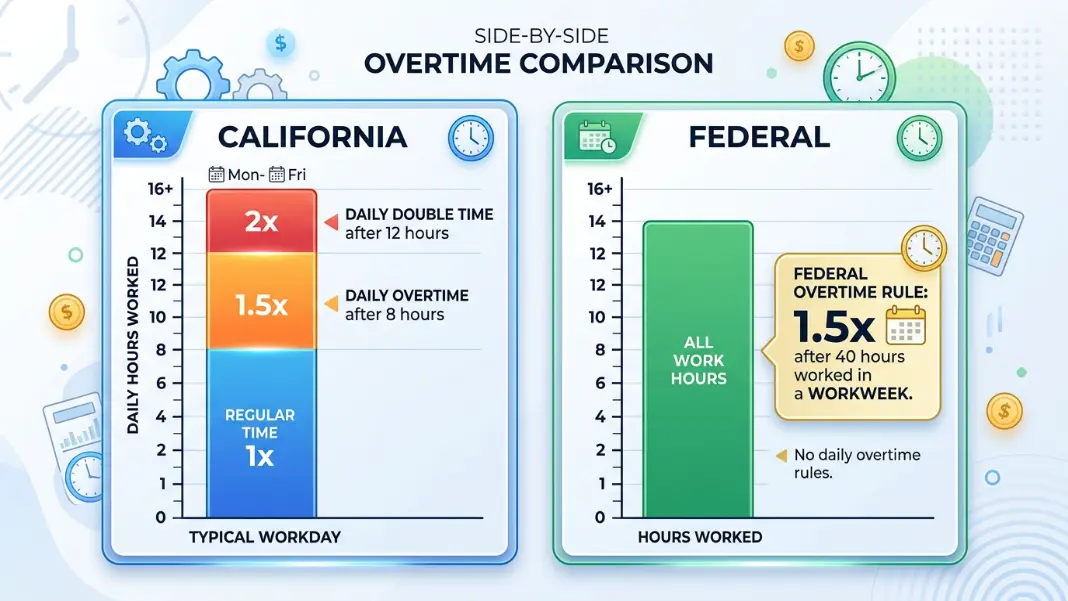
The federal Fair Labor Standards Act (FLSA) requires overtime pay of 1.5 times the regular rate for any hours worked beyond 40 in a seven-day workweek. That is the rule most employers in most states follow. California rejects that as insufficient and adds a daily trigger that no other state matches.
Under California Labor Code Section 510, overtime at 1.5 times the regular rate kicks in after 8 hours worked in a single workday. The employee does not need to have worked 40 hours that week. They do not need to be approaching any weekly threshold. Eight hours on Tuesday, and the 9th hour on Tuesday is overtime. Period.
Double time at 2.0 times the regular rate kicks in after 12 hours in a single workday. Again, no weekly threshold required.
The 7th consecutive day rule adds another layer. If a non-exempt employee works all 7 days of a workweek, the first 8 hours on the 7th day are paid at 1.5 times the regular rate. Any hours beyond 8 on that 7th day are paid at 2.0 times the regular rate.
Here is how that compares to the federal standard:
| Rule | Federal (FLSA) | California |
|---|---|---|
| Overtime rate | 1.5x after 40 hrs/week | 1.5x after 8 hrs/day |
| Double time | Not required | 2x after 12 hrs/day |
| 7th day overtime | Not required | 1.5x for first 8 hrs; 2x beyond 8 hrs |
| 7th day trigger | Not required | Any 7th consecutive day in workweek |
The practical consequence: a California worker who puts in four 10-hour days hits 8 hours of daily overtime even though they work only 40 total hours that week. Under federal law, they would owe zero overtime. Under California law, those 2 extra hours each day, 8 hours of overtime in total, must be paid at 1.5 times the regular rate. An employer who pays that worker at straight time is violating California Labor Code and exposing themselves to penalties, back wages, and attorney's fees.
Exempt employees, those classified as executive, administrative, or professional under both the salary basis test and the duties test, are not entitled to overtime at all. But non-exempt hourly workers, which covers the overwhelming majority of retail, restaurant, warehouse, construction, and healthcare support staff in California, are protected by every one of these rules. Misclassifying someone as exempt when they do not meet the legal standard is one of the most common and expensive wage and hour mistakes California employers make.
How to Calculate Gross Pay for California Hourly Workers With Overtime#
The formula for a California hourly worker's weekly gross looks like this:
Weekly Gross = (Regular hours × Hourly rate)
             + (1.5x overtime hours × Hourly rate)
             + (2x double-time hours × Hourly rate)
Regular hours are any hours in a day up to 8, not exceeding 40 in the week after accounting for daily overtime. Overtime hours are hours 9 through 12 in any single workday, plus hours 1 through 8 on the 7th consecutive day. Double-time hours are any hours beyond 12 in a single workday, plus any hours beyond 8 on the 7th consecutive day.
Here is a complete worked week at $25/hour to show how the California rules affect each day independently.
Schedule: Mon 10 hrs, Tue 9 hrs, Wed 8 hrs, Thu 8 hrs, Fri 10 hrs, Sat 8 hrs, Sun 7 hrs (7th consecutive day).
Monday (10 hours worked):
- Hours 1-8: regular = 8 × $25 = $200.00
- Hours 9-10: overtime (1.5x) = 2 × $37.50 = $75.00
- Monday total: $275.00
Tuesday (9 hours worked):
- Hours 1-8: regular = 8 × $25 = $200.00
- Hour 9: overtime (1.5x) = 1 × $37.50 = $37.50
- Tuesday total: $237.50
Wednesday (8 hours worked):
- Hours 1-8: regular = 8 × $25 = $200.00
- Wednesday total: $200.00
Thursday (8 hours worked):
- Hours 1-8: regular = 8 × $25 = $200.00
- Thursday total: $200.00
Friday (10 hours worked):
- Hours 1-8: regular = 8 × $25 = $200.00
- Hours 9-10: overtime (1.5x) = 2 × $37.50 = $75.00
- Friday total: $275.00
Saturday (8 hours worked, 6th day, not 7th):
- Hours 1-8: regular = 8 × $25 = $200.00
- Saturday total: $200.00
Sunday (7 hours worked, 7th consecutive day):
- All hours on the 7th day pay at 1.5x up to 8 hours = 7 × $37.50 = $262.50
- Sunday total: $262.50
Weekly gross total: $275.00 + $237.50 + $200.00 + $200.00 + $275.00 + $200.00 + $262.50 = $1,650.00
Annualized (if every week followed this schedule): $1,650 × 52 = $85,800.
Compare that to what a federal-only employer would calculate if they ignored California's daily rule. This worker logged 60 total hours in the week. Under federal FLSA, 40 regular hours at $25 plus 20 overtime hours at $37.50 gives $1,000 + $750 = $1,750. That is actually more than California's calculation in this case because the worker's Sunday hours all get 1.5x under California's 7th-day rule rather than being mixed between straight time and overtime as the federal method would allocate them. The point is not that one method always pays more. The point is that they calculate differently day by day, and California's method is mandatory. Using the federal formula for a California worker is a violation regardless of the outcome.
The Time and a Half Calculator is useful if you want to quickly verify the overtime rate at any given hourly wage before running the full weekly calculation.
Double Time in California: When the 2x Rate Kicks In and How to Calculate It#
Double time is where California's overtime system becomes genuinely unfamiliar to employers and workers who come from other states. Most states have no concept of double time in state law. California mandates it in two situations.
First, any hours beyond 12 in a single workday are paid at 2.0 times the regular hourly rate. Second, any hours beyond 8 on the 7th consecutive day of a workweek are paid at 2.0 times the regular rate.
Here is a complete day-level calculation for a worker earning $30/hour who works 14 hours on Monday.
Monday at $30/hour, 14 hours worked:
- Hours 1-8: regular = 8 × $30.00 = $240.00
- Hours 9-12: overtime (1.5x) = 4 × $45.00 = $180.00
- Hours 13-14: double time (2x) = 2 × $60.00 = $120.00
- Total for Monday: $540.00
Now compare that to what a 14-hour straight-time calculation would have produced: 14 × $30 = $420. California law adds $120 to that worker's Monday pay, representing the double-time premium on those last two hours. For an employer who fails to track daily hours accurately, this difference accumulates quickly across a workforce. A single worker doing two 14-hour days per week at $30/hour is owed an extra $240 per week in double-time premium alone.
The 7th consecutive day double-time situation is less common but matters for industries that run weekend shifts routinely. If a worker's schedule runs Sunday through Saturday and they work all 7 days, Sunday is the 7th consecutive day. Hours 1 through 8 on that Sunday pay at 1.5x. Hour 9 and beyond on that Sunday pay at 2.0x. The double-time trigger on the 7th day resets with every workweek, so a worker who takes even one day off breaks the 7th-consecutive-day chain.
7th-day double-time example at $28/hour, 10 hours worked on the 7th consecutive day:
- Hours 1-8: 1.5x = 8 × $42.00 = $336.00
- Hours 9-10: 2.0x = 2 × $56.00 = $112.00
- Total for the day: $448.00
Straight time for 10 hours at $28/hour would be $280. The 7th-day rules add $168 to that single day's pay.
Employers who use timekeeping software that was built around federal overtime rules frequently fail to calculate California double time correctly because the software was never designed to check daily hours against a 12-hour threshold. Manual verification against each employee's daily time records is the only reliable check, and the California Labor Commissioner's office takes wage claims for missed double-time premiums seriously.
How California Taxes Are Withheld From Hourly Paychecks#
California hourly workers face four main deductions on every paycheck: federal income tax, California state income tax, FICA (Social Security and Medicare), and SDI.
How employers calculate withholding for hourly workers
Employers do not calculate income tax withholding based on what you actually earned this pay period in isolation. They annualize your paycheck. If you are on a biweekly schedule and your gross pay this period is $2,000, the employer multiplies $2,000 by 26 pay periods to get an annualized income of $52,000. They then calculate the annual withholding that corresponds to $52,000 based on your W-4 filing status and apply one 26th of that annual amount to this paycheck.
This approach is accurate over a year of consistent pay. It becomes imprecise when your pay varies week to week, as it does for hourly workers whose hours fluctuate or who have occasional overtime. A paycheck that includes several overtime hours will be annualized to a higher income level, which pushes more of the annualized income into higher federal and state brackets. The withholding on that paycheck will be higher as a percentage of gross than a normal paycheck. At year end, the IRS and California Franchise Tax Board reconcile against your actual annual income, so any over-withholding from overtime-heavy periods comes back as a refund.
California state income tax (2026 brackets, single filer)
| Taxable Income | CA State Rate |
|---|---|
| Up to $10,756 | 1% |
| $10,757 to $25,499 | 2% |
| $25,500 to $40,245 | 4% |
| $40,246 to $55,866 | 6% |
| $55,867 to $70,606 | 8% |
| $70,607 to $360,659 | 9.3% |
California's standard deduction is low, $5,540 for single filers, so state taxable income is relatively high for hourly workers compared to federal taxable income after the $15,000 federal standard deduction.
California SDI: 1.1% on every dollar of wages
California's State Disability Insurance program is funded by employees, not employers. In 2024, California removed the SDI wage base cap, meaning SDI now applies to 100% of wages with no annual ceiling. The 2026 SDI rate is 1.1%. For a worker earning $52,000 per year, that is $572 in SDI. For a worker earning $85,800, that is $944 in SDI.
SDI appears on every paycheck, including overtime and double-time checks. It is calculated on gross wages before any pre-tax deductions.
FICA: Social Security and Medicare
Social Security is 6.2% on wages up to $176,100 in 2026. Medicare is 1.45% on all wages, with an additional 0.9% surcharge on wages above $200,000. For hourly workers in the $18 to $35 range, Medicare surcharge is not relevant. The combined FICA rate of 7.65% applies to every paycheck.
For a complete breakdown of how California's tax brackets apply at different annual income levels, the California Paycheck Tax Guide covers each bracket in detail with take-home comparisons at $40,000, $60,000, and $100,000.
Take-Home Pay at $18, $25, and $35 Per Hour in California (2026)#
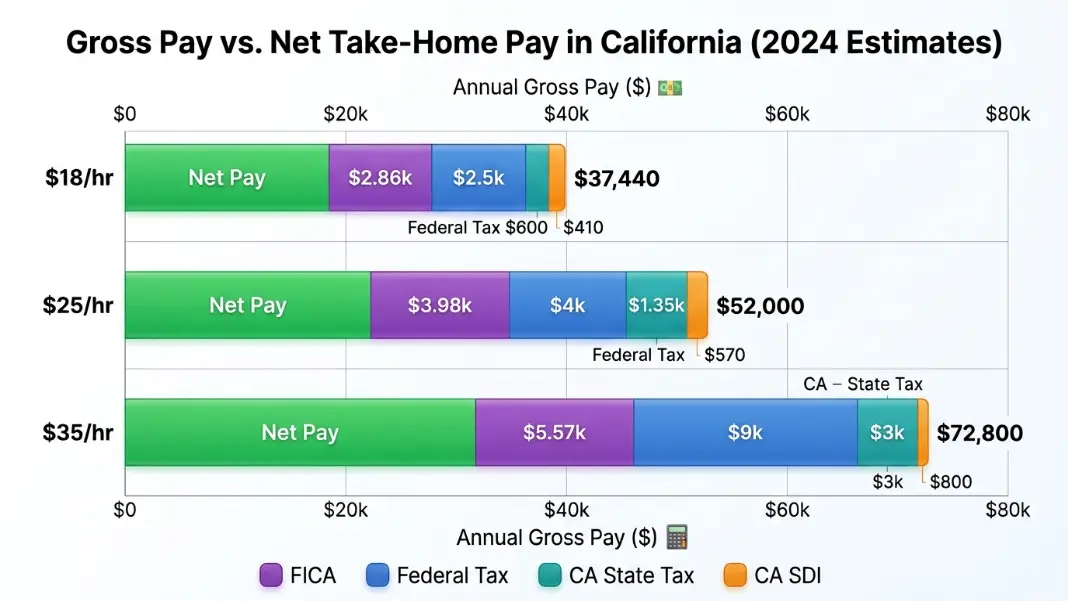
The figures below assume a single filer, no pre-tax deductions (no 401k, no FSA), standard federal and state W-4, and a 40-hour workweek with no overtime. Federal income tax uses the 2026 standard deduction of $15,000. California state income tax uses the 2026 standard deduction of $5,540. SDI is 1.1% on all gross wages.
$18/hour, $37,440 annual gross:
| Deduction | Annual Amount |
|---|---|
| Federal income tax | $2,100 |
| California state income tax | $640 |
| SDI (1.1%) | $412 |
| Social Security (6.2%) | $2,321 |
| Medicare (1.45%) | $543 |
| Total deductions | $6,016 |
| Annual take-home | $31,424 |
| Monthly take-home | $2,619 |
$25/hour, $52,000 annual gross:
| Deduction | Annual Amount |
|---|---|
| Federal income tax | $4,070 |
| California state income tax | $1,135 |
| SDI (1.1%) | $572 |
| Social Security (6.2%) | $3,224 |
| Medicare (1.45%) | $754 |
| Total deductions | $9,755 |
| Annual take-home | $42,245 |
| Monthly take-home | $3,521 |
$35/hour, $72,800 annual gross:
| Deduction | Annual Amount |
|---|---|
| Federal income tax | $9,026 |
| California state income tax | $3,068 |
| SDI (1.1%) | $801 |
| Social Security (6.2%) | $4,514 |
| Medicare (1.45%) | $1,056 |
| Total deductions | $18,465 |
| Annual take-home | $54,335 |
| Monthly take-home | $4,528 |
A few things stand out in these numbers. First, the effective total tax rate increases substantially between $18/hr and $35/hr, from about 16.1% to about 25.4%. This reflects California's progressive state income tax layered on top of the progressive federal brackets. A worker moving from $18/hr to $25/hr takes home roughly $10,821 more per year despite earning $14,560 more in gross pay, because the marginal tax rate on those additional dollars is higher. Second, SDI is a flat percentage that grows proportionally with income, unlike the state and federal taxes which accelerate.
These figures are before any city-level minimum wage premiums affect the baseline. California minimum wage in 2026 is $16.50 per hour statewide, up from $16.00 in 2024. Fast food workers covered under AB 1228 have a $20/hour minimum effective since April 2024. Some cities go further: Los Angeles city sets its minimum at $17.28/hour, and San Francisco's minimum is $18.67/hour. Workers in those cities who are currently earning exactly the city minimum will see different take-home figures than these statewide tables because their gross pay starts higher.
Pre-tax deductions can change these numbers meaningfully. A $25/hr worker who contributes $200 per biweekly paycheck to a traditional 401k reduces their annualized gross for withholding purposes by $5,200, which can drop them into a lower California state bracket and reduce federal withholding. Health insurance premiums paid through an employer's Section 125 cafeteria plan similarly reduce taxable gross for both income tax and FICA purposes.
California requires overtime pay at 1.5 times the regular rate for any hours worked beyond 8 in a single workday, not just beyond 40 per week as federal law requires. Double time at 2.0 times the regular rate applies after 12 hours in a single workday. On the 7th consecutive day of a workweek, the first 8 hours pay at 1.5x and any hours beyond 8 pay at 2.0x. These rules apply to all non-exempt hourly employees in California regardless of their federal classification.
Double time in California is 2.0 times the employee's regular hourly rate. It applies in two situations: first, for any hours worked beyond 12 in a single workday, and second, for any hours worked beyond 8 on the 7th consecutive day of a workweek. For a worker earning $30/hour, double time pays $60/hour. A 14-hour shift at $30/hour produces $240 in regular pay (hours 1-8), $180 in overtime pay (hours 9-12), and $120 in double-time pay (hours 13-14), for a daily total of $540.
Employers annualize each paycheck to determine withholding. If your biweekly gross is $2,000, the employer multiplies by 26 pay periods to get $52,000 and withholds based on the annual brackets for that income level. California deducts state income tax starting at 1% on the first $10,756 above the standard deduction, rising in steps to 9.3%. SDI is withheld at 1.1% on all wages with no annual cap. Social Security is 6.2% and Medicare is 1.45%. Overtime paychecks are annualized at the higher pay period amount, which can result in higher withholding percentages on those specific checks.
California's statewide minimum wage is $16.50 per hour in 2026, up from $16.00 in 2024. Fast food workers covered under AB 1228 have a $20/hour minimum wage effective since April 2024. City minimums are higher in several jurisdictions: Los Angeles city is $17.28/hour and San Francisco is $18.67/hour. Employers in those cities must pay at least the city minimum, whichever is higher than the state floor.
Start with your gross pay: multiply regular hours (up to 8 per day) by your hourly rate, add any overtime hours (hours 9-12 each day) multiplied by 1.5 times your rate, and add any double-time hours (beyond 12 per day) multiplied by 2.0 times your rate. From gross pay, subtract federal income tax (using annualized brackets), California state income tax, SDI at 1.1%, Social Security at 6.2%, and Medicare at 1.45%. The California Paycheck Calculator handles all of this automatically if you enter your hourly rate, hours worked, and pay frequency.
Yes, the 7th consecutive day rule applies to any non-exempt employee who works all 7 days of a workweek, regardless of whether they are classified as part-time or full-time. If a part-time worker is scheduled Sunday through Saturday and works all 7 days, their hours on the 7th day trigger 1.5x pay for the first 8 hours and 2.0x for any hours beyond 8. The workweek is defined by the employer and must be a fixed, regularly recurring period of 168 consecutive hours. Part-time status does not change how California's overtime and double-time rules apply.
California hourly pay involves more moving parts than almost any other state, and the daily overtime trigger is the piece that consistently creates compliance problems and paycheck discrepancies. If you want to verify your take-home at any hourly rate, including weeks with overtime or double time, the California Paycheck Calculator accepts hourly input and calculates each deduction line so you can see where every dollar goes.
One more area that affects hourly workers specifically: when employment ends, the final paycheck rules under California Labor Code Section 201 and 202 apply the same way to hourly workers as they do to salaried ones. The deadlines are strict: immediate payment on termination, within 72 hours for a resignation without notice. The California Final Paycheck Law guide covers what goes into that final check, including unpaid overtime and double time, any accrued but unused PTO, and the penalties California imposes when employers miss the deadline.
Written by
Hassaan Rasheed
Web Developer & Content Researcher
Hassaan builds calculators and writes source-linked guides across the site's subject areas. Calculator methods and reference data are documented in each guide so readers can verify the underlying sources.
About the author and methods