Illinois Paycheck Tax Guide: Flat Rate, Pension Exemption, and Take-Home Pay (2026)
Illinois income tax: constitutionally fixed 4.95% flat rate, full pension and Social Security exemption. Take-home pay at $50K, $75K, $100K for 2025.

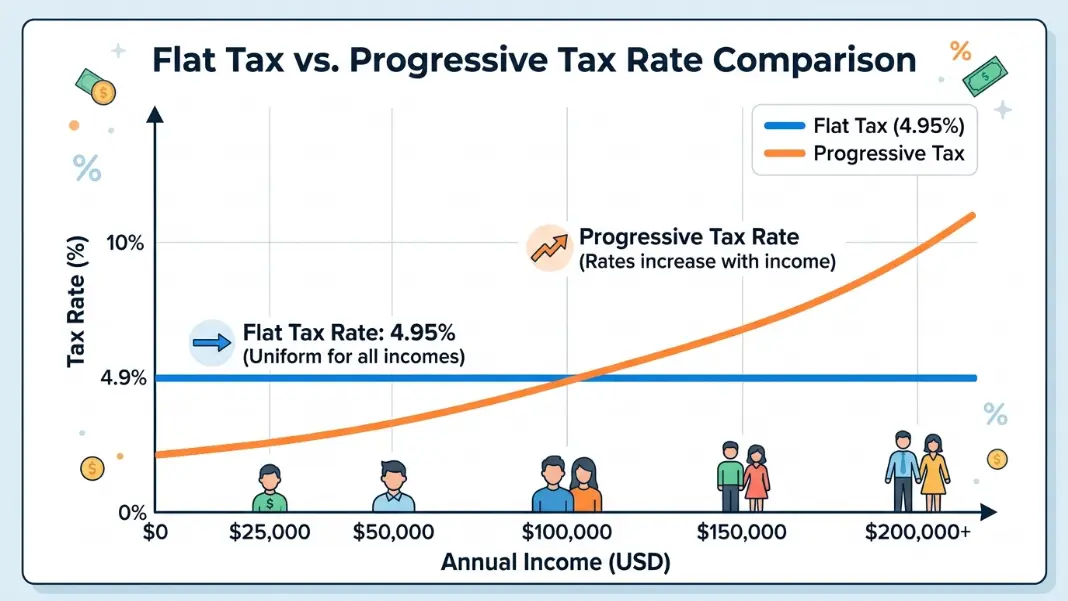
Illinois has had the same income tax rate since 2017, and that rate cannot legally change without a statewide constitutional vote. The flat 4.95% was set when the temporary "millionaire's tax" surcharge expired, and the 2020 "Fair Tax" referendum, which would have replaced the flat rate with progressive brackets, failed at the ballot box. Until Illinois voters approve a constitutional amendment to allow graduated rates, every Illinois worker from minimum wage to seven figures pays 4.95% on each dollar of income. That is not a coincidence or a policy choice that survives on political goodwill. It is a constitutional constraint written into Article IX, Section 3(a) of the Illinois Constitution.
The Illinois Paycheck Calculator applies the 4.95% rate, the correct personal exemption, and federal withholding to give you an accurate take-home figure for any salary. This guide explains what the flat structure actually means for your paycheck, which income types Illinois does not tax at all, and how Illinois compares to Indiana, Wisconsin, and Missouri.
Illinois Income Tax: Flat 4.95% by Constitutional Requirement#
Most state income tax guides treat a flat rate as simply a policy preference. In Illinois, the flat rate is constitutionally mandated. The state constitution requires that any income tax apply at a "non-graduated" rate, meaning a single rate must apply to all taxable income. This is why Illinois cannot selectively lower rates for lower incomes or raise rates on higher incomes without a constitutional amendment: any rate change must still be a single uniform rate applied across the board.
Illinois does not use a standard deduction in the federal sense. Instead, there is a personal exemption: a fixed dollar amount that reduces income before the 4.95% rate is applied. For 2025:
| Filing Status | Personal Exemption |
|---|---|
| Single | $2,775 |
| Married Filing Jointly | $5,550 |
| Each Dependent | $2,775 |
The exemption is modest compared to the federal standard deduction of $14,600 for single filers. For most W-2 workers, the practical result is that nearly all of gross income is subject to the 4.95% rate. A single filer earning $50,000 subtracts $2,775 and pays tax on $47,225.
Illinois income tax calculation at three income levels (single filer):
$50,000: ($50,000 - $2,775) × 4.95% = $47,225 × 4.95% = $2,338
$75,000: ($75,000 - $2,775) × 4.95% = $72,225 × 4.95% = $3,575
$100,000: ($100,000 - $2,775) × 4.95% = $97,225 × 4.95% = $4,813
Notice that the effective Illinois rate at $50,000 is 4.68% and at $100,000 it is 4.81%. That near-flat effective rate is exactly what the constitutional requirement produces: because the personal exemption is fixed and small, the effective rate compresses very close to the nominal rate at almost every income level. There is almost no difference in effective rate between a $50,000 earner and a $200,000 earner in Illinois, something that does not happen in any state with progressive brackets.
Illinois has no local income tax. Chicago, Springfield, Rockford, and every other Illinois city and county are prohibited from imposing a separate local income tax under state law. What appears on your pay stub in Illinois is federal, FICA, and Illinois state. No city line.
What Illinois Does Not Tax: Social Security, Pensions, and Retirement Income#
The flat 4.95% rate applies broadly, but Illinois carves out a large and important category of income entirely: retirement income.
Social Security income is 100% exempt from Illinois income tax. There is no income threshold, no phase-in, and no partial inclusion. A retiree drawing $30,000 in Social Security pays nothing to Illinois on that income.
Pension income is also fully exempt from Illinois income tax. This covers:
- Illinois Teachers' Retirement System (TRS) distributions
- Illinois State Employees' Retirement System (SERS) distributions
- Federal pensions under the Civil Service Retirement System (CSRS) and Federal Employees' Retirement System (FERS)
- Most defined benefit pensions from private employers, if structured as qualifying retirement income
Railroad Retirement benefits are also exempt.
This is a significant provision. Illinois teachers and state workers who retire on a TRS or SERS pension pay no Illinois income tax on that pension income, regardless of how large it is. A retired teacher drawing $80,000 from TRS has zero Illinois income tax liability on that amount. For states that do tax pension income at standard rates, this exemption represents thousands of dollars per year in tax savings.
The exemption matters for current workers too, if you are factoring Illinois into a long-term financial plan. A career in Illinois public service ends in pension income that the state does not touch.
What Illinois does tax as ordinary income: wages, interest, dividends, capital gains, and IRA distributions. The pension and Social Security exemptions do not extend to those categories.
Federal Withholding on an Illinois Paycheck#
Illinois state tax at 4.95% is real, but federal income tax and FICA still dominate the total withholding picture for most earners. At $75,000, federal withholding alone is nearly three times the Illinois state tax.
2025 federal income tax brackets for single filers:
| Taxable Income | Federal Rate |
|---|---|
| Up to $11,925 | 10% |
| $11,926 to $48,475 | 12% |
| $48,476 to $103,350 | 22% |
| $103,351 to $197,300 | 24% |
| Over $197,300 | 32% |
FICA applies to all W-2 wages:
- Social Security: 6.2% on wages up to $176,100 in 2025
- Medicare: 1.45% on all wages, plus 0.9% surcharge on wages over $200,000
Federal vs Illinois state share at $75,000 (single, standard W-4, no pre-tax deductions):
Federal income tax (approximate): $10,294
Social Security: $75,000 × 6.2% = $4,650
Medicare: $75,000 × 1.45% = $1,088
Total FICA: $5,738

Illinois state income tax: $3,575

Total deductions: $19,607
Illinois state share: 18.2%
Federal share: 81.8%
The W-4 controls the largest single line item on any Illinois pay stub. Workers who want accurate withholding rather than a large refund or an April balance due should verify their W-4 elections after any major life change. Illinois does not have its own equivalent of the federal W-4; employers use the federal form for both purposes.
Pre-tax 401k contributions reduce both federal and Illinois taxable income. Every dollar deferred into a 401k saves 4.95 cents in Illinois tax in addition to the federal savings at your marginal rate.
Illinois Take-Home Pay at $50K, $75K, and $100K#
The figures below assume a single filer, one personal exemption, no dependents, no pre-tax deductions, standard W-4 elections, and biweekly payroll. These are annual totals.
| Gross Salary | Federal Tax | FICA | IL State Tax | Take-Home | Effective Total Rate |
|---|---|---|---|---|---|
| $50,000 | $5,294 | $3,825 | $2,338 | $38,543 | 22.9% |
| $75,000 | $10,294 | $5,738 | $3,575 | $55,393 | 26.1% |
| $100,000 | $16,244 | $7,650 | $4,813 | $71,293 | 28.7% |
Illinois state tax on a biweekly paycheck at each income level:
$50,000 / 26 pay periods: ~$90 per paycheck
$75,000 / 26 pay periods: ~$137 per paycheck
$100,000 / 26 pay periods: ~$185 per paycheck
The effective Illinois rate moves barely at all across these three income levels: 4.68% at $50,000, 4.77% at $75,000, 4.81% at $100,000. That near-flat effective rate is the defining characteristic of a constitutional flat tax with a small, fixed exemption. Compare that to Wisconsin, where the standard deduction phases out between roughly $20,000 and $106,000, effectively creating a hidden rate increase in the middle of the income range that pushes effective rates above the stated bracket rates for many workers.
Income levels above $1,000,000 are treated differently in Illinois due to the 2023 constitutional amendment adding a 1% income tax surcharge for education on income over $1,000,000. This is separate from the flat rate and does not affect the 4.95% calculation for W-2 workers below that threshold. For the vast majority of Illinois employees, the only rate that matters is 4.95%.
Illinois vs Indiana, Wisconsin, and Missouri#
Illinois sits between Indiana (lower flat rate) and Wisconsin (progressive but moderate) in the regional comparison.
| State | Structure | Effective Rate at $75K | Local Income Tax |
|---|---|---|---|
| Illinois | Flat 4.95%, constitutional | 4.77% | None |
| Indiana | Flat 3.05% + county tax | 3.05% + 0.5% to 2.9% county | County-based (all 92 counties) |
| Wisconsin | Progressive, sliding deduction | ~3.94% | None |
| Missouri | Progressive | ~3.9% | St. Louis and Kansas City 1% each |
Indiana's 3.05% flat state rate looks lower than Illinois at first glance, and it is. But Indiana is the one state in this group where every county levies its own income tax on top of the state rate. All 92 Indiana counties charge a county income tax ranging from 0.5% in Vermillion County to 2.9% in Pulaski County. The most populated counties, including Marion (Indianapolis) and Lake (Gary), charge between 2.0% and 2.25%. A worker in Indianapolis County at 2.02% county tax pays a combined 5.07% in Indiana state and county income tax, which is higher than Illinois's 4.95% flat rate with no local tax. The combined Indiana rate in several counties already exceeds Illinois, and in higher-rate counties the gap is significant.
Wisconsin's effective rate at $75,000 is approximately 3.94% due to its progressive structure and the standard deduction that applies at that income level. Wisconsin does not have a local income tax, making it a relatively clean comparison. Illinois workers earn slightly less take-home than Wisconsin residents at similar incomes, though the gap is smaller than the headline rates suggest.
Missouri's ~3.9% effective rate at $75,000 is genuinely lower than Illinois, but it comes with the same local tax caveat as Indiana. St. Louis city and Kansas City each impose a 1% earnings tax on income earned within city limits. Workers at large employers in downtown St. Louis or Kansas City pay Missouri state plus 1% local, narrowing the gap with Illinois considerably. Small and mid-sized Missouri cities have no local earnings tax.
The Wisconsin Paycheck Calculator Guide explains Wisconsin's sliding standard deduction in detail, including how the phaseout inflates effective marginal rates between $20,000 and $106,000 in a way that is often missed in simple rate comparisons.
For Illinois residents building retirement savings, the Roth IRA Contribution Calculator shows whether your adjusted gross income falls within the 2026 phase-out range for Roth contributions, which starts at $150,000 for single filers and $236,000 for married filing jointly.
Illinois applies a flat 4.95% state income tax rate to all taxable income. Before applying the rate, a $2,775 personal exemption reduces income for single filers ($5,550 for married filing jointly, $2,775 per dependent). On a $75,000 salary for a single filer, taxable income is $72,225 and Illinois state tax is $3,575, an effective rate of 4.77%. The flat rate is constitutionally required under Article IX, Section 3(a) of the Illinois Constitution and cannot change without a statewide vote on a constitutional amendment.
No. Illinois exempts Social Security income, most pension income, and Railroad Retirement benefits from state income tax. Pension exemptions cover the Illinois Teachers' Retirement System, Illinois State Employees' Retirement System, federal CSRS and FERS pensions, and most private defined-benefit plans. IRA distributions and wages are taxable at the standard 4.95% rate. The pension exemption is particularly significant for retired Illinois public employees, whose entire pension income can be free of state income tax regardless of amount.
No. Illinois cities and counties are prohibited under state law from imposing local income taxes. Chicago, Naperville, Aurora, and every other Illinois municipality do not add a city tax line to your paycheck. This is a meaningful difference from Indiana (county taxes in all 92 counties), Missouri (St. Louis and Kansas City each charge 1%), and Pennsylvania (local earned income taxes across the state). Every Illinois W-2 employee in the state pays the same 4.95% state rate with no location-based variation.
Illinois's constitution requires a single, non-graduated income tax rate. Any change to the flat rate must still be a single uniform rate applied to all income. In November 2020, Illinois voters rejected Amendment 1, known as the Fair Tax proposal, which would have amended the constitution to allow progressive brackets. The amendment failed with approximately 55% voting against it. Until a future constitutional amendment passes by voter approval, the flat rate structure is permanent. A rate change is possible (the flat rate itself is not fixed), but graduated brackets are not allowed.
At $75,000 with no pre-tax deductions, Illinois take-home is approximately $55,393 versus Indiana's $56,000 to $57,000 range depending on county. Indiana's 3.05% flat state rate is lower than Illinois's 4.95%, but all Indiana residents also pay a county income tax between 0.5% and 2.9%. In Marion County (Indianapolis), the combined Indiana state and county rate is 5.07%, which is above Illinois's 4.95%. In lower-rate counties, Indiana residents pay less in combined state and local income tax than Illinois residents at the same income.
Start with gross salary. Subtract pre-tax deductions (401k, health insurance, FSA). Apply federal income tax based on W-4 filing status and IRS brackets. Subtract FICA: 6.2% Social Security on wages up to $176,100 and 1.45% Medicare on all wages. For Illinois state tax: subtract $2,775 personal exemption (single), then multiply the remainder by 4.95%. There are no local taxes to add. The Illinois Paycheck Calculator handles all of these calculations simultaneously for any salary and filing status.
Written by
Hassaan Rasheed
Web Developer & Content Researcher
Hassaan builds calculators and writes source-linked guides across the site's subject areas. Calculator methods and reference data are documented in each guide so readers can verify the underlying sources.
About the author and methods