Law Schools With the Best Scholarships: Merit Aid by Rank Tier (2026)
The law schools that give the most scholarships are not the top-ranked ones. Which rank tiers offer the most merit aid and how to find your targets.

Every guide to law schools with the best scholarships assembles roughly the same list. The names that appear most often are prominent programs, T14 schools, and schools with strong national brands. That list is not wrong, but it sends applicants in the wrong direction if the goal is actually receiving a scholarship.
The schools that distribute the most merit aid per enrolled student are not the most famous ones. They are the programs in the middle of the ranking distribution that compete hardest for applicants who could go somewhere higher-ranked. Understanding that before you build your school list changes which applications you prioritize. The Law School Scholarship Calculator models your scholarship position at any ABA-accredited school based on LSAT and GPA, which gives you something more useful than a list: a specific read on where your numbers give you leverage.
Why the Schools That Give the Most Scholarships Are Not at the Top of the Rankings#
T14 law schools admit fewer applicants per seat than any other tier and attract candidates willing to take on full tuition debt to attend. Their employment outcomes make a credible case that the credential justifies the cost. Because of that, they do not need to compete financially for most admitted students.
The incentive to offer large scholarships only exists when a school faces real competition for the applicants it most wants. A T14 school competing against another T14 is a narrow scenario. A school ranked 35 competing against both T14 programs and schools in its own tier faces multiple competitors at once and needs to make a financial case to win candidates.
The mechanism is the same one that drives all law school merit aid: schools use scholarships to improve their median LSAT, which feeds into rankings. Schools with the most ground to gain or protect are willing to put the most money per student behind it. That means schools in the middle of the distribution, not the schools already at the top.
This also explains why the same LSAT score produces dramatically different scholarship offers at different schools. A 170 is a statistical benefit to a school with a 162 median. It is below median at Yale. The same score that earns a full scholarship at one program earns nothing at another because the incentive structure is completely different.
The Rank Tiers That Give Merit Aid Most Generously#
The scholarship behavior across ABA-accredited programs follows a consistent enough pattern to use as a planning baseline.
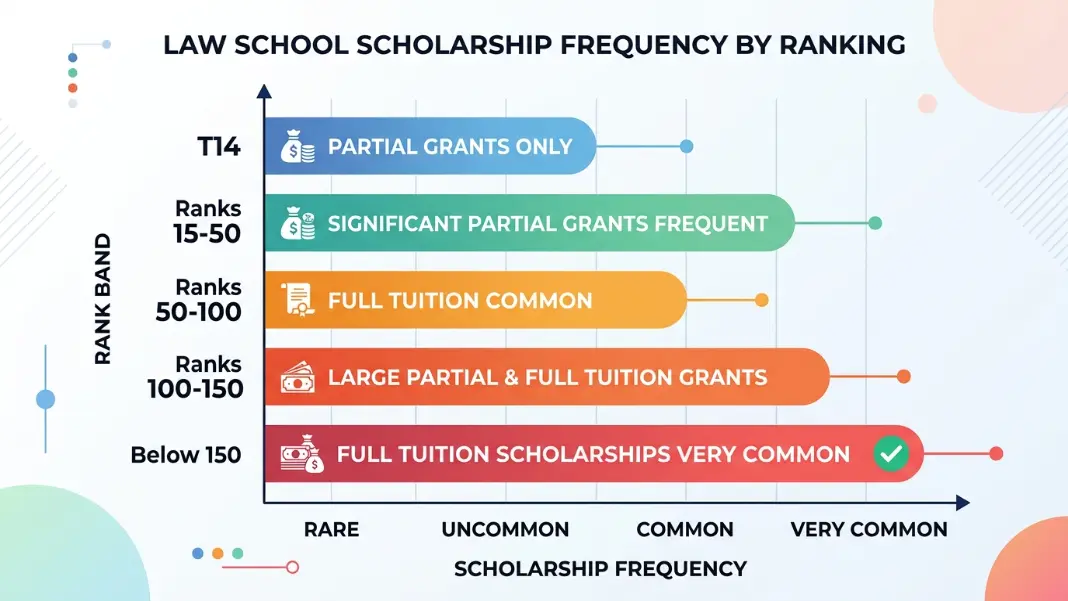
Ranks 15 to 50: These schools compete directly against T14 programs for their best applicants and allocate significant scholarship budgets for above-75th-percentile candidates. Full-tuition offers are available at this tier but require numbers that stand out even within a competitive pool. A 170 LSAT at a school where the median is 163 and the 75th percentile is 167 will generate serious scholarship interest. The full awards exist but are concentrated on candidates who represent the clearest LSAT improvement to the incoming class.
Ranks 50 to 100: This is the tier with the highest frequency of full-tuition and near-full-tuition awards for qualified applicants. Schools here compete against the 15-50 tier and use scholarship money as their primary tool. Above-75th-percentile candidates at these schools are the most likely to receive full-tuition offers automatically, without needing to negotiate. Named scholarship competitions at many programs in this tier extend to living stipends for a small number of top candidates.
Ranks 100 to 150: Full-tuition offers are standard for applicants significantly above median. Some programs run formal scholarship competitions targeting a handful of high-scoring candidates who anchor the incoming class. True full rides with living stipends exist here more commonly than at any other tier.
Regional schools below rank 150: Scholarship amounts can be very large relative to tuition, but employment market reach narrows considerably. Full scholarships at this tier can produce near-zero debt, but the career outcomes comparison with higher-ranked programs is a separate calculation that depends on your target career.
The underlying mechanism across all tiers is the same, which the how law school scholarships work guide explains in full: merit aid flows to applicants who improve the school's statistics, not to applicants who most need or deserve it.
Public Interest and Named Scholarship Programs: A Different Category#
The merit aid discussion above covers automatic scholarship allocations. A separate category exists at many schools, including some T14 programs, that operates through a different process: named scholarship competitions and public interest fellowships.
These programs are funded by endowments rather than the general scholarship budget. They have separate applications, separate selection criteria, and different timelines. Some require additional essays or interviews. The amounts are sometimes larger than automatic merit awards, and they may include living stipends that automatic merit aid does not cover.
Schools like Georgetown, Tulane, Michigan, and Fordham run public interest scholarship programs that provide substantial support specifically for students committed to public interest careers. Some of these programs include summer funding, mentorship, and post-graduate support in addition to the scholarship amount.
Loan repayment assistance programs (LRAPs) are related but distinct. Schools with LRAPs provide post-graduation assistance covering loan payments for graduates who enter government or nonprofit work. The dollar value of an LRAP is real even if it does not appear in the headline scholarship number. Georgetown's LRAP, Yale's COAP, and Harvard's LIPP are examples. A school with a $20,000 automatic merit award and a strong LRAP may represent a better financial outcome for a public interest student than a school with a $35,000 merit award and no post-graduate loan support.
When comparing schools described as having "the best scholarships," separating automatic merit aid from named scholarship competitions from loan forgiveness programs is necessary to compare accurately.
How to Build a School List That Maximizes Scholarship Potential#
The practical process for finding schools that will give you the most merit aid comes down to three steps.
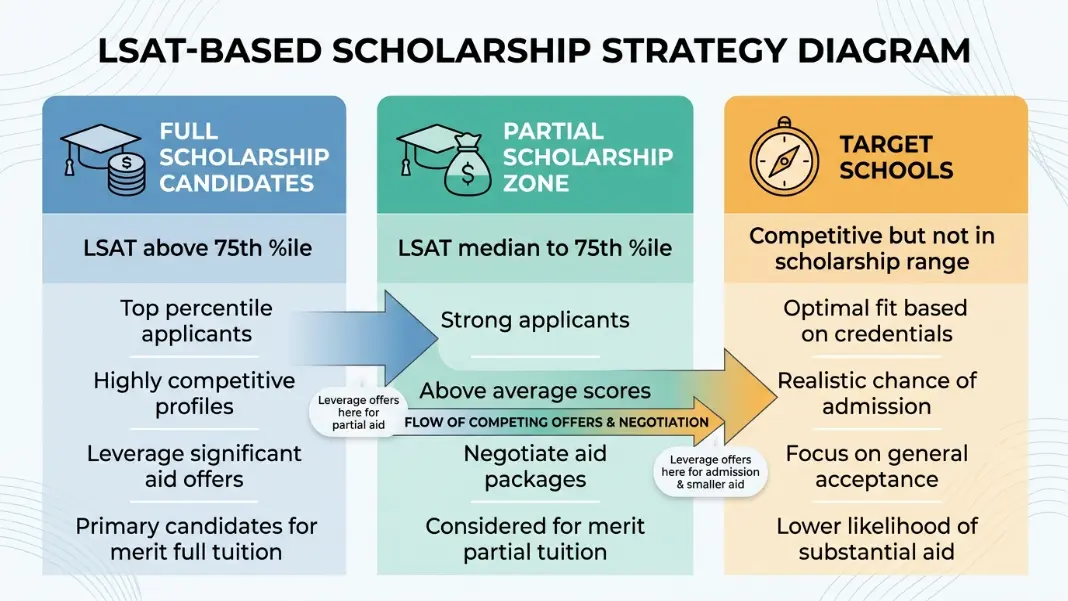
Step 1: Find your LSAT percentile position at target schools. The ABA publishes Standard 509 disclosures for every accredited school annually. Each disclosure lists 25th, 50th, and 75th percentile LSAT and GPA figures for enrolled students. If your LSAT is at or above the 75th percentile, that school is in your scholarship zone. If your LSAT is at or below the median, merit aid is unlikely regardless of other application strengths.
Step 2: Build a tiered list. Include 2 to 3 schools where your LSAT is above the 75th percentile. These are your full-scholarship candidates. Add 3 to 4 schools where your LSAT falls between the median and 75th percentile. These are partial-scholarship candidates and real negotiating options. Your actual target schools, where your numbers are competitive but not above the 75th percentile, round out the list. The goal is to enter April with at least 2 genuine competing offers.
Step 3: Compare the full cost of attendance, not just the scholarship amount. A $50,000 scholarship at a school in San Francisco has different net cost implications than a $50,000 scholarship at a school in a lower-cost city. Law school COA figures include tuition, fees, room, board, books, and personal expenses. The COA-adjusted net figure is more useful than the scholarship headline. For a detailed breakdown of full-tuition and full-ride awards by school tier, the full ride law school scholarships guide covers the structure and LSAT ranges.
Scholarship Renewal Policies: The Second Number to Compare#
The headline scholarship amount is the first comparison point. The renewal conditions are the second, and they matter almost as much for a real three-year cost calculation.
Most law school merit scholarships require maintaining a GPA between 2.67 and 3.0. Schools with strict mandatory grade curves can produce conditions where 15 to 30 percent of scholarship holders lose their award after first year. A school that offers $40,000 per year with a 3.0 renewal threshold and a strict curve may be a worse financial choice than a school offering $35,000 per year with a 2.67 threshold and a more forgiving distribution.
The question to ask every school you are comparing: "What percentage of first-year scholarship holders retained their scholarship through second year?" Some states require disclosure of this figure. Schools with good retention rates share it readily. Schools that deflect or claim not to track this number are telling you something worth weighing.
Some schools structure merit aid as a declining award: full coverage in year one with reduced amounts in years two and three regardless of GPA. This structure is less common but exists. Confirm that any scholarship offer is consistent across all three years before treating it as a three-year commitment.
The LSAC GPA Calculator converts your transcript to the LSAC scale, which is the number schools use in both admission and scholarship decisions. Knowing your accurate LSAC GPA before you apply prevents surprises when offers arrive.
Schools ranked 50 to 100 distribute full-tuition and near-full-tuition merit awards most frequently because they compete hardest for applicants who have better-ranked options. Schools in this range use scholarship money as their primary competitive tool. T14 schools give significantly less merit aid per student because their employment outcomes attract applicants willing to pay full tuition. The schools that give the most scholarships per enrolled student are in the middle of the ranking distribution, not at the top.
Scholarship renewal policies vary by school. The best policies combine a low renewal GPA threshold (2.67 rather than 3.0) with a grade distribution that gives most students a realistic chance of staying above the line. Ask each school directly what percentage of first-year scholarship recipients retained their award after year one. Some states require disclosure of this figure. Schools with retention rates above 80 percent have more applicant-friendly renewal structures than schools where renewal rates are below 60 percent.
T14 schools give less merit aid per student than any other tier, but they do offer merit scholarships. Named endowment programs, public interest fellowships, and occasional competing-offer negotiations produce merit awards at T14 programs. The amounts are usually partial rather than full tuition. Expecting automatic merit aid at a T14 without extraordinary LSAT numbers or a competing T14 offer is not a realistic plan for most applicants.
Pull the school's ABA Standard 509 disclosure to find the 25th, 50th, and 75th percentile LSAT scores for enrolled students. If your LSAT is at or above the 75th percentile, you are in the full-scholarship zone for that school. If your LSAT is between the median and 75th percentile, a partial scholarship is likely. The Law School Scholarship Calculator models this comparison automatically for any ABA-accredited school based on your LSAT and GPA.
Generally, schools that give more merit aid per student are ranked lower than T14 schools, and lower rank does correlate with narrower employment outcomes for specific career paths like elite BigLaw. But for most careers including government, regional practice, public interest, and state-level judicial clerkships, the employment gap between a rank-35 and rank-75 school is small. The question is not whether more scholarship means worse outcomes in general, but whether the specific career you want is achievable from both schools at comparable rates.
A merit scholarship is typically awarded automatically as part of the admission process based on LSAT and GPA. A fellowship is usually a named program funded by an endowment that requires a separate competitive application. Fellowships can include living stipends, mentorship, and practice-area commitments, and they often serve a smaller number of recipients than automatic merit awards. Some fellowships are available at T14 schools and carry larger dollar amounts than the school's general merit aid budget allows.
Written by
Hassaan Rasheed
Web Developer & Content Researcher
Hassaan builds calculators and writes source-linked guides across the site's subject areas. Calculator methods and reference data are documented in each guide so readers can verify the underlying sources.
About the author and methods