Full Ride Law School Scholarships: Which Schools Offer Them and How to Qualify (2026)
Full ride law school scholarships: which school tiers offer full tuition, LSAT scores that qualify, and when a full ride beats a higher-ranked school.
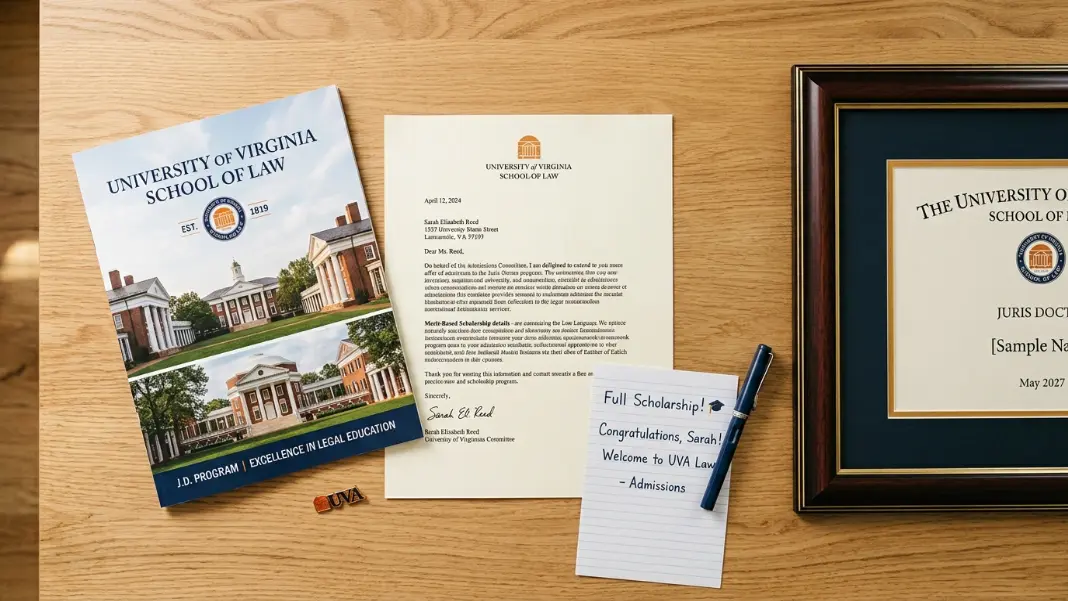
The decision between a full ride at one law school and a higher-ranked school with no aid is one of the most consequential choices in the application process, and most applicants make it with incomplete information. The accepted answer in online forums is "it depends," which is technically true but not very useful when you are comparing a $180,000 debt load to graduating debt-free.
Full ride law school scholarships are available at ABA-accredited programs across every rank tier, but the schools that offer them most consistently are not the ones ranked highest. Understanding which tiers give full scholarships, what scores trigger them, and how to evaluate them against a higher-ranked school without aid is the practical work this post does. The Law School Scholarship Calculator estimates your scholarship position at any ABA-accredited school based on your LSAT and GPA before you apply.
Full Tuition vs. Full Ride: The Distinction That Changes Your Budget#
These terms are used interchangeably in most conversations about law school scholarships. They describe different things.
Full tuition covers tuition and mandatory fees, which at ABA-accredited law schools runs between $45,000 and $72,000 per year depending on the program. Room and board, health insurance, books, bar prep, and living expenses are not included. Over three years, a full-tuition scholarship at a school charging $55,000 per year saves roughly $165,000 in tuition debt, but you still need to fund $30,000 to $50,000 annually in living expenses through loans, work, or savings.
Full ride means full tuition plus a living stipend that covers housing, food, and other costs. True full rides are less common and typically come from named endowment programs rather than a school's general merit aid budget. Some regional schools outside the top 100 use full-ride programs with stipends to attract high-scoring applicants who anchor their incoming class statistics.
The distinction matters when you're comparing offers. A full-tuition scholarship does not mean graduating debt-free. Depending on where the school is located, a student funding living costs through loans can still exit with $90,000 to $130,000 in debt. A true full ride with a living stipend is the scenario that produces near-zero debt.
Before signing any offer described as a "full scholarship," confirm in writing what it covers. Ask for the scholarship letter specifying the annual dollar amount, what categories of expense it applies to, and the GPA condition for annual renewal.
Which School Tiers Are Most Likely to Offer Full Scholarships#
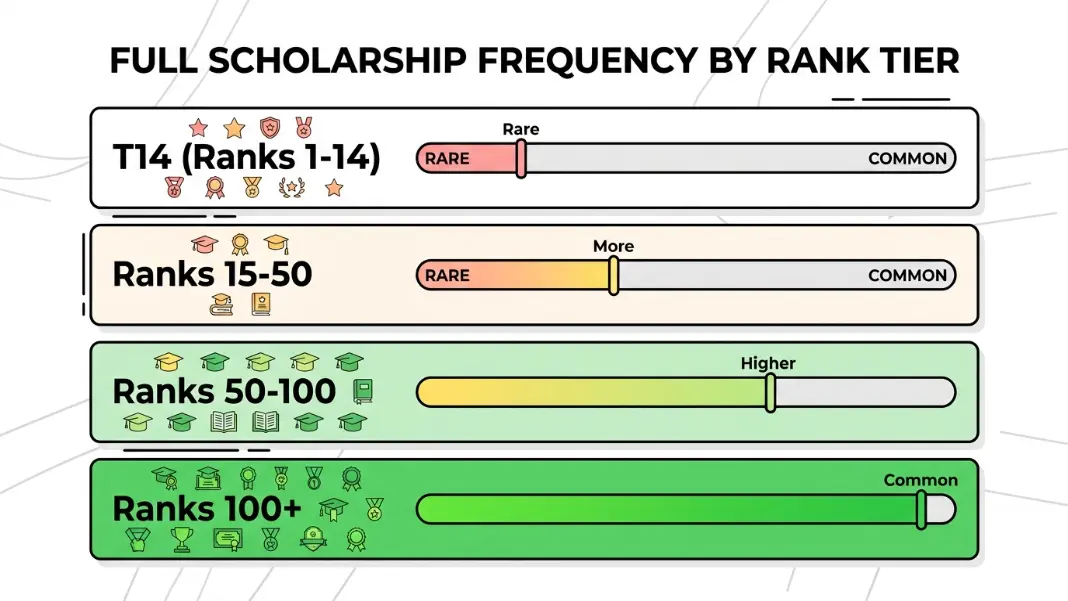
The distribution of full-tuition and full-ride scholarships across ABA-accredited schools follows a clear pattern based on each tier's competitive position.
T14 schools (ranks 1 to 14): Full scholarships are rare. These programs attract enough applicants willing to pay full tuition for the credential and employment outcomes that they have limited financial incentive to compete for individuals with large merit awards. Full scholarships at T14 schools occur through named endowments, specific public interest fellowships, or when a T14 school is negotiating against a competing T14 offer. Expecting one without those circumstances is not a realistic plan.
Schools ranked 15 to 50: Full-tuition scholarships are available to applicants significantly above the 75th percentile LSAT. These schools are competing against the T14 for their best applicants and use scholarship dollars as the primary mechanism. A 170+ LSAT at a school where the median is 163 and the 75th percentile is 167 will generate serious full-scholarship interest. The offers exist but require numbers that stand out even within a competitive pool.
Schools ranked 50 to 100: This is where full-tuition scholarships are most consistently available for strong applicants. Schools in this range compete against the 15 to 50 tier for applicants, and full-tuition offers for above-75th-percentile candidates are common rather than exceptional. Several programs in this tier run named scholarship competitions that include living stipends.
Schools ranked 100 and below: Full-tuition awards are standard for applicants meaningfully above median. True full rides with stipends are available at certain regional programs trying to build their incoming class statistics around a handful of high-scoring students. The trade-off is employment market reach, which narrows considerably below rank 100 outside those schools' regional footprints.
For a complete comparison of which schools across all tiers give the most merit aid, including partial grants and how renewal policies differ, the law schools with best scholarships guide covers the full picture.
The LSAT and GPA Numbers That Trigger a Full Scholarship Offer#
There is no universal LSAT score that produces a full-tuition offer because the threshold is always relative to the school. The consistent pattern is that full-tuition awards go to applicants at or above a school's 75th percentile LSAT, typically 5 to 10 points above the median.
Here is how the math works at a real-world example:
School 25th percentile LSAT: 158
School median (50th %ile) LSAT: 162
School 75th percentile LSAT: 165
Your LSAT: 168

Your position: 3 points above 75th percentile, 6 points above median
Typical result: Full tuition offer, possibly with additional stipend consideration
The same applicant at a school where 168 is the median would likely receive no merit aid or a small partial grant, because they are not providing a statistical benefit to that school's incoming class profile.
This is the structural reason why building a school list for scholarship purposes requires targeting schools across tiers, not just applying to reach schools. Applying only to schools where your LSAT is at or below the median produces no scholarship leverage regardless of how strong the rest of your application is. Including 2 to 3 schools where your LSAT is 5 to 8 points above median creates real full-scholarship candidates.
The GPA component follows the same relative logic. LSAC GPA, not your transcript GPA, is what schools use. For the calculation, all undergraduate coursework counts regardless of which institution it was taken at. The LSAT Score Calculator shows your score's percentile position and helps identify where you cross into above-75th-percentile territory for specific schools.
Timing also plays a role. Schools using rolling admissions, which includes most ABA programs, allocate scholarship budgets as they fill seats. An applicant who applies in October and is admitted in November competes for scholarship funds against a smaller pool than an applicant admitted in March. The early-cycle window is when the largest full-scholarship offers are most frequently made.
Why T14 Schools Almost Never Give Full Rides#
The T14 scholarship scarcity is structural, not a philosophical position.
Yale, Harvard, Stanford, Columbia, Chicago, NYU, Penn, Virginia, Duke, Northwestern, Cornell, Georgetown, Michigan, and Texas all receive far more applications than they have seats. Their employment outcomes create a situation where a significant portion of graduates earn enough in early career to service substantial law school debt. BigLaw first-year associate salaries at major firms in 2026 run roughly $225,000. Federal clerkship pipelines, appellate positions, and major government roles are concentrated in T14 graduate networks. The brand generates enough application demand that bidding wars for individual students are not necessary.
Where T14 full awards appear is narrow. Some schools have endowed named scholarships, funded by donors rather than the general aid budget, that cover full tuition or full costs for a small number of recipients each year. Georgetown's Equal Justice Works fellows, Harvard's Program of Instruction for Lawyers, and similar endowment-funded programs are examples. These are typically separate competitive processes, not automatic merit awards.
The other scenario is negotiation between T14 schools. An applicant admitted to both Columbia and NYU with a scholarship offer from one can sometimes use that to prompt movement from the other. Schools in the same prestige tier with similar employment outcomes are more willing to negotiate than schools competing across tiers. The leverage is real but limited to this narrow circumstance. For the timing, email scripts, and how much room schools actually have, the scholarship negotiation guide covers the full process.
For most T14 applicants, the realistic expectation is full tuition or near-full tuition debt, evaluated against the employment trajectory a T14 credential provides.
When a Full Ride at a Lower-Ranked School Is the Right Call#
This comparison has no single answer, but it has a more specific framework than most discussions offer.
Start with the specific career outcome, not the school ranking. Law school rankings are averages across all graduates and all outcomes. Your outcome depends on the specific career path you are planning, not the school's overall employment rate.
For BigLaw positions at major firms in New York, DC, Los Angeles, and Chicago, school rank carries real weight in on-campus interview access. The largest firms recruit heavily at T14 schools and at a narrow group of regionally dominant non-T14 programs. A full ride at a rank-60 school does not produce equivalent BigLaw access to a T14 without aid for those specific markets. If BigLaw at an elite firm is the goal, the financial math is less straightforward and requires honest assessment of the specific school's BigLaw placement numbers.
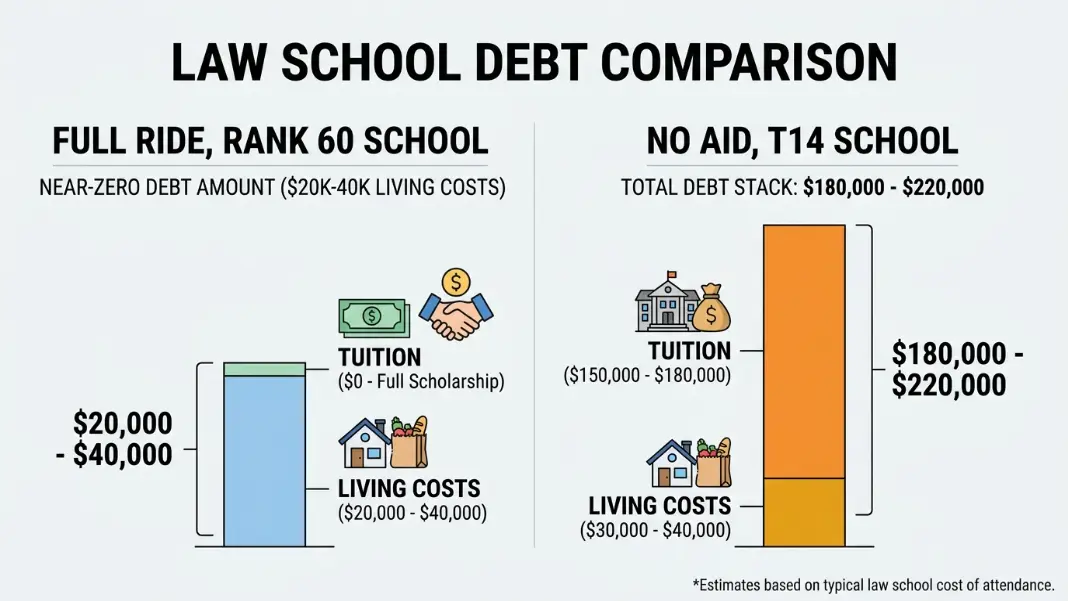
For every other career track, including federal and state government, public interest organizations, regional firm practice, judicial clerkships at the state and district level, compliance, and small firm or solo practice, the financial difference between $180,000 in debt and near-zero debt produces a meaningfully better outcome in most scenarios. The employment gap between a rank-35 and rank-75 school is real but often small for these purposes. The debt gap is large and direct.
The decision framework: look up Law School Transparency's employment outcomes by school for your specific target career. If the higher-ranked school shows measurably better placement into your target role, calculate whether that placement advantage justifies the debt differential. If the outcomes are comparable, take the full ride. The LSAC GPA Calculator helps you confirm your index number before building a scholarship-optimized list across tiers.
A final point that gets skipped: the full-ride renewal condition. Most full-tuition scholarships are conditional on maintaining a GPA between 2.67 and 3.0. Law schools use mandatory grade curves that force a grade distribution. A meaningful percentage of any 1L class falls below the renewal threshold after first year regardless of effort. Before committing to any full scholarship, ask what percentage of last year's 1L scholarship holders retained their award after year one.
For a full breakdown of how merit aid thresholds work across all scholarship levels, including partial grants, the T14 vs. non-T14 dynamic, and how renewal conditions work in practice, the law school scholarships guide covers the complete mechanics.
A full ride law school scholarship covers all tuition and fees, and sometimes includes a living stipend. Full-tuition scholarships, which cover tuition only, are more common than true full rides. At most ABA-accredited schools, full-tuition awards are available to applicants with LSAT scores at or above the school's 75th percentile, typically 5 to 10 points above the median. Living stipends are less common and usually come from named endowment programs rather than general merit aid budgets.
Full-tuition and full-ride scholarships are most consistently offered at schools ranked 50 to 150. Schools in this range use full scholarships to compete for high-scoring applicants who have options at higher-ranked programs. Schools ranked 15 to 50 offer full-tuition awards to applicants well above their 75th percentile LSAT. T14 schools offer full scholarships rarely, primarily through named endowment programs or when a competing T14 offer is presented in negotiation.
There is no single LSAT score that triggers a full ride because the threshold is relative to each school's median. Full-tuition scholarships typically require an LSAT at or above the school's 75th percentile, which is usually 5 to 10 points above the median. At a school with a 162 median and 165 at the 75th percentile, a score of 168 or higher puts you in full-scholarship range. Apply to schools where your LSAT crosses into above-75th-percentile territory to create full-ride candidates.
No. Full-tuition awards are competitive within the pool of applicants who qualify by LSAT position. Schools have fixed scholarship budgets and allocate them on a rolling basis as they fill seats. Applying early in the admissions cycle, typically October through December for fall enrollment, places you in the scholarship pool before the most competitive budget windows close. A strong application with above-75th-percentile numbers submitted early is more likely to generate a full offer than the same application submitted in February.
It depends on the specific career you are targeting. For BigLaw at major firms in primary markets, school rank affects OCI access in ways a scholarship alone does not offset. For government positions, regional firm practice, public interest work, and most careers outside elite BigLaw, the financial difference between $180,000 in debt and near-zero debt produces a better long-term outcome in most scenarios. Compare Law School Transparency placement data for your specific target career at both schools before deciding.
Yes. Most full-tuition and full-ride law school scholarships are conditional on maintaining a GPA between 2.67 and 3.0 each year. Law schools use mandatory grade curves that force a grade distribution across the 1L class, meaning a significant percentage of scholarship holders fall below the renewal threshold after first year regardless of preparation. Before accepting any scholarship, ask the school what percentage of last year's 1L scholarship recipients retained their award at the end of first year.
Written by
Hassaan Rasheed
Web Developer & Content Researcher
Hassaan builds calculators and writes source-linked guides across the site's subject areas. Calculator methods and reference data are documented in each guide so readers can verify the underlying sources.
About the author and methods